
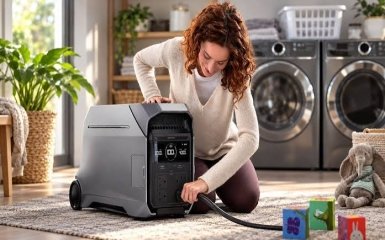
A charging station can keep your internet, laptop, lighting, refrigerator, or other household appliances running during a power outage. However, the difference between a compact device for 5,000 hryvnias and a powerful system for 150,000 is much greater than just the size of the battery.
Points of attention
- Compact USB models are suitable for smartphones and laptops, but for household appliances you need a station with a 230 V outlet.
- For most apartments, a station with a capacity of 1000–2000 Wh is a compromise between energy supply, power, and price.
- Autonomy depends on battery capacity, average device consumption, and losses during energy conversion.
The cheapest models actually function as large power banks. Mid-range stations allow you to connect ordinary devices via 230 V sockets, while devices with 2–4 kWh batteries can support the operation of several important consumers during a long outage.
However, even the most expensive station does not guarantee unlimited electricity supply to the apartment. The operating time depends on the actual consumption of the equipment, the efficiency of the inverter and the available energy reserve.
For most apartments, the optimal compromise is a charging station with a capacity of 1000–2000 Wh. If you only need the Internet and a laptop, a more compact model is enough. For a refrigerator, boiler and several household appliances, the power of the inverter is also more important.
Let's look at ten charging stations in different price categories, compare their characteristics, and explain which model to choose for specific tasks.
Best Home Charging Stations in 2026: Comparison Chart
The selection includes devices from compact USB batteries to large power stations for backup power.
| Model | Capacity | Output power | Estimated price |
| Jackery Explorer 100 Plus | 99.2 Wh | 100 W, USB | From 5,000 UAH |
| EcoFlow TRAIL 200 DC | 192 Wh | 220 W, DC | 8–11 thousand UAH |
| BLUETTI Elite 30 V2 | 288 Wh | 600 W | 16–22 thousand UAH |
| Jackery Explorer 500 V2 | 512 Wh | 500 W | 15.5–26.5 thousand UAH |
| BLUETTI AC50P | 504 Wh | 700 W | 18–30 thousand UAH |
| Jackery Explorer 1000 v2 | 1070 Wh | 1500 W | 25–40 thousand UAH |
| Anker SOLIX C1000 Gen 2 | 1024 Wh | 2000 W | 31–51 thousand UAH |
| BLUETTI Elite 200 V2 | 2073.6 Wh | 2600 W | 50–80 thousand UAH |
| Jackery Explorer 3000 v2 | 3072 Wh | 3600 W total | 70–100 thousand UAH |
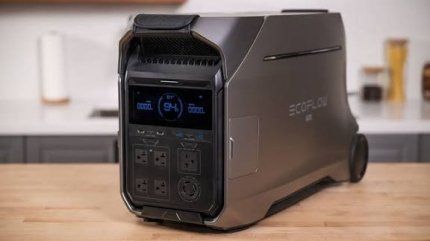
| EcoFlow DELTA Pro 3 | 4096 Wh | 4000 W | 120–193 thousand UAH |
Prices are given as a guide to Ukrainian retail offers as of November 3, 2026. They may vary depending on the store, promotions, configuration and warranty.
For Jackery Explorer 3000 v2, the total power of the sockets is indicated: the permissible load per socket may be lower.
Budget charging stations up to 15,000 UAH
In the most affordable segment, it is important to first check whether the device has a regular 230 V outlet.
Not every portable power station is capable of powering equipment that is connected to the household electrical network.
1. Jackery Explorer 100 Plus — compact battery for smartphones and laptops
The Jackery Explorer 100 Plus has a 99.2 Wh battery and weighs approximately 965 grams.
The model is equipped with two USB-C ports and one USB-A. The maximum output power is 100 W.
The battery used is a LiFePO₄ battery. The manufacturer claims a lifespan of about 2000 cycles before the capacity drops to 70% of its original value.
The main feature: the station does not have a 230 V outlet.
It is designed to charge smartphones, tablets, cameras and compatible laptops via USB.
For a router powered by a network adapter, you will need an appropriate solution with the correct electrical parameters.
The Jackery Explorer 100 Plus is suitable for short outages, travel, and backup charging of electronics, but does not replace a full-fledged home charging station.
2. EcoFlow TRAIL 200 DC - for equipment that does not require 230 V
The EcoFlow TRAIL 200 DC has a capacity of 192 Wh and a maximum total output power of 220 W.
The model uses a LiFePO₄ battery and weighs approximately 1.83 kg.
It has two USB-C ports, one of which supports up to 140W of power, as well as USB-A.
Like the previous model, the TRAIL 200 DC does not have a conventional AC outlet.
This is an important limitation, but also an advantage for certain scenarios.
If the equipment can be powered directly through compatible DC outputs, there is no need to convert battery power to 230V and then back to low voltage.
Who is it suitable for: for charging laptops, mobile electronics and other compatible USB equipment.
This model is not intended for a refrigerator, a TV with a regular plug, or a gas boiler.
Charging stations from 15 to 30 thousand hryvnias
In this segment, full-fledged models with 230 V sockets and pure sine wave inverters are appearing.
They are suitable for home workplaces and individual low-power household appliances.

3. BLUETTI Elite 30 V2 — a compact station with powerful USB-C
BLUETTI Elite 30 V2 has a 288 Wh battery and a rated inverter power of 600 W.
The weight of the device is approximately 4.3 kg.
Among its features are USB-C ports with a power output of up to 100 and 140 W, DC outputs and an AC outlet.
The manufacturer claims charging up to 80% in about 45 minutes in the appropriate mode.
The model also supports automatic switching to battery power with a claimed delay of up to 10 ms.
This is a convenient option for a laptop, the Internet, and lighting.
However, the 288 Wh battery is not designed for many hours of operation of powerful household appliances.
The main advantage is the functionality of a compact station, not a large energy reserve.
4. Jackery Explorer 500 V2 — greater autonomy without a significant increase in weight
The Jackery Explorer 500 V2 is equipped with a 512 Wh LiFePO₄ battery.
The rated output power is 500 W and the weight is approximately 5.7 kg.
The model has 230 V sockets, USB outputs and supports charging from compatible solar panels.
The battery provides almost twice the power reserve of the BLUETTI Elite 30 V2.
However, the inverter is less powerful.
Therefore, the Jackery Explorer 500 V2 should be considered primarily for longer-term power supply of small loads: a laptop, monitor, router, and lighting.
With a total load of 50 W, the estimated autonomy will be approximately 8 hours, taking into account conditional losses.
This model is not suitable for devices that constantly consume more than 500 watts.
5. BLUETTI AC50P — a universal station for a home workplace
BLUETTI AC50P has a battery capacity of 504 Wh and a rated power of 700 W.
The model is equipped with a pure sine wave inverter, USB outputs, and support for charging from the mains and compatible solar panels.
In terms of energy reserve, it is close to the Jackery Explorer 500 V2.
However, a more powerful inverter allows you to use a wider range of devices.
For example, the AC50P can simultaneously power a laptop, monitor, router, and several LED lamps, as long as the total load does not exceed the allowable limit.
With a constant consumption of 100 watts, the estimated autonomy will be about four hours.
Who is it for: working from home and maintaining basic needs during regular outages for a few hours.
Charging stations from 25 to 50 thousand hryvnias
This is one of the most interesting segments for an apartment.
1 kWh class devices combine sufficient energy reserves, relatively compact dimensions, and inverters capable of powering some household appliances.
6. Jackery Explorer 1000 v2 — universal model at 1070 Wh
The Jackery Explorer 1000 v2 has a 1070 Wh battery and an inverter with a rated power of 1500 W.
The weight is approximately 10.8 kg.
The model is equipped with a LiFePO₄ battery. The manufacturer claims a resource of up to 4000 cycles under certain conditions and the ability to quickly charge in about an hour.
This is already a fairly versatile device for an apartment.
It can power a laptop, TV, lighting, and a separate refrigerator, provided the starting characteristics are met.
With an average load of 100 W, the conditional battery life is about 8.6 hours.
For a gas boiler, it is necessary to separately check the compatibility of the power supply.
The advantage of the model is the combination of a battery of over 1 kWh, a powerful inverter, and relatively low weight.
7. Anker SOLIX C1000 Gen 2 — high power and fast charging
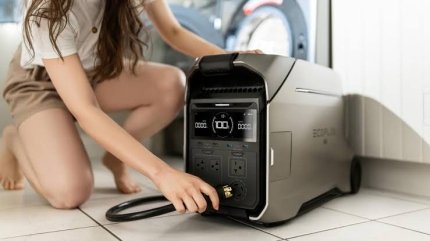
The Anker SOLIX C1000 Gen 2 is equipped with a 1024 Wh battery.
The nominal power of the inverter is 2000 W, peak power is up to 3000 W according to the passport specifications.
The manufacturer claims a full charge in approximately 49 minutes in a special fast mode.
There is also automatic switching to battery power with a claimed time of up to 10 ms.
The model weighs approximately 11.3 kg.
Compared to the Jackery Explorer 1000 v2, it has a slightly smaller capacity, but a more powerful inverter.
This is useful if you need to connect equipment with a significant short-term or constant load.
At the same time, with the same energy consumption, a more powerful inverter does not automatically provide greater autonomy.
Powerful charging stations from 50 to 100 thousand hryvnias
If you need to keep your refrigerator, lighting, work equipment, and other appliances running during a long outage, battery capacity becomes more important.
In this segment, stations with 2–3 kWh are available.
8. BLUETTI Elite 200 V2 — over 2 kWh for an apartment
BLUETTI Elite 200 V2 has a battery with a capacity of 2073.6 Wh and an inverter with a capacity of 2600 W.
The model uses LiFePO₄ technology and supports charging from the mains and solar panels.
This is a significantly larger energy reserve than that of compact stations.
For example, at an average continuous load of 100 W, the estimated operating time is approximately 16.6 hours.
At a load of 200 W - about 8.3 hours.
The inverter's power is sufficient for many household appliances, but their total consumption and starting currents still need to be checked.
Who is it suitable for: for an apartment where the refrigerator, communications, lighting, and some other appliances must work during a power outage.
9. Jackery Explorer 3000 v2 — large battery for long blackouts
Jackery Explorer 3000 v2 has a battery with a capacity of 3072 Wh.
According to the characteristics of the European version, the total output power is up to 3600 watts.
At the same time, the maximum load per outlet is limited separately, so you need to check the connection diagram.
The station weighs approximately 27 kg.
The manufacturer claims a full charge from the mains in approximately 1.8 hours under appropriate conditions.
With an average load of 150 W, the conditional autonomy can be about 16 hours.
This capacity is sufficient to support a number of important household needs during a prolonged outage.
However, this is a fairly heavy device that is not so convenient to carry between rooms.
Premium charging station for home backup power
Powerful systems of 4 kWh and more are approaching home battery systems in capabilities.
They can power a significant number of devices, but require more careful load planning.
10. EcoFlow DELTA Pro 3 — large station for 4096 Wh
The EcoFlow DELTA Pro 3 has a LiFePO₄ battery with a capacity of 4096 Wh and a rated output power of 4000 W.
The model supports connecting compatible additional batteries and charging from solar panels.
The weight is approximately 51.5 kg, so the device is equipped with wheels for movement.
This is a solution for longer-term backup power, including a refrigerator, lighting, internet, and several other consumers.
But even a large capacity does not provide unlimited operating time.
With an average load of 300 W, the estimated autonomy is about 11 hours.
The main advantage of DELTA Pro 3 is the ability to create a scalable system with a large energy reserve.
Connecting to the apartment's fixed electrical network requires a proper professional solution. Homemade connection through a regular outlet is unacceptable.
How to correctly calculate the autonomy of a charging station
Manufacturers indicate the nominal battery capacity in watt-hours.
However, not all of this energy is available through 230 V sockets.
Part of it is spent on the operation of the inverter and internal electronics.
For preliminary calculation, you can use the formula:
Operating time = battery capacity × 0.8 ÷ average load power.
The coefficient 0.8 conditionally takes into account energy losses.
Examples of autonomy
| Station capacity | Load 50 W | Load 100 W |
| 288 Wh | 4.6 hours | 2.3 hours |
| 512 Wh | 8.2 hours | 4.1 hours |
| 1070 Wh | 17.1 hours | 8.6 hours |
| 2074 Wh | 33.2 hours | 16.6 hours |
| 3072 Wh | 49.2 hours | 24.6 hours |
| 4096 Wh | 65.5 hours | 32.8 hours |
The values given refer to a conditional stable load through an AC inverter.
The actual autonomy may be less , especially if the load is very small and the inverter is constantly consuming electricity for its own operation.
For models without a 230 V socket, the calculation must be made taking into account the efficiency of the DC outputs.
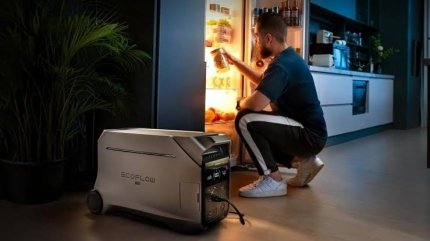
What charging station is needed for a refrigerator?
The refrigerator consumes electricity unevenly.
The compressor turns on and off periodically, so the maximum operating power is not equal to the average daily consumption.
To select a station, you need to check two parameters:
compressor starting power;
average energy consumption per day.
For example, if a refrigerator consumes 1.2 kWh per day, the average load is approximately 50 watts.
Theoretically, a 1070 Wh station can provide about 17 hours of operation at this average consumption.
But the refrigerator must be successfully started from the station's inverter.
That is why for compressor equipment, compatibility cannot be assessed solely by battery capacity.
Can a gas boiler be powered by a charging station?
Many modern gas boilers use electricity for automation, pumps and fans.
However, their compatibility with portable stations depends on more than just the number of watts.
The parameters of neutral, grounding and flame control system operation can be important.
Some boilers do not start from certain models of stations even with sufficient power.
Therefore, before purchasing, you need to check the requirements of a specific boiler.
You cannot change the grounding circuit yourself or install jumpers between the neutral and protective conductor.
Do I need to buy a station with a UPS function?
The UPS function allows you to automatically switch power to the battery after a power outage.
In portable stations, the switching time is often around 10–20 ms.
For many household appliances, this is enough.
However, some computers, servers, and sensitive devices may reboot even after a short break.
Therefore, a portable station with a UPS function is not always a complete replacement for a specialized online UPS.
It is necessary to take into account the requirements of specific equipment.
Why charging speed is especially important during blackouts
If electricity is only supplied for one or two hours, the station must have time to restore a significant portion of the charge during this time.
Therefore, along with capacity, you need to check the maximum input power.
However, fast charging can place a significant strain on your home's electrical grid.
For example, a station that charges with a power of 1600 W consumes electricity at the same time as other running devices.
This should be taken into account if you have old wiring or limited available power.
It is also important to remember that the minimum charging time declared by the manufacturer may only be available in a special mode.
When a charging station is no longer the best solution
If you need to constantly maintain the operation of a large number of devices, a portable station may not be the most convenient option.
For example, for 24 hours of autonomy at an average load of 300 W, about 7.2 kWh of useful energy is required.
Taking into account losses, the nominal capacity of the battery system should be even larger.
In such a situation, it is worth comparing portable models with stationary battery systems and inverters.
A stationary solution can provide automatic power to specific electrical lines in an apartment or house.
But its installation requires appropriate design, electrical network inspection, and professional installation.
How to safely use a charging station at home
The charging station must be operated in accordance with the manufacturer's instructions.
Do not block ventilation openings, use damaged cables, or place the device near sources of strong heat.
It is also necessary to observe the temperature regime.
For many LiFePO₄ batteries, charging at temperatures below 0 °C is prohibited or limited.
Therefore, an unheated balcony is not always suitable for storing and charging the station in winter.
It is absolutely forbidden to connect a portable station to the apartment's electrical network using a homemade cable with two plugs.
This method can create dangerous reverse voltage.
Backup power for stationary power lines requires a properly designed switching power supply system.
The most common mistakes when choosing a charging station
Confusing power and capacity. Power determines the allowable load, and capacity determines the energy reserve.
Buy a model without a 230 V outlet for regular household appliances. A USB station will not replace an inverter device.
Focus only on peak power. It is not designed for continuous operation.
Ignore the refrigerator's starting current. Even a powerful station can shut down due to overload.
Do not consider charging time. During short power outages, this can be a critical parameter.
Purchase the wrong regional version. For Ukraine, compatibility with 230 V, 50 Hz is required.
Do not check the warranty. Service terms and device origin may vary depending on the seller.
Count on unlimited autonomy. Even a 4 kWh battery has a finite energy reserve.

Conclusion
In 2026, the choice of charging stations will range from devices costing a few thousand hryvnias to powerful systems costing over 100 thousand.
For smartphones and laptops, the compact Jackery Explorer 100 Plus or EcoFlow TRAIL 200 DC models may be sufficient. For a full-fledged home workplace, stations with 230 V sockets and 300–500 Wh batteries are more practical.
For a refrigerator and a few household appliances, you should consider a 1–2 kWh class. If you need long-term autonomy, it is advisable to evaluate 3–4 kWh models or stationary battery solutions.
Before purchasing, it is important to determine the actual consumption of the equipment, the required operating time, the permissible load, and the conditions for safe connection.
FAQ: Frequently asked questions about home charging stations
What is the best charging station to buy for an apartment in 2026?
For universal use, it is worth comparing models with a capacity of 1000–2000 Wh. Among them are Jackery Explorer 1000 v2, Anker SOLIX C1000 Gen 2 and BLUETTI Elite 200 V2. The specific choice depends on the required power and autonomy.
What is the cheapest charging station for home?
In a budget of about 5 thousand hryvnias, you can find compact devices like the Jackery Explorer 100 Plus. But they do not have a regular 230 V outlet and are intended primarily for USB electronics.
How much does a 1000 Wh charging station cost?
As of November 2026, individual models in this class are available for approximately UAH 25,000–30,000. The cost depends on the brand, inverter power, charging speed, and warranty.
How many hours will a 1000 Wh charging station last?
At a constant load of 100 W and a conditional efficiency of 80% - about 8 hours. At a load of 200 W - about 4 hours. The actual time may be less due to losses and the station's own consumption.
Can the charging station work with a refrigerator?
Yes, if its inverter can withstand the operating and starting power of the compressor. To calculate autonomy, you need to take into account the average energy consumption of the refrigerator per day.
Can I connect a gas boiler to a charging station?
Only possible with confirmed compatibility. Some boilers have specific requirements for neutral, grounding and power parameters. You cannot change the electrical circuit yourself.
Which is better: LiFePO₄ or a regular lithium-ion battery?
LiFePO₄ typically has a long cycle life and relatively high thermal stability. However, the safety and durability of the station also depend on the quality of the electronics, the protection system and the conditions of use.
Can I use a charging station instead of a UPS?
Some models have an automatic switchover to battery. However, a short power outage may still occur. For sensitive equipment, you should check the allowable switchover time.
What charging station is needed for a 24-hour blackout?
This depends on the consumption. For example, a constant load of 100 W requires approximately 2.4 kWh of useful energy. Taking into account conditional losses, the nominal capacity should be around 3 kWh or more.
Can I connect a charging station to the entire apartment?
Not through a regular outlet or a homemade cable. To power apartment electrical lines, a special system for switching power sources and professional wiring is required.

