
The most beneficial hobby for the brain is not necessarily a crossword puzzle or chess. It is much more important that the activity requires learning, concentration, memorization, solving new problems and gradually increasing complexity. Activities that simultaneously combine mental load with movement and communication can have even greater benefits.
Points of attention
- The key to the usefulness of a hobby for the brain is novelty, complexity, regularity, and progression in the difficulty of tasks.
- Hobbies such as playing musical instruments, dancing, reading, crossword puzzles, and others can train various cognitive skills.
- Physical activity, social connections, and a healthy lifestyle are important components of brain care.
Current research shows that the adult brain retains the ability to learn new skills into old age. However, no hobby can guarantee protection against dementia or completely stop age-related memory decline.
Crossword puzzles, dancing, playing a musical instrument, reading, photography, or learning a language should all be considered part of an active lifestyle. Physical activity, sleep, social contacts, controlling blood pressure, cholesterol, and glucose, quitting smoking, and avoiding excessive alcohol consumption are also important for brain health.
Why the brain needs new tasks
The brain is able to change its way of working under the influence of experience. This property is called neuroplasticity.
When a person learns an unfamiliar skill, the brain has to:
concentrate attention;
hold information in working memory;
find errors;
adjust actions;
create new associations;
automate skills;
move on to more complex tasks.
That is why learning something new is often more interesting in terms of cognitive load than repeating a long-familiar action.
For example, if a person plays the same simple melody on the piano every day for ten years almost automatically, the cognitive challenge will be small. If they learn a new piece, read music, work on rhythm, and correct mistakes, the brain is given a much more difficult task.
What is cognitive reserve?
In the science of aging, the concept of cognitive reserve is often used.
Simply put, it is the brain's ability to perform tasks effectively and to some extent compensate for age-related or pathological changes.
Higher levels of education, complex mental activity, social activity, and other forms of sustained intellectual engagement in research are associated with greater cognitive reserve.
However, this does not mean that you can “train your brain” and guarantee the absence of dementia.
It is more correct to talk about maintaining cognitive activity and forming a lifestyle that can help the brain maintain functionality longer.

1. Learning to play a musical instrument
Music is one of the most interesting hobbies in terms of the simultaneous load on different brain systems.
During the game you need:
listen to the sound;
control the rhythm;
memorize sequences;
coordinate hand movements;
read notes or chords;
correct errors;
plan next moves.
A systematic review and meta-analysis of studies in older adults found that learning to play a musical instrument can produce small to moderate improvements in certain executive functions, including information processing speed, task switching, and inhibition of automatic responses.
However, the study did not show a convincing improvement in all types of memory.
How to get more benefit
If you already play an instrument, regularly:
learn new compositions;
change the pace;
practice more complex rhythms;
play together with other people;
try improvisation.
Almost any instrument is suitable for a beginner: piano, guitar, ukulele, drums, or even a digital synthesizer.
2. Dancing
Dancing is interesting because it combines several types of exercise at once:
physical activity;
memory;
coordination;
sense of rhythm;
spatial orientation;
social interaction.
During a new dance, you need to remember the sequence of steps, follow the music, control your body position, and react quickly to the movements of your partner or group.
A meta-analysis of randomized trials involving older adults found a small positive effect of dance programs on cognitive performance.
From a brain health perspective, dances can be particularly interesting, as they require you to constantly master new combinations:
salsa;
bachata;
tango;
modern group dances;
folk dances;
line dances.
If the choreography is fully learned and performed automatically, it is worth moving on to new connections.
3. Reading
Reading seems like a passive activity, but the brain does complex work while doing it.
A person must:
to hold attention;
recognize words;
understand the context;
remember information;
connect new facts with previous ones;
predict the further development of the text.
In a large, long-term study of nearly two thousand older adults, reading regularly at least once a week was associated with a lower likelihood of cognitive decline over many years of follow-up.
Important: This observation does not prove that reading itself was the cause of the better results.
People who read regularly may differ in education, health status, social environment, and other characteristics.
How to make reading more challenging for the brain
Read different genres:
fiction;
history;
popular science books;
biographies;
essay;
complex analytics.
A useful technique is to try to recall the main ideas in your own words after a section, without immediately returning to the text.
This is active reproduction of information, not simple rereading.
4. Crosswords and word puzzles
Crossword puzzles simultaneously load vocabulary, long-term memory, attention, and the search for associations.
Particularly interesting results were obtained in studies of people with mild cognitive impairment.
In a long-term randomized trial, crossword puzzles showed better results on some cognitive and functional measures compared to computer cognitive games.
But one cannot conclude from this that "crossword puzzles prevent dementia."
The study involved a specific group of participants, a specific training program, and certain tests.
The main rule is complexity.
If you solve one type of crossword automatically in ten minutes, the cognitive challenge decreases.
You can go to:
more complex crosswords;
anagram;
logical problems;
Sudoku;
word puzzles;
deduction tasks.
The goal is to sometimes face challenges for which the answer is not immediately obvious.
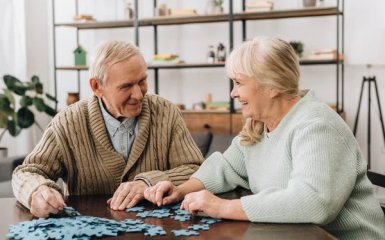
5. Jigsaw puzzles and spatial puzzles
Puzzles train a slightly different set of skills.
It is necessary to evaluate:
form;
color;
spatial relationships;
location of fragments;
visual details.
In studies of adults over 50, puzzle-solving actively engaged several components of visual-spatial thinking.
However, there is not yet enough evidence that regular puzzles produce strong long-term improvements in general intellectual abilities.
That is, puzzles train what you do while putting the puzzle together. The transfer of this effect to all other cognitive functions is much less obvious.
To prevent the activity from becoming automatic, you can gradually:
increase the number of details;
choose images with fewer clues;
fold without looking at the box;
try three-dimensional puzzles.
6. Learning a foreign language
A new language forces the brain to work with words, grammar, sounds, and context simultaneously.
Required:
memorize vocabulary;
remember words;
distinguish unfamiliar sounds;
switch between language systems;
build sentences;
to perceive speech by ear.
Studies of the cognitive effects of language learning in older age yield mixed results.
In one randomized trial, 11 weeks of language training did not produce convincing improvements in memory or general intelligence compared to a control program.
Another study of three months of training found improvements in episodic memory and cognitive flexibility, although the benefit compared to other complex learning activities was limited.
So, a foreign language definitely trains the language skill itself. Whether it has a large universal effect on the entire brain is still an open question.
And this is not a reason to give up on classes: the benefit in the form of a new real skill is already valuable enough.
7. Photography and mastering new technologies
One well-known study of cognitive aging compared different types of leisure activities among people aged 60 to 90.
Participants intensively studied digital photography, quilting, or a combination of both for three months.
It was the groups with challenging learning that showed improvements in episodic memory compared to less demanding activities.
The key was probably not the camera itself.
The participants had to:
understand the technique;
remember functions;
master the software;
plan the frame;
work with composition;
solve new problems.
The same principle can be applied to modern hobbies:
video editing;
graphic design;
3D modeling;
photo processing;
creating music on a computer;
programming for beginners.
It is important that technology presents you with new challenges, rather than turning into endless passive scrolling.

8. Drawing, crafts and other creative activities
Drawing, ceramics, knitting, sewing, carving, and other types of manual creativity can simultaneously involve:
fine motor skills;
spatial thinking;
planning;
concentration;
memory;
creative search.
Especially interesting are activities where a person is constantly moving forward.
For example, in knitting, it could be a transition from a simple scarf to complex patterns. In drawing, it could be from copying simple shapes to perspective, color, and composition.
It is the mastery of a more complex skill that is an important component of cognitive challenge.
Creativity can also give a sense of accomplishment: unlike an abstract brain exercise, after a few hours of work, you are left with a painting, a ceramic cup, a photograph, or a finished product.
9. Chess, board and strategy games
Chess requires planning, evaluating possible options, recognizing patterns, and controlling impulsive decisions.
Similar processes may involve:
th;
bridge;
complex board games;
strategy video games;
resource planning games.
But the rule of specificity also applies here.
A person who plays a lot of chess first becomes a better chess player. It cannot be automatically assumed that this will make them better at all types of memory or protect them from dementia.
The advantage of board games also lies in the social component.
A party with friends combines problem-solving with communication, and social activity itself is part of modern recommendations for maintaining brain health.
10. Gardening
Gardening seems less “intellectual” than chess, but in practice it can combine many useful elements:
physical activity;
planning;
teaching;
manual labor;
being outdoors;
sensory stimulation;
sometimes communication.
You need to decide when to plant a plant, how to water it, what location to choose, what to do with pests, and when to harvest.
Systematic reviews of gardening programs have found potential benefits for psychoemotional state and individual functional indicators, but the evidence base for a pronounced cognitive effect is still weaker than for physical activity in general.
Therefore, gardening should be valued as a multi-component active hobby.
What hobby is best for the brain?
Scientific data does not allow for an honest ranking with one absolute winner.
It is much more useful to ask: what components does a particular lesson contain?
A conditionally good cognitive hobby has several characteristics:
| Sign | What's happening? |
| Novelty | need to form a new skill |
| Complexity | the task is not performed fully automatically |
| Progression | over time you can move to a higher level |
| Regularity | the lesson is repeated over months and years |
| Feedback | you can see errors and fix them |
| Movement | added benefit of physical activity |
| Communion | a social component appears |
| Interest | the person wants to continue studying |
By this logic, a dance class or ensemble can be particularly interesting because they combine several components at once.
However, a hobby that is theoretically "perfect" but you quit in two weeks is unlikely to provide much benefit.
Why doing the same thing over and over again isn't enough
The brain is good at automating skills.
This is one reason why we can walk, type, or perform familiar tasks without having to think about every movement.
It's great for everyday life.
To train new skills, this means that the load needs to be changed gradually.
For example:
Crosswords: move on to more difficult ones.
Music: learn new pieces.
Language: Go from the app to a live conversation.
Drawing: learn a new technique.
Dancing: learn new combinations.
Photography: Go from automatic camera mode to manual settings and more complex composition.
It's useful to feel like a beginner from time to time: it's at this point that the brain has to actively learn.
Do “brain training” apps work?
Computer cognitive games can improve results in precisely the tasks that a person is training for.
If you do a lot of reaction speed exercises, your speed in similar tasks can improve.
It is much more difficult to prove broad transferability of the result — for example, that the game will automatically improve memory in everyday life or significantly reduce the risk of dementia.
Therefore, digital simulators may be one option for mental activity, but there is no reason to consider them mandatory or better than learning music, dancing, reading, or other complex activities.

How much time should you devote to a hobby?
There is no universal "dose for the brain."
Studies vary widely: some programs lasted a few weeks, others months, and observational studies assessed habits over years.
It is more practical to use the regularity rule.
For example:
20–30 minutes of reading every day;
language classes several times a week;
two dance training sessions;
several musical practices;
one longer creative session on the weekend.
It's better to practice for 30 minutes a few times a week for a year than to do one "brain training marathon" and never return to the class again.
What's more important than crossword puzzles for brain health?
This is a fundamental point.
The latest recommendations for reducing the risk of cognitive decline consider the brain in the context of whole-body health.
Among the important factors:
regular physical activity;
quitting smoking;
avoiding harmful alcohol use;
balanced diet;
social and cognitive activity;
blood pressure control;
cholesterol control;
blood sugar control;
correction of hearing impairments;
reducing social isolation.
In 2026, the World Health Organization also supports cognitive stimulation, cognitive training, and social activity as components of a strategy to reduce the risk of cognitive decline in updated recommendations.
So, a crossword puzzle after a whole day of no movement, chronic sleep deprivation, and uncontrolled hypertension is far from a complete strategy for taking care of your brain.
5 mistakes in choosing a hobby "for the brain"
1. Looking for one magic exercise
There is no game that trains all cognitive functions at the same time and guarantees dementia prevention.
2. Only do what is already easy
If the task does not require concentration, the learning component gradually decreases.
3. Engage through strength
A hobby should be enjoyable enough to stay regular.
4. Ignore physical activity
For maintaining cognitive health, the evidence for movement is stronger than for many specific “brain games.”
5. Perceive memory loss as a signal to simply do more crossword puzzles
New or progressive memory problems require evaluation of the cause.
They can be caused by sleep disorders, depression, certain medications, deficiencies, thyroid disease, hearing problems, and other conditions.
When memory problems are no longer like ordinary forgetfulness
As you age, it may become more difficult to quickly recall a name or learn a new device. This in itself does not indicate dementia.
It is worth seeing a doctor if a person:
asks the same question repeatedly;
gets lost in a familiar place;
forgets important events to the point that it disrupts daily life;
has difficulty with finances or routine household chores;
noticeably loses the ability to plan;
cannot recall familiar words so often that it makes communication difficult;
demonstrates marked changes in behavior or personality;
has rapid memory deterioration.
It is especially important to evaluate an abrupt change in cognitive status. Sudden disorientation over hours or days is not a typical manifestation of normal aging and requires medical attention.
How to choose a hobby for your brain
The simplest test consists of four questions.
Is this a little difficult for me?
If so, there is room for learning.
Can I gradually make the task more difficult?
Then the brain will not go completely into automatic mode.
Am I really interested?
Otherwise, there will be no regularity.
Can I add movement or people?
For example, learning a language in a conversation club, dancing in a group, or playing music in an ensemble.
It is this combination that makes hobbies part of an active lifestyle.
Conclusion
A hobby that is good for the brain is, first and foremost, an activity that forces you to learn. Playing a musical instrument, dancing, reading, crossword puzzles, puzzles, foreign languages, photography, creativity, strategy games, and gardening can all challenge different cognitive systems.
The best principle is novelty + complexity + gradual progress + regularity . If movement and communication are added to this, the lesson can have even more practical benefits.
At the same time, no hobby is insurance against dementia. Taking care of your brain includes physical activity, sleep, social life, and controlling cardiovascular risk factors.
Important: The material is for informational and educational purposes only and is not medical advice, diagnosis, or recommendation for the treatment or prevention of cognitive impairment. Self-medication and attempts to explain noticeable memory impairment on your own can be harmful to your health. If memory, attention, or other cognitive functions deteriorate, affect daily life, or cause concern, be sure to consult a doctor.
FAQ
What hobby is most beneficial for the brain?
There is no single best hobby. The most interesting are those that combine novelty, challenge, regular learning, and gradual difficulty. Dance and music additionally involve movement, coordination, and often social interaction.
Do crossword puzzles help improve memory?
Crossword puzzles train vocabulary, information retrieval, attention, and certain aspects of memory. Studies show potential benefits, particularly for people with mild cognitive impairment, but crossword puzzles are not guaranteed to prevent dementia.
What is better for the brain - crossword puzzles or reading?
They load the brain in different ways. Crossword puzzles involve more word searching and solving specific problems, while reading involves sustained attention, understanding context, and memory. You can alternate them.
Does learning a foreign language help the brain?
Language learning definitely trains vocabulary, auditory perception, and language skills. Evidence for broad improvements in memory and other cognitive functions is mixed, although some studies have found positive changes.
Is chess good for the brain?
Chess actively engages planning, attention, pattern recognition, and decision-making. It is a good mental activity, but there is no evidence to suggest that chess itself protects against dementia.
Is it possible to train the brain at the age of 60–70?
Yes. Older people retain the ability to learn new skills, create new memories, and improve performance with practice. Learning may take longer, but age alone does not deprive the brain of its ability to change.
How much time do you need to train your brain every day?
There is no universal norm. Long-term regularity is more important. A practical option may be 20–30 minutes several times a week or longer sessions, depending on the chosen hobby.
Do puzzles help with dementia?
Puzzles challenge visual-spatial thinking, attention, and working memory, but there is no evidence that they alone prevent dementia.
Is dancing really good for memory?
Dance combines physical activity with movement memory, coordination, and often communication. Meta-analyses of randomized trials in older adults show a small positive effect of dance programs on cognitive performance.
What to do if your memory starts to noticeably deteriorate?
Don't rely solely on exercise or hobbies. If forgetfulness progresses and interferes with work, finances, orientation, or household chores, you should see a doctor to evaluate possible causes.

