
Aphids on young shoots, caterpillars on cabbage, thrips on tomatoes, and damaged cucumber leaves are problems that even experienced gardeners face. However, reducing the number of pests does not always require the immediate use of insecticides. Part of the work can be done by properly selected neighboring plants.
Points of attention
- Basil and marigolds near tomatoes can reduce thrips numbers under certain conditions.
- You can plant nasturtium, onions, or thyme near cabbage, and leave dill and coriander to bloom near cucumbers.
- Dill, coriander, lobularia, and phacelia support beneficial insects that help keep pest populations in check.
Marigolds, nasturtiums, basil, dill and other crops can influence insect behavior, attract natural enemies of pests or distract them from the main vegetable beds.
However, there is no plant that is guaranteed to repel all pests just by its scent . The effectiveness of mixed plantings depends on the specific insect species, the location of the plants, weather conditions, and the condition of the garden.
Some combinations have scientific support, while others remain traditional gardening practices with a limited evidence base.
We analyze which plants help protect the garden from pests, what is best to plant next to tomatoes, cabbage, cucumbers, and zucchini, how trap plants work, and what mistakes to avoid when creating natural protection for garden beds.
How plants help fight pests without chemicals
The idea of mixed plantings is to grow crops next to each other that can positively influence each other.
In horticulture, this approach is called compatible or companion cropping.
It is not only used for insect control. Mixed plantings can make more efficient use of space, support pollinators, and provide food for beneficial organisms.
Three main mechanisms of natural defense
Impact on pest behavior: Some plants emit volatiles that can alter the ability of insects to find a suitable crop. However, the effect depends on the type of pest and the specific plant combination.
Attracting beneficial insects. Flowers provide nectar and pollen for bumblebees, parasitic wasps, goldenrods, and other natural enemies of pests.
Use trap plants. Certain crops attract certain pests more than your main vegetables. This allows you to focus them on companion plantings.
The best results are usually not achieved by a single aromatic plant, but by a combination of different crops with proper garden care.
1. Marigolds are useful neighbors for tomatoes and cabbage
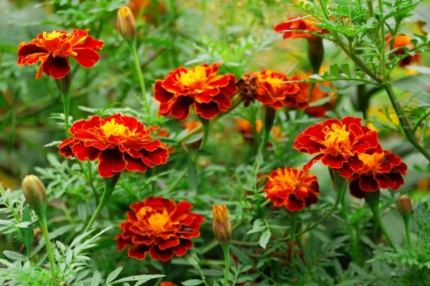
Marigolds are among the most famous flowers grown alongside vegetables.
They are unpretentious, bloom for a long time and are well suited for decorating the edges of beds.
However, their practical use is not limited to decoration.
What pests can marigolds help against?
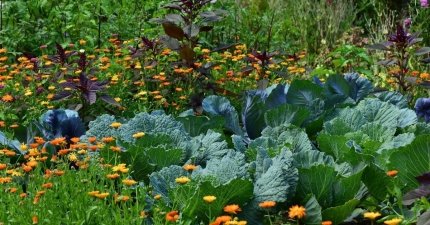
In mixed planting studies, marigolds helped reduce thrips numbers on tomatoes under certain conditions.
A decrease in damage to cabbage crops by some caterpillar species has also been recorded.
However, the results do not mean that marigolds are equally effective against all insects.
For example, the popular claim that potatoes are reliably protected from the Colorado potato beetle is not supported by a number of studies.
Do marigolds help with nematodes?
Certain species and varieties of marigolds, particularly Tagetes patula, can suppress certain types of root-knot nematodes—microscopic roundworms that damage plant roots.
However, it is important how they are grown.
The best results are usually associated with using marigolds as a separate crop in a crop rotation, rather than planting two or three flowers between tomatoes.
The impact also depends on the type of nematode and the plant variety.
Where to plant: Along beds with tomatoes, cabbage and other vegetables, leaving enough space for main crops.
2. Nasturtium - a plant-trap for aphids and other insects
Nasturtium has large rounded leaves and bright flowers.
It is often planted near cabbage, pumpkins and zucchini.
It is important to understand that nasturtium does not always repel pests. In some cases, it actually attracts them.
It is this property that makes it a potentially useful trap plant.
How nasturtium works in the garden
Aphids can infest young shoots and leaves of nasturtium.
If such plantings are regularly monitored, some colonies can be detected and removed before they spread to other crops.
Separate studies have also shown that planting nasturtiums next to cabbage and pumpkin crops can reduce damage from certain pests.
However, it is undesirable to leave nasturtium heavily infested with aphids unattended.
It itself can become a breeding ground for insects.
Where to plant: near cabbage, broccoli, zucchini and pumpkins, but so that the bushes are easy to view.

3. Basil is a good neighbor for tomatoes
Basil is valued for its aromatic leaves, which are used in cooking.
At the same time, it can be useful in mixed plantings with tomatoes.
In some field and greenhouse studies, growing basil and tomatoes together helped reduce thrips numbers.
These are small insects that damage leaves, flowers, and young fruits.
How to plant basil near tomatoes
Place it so that both crops receive enough light and air.
You don't need to plant basil right next to a tomato stem.
Excessive compaction can impair ventilation and increase the risk of disease.
Basil is thermophilic, so it is planted in open ground after the appropriate temperature has been established.
At the same time, a pot of basil on a windowsill is not a reliable means of protecting a room from flies and mosquitoes.
4. Dill is a plant for attracting natural enemies of aphids
Dill is useful in the garden not only as a green.
During flowering, it forms umbrella-shaped inflorescences with small flowers.
They can provide nectar and pollen to beneficial insects, including bumblebees and some parasitic wasps.
The larvae of many species of buzzards feed on aphids.
Therefore, the presence of flowering plants helps create conditions for natural containment of its numbers.
How to use dill correctly
Some plants can be left until flowering.
If you constantly cut off all the greenery before the flowers appear, the benefits to insects will be less.
For continuous flowering, dill can be sown in small batches throughout the season.
However, you should not expect that a few dill bushes will instantly destroy a large colony of aphids.
Where to plant: near cabbage, cucumbers, lettuce, and other vegetable beds.
5. Coriander - support for buzzards and parasitic wasps
Coriander, or cilantro, also belongs to the Asteraceae family.
Its small flowers are accessible to many small beneficial insects.
Among them are parasitic wasps, some species of which lay eggs inside or on the bodies of insect pests.
This is a natural mechanism for regulating the number of certain pests.
How to benefit from coriander
For cooking, cilantro is usually harvested before it is actively blooming.
But to support beneficial insects, some plants need to be left to bloom.
In hot weather, coriander can quickly go on to form flower stalks.
Therefore, it is convenient to use as a companion crop on the edges of beds.
At the same time, the plant does not guarantee protection against aphids: its outcome depends on the presence of appropriate natural enemies.
6. Lobularia maritime - low-growing flowers against aphids
Lobularia marine, also often called sea alyssum, is a compact flowering plant with numerous small inflorescences.
It forms low flowering bushes and can provide beneficial insects with nectar for a long time.
Particularly interesting is its ability to attract hummingbirds.
Why is lobularia planted between vegetables?
Adult bumblebees feed mainly on nectar and pollen, and the larvae of many species destroy aphids.
Therefore, flowering lobularia can support populations of these natural predators.
In studies of mixed plantings with pumpkin crops, the combination of lobularia and other flowers contributed to an increase in the number of natural enemies of aphids.
Where to plant: In small groups along vegetable beds or between crops where there is enough space.
7. Phacelia - a flowering plant for beneficial insects
Phacelia is often grown as a green manure and honey plant.
It can also be useful in the garden thanks to its blooms, which attract pollinators and other insects.
Small flowers provide a food source for various species, some of which participate in the natural regulation of pest populations.
What is important to consider
Phacelia is not a universal repellent.
Its benefit lies primarily in maintaining insect diversity, not in its ability to reliably repel aphids, locusts, or other pests.
Additionally, dense planting can compete with vegetables for water, light, and nutrients.
Therefore, it is better to place phacelia in separate strips or in areas designated for green manure crops.
8. Thyme is a fragrant crop for mixed plantings
Thyme contains essential oils and has a characteristic aroma.
In some studies of mixed plantings with brassica crops, thyme helped reduce damage by certain caterpillar species.
However, this does not mean that its smell protects all neighboring vegetables from any insects.
Where is it best to grow thyme?
Thyme needs plenty of sun and well-drained soil.
It does not tolerate constant waterlogging.
Therefore, planting it directly among crops that require frequent, abundant watering is not always practical.
It is better to use the edges of the beds or separate elevated areas.
When in bloom, thyme also attracts pollinators.
9. Sage - possible protection for cabbage crops
Sage has fragrant leaves and is well suited to sunny areas.
In greenhouse studies, its proximity to certain cabbage crops was associated with a decrease in the number of cabbage moths.
However, the results of a greenhouse experiment are not always fully reproduced in open ground.
How to use sage
It is best to plant it on the edges of beds or in a separate area of herbs.
Sage is a perennial crop, so it is important to provide a place for its continued growth.
It needs well-drained soil and does not like stagnant water.
Using sage as a companion plant can be a useful addition, but not a substitute, for cabbage pest control.
10. Onions and chives are neighbors for cabbage and broccoli
Plants of the genus Allium contain characteristic sulfur-containing compounds.
Their odors can influence the behavior of individual insects.
In mixed planting studies, onions, under certain conditions, helped reduce damage to cabbage crops by some caterpillar species.
How to combine plantings correctly
Onions or chives can be grown next to cabbage and broccoli, maintaining normal distances between plants.
You don't need to plant them so densely that they compete for nutrients and water.
Chives can also be a source of nectar for pollinators during flowering.
At the same time, the statement that any onion is guaranteed to repel carrot flies, aphids, and all other pests is an overgeneralization.
11. Arugula is a trap plant for cruciferous fleas
Arugula belongs to the cabbage family, as do radishes, broccoli, and various types of cabbage.
Its leaves can actively damage cruciferous fleas.
This feature is sometimes used in a trap plant system.
How does this landing work?
Arugula is placed so that some of the fleas populate it instead of the main crop.
However, this does not mean that it is enough to sow one plant next to cabbage.
Effectiveness depends on the type of pest, time of sowing, location of the companion crop, and subsequent insect control.
Studies show that using multiple species of trap plants is sometimes more effective than a single species.
It is also necessary to ensure that excessive pest populations do not form in auxiliary plantings.
12. Mustard — additional protection against cruciferous fleas
Some types of mustard may be more attractive to cruciferous flea beetles than the main garden crop.
Therefore, mustard is sometimes used as a trap plant.
But the result depends on the specific species of plants and insects.
An important nuance
Mustard belongs to the same family as cabbage.
Therefore, it can be a host not only for fleas, but also for other common pests and diseases.
If infected auxiliary plantings are left unchecked, they can become a source of further spread of the problem.
That is why trap plants require regular inspection and timely removal of pests.
What plants are best to plant next to popular vegetables?
For practical planning of a garden, it is important to consider not only the general properties of flowers, but also the specific crops that need to be protected.
| Main culture | Useful neighboring plants | Potential benefit |
| Tomatoes | Basil, marigolds | Possible reduction in thrips numbers |
| Broccoli | Thyme, onion, nasturtium | Minor damage by certain types of caterpillars under certain conditions |
| Cabbage | Marigolds, nasturtiums, onions | Auxiliary protection against some pests |
| Zucchini | Nasturtium, lobularia | Impact on individual pests, support of beneficial insects |
| Pumpkins | Nasturtium, floral stripes | Supporting pollinators and natural enemies |
| Cucumbers | Dill, phacelia, coriander | Attracting pollinators and beneficial insects |
| Potato | Flower strips as part of a diverse garden | Supports beneficial insects, but no guaranteed protection against Colorado potato beetle |
| Radishes and other brassicas | Arugula, certain types of mustard | Possible use as flea trap plants |
The above combinations do not guarantee the absence of pests. Some of them have experimental confirmation only for specific conditions or insect species.
Which plants really shouldn't be considered universal repellents?
The strong aroma of a plant does not mean that it creates an invisible barrier around itself against insects.
Some of the popular recommendations arose from research into concentrated essential oils or plant extracts.
However, a living plant in the garden emits a completely different amount of volatile substances.
Mint
Mint is often referred to as a remedy against ants, mice, fleas, and moths.
However, there is no reliable reason to consider a few mint bushes as effective protection against all of the listed pests.
In addition, mint is able to actively grow using underground shoots.
Therefore, for small gardens, it is more convenient to grow it in containers.
Lavender
Lavender attracts many pollinators and is well suited for sunny flower gardens.
But its scent does not guarantee protection against mosquitoes, flies, and ticks.
Individual components of lavender oil may affect insects, but this does not mean that a living bush is as effective.
Chrysanthemums
Some plants that were traditionally classified as chrysanthemums are a source of natural pyrethrins, substances with insecticidal properties.
However, not all decorative chrysanthemums contain them in sufficient quantities.
Planting chrysanthemums in a flower bed is not equivalent to using a ready-made insecticide.
In addition, pyrethrins can be toxic not only to pests, but also to beneficial insects.
How to properly use trap plants
A trap plant is a crop that attracts a specific pest and helps distract it from the main plantings.
But such a strategy requires control.
If a companion crop becomes a breeding ground for insects, the result may be the opposite of what is expected.

Basic rules
Determine which pest you need to protect your vegetables from.
Choose a trap plant that has been proven effective for this insect species.
Plant it in time so that it is attractive during the period when the pest appears.
Inspect the leaves and young shoots regularly.
Do not allow uncontrolled accumulation of large colonies.
Remove severely affected parts or individual plants as needed.
Not every flower on which aphids have appeared is automatically a useful trap.
It is important that such planting truly reduces damage to the main crop.
How to attract ladybugs, goldfinches and buzzards to the garden
One of the most promising methods of natural protection is creating conditions for beneficial insects.
For example, ladybug and goldfinch larvae actively feed on aphids.
The larvae of many species of buzzards also destroy these pests.
Adult insects often require nectar, pollen, or other supplemental food sources.
Therefore, it is useful to plant flowers with different flowering periods.
Which flowers are especially useful?
For a small garden, dill, coriander, lobularia, phacelia, yarrow and other plants with flowers accessible to small insects are suitable.
It is especially important that flowering continues throughout different parts of the season.
If all the flowers fade at the same time, the food base for beneficial insects can be dramatically reduced.
Also, you should not use broad-spectrum insecticides unnecessarily.
They can destroy natural enemies of pests along with the insects against which the treatment is carried out.
Do fragrant plants really repel mosquitoes?
This is a separate issue that is often confused with the protection of vegetable crops.
Mint, lavender, basil, and lemon balm contain aromatic substances that can affect insect behavior.
However, a few pots of such plants on the terrace do not provide reliable protection against mosquito bites.
Even if odor changes insect behavior under certain conditions, the effect depends on the concentration of volatiles and air movement.
Therefore, to reduce the number of mosquitoes, it is more important to remove containers with standing water, control their breeding sites, and use proven means of protection.
Fragrant plants can remain a decorative addition, but do not replace these measures.
How to plan a garden with natural pest protection
For a small area, it is not necessary to plant all twelve plants.
It is more practical to choose several crops that are suitable for specific vegetables and do not interfere with their growth.
For example, for a garden with tomatoes, cabbage, cucumbers, and zucchini, you can use the following scheme:
Plant basil and a few marigolds near the tomatoes.
Place nasturtium and onions next to the cabbage.
Leave some dill and coriander near the cucumbers until they bloom.
Grow lobularia or phacelia along the edges of the beds.
To test the effectiveness of the trap plants, select a separate small area.
You don't need to place companion plants so densely that they shade the vegetables.
You should also consider different water needs. For example, thyme and sage do best in well-drained soil, while cucumbers need regular moisture.
What to do if pests have already appeared in the beds
Companion plantings work mainly as a supportive or preventative measure.
If plants already have large aphid colonies or significant damage, planting a few fragrant flowers will not provide instant results.
Therefore, you need to act depending on the specific pest.
If aphids appear
Check young shoots and the underside of leaves.
For minor infestations, aphids can sometimes be washed off with a jet of water if the plant is strong enough.
At the same time, it is worth preserving the natural enemies of the pest.
If the cabbage is damaged by a caterpillar
Inspect the leaves, especially the underside.
If there are a small number of caterpillars, they can be collected by hand.
To protect against butterflies that lay eggs, special nets with appropriate cell sizes are sometimes used.
If pests return regularly
It is important to correctly identify the type of insect.
Different pests require different methods of control.
In the integrated plant protection system, preventive, agrotechnical, mechanical and biological methods are initially used.
Permitted plant protection products are used as needed, taking into account the instructions, crop, pest, and impact on beneficial insects.
The most common mistakes when using plants against pests
It is believed that all fragrant herbs repel insects. There is insufficient evidence for most such claims.
Leave trap plants unattended. Pests can breed on them.
Planting flowers too densely will reduce lighting and air circulation.
Count on marigolds against the Colorado potato beetle. Studies do not confirm the reliability of this method.
Use essential oils instead of proven products. Concentrated oils can damage plants and pose a risk to people and animals.
Ignore beneficial insects. Not all insects in the garden are pests.
Planting incompatible crops. Plants with different moisture and light needs may not grow well together.
Expect the complete disappearance of pests. The goal of natural protection is to reduce damage to an acceptable level, not to create a completely sterile garden.
Conclusion
Properly selected plants can help protect the garden from individual pests, but their effectiveness depends on the specific combination of crops.
Marigolds and basil can be useful neighbors for tomatoes, nasturtiums for cabbage and pumpkins, and dill, coriander, lobularia, and phacelia help maintain populations of beneficial insects.
A diverse garden that combines vegetables, flowering plants, proper watering, regular leaf inspection, and timely pest removal works best.
Aromatic herbs do not guarantee protection against all insects, but they can be a useful part of a comprehensive care system without the unnecessary use of insecticides.
FAQ: Frequently Asked Questions About Pest Repellent Plants
What plants best repel pests from the garden?
There are no universal pest repellent plants. However, marigolds, basil, nasturtiums, thyme, and some types of onions have been shown in some studies to help reduce the number of certain pests or damage to vegetables. The effect depends on the specific crops and insects.
What to plant near tomatoes to protect against pests?
Consider basil and marigolds. In some field and greenhouse studies, such mixed plantings have helped reduce thrips numbers. However, they do not guarantee protection of tomatoes from all pests.
What flowers to plant near cabbage?
Nasturtiums and marigolds can be useful companion plants. Onions and thyme are also worth considering. Regular inspection of the foliage and physical barriers, if necessary, are required for additional protection against caterpillars.
What plants help against aphids?
The most practical benefit can be provided by flowering plants that support natural enemies of aphids: dill, coriander, lobularia, phacelia and yarrow. Nasturtium is sometimes used as a trap plant, but it should be inspected regularly.
Do marigolds repel the Colorado potato beetle?
There is no convincing reason to consider them as a reliable protection of potatoes from the Colorado potato beetle. A number of studies have not confirmed this effect. Therefore, marigolds can be planted for other purposes, but you should not rely on them as the main means of controlling the beetle.
Does mint protect the garden from ants and mice?
There is not enough convincing evidence that regular mint bushes provide reliable protection from ants or mice in the garden. Mint also grows quickly, so it is more convenient to grow it in containers in small areas.
What plants attract ladybugs and goldenrods?
Beneficial insects can use flowering plants as a source of pollen, nectar, and shelter. Dill, coriander, lobularia, yarrow, phacelia, and other crops with accessible flowers are suitable for this. It is important to ensure flowering throughout the season.
Can I plant lavender to repel mosquitoes?
Lavender has aromatic substances, but the live plant does not guarantee protection against bites. To reduce mosquito numbers, it is more important to eliminate breeding areas with standing water and use proven protection products.
What are trap plants and how do they work?
These are companion crops that attract certain pests and can distract them from the main plantings. For example, nasturtium is used in some mixed plantings, and arugula or mustard is used against certain cruciferous flea beetles. Such plants should be monitored regularly.
Is it possible to completely protect a garden from pests without insecticides?
In many situations, pest populations can be controlled through mixed plantings, beneficial insect support, crop rotation, and mechanical removal. However, complete pest control is not guaranteed. If damage becomes significant, proper identification of the problem and an appropriate set of measures are required.

