

A two-year-old child plays in the sandbox next to other toddlers, but is in no hurry to join in their fun. A three-year-old gets angry when someone takes his car. And a five-year-old child is already making up complex stories with friends, distributing roles, and arguing about the rules of the game.
Points of attention
- Social skills develop gradually: toddlers often play together, and preschoolers increasingly negotiate roles and rules.
- Dolls, construction toys, balls, role-playing sets, and board games create opportunities for communication, collaboration, and expression of emotions.
- Toys should be chosen based on the child's age, interests, and abilities, taking into account safety and sensory needs.
These are different stages of social development that most children go through.
Parents often want to help their toddler learn to get to know each other, share toys, negotiate, and make friends more quickly. And they naturally wonder which toys best develop communication skills.
There is a wide range of toys to choose from: construction sets, dolls, role-play sets, balls, board games, and interactive devices. However, a more expensive or technologically advanced toy is not necessarily more useful.
The best toys for socialization are those that create opportunities for interaction: inventing something together, negotiating, imitating each other, expressing desires, and gradually learning to take into account the needs of others.
The American Academy of Pediatrics emphasizes that playing with parents and peers supports children's language, emotional, and social development. However, the benefits depend on the child's age, individual abilities, and how the play is organized.
Let's look at how social skills develop at different ages, what toys help practice them, and what adults can do to make it easier for a child to interact with others.
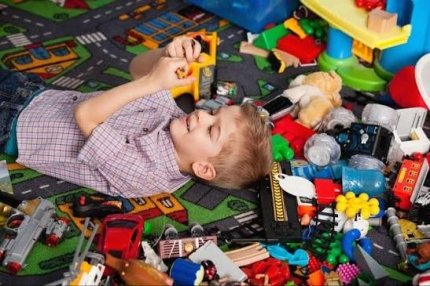
What is child socialization and why play is so important
Socialization is a gradual process in which a child learns to interact with people, understand the rules of communication, express their own needs, and take into account the feelings of others.
This process begins long before kindergarten.
The baby smiles in response to an adult's smile, listens to voices, and responds to facial expressions. Over time, the child imitates the actions of his parents, begins to be interested in peers, and tries to join in on shared activities.
Gradually, she masters important social skills:
to ask for help;
express wishes and disagreements;
to wait one's turn;
participate in joint activities;
agree on rules;
recognize other people's emotions;
respond to conflicts without aggression;
respect one's own and others' personal boundaries.
The game creates natural situations for the development of these skills.
For example, two children are building a tower. One wants to make it tall, the other wants to make it wide. In order to continue the game, they need to find a way to coordinate their ideas.
However, one should not expect that every such situation will end in compromise. At an early age, children often need adult help.
How social play changes with age
One of the most common mistakes is to demand the same behavior from a two-year-old as from a five-year-old.
Social skills develop gradually, so toys and expectations should be age-appropriate.
Up to 1 year: communication through interaction with an adult
A baby does not yet play with peers the way older children do.
The foundation of social development is contact with parents and other close adults.
The baby watches the face, reacts to the voice, smiles, and tries to repeat sounds and movements.
Simple reciprocal games can be useful: the adult makes a sound, pauses, and waits for the child to respond.
Safe rattles, soft objects, large sensory toys, and books with thick pages are suitable.
From 1 to 2 years: imitation and first contacts
The child actively explores objects and repeats the actions of adults.
She can feed a teddy bear, drive a car, or try to clean up with her parents.
At this age, toddlers are often interested in other children, but mostly play alone or together.
This is a normal stage of development.
Large cubes, balls, toy dishes, simple sorters, and objects for imitating everyday activities are suitable for joint activities.
From 2 to 3 years: playing side by side gradually becomes collaborative
In developmental psychology, there is the concept of parallel play .
This is a situation where two children are close together, use similar toys, and observe each other, but do not yet have a common goal.
According to the U.S. Centers for Disease Control and Prevention (CDC), by about 30 months, most children play alongside others and sometimes join in their play.
But the ability to share, wait one's turn, and resolve disputes independently are still developing.
Parents don't need to demand that their child immediately give their favorite toy to another child.
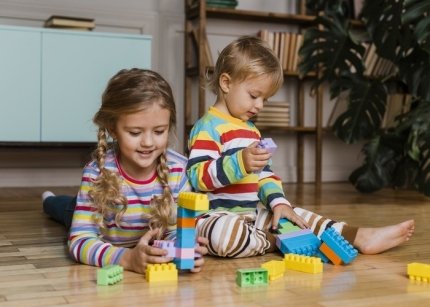
From 3 to 5 years: role-playing games and first agreements
Closer to three years of age, children increasingly notice other toddlers and join in their activities.
By the age of four, role-playing develops more actively: a child can imagine himself as a doctor, a cook, a driver, or a fairy tale character.
And by about five years of age, most children are already able to follow simple rules and order when playing with their peers.
These age guidelines are not a rigid developmental timeline.
Children differ in temperament, speech skills, communication experience, and individual abilities.
12 types of toys that help develop social skills
1. Dolls, stuffed animals and toy characters
An ordinary doll or a soft teddy bear can become a participant in dozens of life stories.
The child puts the toy to sleep, feeds it, calms it down, or takes it for a walk.
Such games create the opportunity to imitate adult behavior and act out familiar situations.
For example, if your child is anxious before going to kindergarten, you can play morning goodbye with a toy bunny.
At the same time, there is no need to impose a certain plot on the child.
Let her decide who the toy will be and what will happen to it.
Recommended age: from early childhood, provided the toy meets age-appropriate safety requirements.
2. Large blocks and construction sets
Building sets allow you to create something together.
One child can build the base, another can add details, and a third can invent what the structure is for.
This creates natural opportunities to communicate, propose solutions, and negotiate.
For the little ones, it is important to choose large pieces that cannot be swallowed.
Older children will benefit from more complex sets according to their age and skills.
Game idea: suggest building a bridge that a toy vehicle can drive over. Don't assign all the work to yourself — give the children the opportunity to discuss the idea.
3. Play kitchen and food
Toddlers love to recreate the actions they observe every day at home.
Toy dishes, vegetables, fruits, and kitchen utensils create space for role-playing stories.
One child prepares dinner, another sets the table, and a third comes to visit.
During the game, you can practice addressing, requesting, and short dialogues.
For example: “What do you want for lunch?”, “Please pass me the cup,” “Thank you.”
At the same time, an adult does not need to constantly check the correctness of the answers.
The game must remain a game.
4. Sets of doctors, hairdressers and other professions
Role-playing sets help children recreate familiar social situations.
For example, a child can examine a toy patient, ask questions, and explain what they will do next.
Such plots are especially useful for getting acquainted with new or unusual circumstances.
Before a visit to the doctor, you can act out a simple trick with a teddy bear.
However, a toy does not replace real preparation for a medical procedure and does not guarantee that the child will stop being afraid.
Choose sets without sharp elements and small parts that are dangerous for the appropriate age.
5. Toy phones and objects for everyday scenes
You don't have to buy a large set for a social game.
Sometimes two toy phones, a bag, safe utensils, or a few familiar objects are enough.
For example, an adult pretends to call a child:
"Good afternoon! Can I take you for a walk?"
The child can respond with words, sounds, gestures, or other methods available to him.
For toddlers, it is the alternation in interaction that is important: one does something, the other responds.
The American Academy of Pediatrics emphasizes the importance of such mutual contacts for early speech and social development.
6. Picture books and cards with real-life situations
The book can become the basis for a shared conversation about the characters' feelings and behavior.
For example, in the picture, one animal is sad because it lost a toy.
You can ask, “How do you think it feels?” or “What could help it?”
Older children can invent a continuation of the story.
For younger children, it is enough to name objects, show characters and observe the reaction.
Important: emotion cards should not turn into a test during which the child is constantly corrected.
It's better to use them as a reason for conversation.
7. Balls and toys for joint movement
For the youngest, social play often begins with a simple ball rolling between an adult and a child.
Gradually, other children can join this activity.
At first, it is enough to pass the ball back.
Later, you can add short rules, change the direction of movement, and agree on who to pass the ball to next.
Such activities create opportunities for rotation and joint attention.
It is important to choose the right size ball and use a safe space.
For children under three years old, small balls pose a choking risk.
8. Simple board games
Board games are suitable for children who are gradually beginning to understand the rules and can wait their turn.
At first, it could be games to find identical images or simple tasks with large details.
Later, games with dice, chips, cards, and a common goal.
A particularly interesting option is cooperative games, where participants try to achieve a result together, rather than defeating each other.
For example, all players help the characters get to a hypothetical house.
It is not necessary to immediately teach your child how to lose gracefully. First, it is more important for them to understand the simple rules and enjoy participating.
9. Materials for collaborative creativity
Large sheets of paper, pencils, safe paints, and playdough can be used for shared activities.
For example, two children create one large drawing.
They choose colors, agree on where to place elements, and respond to each other's suggestions.
But creativity doesn't necessarily have to have a common outcome.
Sometimes children are more comfortable drawing together, using their own materials.
For younger children, choose safe products designed specifically for toddlers and provide appropriate supervision.
10. Puppet theater and finger puppets
Finger puppets, glove characters, or simple homemade figures help act out short stories.
For example, one character wants to join the game but doesn't know how to approach the others.
An adult can show several possible options:
"Can I play with you?"
"What are you building?"
"Can I help?"
This is an opportunity to try different ways of communicating in a safe environment.
However, there is no need to force the child to repeat ready-made phrases.
If she offers her own story, it is better to support her initiative.
11. Costumes and accessories for transformation
Hats, safety capes, bags, and other simple accessories allow children to imagine themselves as different characters.
Such games are often accompanied by the distribution of roles.
For example, one child wants to be a ship captain, and another wants to be an explorer.
If both want to play the same role, an adult can help negotiate the order.
You should not impose professions or characters according to the child's gender.
Her interests, safety, and the ability to choose independently are more important.
12. Simple toys for collaborative exploration
Sometimes social interaction is best supported by ordinary objects.
For example, large containers, safe molds, toy buckets, or materials for playing with sand.
Children can fill containers together, carry objects, or watch what the other person is doing.
This is a particularly convenient format for kids: they don't need to follow complicated rules.
Safe materials and adult supervision are important.
Do not use small water balls, dangerous magnets, or other objects that could cause serious injury if swallowed.
What toys for socialization to choose by age
| Child's age | What can be offered? | The main format of interaction |
| Up to 1 year | Safe rattles, soft toys, baby books | Smiles, sounds, taking turns in interaction with an adult |
| 1–2 years | Large cubes, balls, toy dishes | Imitation, simple joint actions |
| 2–3 years | Large construction sets, dolls, sets for everyday scenes | Parallel play, first attempts to join others |
| 3–4 years | Role-playing sets, puppet theater, simple creative materials | Common plots, distribution of roles |
| 4–5 years | Simple board games, creative sets, costumes | Agreements, order, common rules |
| From 5 years old | Cooperative board games, more complex construction toys, team activities | Collaboration, planning, resolving disagreements |
Age limits are approximate.
If a child has developmental disabilities, the best choice depends on their interests, abilities, and recommendations from relevant professionals, not just the age on the package.
How to properly organize children's joint play
Even a well-chosen toy does not guarantee that children will immediately start communicating.
Sometimes they need time to get used to each other.
Especially if it's a first meeting or a new environment.
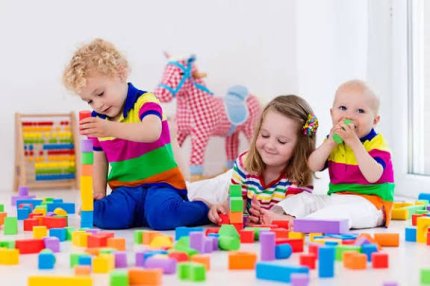
Start with a small number of participants
It is often more comfortable for toddlers to play alone or in a small group.
A large number of children can create excessive noise, competition for toys, and additional difficulties.
For example, instead of a big meeting, you can invite a familiar kid for a short game together.
Prepare enough materials
If there is only one very attractive machine in the room, conflict over it is quite predictable.
At the beginning of your acquaintance, it is better to offer several similar toys.
The American Academy of Pediatrics also recommends allowing your child to put away items that are especially valuable to them and that they are not yet ready to share.
Don't control every step
An adult can suggest an idea, help start a conversation, or explain the rules.
But there is no need to constantly determine who should do what.
If children are playing safely and finding solutions on their own, give them that opportunity.
At the same time, younger children require more active supervision, especially when there is a risk of injury.
What to do if a child doesn't want to share toys
Refusing to share a toy or doll at the age of two does not in itself indicate poor parenting.
The American Academy of Pediatrics explains that at around two years old, children are still learning to take turns, cooperate, and self-control.
Therefore, the demand to immediately give away a favorite thing can cause strong protest.
How to help without coercion
First, acknowledge the child's desire: "You are playing with this car right now and want to leave it."
Then suggest a possible solution.
For example: “We can find another car for the guest” or “When you’re done, we’ll invite a friend to play.”
For older children, you can agree on a turn order if both participants understand the rule.
But you shouldn't take away a personal toy by force just to demonstrate generosity in front of other adults.
The ability to share is developed gradually. It is more important to teach a child to negotiate and respect boundaries than to demand unconditionally giving up anything.
How to help children resolve conflicts during play
Arguments are a normal part of children's communication.
One wants to build a road, another wants to build a house. Someone changes the rules, and someone doesn't like the proposed plot.
The adult's task is to help children understand the situation without humiliation or punishment for the mere fact of disagreement.
For example, you can consistently find out what each child wants.
Then offer several options: take turns playing, use additional materials, or change the shared idea.
If one child is pushing another, it is necessary to stop the dangerous behavior.
At the same time, there is no need to call the child aggressive or bad.
It's better to briefly explain the boundary: "No pushing. If you want a toy, I'll help you ask."
What toys will help a shy child?
Not all children make friends easily and quickly join the company.
Some need time to observe others and feel comfortable.
This does not necessarily indicate a developmental problem.
Games that don't require constant talking can be useful for gradual familiarization.
For example, building together, drawing next to each other, or rolling a ball.
You can start with one familiar peer.
You should not introduce the child with other words, such as "She is very shy at our place" or demand to get to know her immediately.
It's more helpful to give her time and offer help if she needs it.
Are toys suitable for children with autism or developmental disabilities?
Yes, play can support social interaction among children with different developmental disabilities.
However, there is no universal set of “socialization toys.”
Some children prefer repetitive activities, are sensitive to sounds or light, or use alternative methods of communication.
Therefore, it is worth considering the sensory needs, available movements, interests, and communication style of a particular child.
For example, if a child enjoys arranging objects, an adult can carefully join in on this activity without destroying its purpose.
There is no need to force a child to make eye contact, hug others, or participate in group play against their comfort.
If you have any questions about speech, communication, or behavior development, you should contact your pediatrician and relevant specialists.
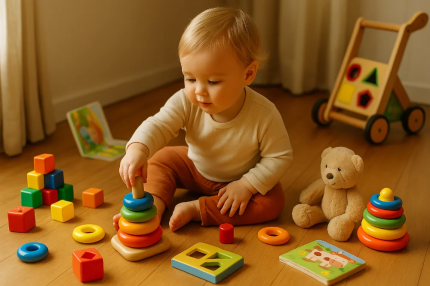
How to choose safe toys for shared play
When choosing a toy, you should consider not only its developmental potential, but also its safety.
The age of the child is of particular importance.
The US Consumer Product Safety Commission (CPSC) warns against the use of small parts and small balls by children under three years of age due to the risk of choking.
Also dangerous are available button batteries, powerful magnets, and some water balloons.
Before buying, check:
manufacturer's recommended age;
the presence of small parts;
strength of fasteners;
quality of materials;
lack of sharp edges;
availability of available batteries or magnets;
the toy's correspondence to the child's real skills.
It is also important to consider younger children who are in the same room.
For example, a construction set with small parts may be suitable for a six-year-old child, but pose a danger to their younger sibling.
Are expensive educational toys needed for socialization?
No. A high price does not guarantee better social development.
The American Academy of Pediatrics recommends paying attention to simple toys that allow children to use their imagination, move, communicate, and independently change the course of the game.
For example, a large cardboard box can be transformed into a house, transport, or hiding place.
A few safe large cubes for the construction site.
And an ordinary ball is an excuse for joint actions.
On the other hand, an electronic toy that does most of the work on its own doesn't necessarily create enough opportunities for conversation.
However, this does not mean that all digital toys are harmful.
More importantly, do they encourage the child's active participation and interaction with others?
Five mistakes parents make when developing social skills
1. Expect adult behavior from your child. A two-year-old is still learning to wait their turn and regulate their emotions.
2. Forcing them to share everything. It is important for a child to know that their personal boundaries are also respected.
3. Organize only strictly scripted activities. Free play allows for independent choice of roles and plots.
4. Constantly compare children. Development rates vary, and individual differences do not allow conclusions to be drawn about a child's abilities.
5. Consider a toy a substitute for communication. Even the best educational set is no substitute for interaction with people.
How to understand that play helps a child develop communication
You don't need to evaluate each game by the number of new words or rules completed.
It is more useful to observe how the child interacts with the environment over time.
For example, she may start showing interesting objects to an adult more often, imitating new actions, or independently suggesting a joint plot.
Older children gradually learn to address peers, negotiate, and respond to different wishes.
But development does not always occur evenly.
After fatigue, illness, moving, or significant life changes, a child may temporarily need more support.
If you notice persistent communication difficulties, a lack of expected age-appropriate skills, or a loss of previously acquired skills, don't expect a new toy to solve the problem.
The CDC recommends discussing such observations with a doctor and undergoing appropriate developmental screening if necessary.
Conclusion
Toys can help a child develop social skills, but it's not the number of items or their cost that matters.
The most important thing is the opportunity to communicate, imitate, negotiate, invent common plots, and gradually learn to interact with other people.
For toddlers, simple games with adults, large cubes, balls, and objects for imitating everyday actions will be useful.
Preschoolers can be offered role-playing sets, creative activities, and simple board games.
But even if a child is still playing mostly alone or with others, this does not necessarily indicate difficulties with socialization.
The best game is one in which the child feels safe, has the opportunity to show initiative, and gradually discovers the joy of communication.
FAQ: Frequently Asked Questions About Toys for Socializing Children
What toys best develop a child's social skills?
Large construction sets, dolls, role-playing sets, balls, creative materials, and simple board games can be useful. What is more important is not the specific toy, but the ability to use it for joint interaction and communication.
At what age does a child start playing with other children?
Interest in peers emerges early, but true collaborative play develops gradually. Around age two, children often play side by side, and by age three, they increasingly join in with others' activities.
Why doesn't a two-year-old want to share toys?
At this age, the skills of taking turns and self-control are still being formed. Refusing to give up a favorite toy in itself does not indicate poor parenting. Adults can gradually teach negotiation without using force.
What games help a child learn to make friends?
For younger children, collaborative construction, simple role-playing, and ball games are suitable. For older children, cooperative board games, creative tasks, and shared fictional stories can be offered.
Do board games help with socialization?
Yes, age-appropriate board games provide opportunities to practice taking turns, following rules, and communicating. But preschoolers often need adult help, and the game itself needs to remain challenging and fun.
What to do if a child doesn't want to play with peers?
First, consider age, temperament, familiarity with the environment, and well-being. Offer short meetings with one familiar toddler without coercion. If there are persistent concerns about communication development, consult a pediatrician.
Is it possible to develop social skills at home without other children?
Yes. Communication with parents, reading together, role-playing, and turn-taking support social development. As children grow older, it is also helpful to create safe opportunities for peer interaction.
Are special expensive educational toys needed?
No. Simple objects that allow for imagination and active interaction can be quite sufficient. Choose toys according to the child's age, safety, and interests.
How to teach a child to negotiate during play?
Show short and clear examples: asking for an object, suggesting a turn, or finding another way to continue the game. Younger children need more help from an adult, and older children can gradually be given more independence.
When should you consult a specialist for socialization difficulties?
If your child is losing skills they have already learned, has persistent communication difficulties, or is not meeting expected developmental milestones, it is a good idea to discuss this with your pediatrician. A single behavioral pattern is not a basis for self-diagnosis.
Important: the article is for informational purposes only and does not replace the advice of a pediatrician, child psychologist, or other medical professional. Self-medication and independent attempts to correct developmental disorders can be harmful to the child's health. If you notice developmental delay, loss of acquired skills, or other worrying symptoms, consult a doctor first. When choosing toys, consider age restrictions, the child's individual capabilities, and safety requirements.

