

Toys are scattered on the floor, clothes are on the chair, and there is no room left on the desk for notebooks. You ask your child to clean the room again, you hear the answer "Now!" - and after an hour nothing changes. In the end, you have to either fight or clean up the mess yourself.
Sounds familiar? Many parents view their child's reluctance to clean as laziness, disobedience, or disrespect. However, the reasons for their child's messiness can be much more complex.
Points of attention
- After school, clubs, homework, and sports, even simple cleaning can seem like an excessive burden.
- The American Academy of Pediatrics recommends paying attention to a child's efforts and gradually increasing the difficulty of homework, rather than immediately demanding a perfect result.
- The UK's National Health Service (NHS) notes that persistent low mood, loss of interest, sleep disturbances and concentration problems can be signs of psychological difficulties in children.
If a child doesn't want to clean their room, it doesn't necessarily mean they're lazy or unruly. Sometimes they lack organizational skills, sometimes the task seems too difficult, and sometimes the problem lies in fatigue, an inconvenient storage system, or constant conflicts with their parents.
The American Academy of Pediatrics emphasizes that feasible household chores help children master practical skills, feel self-sufficient, and learn to cooperate with family members.
But expectations should be appropriate to the child's age and abilities.
We understand why children avoid cleaning, how to teach them to maintain order without threats or punishments, and what to do if even a teenager categorically refuses to clean their own room.
Why a child doesn't want to clean: 9 possible reasons
Before implementing new rules, it is important to understand what exactly is bothering the child.
The same behavior can have different reasons. For example, a four-year-old may not clean up his toys because he doesn't know where to put them. A thirteen-year-old may avoid cleaning because of a conflict with his parents over personal space.
1. The child doesn't know where to start
For an adult, the request "Clean the room" sounds understandable.
However, in reality, it involves a whole sequence of actions: collecting trash, sorting things, folding clothes, putting away books, and sweeping the floor.
The child needs to independently determine the order, keep it in mind, and not get distracted.
Such abilities are associated with the executive functions of the brain — the skills of planning, organization, attention control, and behavior.
Experts at the Harvard University Center for Child Development explain that these skills are formed gradually throughout childhood and adolescence.
Therefore, the inability to organize cleaning on your own does not always mean unwillingness to cooperate.
2. The rules of procedure are unclear.
Parents' and children's perceptions of cleanliness can differ significantly.
For an adult, order means an empty desk, folded clothes, and no toys on the floor.
It is enough for a child to be able to find their favorite things and go to bed freely.
If specific rules are never discussed, disputes can repeat themselves endlessly.
It's important to define exactly what a "tidy room" means in your family.
3. More things than convenient places to store them
Even adults find it difficult to maintain order when closets are overflowing and every item has to be moved from place to place.
For children it is even more difficult.
For example, if all the toys are in one large box, it is difficult for a child to quickly find the right thing and just as easy to put it back.
Sometimes the problem is solved not by additional discipline, but by a simpler organization of space.
4. Cleaning is associated with quarrels
If every attempt to restore order is accompanied by criticism, the child may begin to avoid the process itself.
For example, she folded the books, but only heard remarks about the toys being misplaced.
Over time, the belief arises that there is no point in trying, because adults will remain dissatisfied anyway.
The American Academy of Pediatrics recommends paying attention to a child's efforts and gradually increasing the difficulty of homework, rather than immediately demanding a perfect result.
5. The child is overtired
After school, clubs, homework, and sports, even simple cleaning can seem like an excessive burden.
Especially if adults expect the child to start cleaning immediately after returning home.
It is important to evaluate the overall routine.
You may need to review the time for homework, rather than increasing the number of reminders.
6. Cleaning became a struggle for independence
During adolescence, one's own room is often perceived as personal space.
A teenager wants to decide for himself where his things will be, what his desk will look like, and when he will perform household tasks.
If parents constantly check every shelf and move personal belongings without permission, this can provoke conflicts.
However, the right to privacy does not mean the absence of hygiene and safety rules.
7. The child does not have a formed habit
If adults have been putting away all of the children's things for years, you shouldn't expect that one day the child will automatically start doing it themselves.
The sequence of actions needs to be explained, demonstrated, and responsibility gradually transferred.
The US Centers for Disease Control and Prevention (CDC) emphasize that predictable rules and repetitive routines help children understand adults' expectations.
8. Cleaning is constantly interrupted by other activities
A child collects toys, finds a long-forgotten car, and starts playing.
Then he sees the drawing, remembers the unfinished project, and completely forgets about the original task.
This behavior may be related to attention and self-regulation characteristics.
But isolated cases of distraction do not indicate attention deficit hyperactivity disorder (ADHD).
9. There is an emotional problem behind the reluctance to clean.
Sometimes a sharp change in daily habits is accompanied by a difficult psychological period.
For example, a child used to maintain order, but suddenly stopped cleaning, lost interest in favorite activities, became withdrawn or constantly tired.
Such changes require attention.
The UK's National Health Service (NHS) notes that persistent low mood, loss of interest, sleep disturbances and concentration problems can be signs of psychological difficulties in children.
However, the mess in the room alone does not allow for any diagnosis.
How to teach a child to clean: 10 practical ways
The most effective approach is to gradually teach the child specific actions and create conditions in which maintaining order is quite simple.
1. Replace a general request with a specific task
Instead of “Remove everything immediately,” offer one clear action.
For example:
"Put all the cubes into the blue box."
Once done, proceed to the next step.
The CDC recommends giving young children short and specific instructions that are appropriate for their abilities.
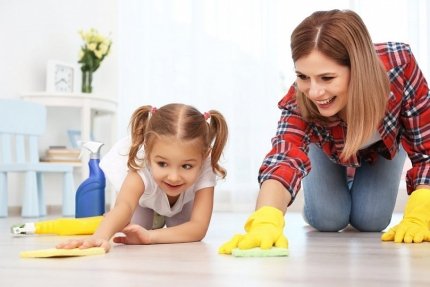
2. Clean together first
Young children often need an example.
You can offer:
"I'll collect the pencils, and you put the cars in the box."
This way, the child sees how the process is organized and gradually learns to carry it out independently.
But if you say "Let's clean up together," really get involved in the work.
3. Give each category of things its own place
Toys, books, clothes, and stationery need clear storage spaces.
For younger children, open boxes with pictures can be convenient.
Separate shelves or labeled containers help schoolchildren.
It is not necessary to buy expensive organizers. It is important that the child can easily use the system.
4. Offer a small selection
It may be easier for a child to cooperate when they have the opportunity to make at least part of the decision.
For example:
"Will you put the books away first or the toys away first?"
Or:
"Would you rather clean up before or after dinner?"
Offer only those options that are truly acceptable.
5. Create a short, recurring ritual
Instead of a general clean after a few weeks of clutter, try to set aside a small space regularly.
For example, putting away toys after playing or preparing the desk for the next school day.
The specific duration depends on age and the number of cases.
The main thing is to make the task feasible.
6. Use visual reminders
Preschoolers can be offered cards with pictures: toys in a box, clothes in a basket, books on a shelf.
For a schoolchild, a short list of a few items.
For example:
Dirty clothes - in the basket.
Books are on the shelf.
Toys are in boxes.
Garbage - in the bucket.
Such a list helps you avoid having to keep the entire sequence of actions in mind.
7. Celebrate specific efforts
Instead of a general “Well done” you can say:
"You put all the toys away yourself and now there's enough room on the floor to play."
This way, the child better understands which behavior was beneficial.
CDC experts recommend specific positive praise as a way to support desired behavior.
At the same time, there's no need to turn every household chore into an event that requires a gift.
8. Let your child organize some of the space on their own
Ask her where she likes to store her books, art supplies, or favorite toys.
Maybe she'll suggest a solution you haven't thought of.
You don't have to agree with everything, but it's helpful to involve your child in organizing their own space.
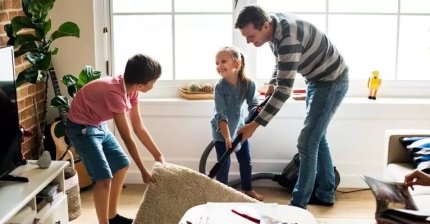
9. Show an example of shared responsibility
If adults leave things everywhere but constantly demand perfect order from children, the rules may seem unfair.
It is helpful for each family member to be responsible for a reasonable portion of household chores.
For example, adults clean the kitchen, and the child puts away their things.
The goal is to show that caring for shared space is not a punishment.
10. Revise the rules if they aren’t working
If a child systematically fails to fulfill agreements, it is not always necessary to increase control.
Try to figure out what the difficulty is.
Maybe there are too many tasks or the cleaning time is inconvenient.
And sometimes it is necessary to clarify the rules and agree on clear, proportionate consequences for breaking them.
The main thing is not to use humiliation, threats, or physical punishment.
What a child can clean independently at different ages
Expectations should be consistent with development, physical capabilities, and previous experience.
The American Academy of Pediatrics recommends gradually increasing the difficulty of homework, without requiring adult-level accuracy from young children.
| Child's age | Examples of errands |
| 2–3 years | Together with an adult, put large toys in a box, move safe things to their place |
| 4–5 years | Put away toys by category, fold books, help organize the play space |
| 6–7 years | Make the bed, put clothes in the basket, keep the shelves tidy |
| 8–10 years | Independently tidy up the desk, fold the laundry, vacuum under appropriate conditions |
| 11–13 years old | Regularly maintain order, change bed linen, perform most simple household chores |
| 14–17 years old | Independently organize room cleaning and participate in the care of common areas |
This is a guideline, not a mandatory age limit.
A child with a disability, developmental difficulties, or other individual needs may need task adaptations.
What to do if your child doesn't put away their toys after playing
For preschoolers, cleaning is best combined with the completion of a specific activity.
For example, before starting a new game, you can put together a preliminary set of toys.
It is important not to demand this too suddenly.
Warn your child that playtime is coming to an end.
We can offer a simple rule: first we assemble the constructor, and then we take the materials for drawing.
Sometimes game elements are useful — for example, collecting all the red pieces or finding a place for each toy animal.
However, play should not become a mandatory way to complete every household task.
Gradually, the child should learn to clean up without special entertainment.
A teenager doesn't clean his room: how to negotiate without conflict
In adolescence, the most important issue often becomes not cleaning itself, but the demarcation of personal space and family rules.
A teenager may consider it normal to leave books on the table or not fold decorative items according to parental standards.
This is not necessarily a problem.
It is important to distinguish between normal clutter and conditions that pose health or safety risks.

What can be left to the teenager's discretion?
For example, the order of books, the design of walls, the location of personal belongings, or the way the work area is organized.
What should remain mandatory
Absence of spoiled food, dangerous items, and household garbage that creates unsanitary conditions.
It is also important not to clutter aisles and exits, especially in the event of an emergency.
You can agree on minimum hygiene rules, leaving the teenager freedom in other matters.
Don't secretly throw away his things or read his personal notes under the pretext of cleaning.
Should I pay my child to clean his room?
A reward system can help at the initial stage of forming a certain behavior.
For example, younger children sometimes like stickers for fulfilling agreements.
However, it is important to distinguish between normal family responsibilities and additional tasks.
Cleaning up your own toys or maintaining basic cleanliness can be part of your daily responsibilities.
Instead, some optional tasks can be paid for by family agreement.
There is no single correct approach.
If you use rewards, explain the rules in advance and don't change them arbitrarily.
You should not deprive your child of food, sleep, necessary care, or other basic needs for not cleaning.
ADHD and Organizational Difficulties: When Your Child Needs a Different Approach
Children with attention deficit hyperactivity disorder may experience additional difficulty completing multi-step tasks.
Specialists at the Child Mind Institute explain that the difficulty of cleaning for such children is often related to planning, prioritizing, and maintaining attention.
For example, a child may understand what needs to be cleaned, but not know how to organize the sequence.
Short instructions, visual lists, simple containers, and a regular routine can be helpful.
At the same time, an untidy room in itself is not a sign of ADHD .
If organizational difficulties also manifest themselves in school and other daily activities, it is worth discussing them with a pediatrician or a relevant specialist.
Safe cleaning of a children's room: what not to entrust to children
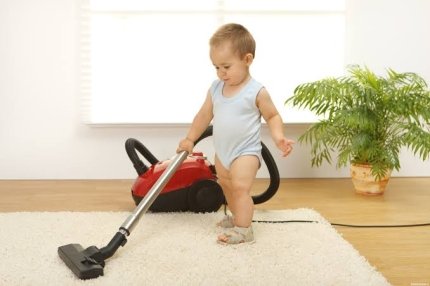
Involving your child in household chores is important, but not all tools and equipment are suitable for independent use.
The American Academy of Pediatrics recommends storing household chemicals in their original packaging, away from children, preferably in locked cabinets.
Concentrated detergents, laundry capsules, bleaches, and drain cleaners can be particularly dangerous.
Children should not work alone with dangerous chemicals, sharp objects, or faulty electrical appliances.
You should not mix different household cleaners, including chlorine-based cleaners, with other products: some combinations can produce dangerous fumes.
Younger children can easily put things away, put away toys, and perform other simple tasks under proper supervision.

A practical seven-day plan: how to start teaching your child to be tidy
It is not necessary to change all household rules in one day.
You can start with a small family experiment.
| Day | Task |
| 1 | Together, define what order in a room means. |
| 2 | Check that each category of items has a convenient place |
| 3 | Do the cleaning together, explaining the sequence |
| 4 | Assign the child one specific action on their own |
| 5 | Establish a short, regular time to tidy up |
| 6 | Check what the child can do without help |
| 7 | Discuss which rules are convenient and which need to be changed |
This is an example of gradual learning, not a scientifically proven technique for forming a habit in seven days.
Some children will need significantly more time, especially if they haven't had regular household chores before.
Five mistakes parents make that prevent their child from being clean
1. Demanding a perfect result. A small child is not required to clean as quickly and neatly as an adult.
2. Giving too many instructions at once. A long list of tasks can be difficult to remember.
3. Reworking everything in front of your child. This can create the impression that their efforts don't matter.
4. Using cleaning as punishment. This approach can create a negative attitude towards regular household chores.
5. Comparing with other children. Phrases like “Look how clean your sister’s room is” can cause resentment instead of cooperation.
It is better to assess the child's personal progress and gradually increase their responsibility.
When reluctance to clean requires specialist consultation
Clutter in a child's room alone is usually not a reason for a medical examination.
However, it is worth seeking help if organizational difficulties are combined with other persistent problems.
For example, a child is consistently unable to complete simple sequential tasks, has significant difficulty paying attention at school and at home, or has suddenly lost interest in everyday activities.
It is especially important to pay attention to prolonged mood swings, sleep disturbances, social isolation, or severe fatigue.
In such situations, it is advisable to start by consulting a pediatrician.
If necessary, the doctor may recommend additional evaluation of development, psychological status, or other factors influencing behavior.
You should not self-diagnose just because you refuse to do household chores.
Conclusion
If a child doesn't want to clean their room, constant reminders and harsh punishments don't always help.
It is much more useful to identify the cause of the difficulties: unclear tasks, overload, lack of skills, an inconvenient storage system, or family conflict.
Young children need to be taught simple actions gradually. Schoolchildren benefit from clear rules and a repetitive routine. And teenagers need to be given more independence, while maintaining mandatory hygiene and safety requirements.
The parents' goal is not to achieve a perfectly tidy room at any cost, but to teach the child to take care of their own space and be responsible for their shared home.
FAQ: Frequently Asked Questions About Kids Who Don't Want to Clean Up
Why doesn't the child want to clean his room?
The reasons may be unclear requirements, lack of organizational skills, overwork, lack of habit, or conflicts with parents. It is important to consider the child's age and specific circumstances, and not to explain everything away as laziness.
How to get a child to put away their toys?
It is better not to use force as the main method. Help your child understand the task, show them where to put things, and start by cleaning up together. For preschoolers, short instructions and regular rituals are useful.
At what age should a child clean up after themselves?
Children as young as two or three years old can be involved in simple household tasks under adult supervision. However, independence and the complexity of tasks should gradually increase as the child develops.
What to do if a 5-year-old child doesn't put away his toys?
Make sure the storage areas are clear enough. Suggest one specific action, such as putting the construction set in the box. At first, clean up together, then gradually hand over responsibility to the child.
How to teach a student to maintain order?
A clear list of responsibilities, a regular time for cleaning, and convenient storage of things help. You don't need to demand a general cleaning every day. It's better to teach your child to perform small actions systematically.
What to do if a teenager doesn't clean his room?
Agree on minimum rules for cleanliness, hygiene, and safety. At the same time, leave your teen the right to organize their personal belongings and room decor on their own. Avoid secretly looking through or throwing away their belongings.
Should you pay your child to clean?
Monetary compensation is not mandatory. Normal household chores can be part of family responsibilities. If desired, compensation for additional tasks that go beyond regular duties can be negotiated separately.
Is it normal for a child to be constantly distracted while cleaning?
This happens, especially at a younger age. Help break down cleaning tasks into short steps and use clear reminders. If attention difficulties are persistent and affect different areas of life, it is worth consulting a specialist.
Can a messy room be a sign of ADHD?
Disorganization alone is not a sign of ADHD. Children with the disorder may indeed have difficulty planning and organizing, but a comprehensive assessment of multiple symptoms and their impact on life is required to make a diagnosis.
How to teach a child to clean without yelling or punishment?
Use specific requests, achievable tasks, shared examples, and regular routines. Celebrate efforts and revise rules if they aren't working. Consistency and respect for your child are usually more helpful than constant arguing.
Important: The article is for informational purposes only and does not replace the advice of a pediatrician, psychologist, or other professional. Self-medication for possible developmental, attention, or mental health disorders can be harmful. If difficulties with organizing daily activities are accompanied by persistent changes in behavior, mood, or other symptoms, consult a doctor first. When cleaning, the child should perform only safe tasks appropriate to their age and abilities.

