
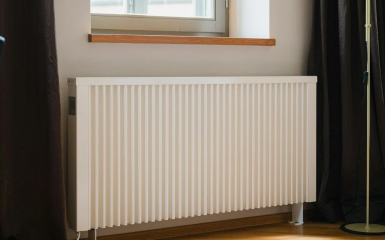
A bag is put on a radiator before the heating season begins not to save heat or to “boost” the radiator. It is used as a simple dust collector when cleaning the radiator: a bag or a large garbage bag is fixed from below, and the flow of cold air from a hair dryer is directed from top to bottom. Dust from the internal ribs, plates and hard-to-reach crevices falls into the bag, and does not scatter across the floor.
Points of attention
- The bag on the battery is used as a dust collector when cleaning the radiator before the heating season.
- The bag and hair dryer method helps remove dust from the internal crevices of the radiator without the risk of spreading it throughout the room.
- The battery pack should be removed immediately after cleaning, and should not be left on the hot surface of the radiator.
This can be useful before you turn on the heat for the first time, as dust builds up inside radiators over the summer. As the radiator heats up, the warm air moves upwards and some of the dust can rise with it. GOV.UK, in its article on indoor allergens, notes that house dust and related allergens can make people with allergies, asthma and other respiratory conditions worse.
Important note: The bag should only be used on a cold radiator and only during cleaning. It should not be left on a hot radiator, electric heater, convector or any heating device. This can interfere with air circulation, damage the plastic, create an odor and increase the risk of unsafe operation.
Why clean radiators before the heating season?
A radiator works by heating the air around it. Cooler air enters from below, passes between the sections or plates, heats up and rises. If the internal channels are clogged with dust, hair, cobwebs and small debris, the air flows more poorly and some of the dirt rises into the room.
Screwfix explains in their practical guide to cleaning radiators that dust inside the convector plates can reduce heat transfer and spread allergens when the heating is on. This is particularly noticeable on panel radiators with internal fins: the radiator may look clean on the outside, but inside, a layer of grey dust builds up between the plates.
A clean radiator won't turn a cold apartment into a very warm one if the house has weak heating, drafts, or poorly insulated windows. But cleaning removes an obvious obstacle to normal air movement and reduces the amount of dust in an area that is constantly heated.
How the bag and hair dryer method works
The essence of the method is simple: the bag collects dust from below, the hairdryer blows it out from above. This is convenient for radiators where it is difficult to reach the inner plates with a narrow vacuum cleaner nozzle or a rag.
Things needed:
a large bag or garbage bag;
hair dryer with cold air mode;
Scotch tape or masking tape;
vacuum cleaner;
damp microfiber;
dry cloth;
gloves;
mask if you are allergic to dust.
The bag is put on from below or placed under the lower edge of the battery. Then the hair dryer is directed from top to bottom into the gaps between the sections or plates. The air flow knocks out the dust, which falls into the bag. After that, the accessible surfaces are wiped with a damp cloth, the floor is vacuumed, and the bag is carefully removed and thrown away.
This method works best if the dust is dry. If there is sticky dirt, grease from the kitchen, or old paint inside the faucet, a hair dryer alone will not be enough.
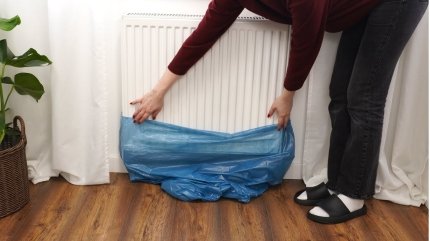
Step-by-step instructions: how to clean a battery with a bag
First, make sure the battery is cold. If the heating is already on, wait until it has cooled down completely. Do not use the bag on a hot surface.
Procedure:
Free up space near the battery.
Move furniture, curtains, children's items and textiles away.
Vacuum the floor under the radiator.
Spread out a large bag and place it under the battery.
If necessary, secure the edges with tape so that the dust falls inward.
Turn the hair dryer on cold air.
Direct the flow from top to bottom into narrow channels.
Move from one edge of the radiator to the other.
Wait for the dust to settle.
Carefully remove the bag and tie it.
Wipe the exterior surfaces with a damp microfiber cloth.
Dry the metal with a dry cloth.
Do not set the hair dryer to hot air. The hot air can heat dust, plastic, paint, sealants, or the wall behind the faucet. It is not temperature that is needed for the job, but air movement.
For which batteries is this method suitable?
The bag method is best for central or autonomous heating water radiators when they are completely cold. It is especially useful for panel radiators with internal convector plates, where dust accumulates between the fins.
It can be used for:
steel panel radiators;
sectional aluminum batteries;
bimetallic radiators;
old cast iron batteries;
water heating convectors with open channels.
For old cast iron radiators, it is often more convenient to combine several methods: first a vacuum cleaner with a narrow nozzle, then a brush, then a bag and a hairdryer for dust residues, and then damp wiping.
When a battery pack cannot be used
Do not use this method on electric heaters, oil radiators, fan heaters, electric convectors, infrared panels, or any appliances that are plugged into the mains. For these, you should follow the manufacturer's instructions: usually unplugging, cooling, dry cleaning the grilles, and preventing water from getting inside.
Electrical Safety First recommends not drying clothes near heaters or open flames, and keeping items a safe distance away to reduce the risk of fire. Health Canada also recommends keeping portable electric heaters at least 1 metre away from combustible materials, including clothing, curtains, beds and furniture.
You cannot:
leave the bag on the battery after cleaning;
wrap a hot radiator with plastic;
dry the bag, clothes or towels on an electric heater;
blow a hot hair dryer on the plastic;
pour water inside electrical appliances;
clean the appliance if it is plugged into the socket;
close the heater's ventilation holes.
If you are not sure which appliance you have, proceed as with an electrical appliance: turn it off, unplug it, wait for it to cool down, and do not cover it.
Will a battery pack improve the heat in the room?
The package itself does not improve the heat. It only helps to collect dust during cleaning. Heat transfer may become better indirectly if the radiator was heavily soiled and air did not pass well between the plates. But you should not expect a sharp increase in the temperature in the room after one cleaning.
Heat is more affected by:
coolant temperature;
condition of the heating system;
the presence of air in the radiator;
cleanliness of internal channels;
lack of furniture in front of the battery;
curtains that do not cover the radiator;
thermal insulation of walls and windows;
correct operation of thermostats.
The State Energy Efficiency Agency of Ukraine advises checking the system before the heating season, eliminating air bubbles and possible leaks, especially at the joints of system parts. This is much more important for real heat than any household trick.
Why you shouldn't leave your radiator closed
The radiator should radiate heat into the room. If you cover it with a tight package, a decorative panel without ventilation, long curtains, a sofa, or a dryer with wet laundry, the flow of warm air is disrupted. Some of the heat remains behind the obstacle, and the room warms up worse.
Citizens Advice explains that radiators heat the air around them, and furniture, curtains or the wrong placement of the thermostat can interfere with the heating working properly. Therefore, after cleaning, the radiator should be open at the bottom, front and top.
It is especially undesirable to keep long curtains over the radiator. In this case, warm air goes between the window and the fabric, and not into the room. It is better if the curtain ends above the windowsill or is pushed back when the heating is on.
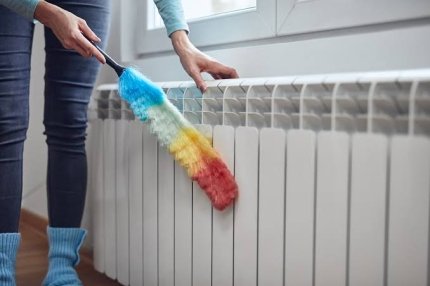
What else can you clean the battery with?
A bag and a hairdryer are a quick option, but not the only one. For high-quality cleaning, you can use a special brush for radiators: long, narrow, and flexible. It passes between the sections and cleans the dust that a hairdryer does not always knock out.
Useful tools:
vacuum cleaner with a narrow nozzle;
radiator brush;
microfiber;
soft dust brush;
a spray bottle for a rag, not for pouring inside;
a small basin or towel under the faucet;
an old towel to protect the floor.
If the radiator is in the kitchen, it may have a greasy coating on it. In this case, dry blowing will not remove everything. A damp cloth with a mild detergent is needed. Do not use aggressive chemicals, abrasive sponges and metal brushes on painted radiators: you can damage the coating and accelerate corrosion.
How often to clean batteries
At least once before the start of the heating season. In an apartment with pets, carpets, active renovations nearby, open windows, kitchen grease, or allergy sufferers, radiators should be cleaned more often.
Practical schedule:
before starting the heating - deep cleaning;
once a month during the season - a quick wipe down of the outside;
after repair - mandatory cleaning from construction dust;
after the smell of dust appears when heating - clean again;
in the spring after the season - light cleaning before summer.
It is best to remove construction dust immediately after work. If it has settled on hot radiators or inside the fins, it can be carried around the room for a long time during heating.
What to check on the battery before starting the heating
Cleaning is just one part of the preparation. Before the season, it's a good idea to inspect the radiator itself and the area around it.
Check:
are there any signs of leakage?
or dry connections;
is there any rust near the threaded joints?
Is the radiator deformed?
Are the taps open if the system requires it?
Is the thermostat working?
whether the battery is not covered by furniture;
is there no air plug after starting;
Do you hear any gurgling or noise?
Does the top and bottom heat up evenly?
The National Commission for the Regulation of Energy and Utilities of Ukraine (NKREKP) emphasizes in its material on preparing buildings for the heating season that warmth and comfort depend, in particular, on the absence of leaks in the basement, washed radiators, repaired windows, and proper preparation of the house.
If you live in an apartment building with centralized heating, you should not unscrew the connections, dismantle the battery, or interfere with the riser yourself. In case of leaks, cold sections, noise, air in the system, or a faulty tap, contact the condominium association, manager, housing association, or emergency services.
Do I need to bleed the battery?
Air in a radiator can prevent normal heating. A typical sign is a radiator that is warm at the bottom but cold at the top, or you can hear a gurgling sound in the system. The Energy Saving Trust notes that cold spots due to air inside can mean that radiators are not working as efficiently as they should; systems with a combination boiler may need to be re-pressurised after bleeding.
In an apartment with autonomous heating and a working Mayevsky crane, you can do this yourself if you know the procedure and have the key. In a house with a centralized system, it is better not to act at random. Incorrect unscrewing can cause leaks, flooding of the apartment or problems in the entire riser.
A bag with a hair dryer removes dust. It does not bleed air, flush the system, restore pressure, or repair a faucet. If the battery is cold for a technical reason, cleaning will not solve the problem.
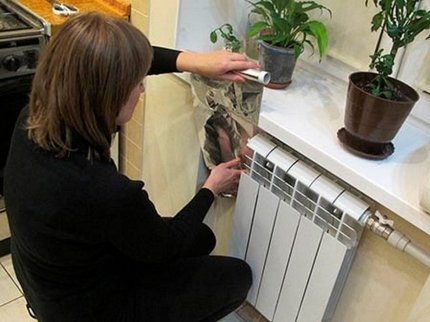
Foil behind the battery: when it is appropriate
A separate topic is the foil screen behind the radiator. It should not be confused with a bag. The bag is used temporarily to collect dust. A foil or special reflective screen is placed on the wall behind the battery so that some of the heat does not go to the cold outer wall.
The Energy Saving Trust explains that radiator reflector panels are installed behind radiators to reflect heat back into the room, and they work best behind radiators on uninsulated external walls. The organisation also notes that these panels are a low-cost way to reduce heat loss through an external wall, but it is worth following the instructions for the specific product.
Kitchen foil can be a temporary option, but it creases, tears, oxidizes, and holds its shape less well. For careful, long-term use, it is better to use special reflective panels or rolled material designed specifically for radiators.
Is it possible to dry things on a battery?
Many people are used to drying small items on a water radiator, but this has its drawbacks. Wet textiles block heat transfer, increase humidity in the room, can leave a damp smell, and impair air circulation. If the radiator is electric or a separate heater, you cannot dry items on it.
Ukrainian fire safety rules for electric heating appliances prohibit using such appliances for drying clothes and linen unless they are intended for this purpose, as well as covering electric heating appliances and heaters with flammable materials.
To dry laundry, it is better to use a dryer with space between items, ventilation or a dehumidifier. The radiator should heat the room, not act as a shelf for wet clothes.
How to prepare the area near the battery for winter
After cleaning the radiator, it's worth checking whether you're blocking the heat with your own interior. Often the radiator is in good condition, but it's covered by thick curtains, a decorative screen, a sofa, a chest of drawers, or a clothes dryer.
What to do:
Move the furniture away from the battery at least a few centimeters.
Do not cover the top of the radiator with shelves without a gap.
Raise or shorten the curtains if they cover the radiator.
Leave an open space at the bottom for cold air to enter.
Do not place boxes, toys, paper and textiles near the radiator.
Check that the thermostat is not hidden behind furniture or curtains.
If the battery is on an outside wall, consider a reflective screen.
Check the seals on windows and doors.
The State Energy Efficiency Agency of Ukraine advises insulating windows and doors, eliminating pipe exits from the home, and using thermostatic regulators on radiators, if installed or available.
Typical battery pack errors
The first mistake is to leave the bag on the radiator after cleaning. This is not beneficial and can interfere with the normal operation of the battery.
The second mistake is to use a hot hair dryer. Cleaning requires a cold stream of air, not heating up the plastic, dust, and paint.
The third mistake is cleaning the battery when it is hot. This makes it more difficult to work, dust can rise more actively, and the plastic can deform.
The fourth mistake is to wrap an electric heater. Electrical appliances should not be covered unless their design allows it.
The fifth mistake is to think that the package replaces maintenance. If the battery is cold on top, leaks, makes noise, or heats unevenly, the system needs to be checked.
The sixth mistake is to only clean the outer panel. The most dust is often inside, between the ribs and plates.
The seventh mistake is to wash the radiator with a lot of water. Moisture can flow onto the floor, into cracks, onto the wall, or onto nearby electrical appliances.
Safe short memo
The bag on the battery only makes sense as a temporary dust collector. It can be used before the heating season if the battery is cold and there is a lot of dust inside.
Safe scheme:
the radiator must be cold;
the package is placed at the bottom, not left on top;
the hairdryer is turned on only for cold air;
after blowing off the dust, the bag is immediately removed;
external surfaces are wiped with a damp microfiber;
the battery is left open for air movement;
Electric heaters are not covered or cleaned while switched on.
If you have allergies, asthma, or a strong reaction to dust, it is better to use a mask, ventilate the room, and remove dust carefully, without blowing it all over the apartment.
Conclusion
A bag on the radiator before starting the heating is needed to collect dust when cleaning the radiator. Together with the cold stream of the hair dryer, it helps to knock out dirt from the internal cracks and not spread it around the room. This is a simple household trick that can be useful before the start of the season.
But the package should not be left on the radiator, it does not save heat by itself and does not repair the heating system. For a real result, the radiator must be clean, open, without air pockets, leaks, thick curtains and furniture in front of it. If the radiator heats unevenly, makes noise or leaks, a technical check is required, not a life hack.
The best preparation for the heating season is a cold cleaning of the battery, inspection of the connections, free space for air circulation, a reflective screen behind the radiator if necessary, and careful attention to fire safety.
FAQ
Why put a bag on the battery before heating?
The bag is used as a dust collector when cleaning a radiator. It is placed or fixed from below, and the dust is blown from top to bottom with cold air from a hair dryer. The dust falls into the bag, rather than flying around the room.
Can I leave the bag on the battery after cleaning?
No. The bag should be removed and discarded immediately. It does not improve heat, can interfere with air circulation, deform from heat, and create unnecessary risks.
Does dust on a battery really reduce heat?
If there is a lot of dust, it can interfere with the passage of air through the internal plates and fins, especially in panel radiators. Practical radiator maintenance guides note that dust inside convector plates can reduce heat transfer and spread allergens during heating.
Can I clean the battery with a hot hair dryer?
Better not. The bag method requires cold air. The hot setting can heat the dust, plastic, paint, wall, and bag itself. The hair dryer's job is to blow away the dust, not heat the radiator.
Can I wrap an electric heater in a bag?
No. Electric heaters, oil radiators, convectors and fan heaters should not be covered unless instructed to do so. Health Canada recommends that portable electric heaters be kept at least 1 metre away from clothing, curtains, beds and other combustible materials.
What is the best way to clean the inside of a battery?
The most convenient combination is a vacuum cleaner with a narrow nozzle, a long brush for radiators, a cold hair dryer with a bag underneath, and a damp microfiber for exterior surfaces. A mild detergent may be needed for the kitchen faucet.
What to do if the battery is cold on top?
There may be air in the radiator. The Energy Saving Trust notes that cold spots due to trapped air can reduce the efficiency of the radiator. In an apartment with autonomous heating, the air is sometimes released through a Mayevsky tap, but in a centralized system it is better to contact the manager, the condominium association or the emergency service.
Does foil behind the battery help?
Yes, but this is a different method. Reflective panels or foil screens are installed on the wall behind the radiator to reflect some of the heat back into the room. The Energy Saving Trust notes that they work best behind radiators on uninsulated external walls.
Can I dry things on a battery?
This is undesirable on a water radiator, as wet clothes block the heat and increase the humidity in the room. You cannot dry clothes on electric heaters unless the appliance is designed for this purpose. Fire safety regulations prohibit covering electric heaters with flammable materials and using them for drying clothes for purposes other than their intended purpose.
How to prepare batteries for the heating season?
You need to clean the dust, check the connections for leaks, make sure that furniture and curtains do not cover the radiator, check the thermostats, and after starting, assess whether the battery is warming up evenly. The State Agency for Energy Efficiency advises to check the system before the season, eliminate air bubbles and possible leaks.
undefined

