
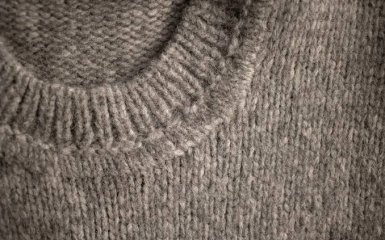
Your favorite sweater has become shorter after washing, the sleeves barely reach your wrists, and the item itself looks two sizes smaller. This most often happens with wool and cashmere, but cotton, viscose, and blended knitwear can also change size.
If a sweater has shrunk after washing but is still soft and elastic, it can sometimes be partially stretched by gently wetting it and drying it horizontally to give it the desired shape. However, if the wool has become very loose, dense, stiff, and felt-like, it is usually impossible to return it to its original size.
Points of attention
- If the sweater remains soft and elastic, its shape can sometimes be partially restored by wet molding and horizontal drying.
- Severe pilling of wool or cashmere is irreversible: a dense fabric, similar to felt, is usually impossible to return to its original size.
- You should check the label before moisturizing, and avoid hot water, twisting, and strong stretching when shaping.
The result depends on the composition of the fabric, the cause of the shrinkage, and how much the fiber structure has changed.
For example, a cotton jumper that has shrunk slightly after drying may regain its shape after being wet. A wool sweater washed on a high heat cycle can sometimes undergo irreversible changes.
Experts from Woolmark, Cashmere and Camel Hair Manufacturers Institute, and the American Cleaning Institute explain that water temperature, mechanical impact, and proper drying are especially important for caring for knitwear.
Let's look at how to determine the extent of damage, what to do with a sweater made of wool, cashmere, or cotton, whether hair conditioner helps, and how to wash knitwear so that it doesn't shrink anymore.
Why does a sweater shrink after washing?
Knitwear can change size for several reasons. The most common are inappropriate temperature, intense drum movements, improper drying, and the characteristics of the fibers themselves.
It is important to note that the word "shrinkage" describes the result, but does not always explain the process.
Shrinkage due to change in knitwear structure
During garment manufacturing, the threads and loops of knitwear are subjected to tension.
After contact with water, some of the internal stresses may decrease, and the loops may change their position.
This sometimes causes the product to become shorter or narrower, even though the fibers themselves have not been permanently damaged.
This change in shape can be partially corrected in some cases.
Wool shedding
This is a much more serious problem.
The surface of wool fibers has microscopic scales. Under the influence of water and mechanical friction, the fibers can move, catch on each other, and become compacted.
Woolmark explains that the pile created in this way is an irreversible process.
That is why a heavily soiled sweater cannot be completely restored by simply soaking it.
Deformation after improper drying
Not every sweater that got smaller or changed shape actually fell apart.
Sometimes it dried unevenly, folds were fixed in the wrong position, and certain areas shrank.
In this case, careful moistening and shaping of the product can help.
How to understand if a sweater can be saved after shrinkage
Before trying to stretch an item, you need to assess its condition.
The most important characteristics are softness, elasticity, and the visibility of knitting loops.
| Sweater condition | What could have happened? | Recovery option |
| It has become a little shorter, but remains soft. | Slight change in the shape of the knitwear | Sometimes it is possible to partially restore |
| The width has decreased, the loops are clearly visible | Shrinkage without significant sagging | Careful shaping possible |
| One sleeve is shorter than the other | Uneven deformation | Partial correction possible |
| The fabric has become dense, the loops are almost invisible | Wool shedding | Recovery is very limited |
| The sweater is stiff and feels like felt. | Severe crash | The original size is usually not returned. |
| The synthetic item was deformed by high temperature. | Possible changes in fiber structure | Recovery may not be possible |
The easiest way to assess damage
Lay the completely dry sweater out on a flat surface.
Inspect the knitting on the sleeves, chest, and bottom.
If the loops remain clearly visible, the fabric is soft and can be stretched slightly without effort, there is a chance of partially restoring the shape.
If the surface has become almost uniform, compacted, and has lost its natural elasticity, severe subsidence is likely.
You should not test the condition of the sweater by pulling it too hard. This can damage the threads, seams, or individual areas of the knitwear.
What to do immediately if a sweater gets stuck in the washing machine
The first rule is to stop any further exposure to high temperatures.
Do not try to wash the item again in hot water to "soften" the fabric.
You should also not put it in the dryer.
If the sweater is still damp, carefully spread it out on a clean towel.
Do not hang heavy wet knitwear on a hanger.
According to Woolmark's recommendations, a wet sweater may stretch unevenly under its own weight, especially in the shoulder area.
Check the label
Before any re-moisturizing, look for the care label.
Pay attention to the composition and permitted cleaning methods.
If only professional cleaning is indicated, you should not soak the item yourself.
If hand washing is allowed, delicate wet shaping can be considered.
At the same time, the designation "wool" or "cashmere" does not in itself determine whether the product can be washed at home.
How to stretch a sweater after washing: step-by-step instructions
For a sweater that has only slightly shrunk and hasn't fallen apart, you can try the wet shaping method.
In professional knitwear care, this procedure is often called blocking or sizing .
The point is to moisten the product, carefully distribute the knitting loops, and leave it to dry in the desired shape.
This approach is also used during the final processing of knitted products.
It does not guarantee shrinkage recovery, but it can help if the fiber structure is preserved.
Step 1. Measure the sweater
Place the item on a flat surface and determine:
The width between the armpits.
Length from shoulder to hem.
Sleeve length.
The width of the bottom.
The length of the shoulder line.
If you have old measurements or a manufacturer's size chart, use them as a guide.
For example, if a sweater was previously 64 cm long, and after washing it became 61 cm, you need to evaluate the possibility of a small correction.
Trying to increase the product by several sizes at once is dangerous.
Step 2. Prepare cool water
If the label allows hand washing, pour water at the appropriate temperature into a clean basin.
For delicate wool and cashmere, cool water is usually used.
If necessary, add a small amount of special wool detergent according to the manufacturer's instructions.
Do not use regular aggressive powder or bleach.
If the item is clean, additional detergent is not always necessary: the task is to moisten the fibers, not to rewash.
Step 3. Gently dampen the cloth
Slowly immerse the sweater in the water.
Let the material get evenly wet without rubbing it with your hands.
For products that are allowed to soak, short-term moistening of about 10–20 minutes is often used.
However, this is not a universal requirement. The time depends on the composition and care recommendations.
There is no need to rub the sweater, squeeze it into a lump, or move it around in the water repeatedly.
Excessive mechanical stress can be particularly dangerous for wool.
Step 4. Remove excess water with a towel
Carefully supporting the entire thing, remove it from the pelvis.
Don't lift a heavy, wet sweater by just the collar or sleeves.
Let the water drain without wringing hard.
Then spread the sweater out on a large clean towel.
Roll the towel and the item into a loose roll and press gently.
This will help remove some of the water without wringing.
The Cashmere and Camel Hair Manufacturers Institute recommends the most delicate pressing through a towel for cashmere knitwear.
Step 5. Return the sweater to its correct shape
Spread the wet product on a dry towel or a special surface for horizontal drying.
Straighten the shoulders, sleeves, and bottom hem.
Gradually adjust the dimensions by moving the fabric in small sections.
Do not pull only on the cuffs or bottom elastic.
For example, if you need to increase the width slightly, distribute the fabric evenly throughout the appropriate area.
Check the symmetry of the sleeves and side seams.
The Craft Yarn Council's professional guidelines for shaping knits include dimensional control when shaping the fabric.
Step 6. Dry horizontally
Leave the sweater on a flat surface at room temperature.
Avoid direct sunlight, batteries, heaters and hot air.
If necessary, replace the wet towel with a dry one.
While drying, you can check to see if the sleeves or bottom hem have shifted.
There is no need to constantly stretch the fabric.
After complete drying, measure the product again and compare the result.
If the sweater has become closer to its original size, this does not guarantee that the effect will remain unchanged after the next wash.
Can I return the size of a wool sweater?
Wool sweaters may respond to wet molding if the fibers have not experienced severe pilling.
Woolmark explains that the properties of wool allow for the creation of stretchy knitwear.
However, wool has a peculiarity: during intense friction in water, the surface scales of the fibers are able to adhere to each other.
Therefore, the outcome depends on the nature of the damage.
If the wool remains soft
You can carefully try horizontal molding according to the label.
It's best to work with small changes in length or width.
For example, sometimes it is possible to partially restore the shape of the cuffs or slightly straighten the body of the sweater.
If the sweater turned into felt
It is usually impossible to restore the original structure of the fibers.
Piling means that the fibers are already heavily intertwined and compacted.
Woolmark describes this process as irreversible.
Even if you manage to increase the size slightly after soaking, the fabric will not necessarily regain its original softness and elasticity.
Excessive stretching in this condition can cause further damage.
How to restore a cashmere sweater after washing
Cashmere is a fine natural fiber used to make light and soft knitwear.
Such things can be particularly sensitive to improper mechanical impact.
The Cashmere and Camel Hair Manufacturers Institute recommends hand washing in cool water with a detergent for delicate fibers for suitable cashmere knitwear.
After cleaning, the item should be carefully squeezed with a towel and dried horizontally.
Can you stretch wet cashmere?
Only do so very carefully and only if the condition of the product allows it.
If the sweater hasn't fallen apart, has no damaged seams, and remains elastic, you can try to straighten its shape.
Do not pull sharply at the neck, cuffs, or bottom hem.
Thin knitwear may deform unevenly.
For example, the sleeve will become longer, but at the same time it will lose the correct width.
For an expensive cashmere item that has noticeably shrunk, a professional assessment of the condition of the fabric is advisable.
However, even professional processing does not guarantee the restoration of heavily faded cashmere.
How to stretch a cotton sweater after shrinkage
Cotton knitwear can also change size after washing.
However, the shrinkage mechanism is different from wool pile.
The American Cleaning Institute notes that cotton fabrics can shrink during washing, especially if they have not been properly pre-treated.
Temperature, material structure and drying have an influence.
Does rehydration help?
If a cotton jumper has become a little shorter, you can sometimes gently straighten it while it is still damp.
To do this:
Check the permissible washing mode.
Lightly dampen the item with cool water.
Carefully remove excess moisture.
Lay the product horizontally.
Evenly shape it into the desired shape.
Leave to dry.
However, recovery will not always be complete or sustainable.
If the product has shrunk significantly due to the characteristics of the fabric, simple stretching may not help.
You should also not fix a wet cotton sweater with excessive tension: its loops and seams may deform.
Can an acrylic, polyester or viscose sweater be restored?
Synthetic and man-made fibers react differently to water and temperature.
Therefore, a universal recipe for all materials does not work.
| Material | Shrinkage features | What can you try? |
| Wool | Possible shape change and irreversible collapse | Careful shaping if the fibers have not fallen off |
| Cashmere | Sensitive to friction and deformation | Very delicate shaping with permitted care |
| Cotton | Shrinkage is possible due to the structure of the fabric. | Partial straightening in wet condition |
| Viscose | May change size and lose strength when wet | Only careful care of the label |
| Acrylic | May deform from high temperatures | Recovery is limited, depends on the damage |
| Polyester | Usually quite stable, but sensitive to excessive heating | In case of thermal deformation, recovery may not be possible. |
| Mixed fibers | Different components behave differently | It is necessary to consider the entire composition |
Why acrylic can't always be stretched
Acrylic fibers have different properties than natural wool.
If synthetic knitwear has undergone permanent deformation due to high temperature, normal soaking may not restore it to its original state.
Additional heating sometimes only makes the situation worse.
Why you need to be careful with viscose
Viscose can be sensitive to mechanical stress when wet.
Therefore, stretching a wet sweater too much can lead to uneven deformation.
For products with a high viscose content, it is important to first follow the instructions on the label.
You should not automatically apply wool care methods to all viscose items.
Will hair conditioner help stretch a sweater?
One of the most popular home methods is to soak a sweater in water with hair conditioner, then stretch it with your hands.
The idea is that the cosmetic supposedly softens the fibers and makes them easier to move.
But this method has significant limitations.
There is no convincing evidence that hair conditioner can restore the original structure of heavily matted hair.
In addition, cosmetics are designed for hair, not for cleaning fabrics.
They may contain fragrances, silicones, oils and other substances that can remain on the material.
Why it is undesirable to use conditioner for cashmere
It is difficult to predict the reaction of an expensive cashmere sweater to a specific cosmetic product.
There may be a residual odor, a change in the feel of the fabric, or the need for additional rinsing.
Each subsequent water treatment creates additional stress on delicate knitwear.
Therefore, it is safer to use products specifically designed for the appropriate fabrics.
Woolmark recommends mild neutral detergents for wool and warns against using unsuitable conditioning products which can leave a residue.

Can I use baby shampoo, vinegar or baking soda?
Household tips often suggest replacing a special wool product with baby shampoo.
However, the word “baby” does not guarantee that the product has the optimal composition for a particular fabric.
Cosmetics may contain ingredients not intended for textiles.
Similarly, you shouldn't use vinegar or baking soda just because you have them at home.
Why baking soda doesn't restore shed wool
Soda is not able to return the fibers to their original position after severe crushing.
In addition, an excessively alkaline environment is undesirable for some protein fibers.
Does vinegar help?
Vinegar is sometimes used in everyday life to clean things, but it is not a guaranteed way to restore the size of knitwear.
For a sweater with unknown dyes and decorative elements, additional acid treatment may pose unwanted risks.
If the goal is to correct a minor deformation, controlled fabric shaping is crucial, not adding household ingredients to the water.
Can I stretch a sweater with an iron or steam?
Steam treatment is used in the professional care of certain knitwear.
It can help smooth out wrinkles and correct shape.
However, steam does not eliminate irreversible pilling of wool.
Also, not every material is allowed to be steam treated.
When a couple may be appropriate
If the label allows for appropriate treatment, professional or careful home steaming can sometimes help smooth out individual areas.
But it must be applied without strong pressure and in compliance with temperature restrictions.
When steam is dangerous
You should not use it without checking for:
Sweaters with a no-ironing policy.
Items with heat-sensitive synthetic fibers.
Products with decorative coating.
Delicate knitwear that is already severely deformed.
There is no need to press a hot iron against the wool fabric, trying to forcefully increase its length.
Excessive heat may deteriorate the product.
Why you shouldn't dry a wet sweater on a hanger
Wet knitwear becomes heavier due to the water the material holds.
If you hang it on a hanger, its own weight can stretch the fabric.
Most often, the deformity occurs in the area of the shoulders, neck, and sleeves.
Woolmark recommends drying wool sweaters horizontally unless the manufacturer specifies another permitted method.
How to properly organize drying
Spread the item on a towel or a special net for horizontal drying.
Ensure air circulation.
Do not place the sweater directly on the radiator.
If the towel remains wet for a long time, replace it with a dry one.
It is especially important to maintain the shape of the shoulders and lower back.
This helps to avoid a situation where, after successfully straightening, the sweater becomes the wrong size again.
How to wash wool sweaters so they don't shrink
The most effective way to combat shrinkage is to prevent it.
Before washing, you need to determine the composition of the fabric and the permitted care method.
Can wool be washed in a machine?
Yes, but only when permitted by the labeling.
Woolmark explains that modern wool products can undergo special treatments that increase their resistance to machine washing.
Thanks to such technologies, some sweaters can be washed multiple times without excessive shrinkage.
However, regular wool without proper treatment can be much more sensitive.
Don't assume that all 100% wool sweaters must be hand washed.
It is also wrong to assume that any wool sweater can be safely sent to the washing machine.
Which program to choose?
If machine washing is allowed, usually use the wool mode or another program explicitly provided for in the instructions.
It is important to consider:
Allowable temperature.
The intensity of the drum movements.
Spin mode.
Type of detergent.
Maximum load.
Drying rules.
There is no need to automatically set 40 °C just because it is available in the washing machine menu.
You need to focus on a specific label.
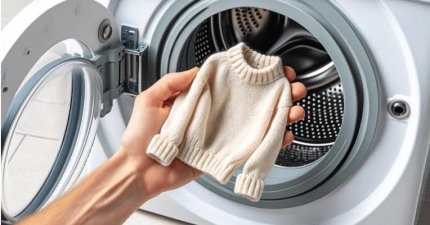
How to read a sweater label correctly
Care labels determine which treatments are allowed to be applied to the product.
The international organization GINETEX explains that the symbols set the boundary conditions for the processing of textile materials.
For example:
Basin with the number 30. Wash at a temperature not higher than 30 °C in a mode that corresponds to other markings.
Hand in basin. Hand washing.
Crossed out basin. Washing in water is prohibited.
Horizontal line under the pelvis. A softer mechanical effect is needed.
Tumble drying symbol crossed out. Tumble drying is prohibited.
Square with a horizontal line. Horizontal drying designation.
You also need to check the manufacturer's text instructions.
For example, a sweater may be recommended to be washed in cold water, not wrung out, and to be dried flat.
These requirements should not be replaced by general advice for all wool items.
What laundry detergent will keep wool from pilling?
No detergent guarantees complete protection against shrinkage if the washing mode is not correct.
However, choosing the right product helps maintain the condition of the fibers.
Woolmark recommends mild neutral detergents designed for wool.
For cashmere, the Cashmere and Camel Hair Manufacturers Institute also recommends using appropriate delicate products.
Why regular powder isn't always suitable
Some all-purpose detergents contain ingredients designed for intensive cleaning of cotton and synthetic fabrics.
For wool, they may be a poor choice.
It is especially important to consider products that contain certain enzymes, in particular proteases, which can affect protein fibers.
Therefore, it is better to use a product whose packaging clearly states compatibility with wool or cashmere.
Can you bleach a wool sweater?
Woolmark warns against using both chlorine and oxygen bleaches on wool items.
They can negatively affect the fibers and color of the fabric.
You should not try to restore a sweater after shrinkage using strong stain removers.
These are different tasks that require different care methods.
Why does a sweater shrink after being put in the dryer?
A tumble dryer combines heating, drum movement, and gradual moisture removal.
For some knitwear, such conditions may lead to shrinkage or deformation.
Whirlpool explains that the temperature and mechanical impact of tumble drying can change the shape of wool materials.
However, not all wool products have the same restrictions.
Is there any wool that can be dried in a dryer?
Yes.
Woolmark notes that some certified products can be tumble dried at low temperatures or on a special setting.
However, this possibility must be confirmed by the labeling of the specific item.
If the label does not allow machine drying, a more careful option is to dry naturally horizontally.
There is no need to test the durability of an expensive cashmere sweater experimentally.
What to do if the sweater has stretched unevenly
Sometimes, after attempting to restore, the item does not become uniformly larger.
For example, the sleeves were lengthened, but the body remained short.
This means that the load was distributed unevenly or certain areas of the tissue have different capacities for deformation.
How to fix slight asymmetry
If the label allows for moisture, you can try to gently adjust the shape without pulling too hard.
To do this you need:
Lay out the sweater symmetrically.
Compare the length of the sleeves.
Identify the area that needs correction.
Carefully moisten the affected part.
Give the correct shape.
Dry horizontally.
Do not try to straighten a short sleeve by pulling sharply on the cuff.
This can distort the shape of the shoulder area and seam.
For significant deformity, professional evaluation is desirable.
Should I repeat the stretching procedure several times?
Re-hydration does not always improve the result.
If after the first careful attempt the dimensions have hardly changed, subsequent procedures can only put additional strain on the tissue.
This is especially true for cashmere and wool with signs of pilling.
There is no reason to believe that after five or ten soakings, the sweater will definitely return to its original size.
Additionally, repeated improper cleaning can accelerate thread wear.
Therefore, after an unsuccessful first attempt, it is advisable to re-evaluate the condition of the fibers rather than automatically increasing the temperature or tensile force.
When a sweater can no longer be returned to its original size
Heavily shed wool has the least chance of recovery.
Main signs:
The fabric has become extremely dense.
The knitting loops are almost indistinguishable.
The sweater has significantly lost its elasticity.
The material resembles felt.
The size has decreased very much.
The thickness and texture of the knitwear has changed.
In this condition, normal shaping will not return the fibers to their original arrangement.
Some products with irreversible shrinkage can be used for other household needs or recycled if their material and condition allow it.
But you shouldn't count on a full restoration of the original planting.
How often should you wash a wool and cashmere sweater?
The frequency of washing depends on the level of dirt, the intensity of wear and the manufacturer's recommendations.
Woolmark notes that wool items often do not need to be washed after each use.
If the sweater has no visible dirt, sometimes airing it out is enough.
But this does not mean that things should be worn for a long time without cleaning, regardless of their condition.
How to reduce the need for frequent washing
For everyday care it is useful:
Wear an appropriate base layer of clothing under the sweater.
Ventilate the product after use.
Treat small stains in a timely manner using an approved method.
Do not leave wet knitwear folded.
Keep the sweater clean and dry.
This way, you can reduce the number of complete washing cycles and, accordingly, the mechanical load on the material.
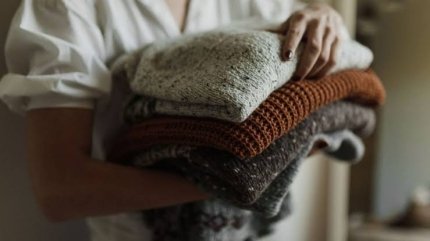
How to properly store sweaters so they don't lose their shape
For heavy knitwear, horizontal storage is often preferable to hanging.
If a sweater hangs on a hanger for a long time, the fabric can gradually stretch under its own weight.
This is especially noticeable on large woolen items.
The Cashmere and Camel Hair Manufacturers Institute recommends folding appropriate knitwear rather than storing it on regular hangers.
Before long-term storage, clothes should be cleaned and completely dried.
You shouldn't put a wet thing in the closet.
You should also avoid over-squeezing delicate knitwear.
The most common mistakes when repairing a sweater
1. Try to stretch dry fabric by force. This can damage the knitting loops and seams.
2. Soak the sweater in hot water. For sensitive wool, this can worsen shrinkage.
3. Use regular aggressive powder. Some components may be incompatible with delicate fibers.
4. Count on hair conditioner as a guaranteed solution. It does not eliminate irreversible frizz.
5. Wringing wet knitwear too hard will cause uneven load.
6. Pull the sweater only by the sleeves. It's easy to break the symmetry.
7. Dry on a radiator. Uneven heating can deform the fabric.
8. Use the iron with high pressure. High temperature and pressure can damage the material.
9. Hang a wet sweater on a hanger. It can stretch under its own weight.
10. Ignore the label. The same fiber composition does not guarantee the same care rules for all products.
Conclusion
If a sweater has shrunk after washing, the possibility of recovery depends primarily on whether the fiber structure has been preserved.
Minor deformation of wool, cashmere or cotton knitwear can sometimes be partially corrected by careful moistening, shaping and horizontal drying.
However, severe hair loss is an irreversible process. Neither hair conditioner, vinegar, nor re-soaking will guarantee the return of the original size.
The most important thing is not to try to stretch the item by force, to follow the label and to dry the knitwear correctly. This will help to maintain the shape of the sweater and avoid further damage to the fabric.
FAQ: Frequently asked questions about a sweater that shrunk after washing
1. Can a sweater be returned to its original size after washing?
Sometimes yes, if the shrinkage is minor and the fibers have not been permanently damaged. Careful wet shaping can help restore some of the dimensions. If the wool has become very loose, it is usually impossible to restore the original structure.
2. How to stretch a wool sweater that has shrunk?
If the label says hand wash, you can gently dampen the sweater in cool water, blot the excess moisture with a towel, and lay it out flat. Then, gently shape the fabric without pulling too hard.
3. Does hair conditioner help if a sweater has shrunk?
There is no reliable evidence that conditioner restores lost wool. It can leave foreign substances on the fabric and does not guarantee the return of size. For delicate knitwear, it is better to use products designed for the appropriate fibers.
4. Can a cashmere sweater be restored after shrinkage?
With minimal deformation and elasticity, careful wet shaping is possible if the label allows it. However, severe shrinkage of cashmere is usually irreversible, and excessive stretching can damage the item.
5. How to restore the shape of a cotton sweater?
Cotton knitwear sometimes partially recovers its shape after being moistened and gently straightened. The sweater should be dried horizontally without pulling too hard. Full recovery of dimensions is not guaranteed.
6. Why did the wool sweater shrink after washing at 30 degrees?
Temperature is not the only factor. For certain wool products, intense mechanical stress can be dangerous, even if the water is not too hot. The structure of the fibers, the detergent and the drying method also matter.
7. Can I stretch a sweater with a steam iron?
Steaming can sometimes help to adjust the shape of certain types of knitwear, but it will not restore heavily pilled wool. It should only be used with the manufacturer's permission and within temperature limits.
8. Can I wash a wool sweater in a washing machine?
Yes, if the label states so. Modern wool products may have special treatment for machine washing. For them, you need to use the appropriate mode, temperature and detergent.
9. Why shouldn't you dry a wool sweater on a hanger?
Wet wool retains a significant amount of water and becomes heavier. Under its own weight, knitwear can stretch unevenly, especially in the shoulder area. Therefore, horizontal drying is recommended for most wool sweaters.
10. How do you know that a dropped sweater can no longer be saved?
The main signs are a very dense and stiff fabric, almost invisible knitting loops, loss of elasticity and significant reduction in size. Once the material has become felt-like, restoring the original structure is usually impossible.

