
You wake up after a night with the air conditioner on with a dry throat, stuffy nose, or irritated eyes — and your first thought is, “I’ve been blown out.” In fact, the air conditioner itself does not cause a cold, flu, or other respiratory infection. Colds are caused by viruses, and sore throats can be caused by various infectious and non-infectious causes. However, there is a real connection between air conditioners and your well-being. Dry air, strong direct drafts, dirty filters, mold, poor ventilation, or excessive cooling of the room can cause dry mucous membranes, eye and throat irritation, worsen allergy symptoms, and create discomfort.
There is another side to the issue: during extreme heat, air conditioning protects health by helping to reduce the risk of overheating, heat exhaustion, and heat stroke.
Therefore, there is no need to be afraid of air conditioning. It is important to use it correctly.
Can you catch a cold from an air conditioner?
In a literal sense, no.
The common cold is a viral infection of the upper respiratory tract. It can be caused by rhinoviruses and many other respiratory viruses.
Cold air does not create the virus and cannot infect a person on its own.
Because of this scenario:
"I was sitting under the air conditioner - that's why I caught the virus"
not quite correct.
There may be several other explanations.
For example, a person was already infected, and symptoms simply appeared the next day.
Or spent a lot of time indoors with other people, where respiratory viruses are more easily transmitted due to insufficient ventilation.
Or the cold, dry air irritated the mucous membranes and created symptoms similar to the onset of a cold.
Therefore, it is necessary to distinguish between infection and irritation due to indoor conditions .
Why can your throat hurt after using air conditioning?
A dry or scratchy throat after a few hours in an air-conditioned room is quite possible.
One reason is the decrease in humidity.
During cooling, the air conditioner removes some of the water vapor from the air. This is why condensation is discharged from the indoor unit.
If the air becomes too dry, a person may experience:
dry nose;
sore throat;
dry mouth;
eye irritation;
discomfort when wearing contact lenses.
Studies of office spaces show a link between low humidity and such complaints, although additional humidification does not always completely eliminate symptoms.
Allergens, dust, nasal diseases, mouth breathing, and time spent indoors also have an impact.
1. Don't turn your room into a refrigerator
One of the most common mistakes is returning from outside when it's +34°C and immediately setting the air conditioner to the minimum temperature.
This does not speed up the cooling of many models as much as it seems: the device simply runs longer at high power.
Excessive cooling can create:
feeling cold;
discomfort;
dryness;
unpleasant sensations from a strong flow of air.
There is no universal medical formula like "the difference between the street and the room should be exactly 5 or 7 degrees."
It is better to focus on a comfortable temperature without feeling cold.
During extreme heat, the World Health Organization recommends setting your air conditioner to around 27°C, with a fan if necessary, as one option. This is a recommendation for safe cooling during hot weather, not a universal temperature for every apartment.
There is no need to strive to get 18 °C in the room just because the air conditioner allows it.
2. Do not direct the strong stream directly at the face
If cold, dry air blows directly into the face for hours, the evaporation of moisture from the surface of the eyes and mucous membranes can increase.
This is especially noticeable during sleep, when the body position does not change for several hours.
It is better to direct the blinds:
above;
away from the bed;
so that the air is distributed throughout the room.
The automatic blind movement mode is also useful.
This also applies to the workplace. If your desk is directly under an air conditioner, sometimes just changing the direction of the air flow can help reduce dry eyes and the feeling of cold.
3. Control humidity, don't guess at it
According to recommendations for indoor air quality, a comfortable guideline is a relative humidity of approximately 30–50% .
Humidity above 60% can already contribute to:
the appearance of condensation;
mold growth;
dust mite reproduction.
Excessively dry air, in turn, can increase the feeling of dryness in the eyes, nose, and throat.
The simplest solution is an inexpensive hygrometer.
This way you will see real numbers instead of assumptions.
Should I turn on the humidifier along with the air conditioner?
Not automatically.
If the room has 45% humidity, there is no need to humidify it further.
If the reading drops below a comfortable level and dryness appears, a humidifier can help.
But it needs to be cleaned regularly according to the manufacturer's instructions. A dirty tank can itself become a source of microorganisms.
The task is to maintain normal humidity, not create the tropics in the room.
4. Clean filters on schedule
The indoor unit of the air conditioner constantly passes air through it.
The following gradually accumulate on the filters:
dust;
animal hair;
skin particles;
pollen;
other pollution.
If the system is not maintained for a long time, air quality may deteriorate.
This is especially important for people with:
allergic rhinitis;
asthma;
increased sensitivity to dust.
There is no one universal rule of "clean the filter every two weeks" for all air conditioners.
The frequency depends on:
models;
intensity of use;
amount of dust;
the presence of animals;
manufacturer's requirements.
Therefore, the basic rule should be the instructions for a specific device.
When working actively in a dusty room, you will have to check the filters more often.
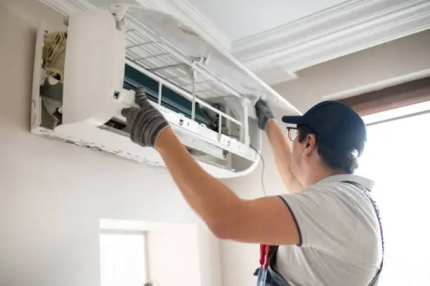
5. Don't forget about drainage and the indoor unit
The filter is only part of the system.
Condensation forms inside the air conditioner during operation. It should drain normally through the drain.
If water constantly remains inside or the drainage tray becomes contaminated, favorable conditions arise for microorganisms and mold.
Signs that the air conditioner needs maintenance:
musty smell after turning on;
the smell of mold;
water is dripping from the indoor unit;
airflow has noticeably deteriorated;
visible dirt or mold;
the system is unusually noisy;
Filters quickly become covered with a thick layer of dust.
In such a situation, simply wiping the outer panel is not enough.
A complete cleaning or maintenance is required.
6. Air conditioning does not replace ventilation
This is a critically important point.
Most conventional wall-mounted split systems do not supply fresh air from the outside .
They take air from the room, cool it, and return it.
Therefore, an air conditioner may make a room cool, but the level of carbon dioxide and some pollutants will continue to increase.
Particles emitted by people, materials, furniture, and household chemicals also remain in the room.
Therefore, separate ventilation is required:
ventilation when the outside air is clean and the temperature allows;
supply ventilation;
the centralized ventilation system is properly configured.
This is especially important in rooms where there are many people.
Can air conditioning spread viruses?
The air conditioner itself does not produce viruses.
But respiratory infections are more easily transmitted in closed spaces where people are close to each other and there is not enough fresh air.
That is why ventilation remains important even when the air conditioner is running.
Centralized ventilation and air conditioning systems can use filtration and supply outside air - it depends on the design of the system.
A typical home split system mostly just mixes the air within a single room.
Therefore, the logic is:
"The air conditioner is on - so there's no need to ventilate"
wrong.
Can air conditioning make allergies worse?
Both scenarios are possible.
A clean air conditioner can help
During pollen season, closed windows and air filtration can reduce the amount of outdoor allergens indoors.
Cooling also reduces humidity, and excess humidity creates better conditions for mold and dust mites.
A dirty system can worsen symptoms
If the system has accumulated:
dust;
mold;
other biological pollutants,
they can become airborne.
In sensitive people, this can provoke:
nasal congestion;
sneeze;
cough;
eye irritation;
asthma exacerbation.
If symptoms recur in a specific room, it is worth checking the air quality and condition of the air conditioner.
Air conditioning and asthma: good or bad?
Air conditioning itself is not automatically harmful to a person with asthma.
Controlling temperature and humidity sometimes even improves indoor conditions.
Problems arise if the system:
contaminated;
spreads dust or mold;
creates very cold air, which provokes bronchospasm in a particular person;
operates without sufficient room ventilation.
It is important for people with asthma to keep their system clean and follow their own treatment plan.
If you regularly experience wheezing, coughing, or shortness of breath after turning on the air conditioner, you should discuss this with your doctor.
Why does air conditioning dry out your eyes?
The surface of the eye is covered with a thin tear film.
Airflow and low humidity can increase tear fluid evaporation.
The problem becomes especially noticeable in people who:
work at a computer;
blink less often due to concentration on the screen;
use contact lenses;
already have dry eye syndrome.
In this case, it helps:
divert the air flow away from the face;
check humidity;
take breaks from the screen;
blink more often;
If symptoms persist, consult an ophthalmologist.
It is not worth explaining constant eye redness with air conditioner alone.
Is it safe to sleep with the air conditioner on all night?
Yes, if the system is properly configured and maintained.
There is no medical requirement to turn off the air conditioner an hour after falling asleep.
During periods of extreme heat, maintaining a comfortable temperature at night can even be important for health and normal sleep.
Particularly vulnerable to overheating are:
small children;
elderly people;
pregnant;
people with cardiovascular diseases;
people with lung diseases;
people with kidney disease and other chronic conditions.
It is much more important to adhere to several principles:
do not overcool the bedroom;
do not direct a strong stream at the head and face;
control humidity;
clean the system;
provide ventilation.
A timer or night mode can be used for comfort and energy saving, but they are not a prerequisite for safe sleep.
Air conditioning in the children's room: is it possible or not?
The mere fact of using an air conditioner in a child's room is not dangerous.
In extreme heat, overheating can pose a much greater threat.
The basic rules are the same:
comfortable temperature;
lack of strong direct flow;
clean filters;
normal humidity;
fresh air;
clothing according to the room temperature.
There is no need to swaddle your baby just because the air conditioner is running.
When it comes to an infant, it is especially important to avoid overheating and follow your pediatrician's recommendations for safe sleep.
Can air conditioning cause pneumonia?
Home air conditioning is not a common cause of pneumonia.
It is worth mentioning legionellosis separately, a bacterial infection that is often discussed in the context of air conditioning.
Legionella bacteria can multiply in water systems and spread with small water droplets.
Typical sources are:
cooling towers of large cooling systems;
whirlpool baths;
decorative fountains;
complex building water supply systems.
But common home and car air conditioners do not use water to cool the air in this way and are not considered a source of Legionella breeding .
Therefore, the phrase "you can get Legionella from a home split system" is usually incorrect.
This does not eliminate the need to clean the system of dust and mold.
Is a sudden transition from heat to cold harmful?
Going from +35°C to a very cold room can be unpleasant.
Skin vessels react to changes in temperature, and the body changes its heat dissipation mechanisms.
A person may feel:
chills;
cold;
discomfort;
headache;
muscle tension.
But this does not mean that a temperature difference automatically causes a viral infection.
A healthy body tends to adapt to temperature changes.
It is more practical to avoid extremes: do not cool the room more than is necessary for normal well-being.

8 rules for safe use of air conditioners
To benefit from cooling without unnecessary discomfort, a simple algorithm is enough.
1. Do not set the minimum temperature unnecessarily.
Cool the room to a comfortable level.
2. Direct the flow away from people.
Especially from the face, desk, and bed.
3. Control humidity.
A guideline for a home is approximately 30–50%.
4. Check filters regularly.
Clean or replace them according to the manufacturer's instructions.
5. Monitor drainage.
Water, an unpleasant odor, or visible mold are reasons for service.
6. Don't forget about ventilation.
Air conditioning and fresh air supply are different processes.
7. Don't turn off the air conditioner for fear of catching a "cold" during dangerously hot weather.
Overheating poses a real health risk.
8. Don't blame all symptoms on the air conditioner.
Fever, severe sore throat, or severe shortness of breath require another explanation.
7 popular myths about air conditioning
Myth 1. Air conditioning causes colds
Colds are caused by viruses. Air conditioning can create dryness and irritation that sometimes resembles the first symptoms of an infection.
Myth 2. You can't sleep with the air conditioner on.
It is possible. The main thing is a comfortable temperature, a clean system, and the absence of a strong flow directly on the person.
Myth 3. The colder the better the cooling
Minimum temperature does not mean optimal conditions for health or comfort.
Myth 4. Air conditioning provides fresh air
Most household split systems simply recirculate the air in the room.
Myth 5. Air conditioning will definitely cause a sore throat
No. A sore throat after a night with air conditioning can be a result of dryness, but infectious sore throats are caused by pathogens.
Myth 6. You should always leave the humidifier on.
No. First, measure the humidity. Too much humidity promotes mold growth.
Myth 7. Home air conditioning is a typical source of legionellosis
No. The risk of Legionella is primarily associated with water systems and cooling towers, not with conventional home or car air conditioners.
When a sore throat is more than just dry air
Irritation from air conditioning is usually mild and subsides after leaving the room, normalizing the humidity, and stopping the direct airflow.
You should not automatically blame the air conditioner if you experience:
high temperature;
severe sore throat;
severe weakness;
enlarged or painful lymph nodes;
rash;
significant difficulty swallowing;
difficulty breathing;
wheezing;
symptoms that are noticeably worsening or persist for a long time.
The cause may be a viral or bacterial infection, allergies, asthma, or another condition that requires proper diagnosis.
Conclusion
Air conditioning is not an enemy of health and does not cause colds in itself. When used correctly, it creates comfortable conditions indoors, and during extreme heat helps protect against dangerous overheating.
Problems often arise due to improper operation: excessive cooling, direct air flow, too low humidity, dirty filters, mold, or lack of proper ventilation.
Therefore, the best strategy is simple: maintain a comfortable temperature, control humidity, maintain the system in a timely manner, and remember that cool air and fresh air are not the same thing.
Important: the material is for informational and educational purposes only and does not constitute medical advice, diagnosis or treatment recommendations. Self-medication can be harmful to health. If sore throat, cough, shortness of breath, fever, allergy symptoms or other complaints are severe, recurring or worsening, be sure to consult a doctor first.
FAQ
Can you catch a cold from air conditioning?
Air conditioning itself does not cause colds, as colds are caused by viruses. However, the cold, dry air can irritate the mucous membranes and cause a dry or scratchy throat.
Why does my throat hurt after using air conditioning?
The most common possible causes are dry air, strong drafts in the face, mouth breathing, dust, allergens, or contamination of the system. However, a sore throat can coincide with the onset of a true infection.
What temperature should I set on the air conditioner?
There is no single medical number that fits all. It is necessary to maintain a comfortable temperature without excessive cooling. During extreme heat, the WHO recommends around 27 °C as one option, with the additional use of a fan.
What humidity should be in an air-conditioned room?
A practical guideline for a residential space is approximately 30–50% relative humidity. Much higher humidity can promote mold growth.
Can I leave the air conditioner on all night?
Yes, if the temperature is comfortable, the air flow is not directed directly at the person, the system is clean and working properly.
How often should you clean your air conditioner?
There is no universal term for all models. Filters and the system should be maintained according to the manufacturer's instructions, taking into account the intensity of work, the amount of dust and the presence of pets.
Do I need to ventilate the room if the air conditioner is running?
Yes, if your system does not have a separate supply ventilation function. Most domestic split systems cool the air inside the room, but do not supply enough fresh outside air.
Can air conditioning make asthma or allergies worse?
Maybe if the system is contaminated with dust or mold. At the same time, clean air conditioning and filtration can reduce pollen from outside and control excessive humidity.
Can I use air conditioning in my child's room?
Yes. It is important to avoid overheating, strong direct current, excessive cooling, and to monitor the cleanliness of the system and air humidity.
Can you get legionellosis from a home air conditioner?
Conventional home and car air conditioners are not considered a typical source of Legionella because they do not use water to cool the air in the same way that water cooling towers in large centralized systems do.

