

Small carrots in September do not always mean a failed harvest. If the plants are still green, the roots are elastic, the soil is not overmoistened and there is still time before stable frosts, the bed can still be “tightened” with proper care. Most often, carrots lack two things: uniform moisture and space between the plants.
Points of attention
- Carrots best form smooth root crops in light, well-drained soil.
- Carrots need good soil moisture for quality and size.
- Late and mid-season varieties, especially those sown late, may continue to flower in early fall.
But in the fall, it's easy to do harm. Abundant watering after a long drought can cause root crops to crack, late nitrogen fertilization can cause a shoot to grow instead of a root, and rough thinning can damage neighboring plants. Therefore, in September, it's important not to "disperse" carrots at any cost, but to assess the condition of the bed and act carefully.
Carrots grow best in light, well-drained soil, but overwatering, lack of water, heavy or rocky soil, and excess nitrogen can lead to small, branched, or deformed roots. The University of Minnesota notes that carrots need good soil moisture for quality and size, and that if they are not watered, the roots can be bitter, tough, fibrous, deformed, and small.
Can carrots still grow in September?
Yes, maybe, if the variety has not yet completed its growing season. Carrots do not grow “according to the calendar” in the same way on all beds. The size is affected by the sowing date, variety, density, soil structure, amount of moisture, temperature, lighting and previous care.
Early carrots sown in spring usually don’t need to be left in the ground for long if they’ve reached their full size or are starting to get coarse. And late and mid-season varieties, especially those sown late, can continue to produce into early autumn. The RHS says carrots are usually ready to harvest around 12-16 weeks after sowing, with the main varieties available for harvest in summer and early autumn.
Focus on the condition of the plants. If the top is alive, green, without mass wilting, and the root crop is already forming, you can give the bed a little more time. If the carrots are very thin, the sowing was very late, the nights are cold, and the leaves are turning yellow and falling, you should not expect a sharp increase in size.
Why do carrots stay small?
Small root crops have several typical causes. They often overlap: carrots were sown thickly, the soil dried out, weeds took up moisture, and then the bed was suddenly flooded with water.
The most common reasons:
thickened sowing;
uneven watering;
prolonged drought;
heavy, rocky or compacted soil;
weeds in the rows;
excess nitrogen fertilizers;
late sowing;
variety with a short or small root crop;
root damage at an early stage;
shading the bed;
pests or diseases.
The University of Minnesota explains: If plants have a healthy green top but poor root development, the cause is often overcrowding; excessive nitrogen fertilizer can also produce a lot of leaves at the expense of root growth.
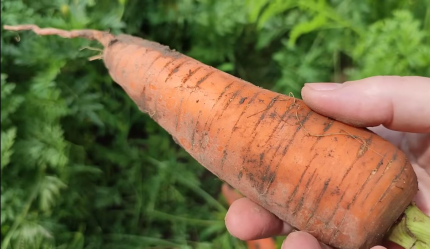
How to check if carrots need watering
In September, you can’t water carrots according to the habit of “a little every day.” The top layer of the soil may seem dry, but there is still moisture below. Or it may be the other way around: after a short rain, the surface is wet, but the root zone remains dry.
The easiest test is to dig a small hole at the side of the row to a depth of about 10–15 cm. If the soil at this depth crumbles into dust and does not hold its shape, the carrots are lacking water. If the soil is cool, moist, and clumps easily, additional watering is not necessary.
The University of Minnesota recommends checking the depth of the soil with a trowel: if the soil is only 2–5 cm wet, watering should continue. For carrots and parsnips, a guideline is also given: if there is no rain of about one inch per week, it is worth using irrigation.
How to properly water carrots in September
The goal of autumn watering is not to flood the bed, but to stabilize moisture in the root zone. Carrots prefer less frequent, but deeper watering than frequent surface wetting.
The RHS notes that carrots are generally drought tolerant, but during long dry spells they benefit from a good soaking about once every two weeks to keep growth even; large fluctuations in humidity can cause the roots to crack.
Practical scheme for September:
after rain, do not water until the soil in the root zone is moist;
in dry weather, water less often, but so that the water reaches the root crops;
do not pour water with a strong stream on the rows;
it is better to water in the morning or evening;
after a long drought, do not immediately give excessive amounts of water;
Reduce watering 1–2 weeks before the planned harvest, unless there is a severe drought.
Sandy soils drain faster, so watering can be done more often. Heavy clay soils hold excess water longer, so it's important not to create waterlogging. The University of Minnesota recommends watering deeply once a week on heavier soils and twice a week on sandy soils; one inch of water can moisten heavy clay soil about 6 inches (15 cm) deep, and sandy soil about 10 inches (25 cm).
Why do carrots crack after watering?
Cracking often occurs after a sudden change in conditions. The root crop grew for a long time in dry soil, the outer tissues became less elastic, and then after abundant watering or a heavy downpour, the inner part quickly absorbed water. As a result, the root breaks.
This is especially annoying in September: the carrots are almost ready, but after one improper watering, part of the crop loses its marketable appearance and is stored worse. It is better to use cracked root crops first, because they dry out faster and can rot.
To reduce the risk:
do not allow the bed to dry out completely;
do not immediately fill dry soil with a large volume of water;
maintain uniform humidity;
mulch the row spacing with a thin layer of organic matter after watering or rain;
Harvest ripe carrots on time, without keeping them in the ground because of excessive size.
RHS directly links root cracking to severe fluctuations in humidity, so a stable regime is more important than a one-time “shock” watering.
Do you need to thin out carrots in September?
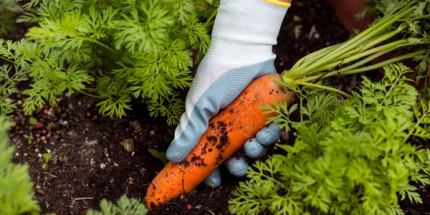
If the carrots are growing thickly, thinning can help, but be careful. By September, the roots of neighboring plants may be intertwined. If you abruptly pull large plants out of the dry soil, you can damage the remaining ones.
The RHS advises thinning carrots to aim for 5–7.5cm between plants, while the University of Minnesota recommends leaving around 5–10cm, depending on the size of the variety.
In September, it is better not to pull everything out at once. First, choose the most densely packed places where the carrots stand “like a brush”. Remove the weakest, thinnest, crooked or excess roots. If the soil is dry, it is worth slightly moistening it a few hours before work so that the plants emerge more easily.
A good way is not to pull out neighboring carrots by force, but to cut off the excess top near the soil surface with scissors. This way, the root will remain in the ground and gradually die, and neighboring plants will not be mechanically damaged. This method is not always suitable if you need to free up physical space, but it is safer in dense rows.
How to thin out to avoid attracting carrot flies
Carrot flies respond to the smell of damaged leaves and roots, so thinning, weeding, and rough handling of the tops can increase the risk of infestation, especially if the pest is active in your area.
The RHS warns that carrot fly larvae can damage root crops by gnawing through the holes, and when weeding, avoid touching the leaves too much, as the smell attracts the pest. The RHS says that covering the entire crop with insect netting is effective for protection.
After thinning:
immediately remove uprooted plants from the bed;
do not leave a top in the rows;
Lightly compact the soil around the remaining plants;
water the bed moderately if the soil is dry;
if possible, cover the rows with agrofibre or netting;
Do not thin out in hot weather or strong winds.
The best time is evening or a cloudy day. This way the plants will wilt less and the smell of the damaged tip will spread less.
Is it necessary to feed small carrots in the fall?
Not always. If the carrots are small due to compaction, drought, or dense soil, fertilizer will not solve the problem. And late nitrogen fertilization can worsen keeping quality and direct the plant's energy into the leaves.
The University of Minnesota notes that excess nitrogen fertilizer promotes leaf growth at the expense of root development. Therefore, in September, you should not use fresh manure, chicken droppings, a lot of urea or ammonium nitrate. Such top dressing is appropriate not at the end of the season, but in a well-thought-out feeding system before or at the beginning of active growth.
If the soil is poor and the carrots are still actively growing, you can consider a mild potassium-phosphorus top dressing. But the dosage should be moderate, without experiments “by eye”. In a home garden, it is often safer to limit yourself to watering, thinning, weeding and mulching than to try to dramatically increase the number of root crops in a few weeks with fertilizers.
What to do with weeds
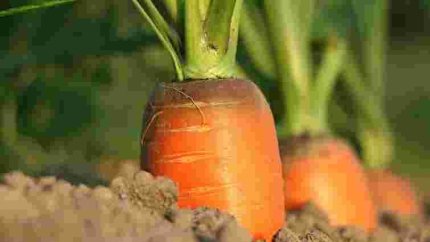
Weeds take water, light, and nutrients from carrots. They may seem like a minor problem in September, as the season is almost over, but in dense beds, even short grass impairs aeration and traps excess moisture near the top.
The RHS notes that fast-growing weeds can crowd out carrots, and that row spacing should be done carefully to avoid damaging the top of the root ball. The University of Minnesota also recommends cultivating the soil shallowly to cut weeds below the surface without damaging the plants.
In practice, this means: it is better to weed by hand near the rows, and very shallowly with a hoe between the rows. Deep loosening near carrots in the fall is dangerous: you can cut or expose the root crops.
Will mulch help?
Mulch can help if September is dry or if the soil crusts over quickly after watering. It reduces evaporation, suppresses weeds, and helps maintain more even moisture.
The RHS advises mulching the soil under edible crops after watering or rain with a 5–7.5cm layer of organic matter to retain moisture and suppress weeds. For carrots, the layer around the rows should be neat: do not cover the top or create a wet “blanket” close to the plants.
Suitable:
dry chopped grass without seeds;
straw;
rotted compost in a thin layer between the rows;
crushed dry leaves;
Agrofibre for temporary cover.
Do not use fresh, thick grass mulch, which will clump, heat up, and become acidic. In rainy September, it is better not to add mulch or to make it very thin so as not to provoke rot.
When is it better to dig up carrots?
It is not always worth leaving small carrots in the ground. If they have reached an edible size, but the forecast promises prolonged rains, waterlogging or frosts, it is better to harvest part of the crop. This is especially true for heavy soils, where water stands for a long time after rain.
OSU Extension notes that carrots can be harvested when the top of the root, the “shoulder,” is about 1/2 inch or more, and they are easier to dig out of moist soil after loosening the soil with a spade or pitchfork.
Signals to collect:
the root crop is already suitable for eating;
the tip began to turn yellow en masse;
the soil is constantly wet;
the roots are cracking;
severe frosts are expected;
there are signs of rot or pest damage on the bed;
The variety is early and already overripe.
Don't wait for "giant" carrots. The RHS advises harvesting carrots when they are large enough to use, as going for the biggest roots can compromise the taste.
How to dig up carrots so they don't break
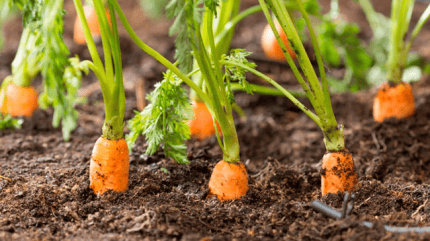
In September, the ground can be dense after the heat or heavy after the rains. If you simply pull on the top, the root crop will break easily, especially in long varieties.
The University of Minnesota recommends watering the bed the day before harvesting or digging after a rain, then inserting a garden fork into the soil near the plant, moving the root to the side to loosen it, and only then pulling it out; simply pulling without loosening it can break the root.
After harvesting, do not beat the carrots together to knock the soil off. This creates micro-damages that make storage worse. It is better to gently shake off the soil, cut off the top and divide the harvest: whole, healthy carrots for storage, damaged and cracked ones for quick use.
How to store carrots after harvesting
For long-term storage, it is important to remove the top quickly. The leaves continue to draw moisture from the root, causing the carrots to wilt more quickly.
Iowa State University Extension recommends cutting the green part 1/2 to 1 inch above the root after harvesting; small quantities can be stored in perforated plastic bags in the refrigerator, and larger quantities can be stored in sand or sawdust in a cool, moist place.
For winter storage, the optimal conditions are very cool and humid. Iowa State University Extension suggests temperatures of 32–35°F and relative humidity of 98–100%; under the right conditions, carrots can be stored for an average of 4–6 months, but at temperatures of 40°F and above, they are more likely to sprout or spoil.
An apartment often doesn't have ideal conditions, so it's better to store part of the harvest in the refrigerator, and the rest to process, freeze, or use first.
What to do now: a quick plan for September
Inspect the bed and dig up a few control carrots from different spots. This will help you understand whether the problem is throughout the area or just in dense or dry areas.
Then act according to the situation:
If the soil is dry at the root level, water deeply, but do not overwater.
If the carrots are growing very densely, carefully thin out the densest areas.
If there are a lot of weeds, remove them with your hands near the rows.
If the soil dries out quickly, mulch the rows after watering.
If the top is lush and the root is small, do not add nitrogen.
If the carrots are already edible, harvest them in parts.
If prolonged rains are forecast, do not over-plant the crop in heavy soil.
If there are cracks or rot, use the damaged carrots first.
Typical mistakes of gardeners
The first mistake is to water frequently and superficially. The water only moistens the top layer, and the roots do not receive stable moisture.
The second mistake is to suddenly water a dry bed. This can cause cracks.
The third mistake is to leave the carrots in the thickening. The plants compete with each other, and the root crops do not reach normal size.
The fourth mistake is to apply nitrogen fertilizers in the fall. Excess nitrogen stimulates the leaves, not the roots.
The fifth mistake is to roughly thin out a dry row. This is how you can easily damage neighboring roots.
The sixth mistake is not taking the variety into account. Short-fruited varieties will not become long, and carrots sown late may not have time to reach their maximum size.
The seventh mistake is keeping the crop in wet soil for too long. In heavy soil, this can result in rot or cracking.
Conclusion
If the carrots are still small in September, start not with fertilizers, but with diagnostics. Check the sowing density, soil moisture at the root depth, the presence of weeds, the condition of the tops and the weather forecast. In many cases, the harvest can still be improved: give uniform deep watering, carefully thin out thickened areas, remove weeds and protect the soil from drying out quickly.
At the same time, you shouldn't expect the impossible. Late sowing, heavy, compacted soil, excess nitrogen, or a variety with a small root crop cannot be corrected in a few weeks. The task of September is to help carrots grow as much as their conditions allow, and not to spoil what has already formed.
The best tactic is gentle care without extremes: do not overwater, do not overdry, do not apply nitrogen, do not injure the roots, and do not overexpose the crop in cold, wet soil.
FAQ
Why are carrots small in September?
The most common causes are overcrowded planting, lack of moisture, weeds, heavy or rocky soil, late planting, poor variety, or excess nitrogen. The University of Minnesota notes that with healthy shoots and poor root development, overcrowded planting is often the cause, and excess nitrogen promotes leaf growth to the detriment of the root crop.
Will carrots still grow in September?
It can be grown if the variety is not yet fully grown, the top is green, the roots are healthy and the weather allows for the bed to be left in place for a while. The RHS states that carrots are usually ready to harvest 12-16 weeks after sowing, with the main varieties being harvested in summer and early autumn.
How often should you water carrots in September?
Not by the calendar, but by the moisture content of the soil. If the soil is dry at the root level, a deep watering is needed. If the soil is wet after rain, additional water can be detrimental. The RHS advises giving carrots a good soaking during long dry spells, rather than maintaining sudden fluctuations in moisture.
Is it possible to thin out carrots in the fall?
You can if it is growing too densely, but you have to do it carefully. The RHS recommends leaving 2–3 inches (5–7.5 cm) between plants, and the University of Minnesota recommends about 2–4 inches (5–10 cm), depending on the variety. In September, it is best to remove the weakest plants and not pull the row roughly.
How to feed small carrots in September?
In many cases, fertilizing is not necessary. First, correct watering, compaction, and weeds. It is better not to apply nitrogen fertilizers in the fall, because excess nitrogen can stimulate the top instead of the root.
Why do carrots crack in the ground?
This is most often due to uneven moisture: the soil has been left dry for a long time, then received a lot of water after a rain or heavy watering. The RHS notes that carrot roots can crack if moisture levels fluctuate greatly.
When to dig up carrots in the fall?
Carrots can be harvested when they are of edible size. OSU Extension recommends aiming for a “shoulder” of about 1/2 inch or more. If prolonged rains are forecast, severe cold snaps, or the soil is soggy, it’s best to wait until harvest time.
Do you need to water carrots before digging them up?
If the soil is dry and hard, a light watering the day before will make harvesting easier. The University of Minnesota recommends watering the bed the day before harvesting or digging after a rain so that the roots are moist and less likely to break.
How to store carrots after harvesting?
After harvesting, the tops should be cut off to prevent the roots from losing moisture. Iowa State University Extension recommends cutting the greens 1/2 to 1 inch above the root, and for long-term storage, keep the carrots in a cool, moist place; under the right conditions, they can last 4 to 6 months.
Can I leave carrots in the ground until winter?
In some conditions, carrots can be left in the ground and gradually dug up, but this is not suitable for every site. The RHS notes that at the end of the season, carrots can be left in the ground, covered with straw or cardboard to protect against frost, but if the ground becomes waterlogged in winter, it is better to dig up and store the crop separately.

