
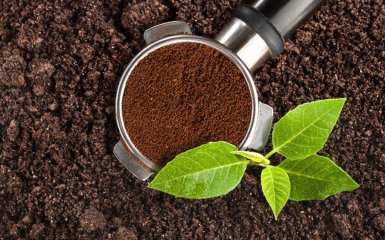
Coffee grounds can be beneficial for plants, but they should not be considered a universal fertilizer for all flowerpots, beds and lawns. They contain organic matter, small amounts of nitrogen, phosphorus, potassium, magnesium and trace elements, can improve soil structure and work well in compost. Problems begin when they are poured into a thick layer in a pot, added to seedlings, used in place of a full-fledged fertilizer or tried to “acidify” the soil with it without checking the pH.
The safest way to use coffee grounds is to add them to your compost pile along with dry leaves, shredded cardboard, grass clippings, and other organic debris. Oregon State University Extension notes that used coffee grounds can be valuable to your garden and compost pile if used sparingly; however, too much can harm plants, inhibit seed germination, and temporarily fix nitrogen in the soil.
This article explains what coffee grounds do for plants, who they are suitable for, why it is better to compost them, how not to spoil the soil in pots, and what common advice from the Internet should be avoided.
What's in coffee grounds?
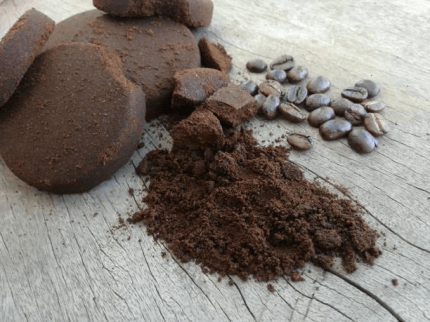
Used coffee grounds are the organic residue left over from brewing coffee. They contain parts of the plant material, small doses of nutrients, organic compounds, residual caffeine, polyphenols, and small particles that gradually decompose in the soil.
Oregon State University Extension states that coffee grounds contain about 1–2% nitrogen, small amounts of phosphorus, potassium, calcium, magnesium, iron, copper, manganese, and zinc, but are not a significant source of plant nutrition. Its primary benefits are more related to soil structure, drainage, and the activity of soil microorganisms.
Therefore, coffee grounds are more of a soil improver and compost component than a replacement for complex fertilizer. If a plant is deficient in nitrogen, potassium, iron, or magnesium, coffee grounds will not solve the problem quickly and accurately. To do this, it is better to test the soil, assess the symptoms, and select the appropriate fertilizer.
Why coffee grounds are not a “magic fertilizer”
A popular myth is that coffee grounds are rich in nitrogen, so they can be sprinkled under almost all plants. In fact, the nitrogen in them does not work as quickly as in mineral or well-rotted organic fertilizer. Nutrients become available gradually, after the decomposition of organic matter by microorganisms.
There is another nuance. When fresh manure is added directly to the soil, microorganisms can temporarily use the available nitrogen for their own growth. Because of this, plants receive less nitrogen for a certain time, not more. That is why an excess of manure in a pot or on a bed can have the opposite effect: the plant slows down, the leaves turn pale, and the seedlings develop weaker.
A study of the effects of espresso residue as a nitrogen supplement showed reduced germination and growth of crop plants, as well as immobilization of nitrogen and phosphorus; the authors suggested that this may be due to the properties of the residue itself or the presence of caffeine.
Do coffee grounds acidify the soil?
Another common myth is that coffee grounds are good for acidifying the soil for hydrangeas, azaleas, rhododendrons, blueberries, and camellias. The logic is clear: coffee tastes sour, so the grounds should make the soil more acidic. But after brewing, the situation is different.
The Oregon State University Extension explains that used coffee grounds are near neutral after brewing, around pH 6.5–6.8, and any effect on soil pH is minor and temporary; therefore, they are not able to reliably lower the acidity to the level needed by acid-loving plants. The University of Maine Cooperative Extension also notes that coffee grounds have a neutral pH range of 6.5–6.8, so they are not an effective way to lower soil pH.
If your plant truly needs acidic soil, test the pH first. Use a special soil mix, elemental sulfur, or other professional materials to correct acidity, as recommended for your specific crop. The University of Illinois Extension recommends using elemental sulfur, not coffee grounds, to lower pH.
The best way: add the pulp to the compost
Composting is the smartest way to dispose of coffee grounds. In a compost pile, they mix with other materials, gradually decompose, lose some of their potentially problematic properties, and become part of a more stable organic fertilizer.
The EPA classifies coffee grounds as a “green” compost material, a source of nitrogen, and recommends a ratio of two to three parts carbon-rich “brown” materials to one part “green.” Dry leaves, shredded cardboard, straw, unprocessed sawdust, or small twigs help balance the moist coffee grounds and prevent the compost from turning into a dense, acidic ball.
Oregon State University Extension recommends mixing three parts leaves, one part fresh grass, and one part coffee grounds by volume in your compost pile; the proportion of grounds should not exceed 20% of the total volume of the pile, as more can be toxic to plants.
How to add coffee grounds to compost
Don't pour a bucket of wet slurry into the compost in one dense layer. It clumps together, doesn't let air through well, and can mold on the surface. It's better to spread it thinly and mix it in with the dry materials right away.
Practical algorithm:
Collect the used grounds after coffee.
If possible, dry it a little or mix it with dry leaves.
Add to the compost in a thin layer.
Mix with the “brown” materials.
Make sure the compost is moist but not wet.
Stir the pile once a week or as needed.
Use the finished compost after it has completely decomposed.
Paper coffee filters without plastic elements can also be composted. The EPA specifically includes coffee grounds and paper filters as materials suitable for home composting.
Can I pour coffee grounds directly into the soil?
You can, but be very careful. Direct addition is not suitable for all situations and should definitely not turn into regular filling of the pot with a thick layer.
Oregon State University Extension recommends that when using coffee grounds as a soil amendment, apply a layer of about 1.25 cm and work it into the soil to a depth of about 10 cm. If using it as mulch, cover it with leaves or bark to prevent the surface from drying out and becoming a water-repellent barrier.
The University of Illinois Extension warns that too thick a layer of coffee grounds can reduce water infiltration and create a water-repellent layer. This is especially dangerous in pots, where the volume of soil is small and the roots react quickly to lack of air and uneven moisture.
A safer rule for home use is not to pour the slurry “top-full” on top, but to add just a little, mixing it with soil or compost.
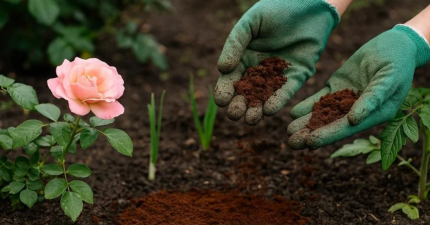
Coffee grounds for houseplants
Houseplants are more likely to suffer from too much coffee grounds than from too little. There is little soil in the pot, limited ventilation, a different watering regime, and a higher chance of mold. If you pour wet grounds on the surface, they can clump, not drain well, attract midges, and create an unpleasant odor.
For flowerpots, it is better to use not fresh pulp, but a small amount of well-rotted compost, where coffee grounds were only one of the components. If you still want to try it directly, take dry pulp, add literally a pinch to the top layer of soil and observe the plant.
Do not add coffee grounds to pots with cacti, succulents, plants in heavy, waterlogged soil, newly repotted pots, weak roots, or seedlings. The University of Maine Cooperative Extension emphasizes that coffee grounds contain only small amounts of nutrients and work best as a mild soil conditioner or compost component.
Coffee grounds for the garden
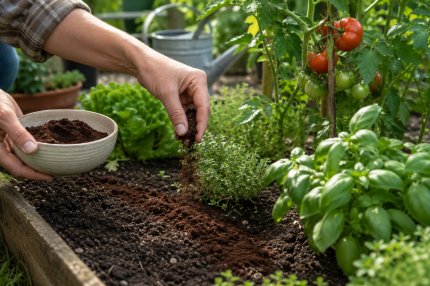
In the garden, coffee grounds can be useful as part of compost, which is then added to vegetables. This is safer than pouring fresh grounds into seed holes or under young seedlings.
Particular care should be taken with seedlings, carrots, lettuce, radishes, cucumbers, early-stage tomatoes, and any crops that are just starting to germinate. Residual caffeine, polyphenols, and the active decomposition process can inhibit germination or slow the development of young plants. A review of research on used coffee grounds as a soil amendment notes that many studies link direct application of raw grounds to the risk of growth inhibition due to phytotoxic substances, particularly caffeine and phenolic compounds, as well as nitrogen fixation.
For garden beds, it is better to use the following scheme:
coffee grounds - in compost;
ready compost - into the soil before planting or as a mulch layer;
mineral or organic fertilization - according to the needs of the crop;
pH and fertility should be checked with a test, not assessed “by eye.”

Can I add slurry to the hole under the plant?
Adding coffee grounds directly into the hole for seeds or young seedlings is not the best idea. In the hole, it concentrates near the roots, can change the moisture content, clump together, and temporarily bind nitrogen. The risk is even greater for seeds, because the seedling is very sensitive to phytotoxic substances.
If you want to use coffee grounds in your garden, it's best to compost them beforehand or mix a very small amount into a large pot of soil in the fall. Don't put a teaspoon or tablespoon of grounds directly under each plant, especially if it's a container, greenhouse, or heavy, wet soil.
Coffee grounds for the lawn
Coffee grounds can only work as a very moderate organic fertilizer for your lawn. They should not be applied in mounds or in a dense layer. If the small particles stick together, they can block the access of water and air to the grass.
A safer option is to add the slurry to your compost and spread the finished compost thinly over your lawn as a top dressing. If you use the slurry directly, it should be well-dried, spread very thinly and evenly, and then watered or wait for a light rain.
Don't expect coffee grounds to quickly restore a burnt lawn after a drought. Regular watering, proper mowing height, aeration, seasonal fertilization, and healthy soil are important for a lawn. Coffee grounds can only be a supplemental organic matter, not a primary solution.
Coffee grounds against slugs
There are studies on the use of caffeine against slugs and snails. Oregon State University Extension reports that a 1–2% solution of caffeine as a soil drench caused slugs to leave treated soil and kill them, while a 2% solution in orchid substrate killed 95% of snails.
But that doesn't mean you can just spray your garden with strong coffee. Caffeine can also affect plants. OSU advises that before treating your leaves with diluted coffee, check a few leaves and wait a few hot, sunny days to make sure there are no burns or other damage.
For the home garden, it is better to perceive coffee against slugs as an experimental auxiliary method, rather than a replacement for proven approaches: hand picking, barriers, reducing wet shelters, proper watering, and approved pest control products.
Can I make a “coffee infusion” for watering?
Coffee grounds are often recommended for houseplants, but it's easy to get it wrong. If you make the solution too concentrated or water it too often, you can end up with a coating on the soil surface, an odor, midges, and stress to the roots.
For most plants, it is best not to do regular “coffee watering.” If you want to use the grounds, it is safer to send them to the compost. For pots with a small volume of soil, any home fertilization should be weak and infrequent in use.
If a plant is not growing well, first check the light, watering, drainage, pot size, root condition, seasonality, and substrate composition. Often the problem is not a lack of “natural fertilizer,” but overwatering, lack of light, or unsuitable soil.
For which plants may coffee grounds be appropriate?
Coffee grounds are best used where organic matter is needed and can be mixed well with soil or compost. They work best not under a specific “favorite” plant, but as part of an overall soil improvement.
In the garden, it can be used carefully around mature ornamental shrubs, perennials, trees, in vegetable garden compost, and in mulch mixtures with leaves or bark. The RHS notes that reliable sources agree that coffee grounds are best incorporated into compost; when used directly, large quantities and thick layers should be avoided as they can block water and air access to the roots.
For indoor plants, it is best to limit yourself to composted organic matter or very rare, moderate use. For seedlings, seeds, succulents, cacti, and plants in a constantly moist substrate, coffee grounds often pose more risks than benefits.

How to dry and store coffee grounds
Wet coffee grounds quickly grow moldy, especially in a warm kitchen or a sealed jar. Mold isn't always a problem for compost, but it can create an unpleasant smell and appearance in your home.
To store the pulp:
Spread it in a thin layer on a plate, paper, or baking sheet.
Let dry completely.
Stir the lumps.
Store in a dry, open or loosely closed container.
Do not accumulate large volumes unless you have a composter.
Do not add sugar, milk, syrups or cream.
If the coffee was made with milk, sugar, or flavorings, it is best not to use such grounds in indoor pots. In compost, it can also attract insects or give off an odor, so it should be mixed well with the dry materials.
How much coffee grounds can you use?
A safe guideline for compost is up to 20% of the total volume, less is better. OSU specifically states that the proportion of coffee grounds in a compost pile should not exceed 20%, as higher amounts can be toxic to plants.
For direct application to the soil, apply a thin layer and be sure to mix. For mulch, be even more careful: the mixture should not form a thick crust. For indoor plants, it is better to start with a minimal amount or use only ready-made compost.
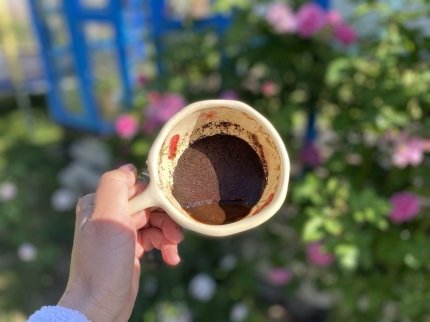
A bad approach is to regularly pour all the grounds from a coffee maker into one pot. Even a large monstera, ficus or dracaena does not need a constant layer of coffee grounds on the surface. In a pot, this can lead to compaction, mold, midges and impaired air exchange.
Common mistakes with coffee grounds
The first mistake is to consider coffee grounds as a complete fertilizer. It contains nutrients, but in small quantities and not in a form that can quickly fill deficiencies.
The second mistake is to pour a thick layer on the surface of the soil. Such a layer can stick together, repel water, and impair air access to the roots.
The third mistake is to use the pulp for seedlings and seeds. Residual caffeine and other compounds can inhibit germination and initial growth.
The fourth mistake is trying to acidify soil for blueberries, hydrangeas, or azaleas without a pH test. The used grounds after brewing are close to neutral, so they are not a reliable acid corrector.
The fifth mistake is adding wet compost to indoor pots. This increases the risk of mold, odor, midges, and overwatering.
The sixth mistake is mixing coffee grounds with milk, sugar, or syrup and applying them to plants. It is better not to use such residues in pots.
When is it better not to use coffee grounds?
Do not add coffee grounds if the plant is weak, has root rot, is growing in constantly wet soil, or is in a pot without good drainage. In such conditions, additional organic matter can worsen the situation.
It is better to abandon the thick for:
fresh seedlings;
sowing seeds;
cacti and most succulents;
plants with root rot;
pots with mold on the surface;
heavy clay soil without loosening;
very small pots;
plants that require a drier regime.
If you're not sure, add the grounds to your compost. This is the least risky way to turn coffee grounds into something beneficial for the soil.
Practical scheme for using coffee grounds
For an apartment: collect clean used pulp without milk and sugar, dry it and add it in small portions to the composter or give it to those who have a garden. Add it to pots only minimally and rarely, preferably in the form of ready-made compost.
For the garden: mix the pulp with leaves, grass, shredded branches, cardboard and kitchen scraps. Make sure the compost is not wet and dense. Use the finished compost for vegetables, trees, bushes and flowers.
For beds: Do not put the slurry in the holes with the seeds. If you want to apply it directly, spread it thinly, mix it well with the soil, and do not repeat this too often.
For lawns: Do not spread in mounds. It is better to use compost with coffee grounds as a thin layer after aerating or lightly loosening.
Conclusion
Coffee grounds can be beneficial to plants if used in moderation and correctly. They add organic matter, support microorganisms, can improve soil structure, and work well in compost. But they are not a quick fix, are not a substitute for a full-fledged fertilizer, and are not capable of reliably acidifying soil for acid-loving plants.
The best way to use it is in composting. This is where coffee grounds decompose more safely, mix with other materials, and gradually turn into a useful soil improver. Direct application to the soil is only possible in a thin layer, in small quantities, and without contact with seeds or young seedlings.
The main rule: coffee grounds should be part of a systematic care regimen, not a home “miracle remedy.” If the plant is not growing well, first check the light, watering, drainage, pH, soil nutrients, and root condition. Only then should you look for additional feeding.
FAQ
Are coffee grounds good for plants?
Yes, but in moderation. It contains organic matter, small amounts of nitrogen and trace elements, can improve soil structure, and is good for compost. However, too much of it can inhibit plant growth.
Can I pour coffee grounds directly into the pot?
You can only do it very little and infrequently. It is better to use dry pulp, mix it lightly with the top layer of soil and make sure that there is no mold, midges or a dense crust. It is safer to add the pulp to the compost.
What plants like coffee grounds?
Coffee grounds are not suitable for “favorite” plants, but for soils that need organic matter. They can be used carefully around mature ornamental shrubs, perennials, and in compost for vegetables, trees, and flowers. They are often undesirable for seedlings, seeds, and succulents.
Do coffee grounds acidify the soil?
No, it does not reliably acidify. Used coffee grounds after brewing are close to neutral, approximately pH 6.5–6.8, and the impact on soil pH is usually insignificant and temporary.
Can I use coffee grounds for blueberries and hydrangeas?
You can add a small amount of compost where the coffee grounds were, but don't count on it as a way to acidify the soil. For blueberries, hydrangeas, azaleas, and rhododendrons, it's best to check the pH and use materials specifically for acidic soil.
Can coffee grounds be added to compost?
Yes, this is the best way to use it. Coffee grounds are a nitrogenous “green” compost material. It is important to mix them with “brown” materials — dry leaves, cardboard, straw, or shredded branches.
How much coffee grounds can you add to compost?
Oregon State University Extension recommends that coffee grounds make up no more than 20% of the total volume of your compost pile. Any more than that can be toxic to plants.
Can I use coffee grounds for seedlings?
It is best not to use. Seeds and young seedlings are sensitive to residual caffeine and other compounds. Studies have shown that direct application of coffee grounds can reduce germination and inhibit plant growth.
Do coffee grounds help with slugs?
Caffeine can affect slugs and snails, but concentrated coffee can harm plants. If using coffee as an adjunct, it should be diluted, tested on a few leaves, and not used indiscriminately.
Why does mold appear on coffee grounds?
Wet pulp contains organic matter and retains moisture, so it quickly molds in warm weather. This is usually not a problem for compost, but in indoor pots it can create odors, midges, and problems with the soil surface. It is better to dry the pulp or mix it with the compost immediately.

