
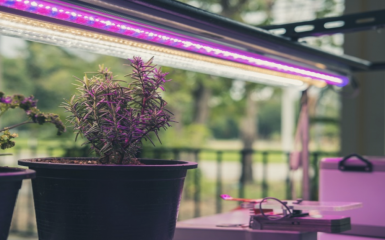
In winter, basil on the windowsill stops growing, seedlings stretch out, and indoor plants gradually lose their decorativeness. Often the reason is a lack of natural light. Even if the room seems bright, the plants may receive much less light than they need for normal development.
Points of attention
- A phytolamp is often needed for greenery, seedlings, and light-loving plants, while shade-tolerant flowerpots can winter without one.
- Signs of a lack of light may include elongated shoots, small new leaves, and slowed growth, but it's worth checking other care conditions as well.
- When choosing a light, consider leaf-level PPFD, spectrum, coverage area, and recommended distance, not just the color of the light or wattage.
A phytolamp helps to compensate for this deficiency. However, it is not necessary to buy special lighting for each flowerpot. Some houseplants tolerate the winter reduction in light, while lettuce, basil and vegetable seedlings need much more light.
A phytolamp is really needed if plants lack natural light for active growth. For growing greens in winter, it often becomes necessary, and for shade-tolerant ornamental plants it can be just an added advantage.
It is important to choose the right lamp. Its effectiveness does not depend on the purple color of the glow or the advertised power, but on the amount of light that the leaves actually receive, its spectrum, and the duration of the lighting.
We'll figure out which plants need supplemental lighting, whether a regular LED lamp is suitable, how many hours per day the lighting should be on, and how to avoid common mistakes.
What is a phytolamp for and how does it work?
A phytolamp is a source of artificial lighting designed to support plant growth and development.
Its main task is to provide the light necessary for photosynthesis.
During this process, plants use light energy to form organic substances from water and carbon dioxide.
If there is not enough light, the rate of photosynthesis decreases. The plant may slow down its growth, form smaller leaves, or stretch out shoots towards the light source.
But more light doesn't always mean better results.
Each species has its own light range. Too much light can also cause stress, leaf damage, and stunted growth.
What kind of light do plants use?
For photosynthesis, plants primarily use radiation in the range of approximately 400–700 nanometers.
It is called photosynthetically active radiation, or PAR.
The red and blue parts of the spectrum are especially important, but that doesn't mean that other colors are useless.
Green light also participates in photosynthesis and can penetrate deeper into dense foliage.
Therefore, modern white, broad-spectrum LED lamps may be well suited for home growing.
Do plants really need a phytolamp in winter?
The need for additional lighting depends primarily on the type of plant and where it is located.
In Ukraine, daylight hours shorten significantly in the fall and winter. In Kyiv, it is about eight hours at the end of December.
However, even during these hours, plants do not always receive enough light.
Illumination is affected by cloud cover, window orientation, neighboring buildings, trees, balconies, and distance from the windowsill.
When a phytolamp will be useful
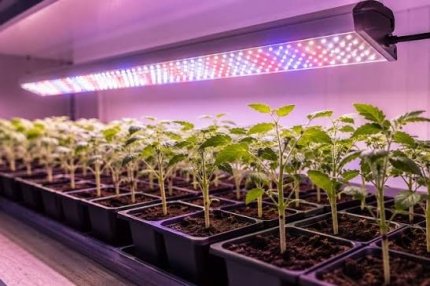
Additional lighting is usually needed if:
you grow basil, lettuce or other greens in the winter;
tomato or pepper seedlings are standing near a window that does not get enough light;
light-loving plants are located away from windows;
shoots noticeably lengthen, and new leaves become smaller;
it is necessary to maintain active plant growth throughout the year;
Natural lighting in the room is limited.
If the houseplant maintains a healthy appearance, does not stretch out, and tolerates the winter period normally, an additional lamp may not be necessary.
Which indoor plants need a phytolamp and which don't?
Houseplants can be roughly divided into three groups based on their lighting needs.
It is important to note that shade tolerance does not mean the ability to grow in complete darkness.
Even unpretentious plants need a certain amount of light.
| Plants | The need for lighting | Is a phytolamp needed in winter? |
| Zamioculcas, sansevieria | Low or moderate | You can often do without it. |
| Epipremnum, some philodendrons | Moderate, tolerates lower light | In case of insufficient natural lighting |
| Monstera, ficus | Mostly bright diffused light | Useful in a dark room |
| Citrus fruits, lots of succulents | High | Often needed during active winter growing |
| Basil, lettuce, dill | High for productive growth | Usually needed in winter |
| Tomato and pepper seedlings | High | Often necessary |
The table is a general guideline. Requirements may vary depending on the species, variety and stage of development.
Plants that can winter without a phytolamp
Zamioculcas, sansevieria, aglaonema, and some philodendrons are adapted to conditions with relatively little light.
In winter, their growth can slow down noticeably.
This does not necessarily indicate a problem.
Plants generally use less water in lower light conditions, so it's important not to continue watering them as often as in the summer if the soil dries out more slowly.
Light-loving pots that may lack winter sun
Citrus trees, some succulents, ornamental flowering plants, and species with high light needs may experience a lack of light even near a window.
Especially if the windows face north or are shaded by neighboring buildings.
For such plants, supplemental lighting helps maintain photosynthesis and reduce the risk of shoot elongation.
However, for species with a natural dormant period, it is not always necessary to stimulate active growth in winter.
Do I need a phytolamp for greenery on the windowsill?
For growing fresh greenery in winter, a phytolamp often has greater practical value than for decorative flowerpots.
The reason is simple: parsley, basil, or lettuce are expected not only to survive, but also to regularly produce new leaves.
If there is little light, plants grow slowly, stretch out, and form weaker shoots.
Basil
Basil is a light-loving crop.
With insufficient light, its shoots can become long and thin, and its leaves can become smaller.
For winter cultivation with regular cutting of greenery, it is advisable to provide sufficiently intense light for approximately 12–14 hours a day.
Specific parameters depend on the variety and lighting power.
Parsley, dill and mint
These crops may have different requirements for growing conditions, but they also need sufficient light to actively form greenery.
Parsley sometimes tolerates cooler conditions better than basil.
Mint can grow in moderate light, but with a lack of light, shoots often stretch out.
If the greenery is near a north window in November or December, special additional lighting can significantly improve the result.
Lettuce and other leafy greens
Leaf lettuce is well suited for home growing under LED lighting.
However, not only the hours of lamp operation, but also the intensity of light are important for the formation of a sufficient number of leaves.
A weak light bulb that shines for 16 hours will not always provide the same result as a more powerful light for 12–14 hours.
Why seedlings especially need additional light
Seedlings of tomatoes, peppers, and many flower crops need sufficient light immediately after emergence.
In February and March, natural light on the windowsill is often not enough, especially in cloudy weather.
Because of this, young plants can form long, thin stems, lean toward the window, and lose their compactness.
This phenomenon is called etiolation.
For seedlings, approximately 14–16 hours of light per day is often recommended, although the specific regimen depends on the crop and lamp intensity.
The lamp should be gradually raised as the seedlings grow.
How to understand that plants are not getting enough light
Lack of lighting usually does not manifest itself immediately.
At first, the plant may simply slow down its growth, and after a while its appearance changes.
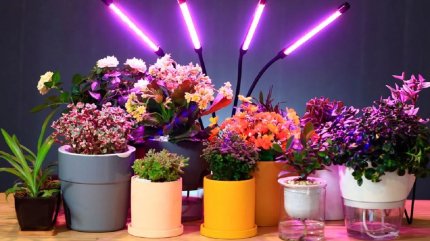
The main signs of light deficiency
Elongated shoots. The distance between the leaves increases, the stems become longer and thinner.
Small new leaves. The plant is producing smaller leaves than under favorable conditions.
Tilt towards the window. Shoots gradually grow towards the main light source.
Loss of bright coloration. Some ornamental plants may lose the vibrancy of variegated or colored areas on their leaves.
Lack of flowering. Light-loving flowering plants may not form buds.
Slow recovery after pruning. Especially noticeable in basil and other herbs.
However, yellowing, leaf drop, or stunted growth are not always related to light.
Similar symptoms can occur due to excessive watering, root damage, pests, or low temperatures.
Therefore, before purchasing a phytolamp, you need to evaluate all the care conditions.
How to choose a phytolamp: main characteristics
On the packages you can see the inscriptions Full Spectrum, LED Grow Light, 4000 K or 50 W.
But not all of these options are equally useful.
For plants, it is important how much photosynthetically active light reaches the leaves, over what area it is distributed, and how long the lighting lasts.
What is PPFD and why is it more important than brightness?
PPFD is the flux density of photosynthetic photons that fall on a certain area per second.
The indicator is measured in micromoles per square meter per second: μmol/m²/s.
Simply put, it shows how much light suitable for photosynthesis is received by the plant surface.
To compare fixtures, it is helpful to look at the PPFD listed for a specific distance.
For example, a manufacturer may specify illumination at a height of 20, 30, or 40 cm.
This allows you to understand whether the lamp is suitable for a small shelf with greenery or several large flowerpots.
Why watts are not enough
Wattage shows how much electricity a light fixture consumes.
But it does not directly determine the amount of light that plants receive.
Two LED lamps with the same consumption may have different efficiencies.
Therefore, the inscription "100 W" without explaining whether it refers to actual consumption does not provide complete information.
You should be especially careful with advertising labels like "analog 500 W".
Do lumens and kelvins matter?
Lumens characterize the luminous flux taking into account the sensitivity of the human eye.
This is a useful indicator for general lighting, but not the most accurate for assessing plant needs.
Kelvins indicate the color temperature of white light.
For example, 4000 K is neutral white, and 6500 K is a cooler white light.
However, color temperature alone does not guarantee sufficient lighting.
When choosing a grow light, the combination of spectrum, PPFD, coverage area, and actual power consumption is more important.
Which phytolamp is better: white or purple?
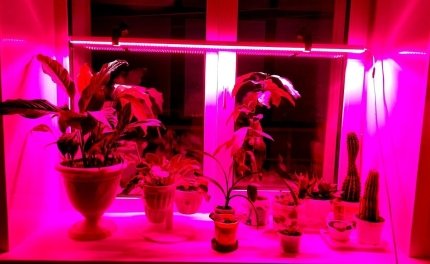
Purple grow lights usually use a combination of red and blue LEDs.
Such spectra can be effective for photosynthesis, but are not necessary for home growing.
Modern white, broad-spectrum LED lights are also suitable for greenery, seedlings, and many indoor plants.
Comparison of lighting types
| Lamp type | Features | What is it suitable for? |
| Broad spectrum white LED | More comfortable for the living room | Greenery, seedlings, flowerpots |
| Red-blue LED | Characteristic pink-purple glow | Specialized cultivation |
| LED panel for plants | Can evenly illuminate a larger area | Shelves, several containers |
| LED lamp with base | Compact and easy to install | One or two small flower pots |
| Linear LED lamp | Convenient for long shelf | Seedlings, greens in containers |
For a regular apartment, the most convenient solution is often a white LED lamp with proven characteristics for growing plants.
Purple light does not have an automatic advantage just because of its color.
How many hours a day should a phytolamp work?
The correct duration depends on the type of plant, the intensity of the light, and the amount of natural light.
It is necessary to take into account the total lighting during the day, not just the lamp operating time.
Approximate modes:
| Plants | Duration of lighting per day |
| Vegetable seedlings | 14–16 hours, sometimes up to 18 |
| Basil, lettuce and other greens | 12–14 hours |
| Most ornamental foliage plants | 12–14 hours as needed |
| Some flowering houseplants | 12–16 hours depending on the species |
These values do not mean that all plants should receive the maximum duration of light every day.
Its intensity also plays an important role.
It is not recommended to leave the phytolamp on 24/7. Many plants need a regular dark period.
It is convenient to use a timer for automation.
Why light is needed not only for the number of hours
In professional cultivation, the DLI indicator is used - the daily amount of photosynthetically active light that a plant receives.
It takes into account the intensity of the lighting and the duration of its exposure.
For example, a lamp with a PPFD of 200 μmol/m²/s, operating for 14 hours, provides approximately 10 mol/m² of light per day.
But if the actual intensity at the leaf level is half as low, the daily amount of light will also be about half as low.
Therefore, increasing the operating time of a weak lamp does not always compensate for insufficient power.
At what distance from plants should you place a phytolamp?
The distance determines how much light the leaves receive and how evenly the plant is illuminated.
The further away the light is, the less light usually falls on a particular area.
At the same time, too close a location can lead to local overheating or excessive intensity.
Approximate distances
For young seedlings under appropriate low-power lamps - approximately 10–15 cm.
For lettuce and small greens, approximately 15–30 cm.
For decorative leafy flowerpots - approximately 30–60 cm.
For powerful LED panels - according to the manufacturer's recommendations.
These values are guidelines, not universal rules.
The actual distance depends on the design, power, and optics of the fixture.
It is best to focus on the manufacturer's stated PPFD and recommended installation height.
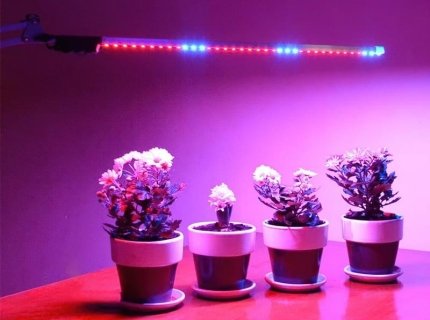
How to properly install a phytolamp at home
A small home garden does not require a complex lighting system.
It is enough to choose a lamp according to the number of plants and ensure a stable mount.
Step-by-step setup
Determine the area. Measure the length and width of the shelf or windowsill where the plants are located.
Group plants. Place light-loving species together and shade-tolerant ones separately.
Check the lamp specifications. Pay attention to the PPFD, the area of illumination, and the recommended distance.
Place the light on top. This will give the plants more even light and reduce the risk of stretching to the side.
Set the timer. Set the mode according to the needs of the crop.
Watch the leaves. Over the next few weeks, assess the appearance of new shoots, their compactness, and the condition of the leaves.
Adjust the height. Raise the lamp as the plants grow, maintaining the desired distance.
Do not install an electric light where water may fall on it during watering.
It is also important to ensure ventilation and comply with electrical safety requirements.
Can a phytolamp harm indoor plants?
Yes, if used incorrectly.
Excessive lighting can cause stress, even when the air temperature remains normal.
Plants adapted to shaded conditions may be particularly sensitive.
Signs of excess light
light or bleached areas on the leaves;
dry brown spots;
twisting of leaves;
excessive heating of the upper part of the plant;
deterioration of the condition after a sharp increase in illumination.
However, these symptoms can also be due to improper watering, pests, and other causes.
If the plant has been in the shade for a long time, transfer it to more intense lighting gradually.
You should also not use ultraviolet lamps without special need and proper safety measures.
For normal home growing of greens and most flowerpots, additional ultraviolet lighting is not required.
Can I replace a phytolamp with a regular LED bulb?
Yes, in some cases, a regular white light LED lamp may be sufficient for houseplants.
However, it is important to consider not only the color of the glow, but also the actual illumination.
A regular LED bulb designed to illuminate a room does not always provide the necessary intensity at the leaf level.
Especially if it is located far away or has a wide scattering angle.
For one small flowerpot or supporting additional lighting, such a lamp can be a practical solution.
To grow a large amount of greenery or seedlings, it is better to use a lamp whose characteristics meet the needs of the plants.
How much electricity does a phytolamp consume?
Costs depend on actual power and duration of operation.
For example, if an LED lamp consumes 20 watts and operates for 14 hours a day, its consumption will be:
20 W × 14 hours × 30 days = 8.4 kWh per month.
For a 40 W lamp in the same mode, it is 16.8 kWh.
This calculation is for the lamp only, without taking into account additional equipment.
To determine the costs in hryvnias, the obtained consumption must be multiplied by the current electricity tariff.
It is wrong to choose a lamp based solely on the lowest power: the important relationship is between consumption and the amount of useful light that plants receive.
How to care for plants under a phytolamp
Additional lighting affects not only growth, but also water consumption.
If a plant receives more light and is actively growing, its need for moisture may increase.
But this does not mean that all flower pots under the lamp need to be watered every day.
Assess the moisture content of the substrate and the needs of the specific species.
Fertilization also does not replace lighting.
If there is not enough light, additional fertilizers will not eliminate the cause of poor growth and under certain conditions may harm the roots.
It is important to maintain a balance of light, temperature, watering and nutrition.
The most common mistakes when using phytolamps
Choose only by the purple glow. The color does not guarantee the effectiveness of the lamp.
Focus only on watts. Actual power does not indicate how much useful light the plants receive.
Too much distance. The leaves may not receive enough light even from a good lamp.
Continuous work. Many plants need regular cycles of light and darkness.
The same regime for all pots. Lettuce and Zamioculcas have different needs.
Using a lamp that is too powerful. Excessive intensity can damage the leaves.
Ignoring watering. Changing lighting affects moisture consumption.
Try to cure any yellowing with a light bulb. This could be due to root problems or pests.
Unstable mounting. The lamp must be securely mounted and protected from water.
Is it worth buying a phytolamp if the lights are often turned off?
In unstable power supply conditions, the effectiveness of supplementary lighting depends on the ability to maintain a sufficiently regular regime.
Turning off the lamp briefly does not mean that the plant will immediately suffer.
However, if the lighting operates for significantly less than the scheduled time each day, the total amount of light may not be enough for active green growth.
In such conditions, it is advisable to use the maximum available natural light, place plants closer to windows and take into account their need for light.
If backup power is provided, it is necessary to take into account the actual lamp consumption and the capabilities of the power source.
Don't try to compensate for a few days of insufficient lighting by continuously operating a lamp that is too bright.
Conclusion
A phytolamp is not needed for all indoor plants, but it can significantly improve the growing conditions for greenery, seedlings, and light-loving flowerpots in winter.
For basil, lettuce, and seedlings, supplemental lighting is often necessary if natural light is not enough. Zamioculcas, Sansevieria, and other shade-tolerant species can often overwinter without a special lamp.
The best choice for home use is a quality LED light with appropriate lighting characteristics. It is important to consider PPFD, coverage area, distance to leaves, and operating time.
A phytolamp does not replace proper care, but with sufficient intensity and a properly set mode, it helps plants survive the lack of winter sun.
FAQ: frequently asked questions about phytolamps
Do I need a phytolamp for indoor plants in winter?
Not for everyone. Shade-tolerant plants can tolerate winter reductions in light. Light-loving species, as well as greenery and seedlings, often need additional light for active growth.
Which phytolamp is best for houseplants?
For most household tasks, a white LED lamp with a wide spectrum is convenient to use. You need to choose based on light intensity, area covered, recommended distance, and actual power.
Can I use a regular LED lamp instead of a phytolamp?
Yes, if it provides enough light at leaf level. However, a regular bulb may not be enough for a large number of seedlings or rapid green growth.
How many hours a day should the phytolamp be turned on?
For many types of greenery, about 12–14 hours of general lighting is suitable, for seedlings - often 14–16 hours. The specific regime depends on the type of plant and the intensity of the light. 24-hour lighting is usually not necessary.
At what distance should you place the phytolamp from the seedlings?
For some low-power lights, a guideline is about 10–15 cm above the tops of the seedlings. For more powerful LED panels, a greater distance is required. It is best to follow the manufacturer's recommendations.
Do I need a phytolamp for basil on the windowsill?
This is often the case in winter. Basil needs enough intense light to form strong shoots and new leaves. On a dark windowsill without additional lighting, it can stretch out and grow slowly.
Is a purple phytolamp harmful to plants?
The purple color itself is not a sign of harm. Problems can arise from excessive intensity, the wrong spectrum, or the wrong distance. For residential spaces, white light is often more convenient.
Can I leave the phytolamp on all night?
The mode should be selected taking into account the needs of the plant and its dark period. Most houseplants do not need 24-hour lighting. It is most convenient to use a timer with a regular schedule.
How do you know if the phytolamp is too close?
Light spots, dried leaf edges, curling or signs of overheating may appear. However, these symptoms have other causes. It is important to check the recommended distance and actual light intensity.
Will a phytolamp help a plant if its leaves turn yellow?
Only if the cause is truly related to a lack of light. Yellowing can also be the result of overwatering, root problems, temperature stress, or pests. Therefore, you should first assess the conditions under which the plant is kept.
undefined

