
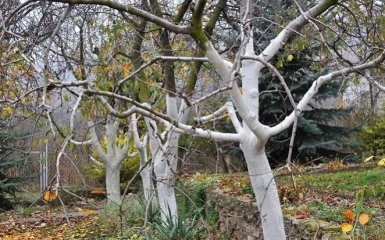
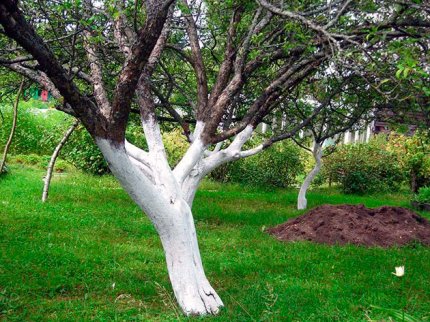
Autumn whitewashing of trees is a familiar procedure for many garden owners. However, not everyone understands why they cover the trunks with a white mixture before winter. Some gardeners believe that this protects the trees from frost, others hope to get rid of pests, and some refuse whitewashing altogether, considering it an outdated tradition.
Points of attention
- Whitewashing reduces the heating of the bark by the winter sun and the risk of damage due to sudden temperature changes, but does not insulate the tree.
- Young trees with thin bark and trunks that have suddenly been exposed to direct sunlight need the most protection. Mature trees with thick, healthy bark often do not need to be whitewashed.
- In Ukraine, whitewashing is usually carried out in late October or November, in dry weather and at the temperature specified by the product manufacturer.
In fact, whitewashing has a very specific purpose. Its main task is to reduce the heating of the bark by sunlight in winter and the risk of tissue damage due to sudden temperature fluctuations .
Such protection is especially important for young fruit trees with thin bark, as well as for trunks that were previously in the shade but are now exposed to the winter sun.
At the same time, it is not necessary to whitewash every tree in the garden. Adult plants with healthy, thick bark often do not need such protection, and an incorrectly selected mixture can do more harm than good.
We analyze when it is best to whitewash apple, pear, cherry, and plum trees, what whitewash to use, how to properly prepare the trunks, and what to replace traditional lime with.
Why whitewash trees in the fall and how whitewashing works
The main purpose of whitewashing is to reflect some of the solar radiation.
Tree bark, especially dark bark, absorbs solar energy. Therefore, on a clear winter day, the surface of the trunk can heat up much more than the surrounding air.
The problem arises when the temperature drops sharply after such heating.
This happens quite often in winter: the sun shines during the day, and in the evening the temperature drops below zero.
A light surface reflects more sunlight than a dark one. Therefore, a white coating helps reduce daytime heating of the trunk.
This is especially important in late winter and early spring, when the sun is already noticeably more active, but night frosts are still possible.
What is winter sunburn of the bark?
Winter sunburn, or sun-frost damage, occurs due to sudden changes in the temperature of the trunk tissues.
On a sunny day, the bark heats up. Beneath it, cells that were in a winter dormancy can become active.
After sunset or a sudden cold snap, the temperature drops quickly.
Such vibrations can damage living tissue beneath the bark.
Lesions most often appear on the south and southwest sides of the trunk, which receive the most direct sunlight.
The damaged area may change color, sink, dry out, and eventually crack.
Sometimes the effects become noticeable only in the spring or even later.
Does whitewashing protect against severe frosts?
Not quite.
The white layer does not work as a full-fledged insulator and is not able to protect the entire tree from extremely low temperatures.
Its main function is to reduce overheating of the bark during the day and the associated temperature fluctuations.
If the tree suffers from freezing roots, insufficient winter hardiness of the variety, or severe frost, whitewashing alone will not solve the problem.
Therefore, it should be considered as one of the elements of winter protection of the garden.
Which trees need to be whitewashed in the fall, and which can be left without whitewashing?
The need for whitewashing depends on the age of the tree, the thickness of the bark, the type of plant, and its location in the garden.
Young trees with thin, smooth bark are usually the most vulnerable.
Their tissues react more strongly to temperature fluctuations, especially if the trunk is exposed to direct sunlight.
Which fruit trees need special attention?
| Tree | When whitewashing can be useful |
| Apple | Young saplings with thin bark |
| Pear | Young trees in open sunny areas |
| Cherry | Young trees and trunks with exposed bark |
| Merry | Young plants, especially after planting |
| Plum | Thin bark, risk of winter sun damage |
| Peach | Young trees and exposed trunk areas |
| Apricot | Trees with sensitive bark growing in the sun |
This does not mean that all of the listed trees need to be whitewashed every year, regardless of their condition.
For example, a mature apple tree with thick, healthy bark that has no history of winter damage may not need additional white coating.
However, a young tree may be much more vulnerable after being planted in an open area.
Do young seedlings need to be whitewashed?
Young trees often need protection the most.
However, it is their thin bark that can be sensitive to improperly selected whitewashing mixtures.
Therefore, for seedlings it is especially important to use materials that are compatible with living bark.
A good alternative to whitewash is a special light-colored wrap or protective cover for the trunk.
Such products help reflect sunlight without the need to apply a chemical mixture directly to the bark.
Do you need to whitewash old trees?
Mature trees with thick bark are usually less vulnerable to winter sunburn.
Therefore, whitewashing is often optional for them.
However, there are exceptions.
If, after heavy pruning or removal of a neighboring tree, part of the trunk suddenly finds itself in direct sunlight, even an adult plant may need protection.
The same applies to trees that previously grew in the shade and were then transplanted to an open area.
When to whitewash trees in autumn in Ukraine
The best period for autumn whitewashing is after the end of active vegetation, but before the establishment of persistent frosts.
For many regions of Ukraine, this is the end of October and November.
However, the specific date depends on the weather.
In a warm autumn, whitewashing can be done later. If frosts begin early, it is better not to postpone the work.
What should the weather be like?
To apply the protective coating, it is advisable to choose a day when:
the tree bark is dry;
there is no rain or sleet;
the temperature meets the manufacturer's requirements;
no precipitation is forecast in the near future;
the coating will have time to dry before frost.
For some water-based paint mixtures, an air temperature above +10 °C is recommended.
Special garden products may have different requirements. Therefore, it is necessary to follow the instructions for the selected product.
Do not apply whitewash to wet, frozen bark or immediately before heavy rain.
Is it possible to whitewash trees in December?
It is possible if the weather allows you to perform the work in accordance with the requirements of a specific tool.
But you need to take into account the air temperature, bark humidity, and drying time of the coating.
If frost has already set in and there are no suitable conditions, it is safer to use a special light protection for the trunk than to apply the mixture in violation of the instructions.
Why autumn whitewashing is more important than spring whitewashing
To prevent winter damage, a protective coating should be on the trunk before dangerous temperature fluctuations begin.
That is why autumn tillage makes practical sense.
If you whitewash a tree only in April, winter sunburn could already occur.
Sunny days at the end of winter are especially dangerous, when the temperature rises noticeably during the day and drops below zero again at night.
Is it necessary to repeat whitewashing in the spring?
If the protective coating has held up well after winter, additional application may not be necessary.
However, if rain and snow have significantly washed away the layer, it may need to be renewed.
The decision depends on the condition of the coating, the type of wood and the risk of sun damage.
Spring whitewashing does not replace timely autumn protection, but can sometimes help maintain its effectiveness.
What is better to whitewash trees: with lime or special paint?
The choice of mixture is of great importance.
Traditionally, slaked lime-based solutions were used for whitewashing.
Today, special garden whitewashes and light water-based coatings designed to protect bark are also available.
It is important not to confuse decorative painting of trunks with protective treatment of a living plant.
Lime whitewash
Lime forms a light layer that reflects solar radiation.
However, slaked lime is an alkaline substance, and its concentrated solutions can irritate or damage tissues.
Particular caution should be exercised when using such mixtures on young trees with thin bark.
Increasing the amount of lime alone will not make the coating more effective.
Also, you should not experiment with adding unknown substances based on advice from untested home recipes.
Ready-made garden whitewash
For a home garden, it is convenient to use a product designed for application to living trees.
The advantage of this option is that there are instructions on preparation, dilution, temperature, and method of application.
However, even a special name on the packaging does not mean that the product is suitable for absolutely all plants.
You need to check age restrictions, purpose, and composition.
White water-dispersion paint
Professional gardening guidelines also describe using white water-based latex paint diluted with water to reduce solar heating of trunks.
One common option is one part of a suitable white paint to one part of water.
However, paints differ in composition and additives. Not every modern construction paint is suitable for application to bark.
In particular, oil paints, aggressive solvents, or materials of unknown composition cannot be used.
For home use, it is easiest to choose a product whose compatibility with living trees has been confirmed by the manufacturer.
How to properly whitewash trees in the fall: step-by-step instructions
The main task is to create a uniform reflective layer without damaging the bark.
There is no need to apply an extremely thick coating or treat the entire tree to the top.
Step 1. Inspect the trunk
Before you begin, check the bark for any major damage, cracks, dead areas, or signs of pests.
If a tree shows serious signs of disease, whitewashing should not replace diagnosing the problem.
It is especially important to inspect the south and southwest sides of the trunk.
Step 2. Carefully prepare the surface
Remove dry leaves, dirt and other foreign matter if they interfere with the application of the coating.
There is no need to scrape off healthy bark with a metal brush or knife.
This treatment is especially dangerous for young trees.
Also, you should not specifically remove lichen along with healthy layers of bark. Lichens themselves are not evidence of a dangerous tree disease.
Step 3. Prepare the protein mixture
If you use a ready-made garden product, follow the manufacturer's recommendations.
Do not change the concentration arbitrarily.
The mixture should be uniform enough to apply with a brush.
If the product requires dilution, use the specified amount of water.
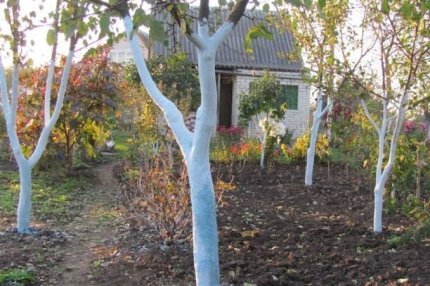
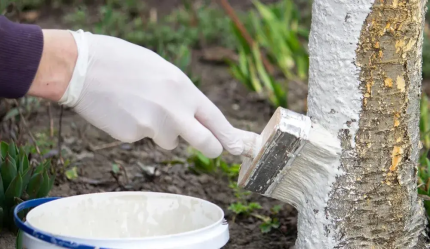
Step 4. Apply a protective coating
Start at the bottom of the trunk and work your way up.
Pay special attention to areas that receive direct winter sun.
If necessary, treat the bases of lower skeletal branches if their bark is thin and exposed to sunlight.
Apply an even layer without large gaps.
There is no need to specifically paint the leaves, the root collar underground, or the open wounds of the tree.
Step 5. Let the coating dry
After application, leave the wood until completely dry.
It is important that it does not rain during this period.
If the coating is washed off before it dries, its effectiveness may be reduced.
Reapply only as needed and according to product instructions.
How high should trees be whitewashed?
In home gardening, the focus is often on trimming the trunk from its lower part to the base of the first large branches.
For a small seedling, this can be almost the entire height of the trunk.
For an adult tree, there is no need to cover the entire crown with a white mixture.
However, it is important to protect more than just the bottom 20–30 centimeters if most of the thin bark remains exposed to the sun.
Do I need to whitewash the branches?
Not everyone.
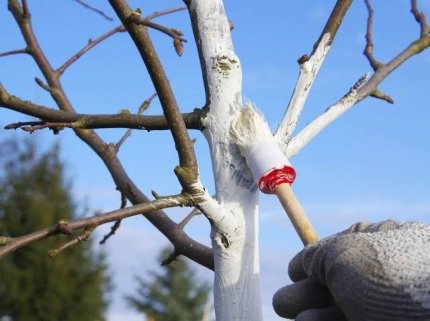
Protection can be useful for lower, large branches with thin bark, especially if they face south or southwest.
Young, thin shoots and the entire crown do not need to be whitewashed.
If the tree is small and has many thin branches, it is more advisable to evaluate the possibility of using reflective trunk protection instead of solid painting.
Does whitewashing trees help against pests and diseases?
It is widely believed that whitewashing simultaneously protects trees from frost, fungi, insects, and rodents.
In fact, these are different problems that require different measures.
Plain white coating cannot be considered a universal insecticide or fungicide.
Its main confirmed function is to reduce the heating of the crust by sunlight.
At the same time, whitewashing may indirectly reduce the risk of some problems.
For example, bark damaged by sunburn becomes more vulnerable to certain wood-destroying insects and pathogens.
Reducing the amount of such damage helps maintain the tree's natural protective barrier.
But this does not mean that whitewashing directly destroys pests.
Should I add copper sulfate?
Copper sulfate is sometimes found in traditional whitewashing recipes.
However, copper compounds are used as plant protection products only in appropriate concentrations and under certain conditions.
Their arbitrary addition can create a risk of damaging the bark, especially the young one.
Therefore, you should not independently convert ordinary whitewash into a mixture with pesticide components.
To combat a specific disease or pest, a separate assessment of the problem and the appropriate approved product are required.
Does whitewashing protect against hares, mice and voles?
The white layer on the trunk does not provide reliable mechanical protection against rodents.
Mice and voles can damage the bark near ground level, while rabbits can damage it higher up, especially when a lot of snow accumulates in winter.
For young trees, such damage can be very dangerous.
If the bark is gnawed around a significant portion of the trunk, the normal functioning of the tree's tissues is disrupted.
How to protect trees from rodents
To do this, special protective nets, cylindrical casings, or other structures are used that physically restrict animals' access to the bark.
The protection must be installed so as not to compress the trunk and not to impede its growth.
You also need to take into account the possible height of the snow cover.
Whitewashing itself does not replace such structures.
What can replace autumn whitewashing of trees?
If you don't want to apply the coating directly to the bark, you can use special reflective trunk wraps.
They are especially useful for young trees.
The light material reflects some of the solar radiation and helps reduce the heating of the crust.
White protective wraps
Special white garden wraps and covers are used for winter protection.
They are installed in the fall and removed in the spring according to the manufacturer's recommendations.
It is undesirable to leave a tight wrap on the tree all year round.
Moisture, insects, and other undesirable factors can accumulate under it.
Additionally, material that is not adjusted as the trunk grows can gradually compress it.
Why you shouldn't wrap the trunk with black film
Dark materials absorb more solar radiation.
Therefore, black film or dark, dense wrapping does not perform the same task as white reflective coating.
In addition, the impermeable film can retain moisture near the bark.
It is not recommended to use it instead of special garden protection.
How to protect young trees from frost without whitewashing
Whitewashing is just one of the measures to prepare the garden for winter.
For young trees, the condition of the root system, the moisture content in the soil, and protection from mechanical damage are equally important.
Mulching the trunk circle
A layer of mulch helps reduce soil temperature fluctuations and moisture loss.
You can use wood chips or other suitable organic material for this.
Mulch is distributed around the tree, leaving a small gap near the trunk itself.
You should not pour it in a tall cone directly onto the bark.
Excessive moisture accumulation near the trunk can create unfavorable conditions and contribute to damage.
Watering before winter
If the fall was dry, young trees may need sufficient soil moisture before it freezes.
A well-moistened root zone helps the plant tolerate winter conditions.
However, the amount of water depends on the weather, soil type, and condition of the tree.
In overwatered areas, additional watering may not be necessary.
Caution with late top dressing
Excess nitrogen fertilization at the end of the season can stimulate unwanted late shoot growth.
Such shoots sometimes do not have time to properly prepare for winter conditions.
Therefore, autumn care should be aimed primarily at maintaining the normal condition of the tree, rather than stimulating active growth.
The most common mistakes during autumn whitewashing
Even a useful procedure may not produce the desired result if performed incorrectly.
Whitewash all trees without exception. Old trees with thick, healthy bark do not always need such protection.
Perform the procedure in the spring instead of the fall. Winter damage may have already occurred by this time.
Apply the coating to wet bark. It may not adhere well or dry unevenly.
Using too concentrated a lime solution is especially dangerous for young seedlings.
Apply random construction paint. Not all paints are compatible with live bark.
Roughly clean the trunk with a wire brush. You can damage healthy tissue.
Count on protection against all pests. Regular whitewashing does not replace other measures.
Apply thick layers unnecessarily. Even coverage is more important than maximum thickness.
Leave winter wraps on all summer. This can cause moisture to accumulate or the trunk to shrink.
Ignore existing bark damage. Whitewashing will not cure cracks, rot, or disease.
What to do if a crack appears on a tree after winter
Not every crack in a tree trunk is caused by sunburn.
Such damage may be associated with frost, mechanical injury, pests, or bark diseases.
If the crack is located on the south or southwest side and is accompanied by subsidence or death of the bark, sun-frost damage is possible.
However, it is wrong to establish the cause solely by location.
Do I need to cover the crack with garden var?
You should not automatically apply paints, resins, or sealants to every wound in the tree.
In modern tree care guidelines, such coatings are usually not considered necessary for normal healing.
The tree does not repair damaged tissue in the same way that human skin does. Instead, it gradually isolates the affected area and forms new tissue around the edges of the wound.
If the damage is extensive, the bark is peeling, or the trunk shows signs of rot, its condition should be assessed separately.
Bleaching is not able to restore already dead cells.
How to determine if your tree needs whitewashing
Before preparing the mixture, it is worth evaluating several factors.
For example, a young pear tree, a three-year-old cherry tree, and a twenty-year-old apple tree grow in the garden.
Pear and sweet cherry trees have relatively young bark, so they may need winter protection, especially in an open area.
An old apple tree with thick, healthy bark can winter normally without whitewashing.
But if after pruning its large trunk suddenly finds itself in direct sunlight, the situation changes.
Practical criteria
| Condition | Should you consider whitewashing? |
| Young tree with thin bark | Yes |
| Newly planted seedling in a sunny area | Yes, or a light protective cover |
| Mature tree with thick healthy bark | Often optional |
| The trunk opened to the sun after heavy pruning | Yes |
| The tree already shows signs of winter sun damage | Yes, as a prevention of new damage |
| It is necessary to protect the roots from severe frost. | Whitewashing does not solve this problem. |
| There is a problem with rabbits or voles in the garden | Mechanical protection is required |
Thus, decisions should not be made out of habit, but based on the real risk of damage.
Conclusion
Autumn whitewashing of trees makes practical sense, but not every tree needs it.
Its main purpose is to reduce the heating of the bark by the winter sun and the risk of tissue damage due to sudden temperature changes.
Young apple trees, pears, cherries, plums, peaches, and other trees with thin bark need this protection the most.
Whitewashing is best done in late autumn, in dry weather, using a mixture suitable for living trees. For young seedlings, an alternative may be special white protective wraps.
At the same time, whitewashing does not replace pest control, protection from rodents, proper watering, and preparation of the root system for winter.
FAQ: Frequently asked questions about whitewashing trees in the fall
Is it necessary to whitewash trees in the fall?
No, not all. Whitewashing can benefit young trees with thin bark and plants whose trunks are exposed to direct winter sun. Mature trees with thick, healthy bark often do not need annual whitewashing.
When is the best time to whitewash trees in autumn in Ukraine?
Usually in late October or November, before the onset of persistent frost. The most important thing is to choose a dry day with a temperature that meets the requirements of the selected product, and to ensure that the coating dries before precipitation.
Do young fruit tree seedlings need to be whitewashed?
Such trees often need protection from winter sunburn. However, due to the delicate bark, it is important to use compatible materials. An alternative to whitewash can be special light-colored garden wraps or casings.
What is the best way to whitewash trees in the fall?
The easiest way to use a ready-made garden whitewash intended for living trees. In professional gardening, suitable white water-based latex coatings are also used. Oil-based paints and random building mixtures should not be used.
Can you whitewash trees with lime?
Yes, lime mixtures are traditionally used for whitewashing. But it is important to choose the right concentration and take into account the age of the tree. An overly concentrated alkaline coating can damage the delicate bark of young seedlings.
Do apple and pear trees need to be whitewashed every year?
Not always. Young trees are more likely to need protection, especially during the first few years after planting. Mature apple and pear trees with healthy, thick bark may not need regular whitewashing.
Does whitewashing protect trees from frost?
Whitewashing primarily reduces the heating of the bark during the day, which can reduce the risk of damage from sudden temperature fluctuations. It is not a complete insulator and does not protect the roots from severe freezing.
Does whitewashing help against pests?
Regular whitewashing is not a universal means of controlling insects and fungal diseases. It can indirectly reduce the risk of damage by preserving the integrity of the bark, but it does not replace special plant protection measures.
Is it possible to wrap the trunks instead of whitewashing the trees?
Yes. Special white garden wraps and protective covers can help reflect winter sunlight. They are installed in the fall and usually removed in the spring to prevent moisture buildup and trunk compression.
Can I whitewash trees in spring instead of fall?
Spring application of the coating does not replace autumn protection against winter sunburn. If the tree was not protected in autumn, damage could occur before spring. Therefore, preventive treatment is best carried out before the period of dangerous temperature fluctuations.

