
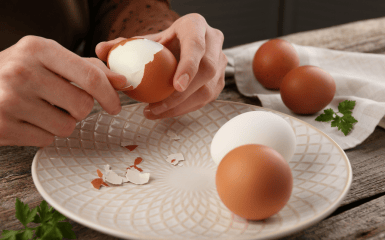
Scrambled eggs seem like one of the simplest dishes, but eggs often become a "gray" product in the refrigerator: you bought a package, used some, and the rest lies for weeks. Labeling on the box, advice from the Internet, and popular "tests" for freshness add to the confusion. It's safer to act logically: understand how an egg behaves over time, what the expiration date on the package actually means, and how to store the product in a way that minimizes risks.
Points of attention
- Understanding expiration dates: Learn how to interpret 'use by' and 'best before' dates on egg packaging for better safety practices.
- Proper storage guidelines: Discover practical tips for storing eggs in the refrigerator and avoiding common mistakes that can lead to eggs spoiling faster.
- Checking egg freshness: Explore reliable methods for assessing egg freshness, including evaluating during breakdown, the 'water test,' and checking the shell.
How packaging terms work: what they really mean
Eggs and packaging usually have dates associated with quality and/or safety. The wording may vary depending on the manufacturer.
"Use by" and "best before" are different approaches
“Use by” (or similar wording) is generally taken as a stricter guideline for safe consumption. After this date, risks increase, especially if storage conditions have been unstable.
"Best before" more often refers to quality (taste, white/yolk consistency) rather than guaranteed "danger" after the date.
If the labeling is not obvious, it is safer to interpret the date as a limit after which increased caution is required: checking each egg individually and avoiding raw/undercooked dishes.
Why eggs "get old" even if they haven't spoiled
Over time:
moisture and gases slowly escape through the pores of the shell;
the air chamber inside increases;
The white becomes thinner, the yolk flatter.
This does not always mean spoilage, but it does affect the culinary result: for poached eggs or "sunny" scrambled eggs, fresher ones are preferable.
How long can you store eggs at home: practical guidelines
It's difficult to name an exact "universal" time frame: the packaging date, initial freshness, temperature on the way from the store, and conditions at home are all important. Therefore, it's better to use a system of guidelines.
Refrigerator landmarks
If eggs are constantly stored in the refrigerator and not exposed to prolonged heating/cooling, they usually maintain their quality significantly longer than at room temperature.
For dishes with fully cooked eggs (well-fried scrambled eggs, omelets without a "liquid" middle, pastries), the permissible use is often wider than for raw creams or homemade mayonnaise.
Safe habit: plan your use so that the eggs don't get stale, and evaluate each one before cooking.
Room temperature: why it's a high-risk area
At room temperature, microorganisms potentially multiply more quickly. In addition, temperature changes (for example, “standing on the table - returned to the refrigerator”) increase the risk of condensation on the shell and the transfer of contaminants.
If the eggs have been kept warm for a long time, it is better to:
do not use them for dishes with minimal heat treatment;
carefully assess the condition of each egg;
If in doubt, dispose of it.
Proper storage: what really works
Where to keep eggs in the refrigerator
Inside the main chamber, not in the door. The temperature in the door fluctuates more often due to opening.
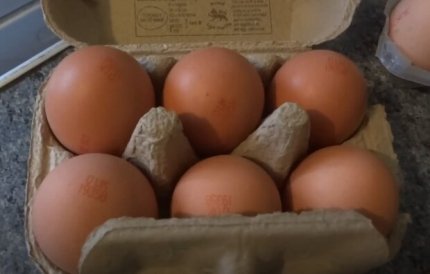
Preferably in the original packaging: it protects against odors from other products and partially from humidity fluctuations.
With the sharp end down - this way the air chamber on top remains more stable.
Do you need to wash eggs before storing them?
For home safety, it is usually more logical not to wash eggs in advance. Moisture can make it easier for contaminants to penetrate through the pores of the shell, as well as "smear" microflora on the surface.
It is better to do this:
wash (or wipe) the egg immediately before use if there is visible dirt;
Wash your hands after contact with the shell and do not touch clean products.
Odors, moisture, proximity of products
Eggs can absorb odors due to their porous shells. Store them in a box, away from strong-smelling foods.
Avoid situations where eggs "sweat" after being transferred from cold to warm.
How to check freshness: reliable methods for the kitchen
No home test provides a 100% guarantee of safety, but the combination of signs works well in practice.
1) Evaluation during breakdown
Break the egg into a separate bowl, and only then add it to the mixture - this way it's easier to discard the doubtful ones.
Signs that the egg is fresher:
the protein holds its shape, there is a denser part near the yolk;
The yolk is convex, does not spread.
Signs that it is better not to use an egg:
sharp unpleasant odor (hydrogen sulfide/putrid);
clearly changed color, suspicious inclusions, atypical mucus;
cracks with traces of leakage or stickiness of the shell.
2) “Water test” – how to interpret it correctly
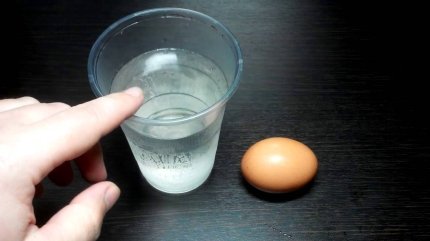
Popular method: dip the egg into water.
It lies horizontally on the bottom - usually fresh.
Standing upright or raised at one end — older (larger air chamber), but not necessarily damaged.
Floating - more often means significant moisture loss/gas exchange; it is better not to eat such an egg.
Important: The test mainly shows age/air chamber, not a guaranteed absence of dangerous bacteria.
3) Checking the shell
Matte, clean, without cracks is better.
Cracks, "spider webs", stickiness - a reason not to take risks.
Safety and heat treatment: when it's better not to experiment
The risks of food poisoning are not only related to freshness, but also to how you cook and what the raw egg comes into contact with.
Dishes that require increased caution
The potentially riskier ones include:
eggs with liquid yolk;
homemade sauces and creams based on raw eggs;
drinks with raw eggs.
If the eggs are not the freshest, have been stored questionably, or are being prepared for people at higher risk (children, pregnant women, the elderly, immunocompromised), it is better to choose full heat treatment.
Kitchen hygiene that really reduces risks
Wash your hands after contact with the shell.
Do not use the same cutting board/knife for foods that will not be cooked.
Do not leave the egg mixture at room temperature for a long time.
Cook the scrambled eggs to a state that, for you, means without liquid protein.
Practical tips: how to organize eggs in the refrigerator
Label the box with a marker: date of purchase or “opened.” It’s an easy check without the guesswork.
Keep your eggs in one place so you don't forget about them.
Use the "oldest first" principle: move new eggs to the back and old eggs to the front.
If in doubt about several eggs, do not mix them: check and cook them separately.
Common mistakes that make eggs spoil faster
Store in the refrigerator door (constant temperature fluctuations).
Wash the eggs in advance, and then keep them in the refrigerator for a long time.
Return eggs that have been sitting on the table for a long time to the refrigerator.
Break immediately into a common bowl for omelettes or dough.
Ignore the cracks and sticky shell.
To conclude about safety only based on the "water test".
FAQ: short answers to frequently asked questions
Can you eat eggs after the date on the package?
Sometimes an egg can remain good after the specified date if it has been kept consistently cold and shows no signs of spoilage. But the risks increase, so it is better not to use it for dishes with raw/undercooked eggs. When in doubt, it is safer to throw it away.
Is it true that a floating egg is definitely spoiled?
Floating often means the egg is old and has a large air pocket. This is a strong signal not to take any chances, but the final conclusion should be made after breaking it (into a separate bowl) and assessing the smell/appearance.
Can eggs be stored without a refrigerator?
Eggs can be stored for some time in a cool, stable place, but for household safety, a refrigerator is usually more reliable, especially if the house is warm or the temperature changes.
Why store eggs pointy end down?
This way the air chamber on top "moves" less, and the egg retains its better structure for longer. It's not magic, but a practical detail.
If an egg cracked in the refrigerator - what to do?
It's best not to store a cracked raw egg for long. If the crack is fresh and there is no odor, some people cook it immediately with a full cook, but it's safer to discard it, especially if you don't know when the crack appeared.
Can you freeze eggs in their shells?
This is usually a bad idea: the contents expand and the shell cracks. If necessary, it is more practical to freeze without the shell (beaten egg or separate whites/yolks) in a clean container, but it is important to maintain hygiene.
Why do eggs sometimes smell "sulfurous" when cooked, but aren't spoiled?
During heat treatment, sulfur-containing compounds may form - this is not always a sign of spoilage. Focus on the smell of a raw egg after breaking it: a sharp putrid smell is a signal to refuse.
Can I use older eggs for baking?
Often yes, if there are no signs of spoilage and the eggs were stored correctly, because baking undergoes a long heat treatment. But it is still better to break each egg separately.
Conclusion
The expiration date on the package is a useful guide, but home safety rests on three things: consistent cold storage, hygiene during preparation, and checking each egg before use. The most practical scheme for scrambled eggs and omelets: keep eggs in a carton on the shelf of the refrigerator, do not wash them beforehand, crack them one at a time into a separate bowl, and do not risk dishes with runny eggs if there is any doubt about their freshness.
undefined

