
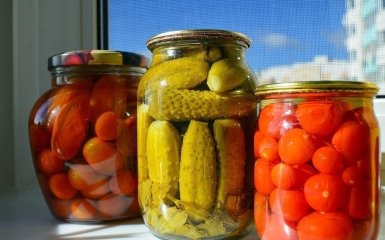
Home-made preserves can be stored in a pantry or cellar for months, retaining their familiar appearance and taste. However, a hermetically sealed jar does not mean that its contents will remain suitable for consumption indefinitely. The shelf life depends on the products, acidity, method of preservation, temperature, and compliance with cooking technology.
Points of attention
- Properly made homemade twists are recommended to be used within a year, but the term itself does not guarantee safety.
- Mushrooms, meat, and fish require special care: low-acid canned foods require pressure processing using proven technology.
- Closed jars should be stored in a dry and dark place at a temperature of approximately 10–21 °C, and after opening, in the refrigerator.
Be especially careful with homemade mushrooms, meat, fish, and vegetable preparations. If they have been canned incorrectly, even a jar without a swollen lid can be dangerous due to the risk of botulism.
According to the recommendations of the Ministry of Health of Ukraine and the National Center for Home Canning in the United States, it is advisable to use homemade pickles within one year. However, one year is not a guarantee of safety: improperly prepared preserves can become dangerous much earlier.
Let's look at how long various homemade preserves can be stored, at what temperature to keep them, how to check jars, and what to do if there is canned food left over from previous years.
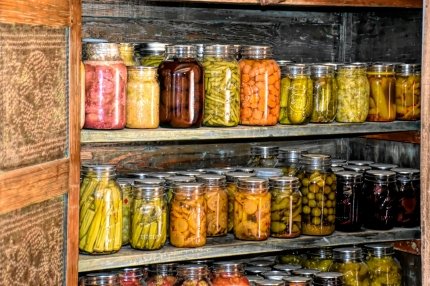
What determines the shelf life of home preservation?
The shelf life of the twists is determined not only by the recipe. The most important things are the acidity of the product, the correct heat treatment, and the tightness of the packaging.
For example, sour berry jam and meat stew require fundamentally different preservation methods.
Acidity of products
According to food safety rules, canned foods are divided into acidic and low-acid.
Acidic foods have a pH of no higher than 4.6. These include most fruits, berries, and properly acidified pickled vegetables.
Low-acid foods have a pH above 4.6. These include meat, fish, mushrooms, beans, carrots, and most fresh vegetables.
This distinction is extremely important because of the bacterium Clostridium botulinum , which under certain conditions can produce dangerous botulinum toxin.
In properly acidified products with a pH no higher than 4.6, the development of these bacteria is blocked by acidity. However, in low-acid hermetic canned foods, the risk is much higher if the processing technology is violated.
Canning method
Many proven recipes for acidic foods use boiling water to process jars.
Low-acid canned food requires special equipment that provides heat treatment under pressure according to set parameters.
Simply boiling cans in a saucepan does not guarantee the destruction of botulism spores.
Temperature and storage conditions
Even properly preserved products lose quality more quickly in a warm room.
High temperatures accelerate changes in color, flavor, and consistency. Humidity can contribute to corrosion of metal lids and loss of seal.
Therefore, the storage location should be cool, dry, dark and protected from sudden temperature fluctuations.
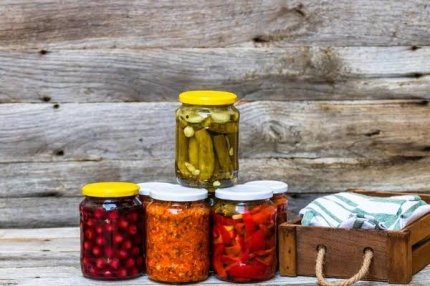
How long do homemade spins last: table
There is no universal term for home canning that would guarantee the safety of all products.
The US National Center for Home Canning recommends planning your supplies so that they are used within a year of preparation.
This is primarily a guideline for properly made preservation according to proven recipes.
| Type of workpiece | Storage reference | Important conditions |
| Jams and preserves | Use within a year | Proven recipe and proper heat treatment |
| Compotes and fruit juices | Use within a year | Sufficient acidity and proper preservation |
| Pickles | Use within a year | Acid concentration checked |
| Pickled tomatoes | Use within a year | Proper acidification |
| Lecho and vegetable salads | Use within a year | The processing method depends on the composition and acidity. |
| Canned mushrooms | Use within a year only with proven safe technology | Low-acid mushrooms require pressure processing |
| Meat stew | Use within a year only with proven safe technology | Pressure treatment according to a proven regimen |
| Canned fish | Use within a year only with proven safe technology | Particularly high process requirements |
| Sauerkraut without heat treatment | According to the recipe and refrigerated storage conditions | Not a regular room temperature can |
| Raw jam without cooking | In the refrigerator or freezer | The shelf life depends on the recipe and storage method. |
Important: The dates listed do not mean that any homemade mushrooms, stew, or vegetable salad can be safely stored for a year. If the preparation method did not meet the verified requirements, the product cannot be considered safe regardless of the date.
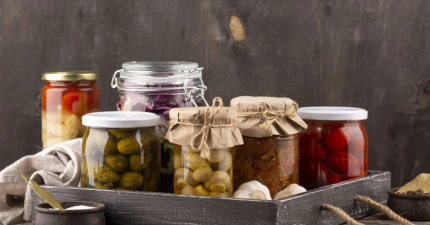
How long can you store homemade jams and preserves?
Jam is one of the most common homemade preparations.
Its storage ability depends on the acidity of the fruit, sugar concentration, preparation method, and airtightness.
For traditional boiled jam, made according to a proven recipe and properly preserved, a practical guideline is one year.
After this, the color, aroma, consistency, and taste may deteriorate.
Can jam be stored for two or three years?
Hermetically sealed jam sometimes shows no visible signs of spoilage even after several years.
However, the absence of such features is not a basis for guaranteeing its suitability.
The Ministry of Health of Ukraine recommends not using homemade canned food that has been stored for more than a year.
Therefore, you should not specifically stockpile jam for several seasons.
Does jam with a lot of sugar last longer?
Sugar in sufficient concentration reduces the availability of water to many microorganisms, which helps to inhibit their growth.
However, it is not a substitute for proper preservation.
Jam with reduced sugar content may lose quality more quickly and have different recipe and storage requirements.
If mold appears on the surface, you don't need to remove just the top layer. Food safety experts recommend disposing of the entire contents of the can.
How long do compotes and juices last?
Homemade compotes are usually made from fruits or berries that naturally contain organic acids.
With proper preservation, such preparations can be planned for use throughout the year.
However, it is not only the fruit that is important, but also the method of processing.
Just pouring boiling water over the fruit and screwing the lid on does not guarantee proper preservation. Safety depends on a proven recipe and appropriate heat treatment regimen.
Do fruit stones affect shelf life?
The common rule that all compotes with seeds must be consumed within six months is not a universal scientifically based norm.
The type of fruit, the integrity of the seeds, and the method of preparation are important.
The seeds of some fruits, including apricots and bitter almonds, contain compounds that can release cyanide under certain conditions.
Therefore, you should not arbitrarily add crushed seed kernels to homemade preparations.
For canned fruit, you need to use proven recipes that provide for the appropriate method of preparing the fruit.
How long do pickled cucumbers and tomatoes last?
Pickled vegetables may be suitable for storage at room temperature if the product has sufficient acidity and has undergone proper heat treatment.
For such spins, it is also advisable to focus on use within one year.
However, not every pickled cucumber or tomato recipe provides the desired level of acidity.
Why it is dangerous to change the amount of vinegar
In proven recipes, vinegar is added not only for taste.
Its concentration and ratio with water, vegetables, and other ingredients help provide the necessary acidity of the product.
If you reduce the amount of vinegar, increase the amount of vegetables, or arbitrarily change the proportions, the product may no longer meet the requirements for safe canning.
Especially risky are recipes in which the acidic marinade is replaced with a small amount of citric acid without confirmed proportions.
The sour taste does not allow you to accurately determine the pH of the finished product.
What is the difference between pickled vegetables and pickled ones?
Pickling usually involves the addition of acid.
Sourdough is a fermentation process during which lactic acid bacteria convert some of the carbohydrates into organic acids.
Properly conducted fermentation can provide the desired level of acidity, but the composition of the brine, temperature, duration, and process conditions are important for this.
Fermented products without further proper preservation should not automatically be considered suitable for long-term storage in a warm pantry.
How long do homemade mushrooms last?
Homemade mushroom preserves require special attention due to the risk of botulism.
Mushrooms are naturally low-acid foods.
Simply boiling them, putting them in jars, and sealing them tightly does not provide proven safe canning.
Why mushrooms can't be canned like regular compote
Clostridium botulinum spores can persist after conventional boiling.
In a sealed jar with low acidity, conditions are created under which bacteria are potentially able to grow and produce a toxin.
Low-acid canned mushrooms require special pressure canning according to a proven recipe.
Pickled mushrooms may have different requirements as long as the recipe provides sufficient acidification and proper processing.
At the same time, not every mushroom marinade can be considered safe just because it contains vinegar.
If you do not know the technology used to make homemade canned mushrooms, it is better not to consume them.
Can homemade stew be stored for several years?
Homemade stew is one of the riskiest types of preservation due to technological violations.
The meat has low acidity and requires a special pressure cooking regime.
Conventional boiling of cans, baking them in the oven, or prolonged cooking is not an equivalent substitute for proven meat canning technology.
Why conventional sterilization is not suitable
At boiling water temperatures, spores of the botulism pathogen can remain viable.
For low-acid canning, temperatures of approximately 116–121 °C, achievable in appropriate pressure equipment, are used.
Specific parameters depend on the product, can volume, altitude, and the tested processing mode.
You cannot set a universal time or temperature for all types of stew.
Also, not every regular pressure cooker or electric multicooker is suitable for safely canning low-acid foods.
How long to store properly cooked stew
For home canning, the general guideline remains to use the product within one year.
Industrial stew may have a much longer shelf life than the manufacturer claims, but it is wrong to transfer these dates to home canning.
Industrial production involves other technological control and safety verification systems.
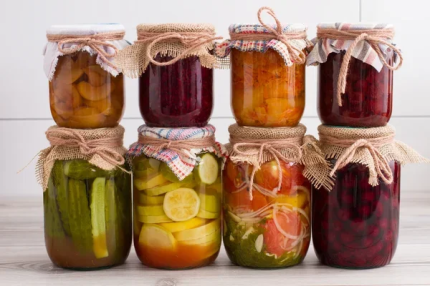
At what temperature should homemade twists be stored?
Properly preserved foods intended for storage without refrigeration are best kept in a cool, dry, and dark place.
The US National Center for Home Canning recommends a temperature of approximately 10–21 °C for preservation quality.
At higher temperatures, foods lose color, flavor, and nutritional properties more quickly.
It is especially undesirable to store curls near batteries, stoves, heating pipes, or in direct sunlight.
Temperatures above 35 °C are not suitable for safe long-term storage of home-canned food.
Can I keep jars on the balcony?
A balcony does not always provide stable conditions.
In summer, the temperature there can rise sharply, and in winter, it can drop below zero.
Freezing the contents can damage the glass jar or break the seal.
Therefore, an unheated balcony with large temperature fluctuations is not an optimal storage location.
Is the basement suitable?
A cool, dry cellar can provide the right conditions.
However, it is necessary to monitor humidity, the condition of the shelves, the presence of mold, and possible temperature changes.
If metal lids are constantly covered with condensation or rust, storage conditions need to be changed.
How to tell if home-made preserves have gone bad
Some signs help identify jars that absolutely should not be opened for tasting.
These include:
A deflated or deformed cover.
Liquid leaking from under the cover.
Cracks in the glass and other damage to the jar.
Severe corrosion of the cover.
The appearance of mold.
Unusual foaming or leaking of contents under pressure.
If the can has these signs, the product should not be tasted, even in small quantities.
However, there is an important nuance.
The normal appearance, smell, and taste of homemade canned goods do not guarantee the absence of botulinum toxin.
The US Centers for Disease Control and Prevention emphasize that this toxin cannot be reliably detected by the senses.
Therefore, the main safety criterion is compliance with proven manufacturing technology, not just the external condition of the can.
Can you eat homemade twists that are two or three years old?
Sometimes jars prepared several seasons ago are found in the pantry.
If the lid is not blown off, there is a temptation to open the workpiece and check the taste.
However, this method of verification is dangerous.
The Ministry of Health of Ukraine recommends not using home-canned food that has been stored for more than one year.
This is especially true for blanks with unknown recipe, storage conditions, and heat treatment method.
Can you re-boil an old twist?
Heating may affect certain toxins and microorganisms, but does not automatically make a product with compromised preservation technology safe.
Low-acid canned foods may contain heat-resistant spores, and without proper process control, the result cannot be guaranteed.
Therefore, there is no need to try to "save" suspicious home-canned food by re-boiling.
If the safety of a product is in doubt, it should be disposed of.
How long do homemade canned goods last after opening?
After opening the can, the vacuum seal is broken, and the contents come into contact with air, dishes, and microorganisms in the environment.
From this point on, the product can no longer be stored according to the rules of closed preservation.
It needs to be put in the refrigerator.
The USDA provides the following guidelines for opened canned foods:
| Product | Storage guideline after opening |
| Meat, fish and other low-acid canned foods | 3–4 days |
| Fruits, fruit juices, acidic marinades | 5–7 days |
| Traditional boiled jam with enough sugar | Best used within about a month |
| Reduced sugar jam | May have a shorter term |
| Fermented foods | Depending on the recipe and storage conditions |
These deadlines assume proper preparation of the product and refrigerated storage at a temperature not exceeding 4 ° C. They do not apply to canned goods that were unsafe even before opening.
How to properly store an open jar
To remove food, use a clean spoon or other clean utensils.
You shouldn't leave open canned food on the table for long.
This is especially true for meat and fish products.
If mold appears in an open jam, it is necessary to throw away the entire contents, not just the affected part.
Why a tight-fitting lid doesn't always mean safe
Vacuum sealing is important, but it is no substitute for proper heat treatment.
For example, if low-acid vegetables are sealed in a jar after conventional boiling, the lid may retract during cooling.
This indicates the creation of a vacuum, but does not prove that the dangerous spores have been destroyed.
How to check jars after canning
For standard two-component lids, experts recommend letting the jars cool for approximately 12–24 hours and then testing for leaks according to the instructions.
In a properly closed jar, the central part of the lid is usually slightly retracted and does not spring back when inspected.
For other types of lids, follow the manufacturer's recommendations.
If the jar is not sealed, you cannot leave it on the shelf with other twists.
The decision to re-can, chill, or freeze depends on the type of product and whether proven technology was followed initially.
Five mistakes that shorten the shelf life of your spins
1. Canning according to untested recipes
Random recipes for canned meat, mushrooms, and vegetables that do not take into account acidity and the required processing regime can be especially dangerous.
Even if the blanks have been successful before, this does not prove the safety of the technology.
2. Randomly changing the amount of vinegar
In pickled foods, vinegar helps provide the necessary acidity.
Reducing its quantity without verified calculations can change the conditions for the development of microorganisms.
3. Using damaged jars and lids
Cracks in the glass, damage to the seal and deformations can compromise the tightness.
For lids, it is important to follow the manufacturer's instructions, particularly regarding reusability.
4. Storage near heat sources
High temperature accelerates deterioration and can negatively affect tightness.
Do not keep the twists in a cupboard directly next to the oven or radiator.
5. No date of preparation
Without labeling, it is difficult to determine which cans were made this year and which were left over from previous seasons.
This is especially important for families who stock up on large amounts of food each year.
How to properly organize the storage of home canned goods
For homemade preparations, it is useful to create a simple accounting system.
Each jar should state:
Product name.
Month and year of preparation.
If necessary, batch number or recipe features.
For example, the inscription "Pickled cucumbers - August 2026" allows you to quickly determine the age of the product.
The new season's jars can be placed in the back, and last year's jars, which are still within the recommended use period, can be placed in the front.
It is better to place heavy jars on sturdy lower shelves.
Do not place excessive strain on the lids by stacking multiple layers of jars without proper support.
It is also worth periodically checking the shelves for moisture, damaged glass, and corrosion.
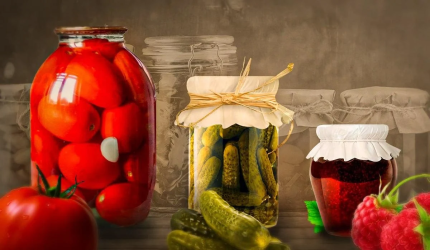
Is it worth conducting a pantry audit every year?
Yes, especially before the start of the new canning season.
During the inspection, old cans, products with unknown dates, and blanks made using questionable technology should be separated.
Do not open suspicious jars to check the smell.
If there are signs of spoilage or a risk of botulism, contact with the contents should be avoided and safe disposal should be performed.
Why botulism is the main danger of home canning
Botulism is a serious disease that occurs as a result of the action of botulinum toxin on the nervous system.
In home canning, the greatest risk is associated with improperly processed low-acid products that are stored in conditions of lack of oxygen.
Canned meat, fish, mushrooms, and some vegetables require the greatest caution.
What symptoms may indicate botulism?
Symptoms may include:
Double or blurred vision.
Drooping eyelids.
Dry mouth.
Speech disorders.
Difficulty swallowing.
Muscle weakness.
In severe cases, respiratory failure.
The first symptoms may appear at different times after consuming contaminated food.
If botulism is suspected, seek immediate medical attention. The disease can progress rapidly, so it is dangerous to wait for symptoms to disappear on their own.
You should also not taste test suspicious canned goods: even a small amount of botulinum toxin poses a serious threat.
Conclusion
Homemade twists are best planned to be used within a year of preparation. This is in line with food safety experts' recommendations, but only applies to products that have been properly preserved.
Jams, compotes, pickled vegetables, mushrooms, and stewed foods have different acidity and heat treatment requirements. Low-acid canned foods made without special equipment can be especially dangerous.
The main rule is not to rely solely on the appearance of the can. The correct recipe, appropriate canning method, cool storage, and timely use of the preparations are more important than any home methods of checking freshness.
FAQ: Frequently asked questions about the shelf life of homemade spins
How many years can you keep home-canned food?
According to the recommendations of the Ministry of Health of Ukraine, home-canned food that has been stored for more than a year should not be used. For properly made twists, one year is also a guideline for the best quality. However, the term itself does not guarantee the safety of the product.
Can you eat two-year-old twists?
Not recommended. Even if the can is airtight and has no visible signs of spoilage, this does not confirm its safety. It is especially dangerous to taste old canned meat, fish, mushrooms, and low-acid vegetables.
How long does homemade jam last?
Traditional boiled jam, properly preserved according to a proven recipe, is best used within a year. After opening, it should be kept in the refrigerator. For regular jam with a sufficient amount of sugar, the guideline is about one month after opening.
Can pickled cucumbers be stored for two years?
For home-made pickles, it is advisable to plan to use them within a year. Safety depends on a proven recipe, proper acidity, and heat treatment. Storage for two years does not meet the prudent guidelines for home preservation.
How long does homemade stew last?
For homemade stew, a general guideline is one year only if properly pressure canned using proven technology. Meat sealed after conventional boiling or oven processing cannot be considered safe for long-term storage.
Why does the lid on a can of preserves blow off?
Bloating can occur due to gas formation due to microbiological spoilage or other disturbances. Such a jar should not be tasted. However, the absence of bloating does not guarantee the absence of botulinum toxin.
What is the best temperature to store twists at?
For properly prepared canned goods intended for storage without refrigeration, the optimal guideline for preserving quality is approximately 10–21 °C. The room should be dry and dark, without sudden temperature fluctuations.
Can I store homemade preserves in the refrigerator?
Yes, but the need for refrigeration depends on the type of product. Properly prepared, sterilized canned goods can be stored under the appropriate conditions without refrigeration. Raw jam, some fermented foods, and all opened cans require refrigeration.
How long do open pickles last?
For properly preserved acidic foods, a general guideline after opening is 5–7 days in the refrigerator at a temperature not exceeding 4 °C. For individual industrial or fermented foods, conditions may vary. If the product shows signs of spoilage, it should be disposed of earlier.
Can botulism be detected by the smell or taste of canned food?
No. Botulinum toxin cannot be reliably identified by smell, taste or appearance. Even a small sample of contaminated product can be dangerous. If there is uncertainty about the correctness of the canning process, the product should not be consumed.
The material is for informational purposes only and does not replace medical advice. Self-medication can be harmful to health. If you suspect botulism or develop neurological symptoms after consuming home-canned food, you should seek medical attention immediately. Canning technologies should be used only according to proven recipes with appropriate equipment.

