
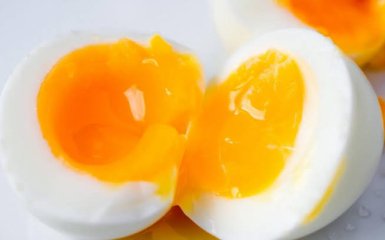
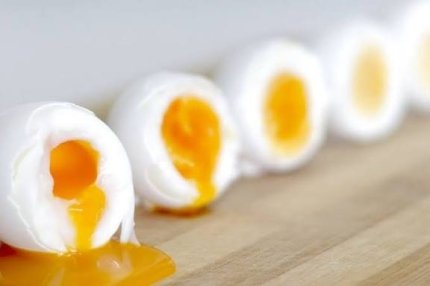
To get an egg with a runny yolk and a soft white, it usually takes 5–6 minutes. For a creamy center, it takes about 7–8 minutes, and for a completely hard yolk, it takes about 10–12 minutes. However, these values are not valid for all cooking methods: the result depends on the size of the eggs, their initial temperature and the moment from which the timer is started.
If you put medium or large chicken eggs in boiling water, the yolk will usually be runny after 6 minutes, creamy after 8 minutes, and completely hard after 11–12 minutes. If you start cooking in cold water, you need to use a different calculation.
Points of attention
- When eggs are placed in boiling water, a runny yolk usually forms in 5–6 minutes, a creamy yolk in 7–8, and a hard yolk in 11–12 minutes.
- Cooking time depends on the size and temperature of the eggs. For boiling in cold water, a different calculation is required.
- Moderate boiling and careful immersion help reduce the risk of cracking, while rapid cooling helps maintain the desired consistency of the yolk.
- Eggs with a runny yolk have a higher risk of foodborne infections; to minimize the risk, both the white and yolk should be fully cooked.
- Eggs are stored cool in the refrigerator at a temperature not higher than +4 °C and used within seven days.
For salads, deviled eggs, and dishes that are prepared in advance, it is important to have both the white and yolk fully cooked. For breakfast with toast, a softer consistency is often chosen, although undercooked eggs have additional food safety risks.
The American Egg Board, the United States Department of Agriculture (USDA), and culinary experts at BBC Good Food recommend monitoring not only the duration of heating, but also the rate of cooling after cooking.
Let's look at how long to cook eggs after boiling, the differences between cold and hot water methods, how to avoid cracks, why the shell is difficult to remove, and how long you can store cooked eggs.

How many minutes to boil eggs: time table
The values given are suitable as a starting point for regular medium and large sized chicken eggs.
Important: The time in the table is counted from the moment the eggs are immersed in boiling water. After immersion, adjust the heat so that the water continues to boil moderately.
| Cooking time | Protein status | Yolk condition |
| 4–5 minutes | Partially or mostly seized | Very liquid |
| 6 minutes | Mostly ready | Liquid |
| 7 minutes | Dense | Soft, partly creamy |
| 8 minutes | Completely caught up | Thick, creamy |
| 9 minutes | Dense | Mostly thick, with a soft middle |
| 10 minutes | Dense | Almost or completely solid |
| 11–12 minutes | Completely ready | Firm |
| 13–14 minutes | Dense | Completely solid, possible overdrying |
The time is approximate. Particularly large eggs from the refrigerator may need an extra minute or more.
At the same time, small eggs will cook faster.
For consistent results, it is advisable to use the same cooking method, approximately the same size eggs, and the same temperature each time.
How long to boil soft-boiled eggs so that the yolk remains liquid
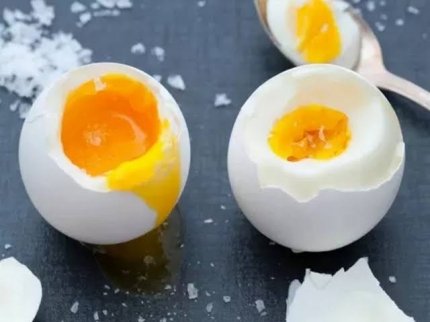
A soft-boiled egg has a tender white and a liquid or semi-liquid yolk.
For this result, a medium-sized chicken egg is usually dipped in boiling water for about 5–6 minutes.
The time depends on the initial temperature.
For example, an egg that has just been taken out of the refrigerator may take a little longer to cook than the same egg that is already at a higher temperature.
How to properly boil an egg with a runny yolk
Pour water into the pan so that it can completely cover the eggs.
Bring the water to a boil.
Carefully lower the eggs with a spoon.
Reduce heat to a gentle simmer.
Set the timer for about 6 minutes.
Once finished, immediately transfer the eggs to cold water.
Cool slightly before serving.
If you need a very runny yolk, you can reduce the time slightly.
But it is important to understand: short cooking does not always ensure that the egg is fully heated to the temperature necessary to destroy dangerous bacteria.
The FDA recommends that to minimize the risk of foodborne infections, cook eggs until the white and yolk are completely set.
How long to boil eggs in a bag
Eggs in a pouch occupy an intermediate position between soft-boiled and hard-boiled eggs.
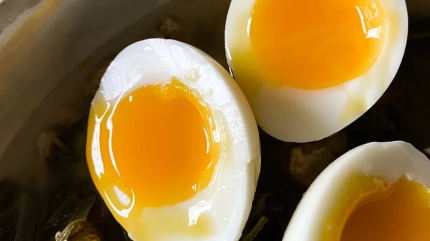
The white is already quite dense, and the yolk remains soft, thick, or creamy.
For this result , 7–9 minutes after immersion in boiling water is usually used.
What will be the result after 7, 8 and 9 minutes?
After 7 minutes, the yolk often has a soft texture with a runnier center.
After 8 minutes, the middle may become thick, similar in consistency to cream.
After 9 minutes, most of the yolk is usually firm, but the center sometimes remains soft.
These are the eggs that are often used for ramen, salads, and breakfasts.
However, the actual result must be evaluated taking into account the size of the egg.
Why it's important to refrigerate eggs immediately
The egg remains hot after the heating is turned off.
Heat continues to transfer inward, so the yolk may become denser even after the pan has been removed from the stove.
To better control the consistency, the finished eggs are transferred to cold water.
This is especially important for eggs with creamy yolks, where even an extra 1–2 minutes of heating can make a noticeable difference in the outcome.
How long to boil eggs
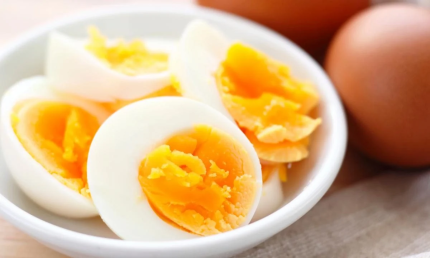
A hard-boiled egg should have a fully cooked white and a firm yolk.
If the eggs are dropped into boiling water, the approximate time is 10–12 minutes , and sometimes longer for large or very cold eggs.
For salads and deviled eggs, make sure there is no liquid in the center.
How to hard boil eggs without over-dried yolks
Do not use excessive boiling.
After lowering the eggs, maintain moderate heat.
Do not leave eggs in boiling water for much longer than necessary.
Once done, transfer them to cold water.
This method helps avoid a dry, brittle middle and too dense white.
How long to boil eggs for Olivier
Olivier requires fully cooked eggs.
If you are using the boiling water method, a starting point might be 11–12 minutes for regular large chicken eggs.
After cooking, cool them, peel and chop.
There is no need to leave eggs in a hot pan until they have completely cooled naturally.
How to properly boil eggs in cold water
This is another method that should not be confused with cooking in already boiling water.
The American Egg Board recommends placing eggs in a single layer in a saucepan, covering with cold water, and bringing to a boil.
After boiling, remove the pan from the heat, cover with a lid, and leave the eggs in the hot water until fully cooked.
How long to keep eggs after boiling
For large eggs, the American Egg Board recommends about 12 minutes of standing time in hot water after turning off the heat.
The USDA recommends about 15 minutes for large eggs for a similar method.
This difference is due to the cooking conditions and the specifics of the specific instructions.
In any case, it's not 12–15 minutes of active boiling .
This involves leaving the eggs covered in hot water after heating is complete.
Why can't you use the same table for both methods?
When eggs are placed in cold water, they begin to heat up long before it boils.
If the pan is large or the burner is low-power, this stage may take noticeably longer.
During this time, the egg white and yolk are already partially cooked.
Therefore, six minutes after boiling from a cold start is not equal to six minutes from the moment of immersion in boiling water.
For a predictable result, you need to follow one proven algorithm.
Which method is better: putting eggs in cold or boiling water?
Both methods have advantages.
| Criterion | Cold water | Boiling water |
| Start of heating | Gradual | Fast |
| Countdown | Depends on the chosen method | From the moment of immersion |
| Soft yolk control | Less predictable without a proven pattern | More convenient with a timer |
| Risk of mechanical shock | Smaller during laying | Careful immersion required |
| Ease of cleaning | May vary | A hot start sometimes helps |
| Cooking cool | Convenient with exposure time under the lid | Convenient with time control |
If the goal is to achieve a specific yolk consistency, the boiling water method is often easier to repeat.
If you need to hard boil a few eggs, the method with cold water and subsequent standing is also suitable.
In any case, it is important to consider food safety rules.
How to properly boil eggs so they don't crack
The shell can be damaged by hitting the bottom of the pan, colliding with other eggs, or a sudden change in temperature.
It is impossible to completely avoid cracks, but you can reduce their likelihood.
Crack-free cooking rules
Use a pan of the appropriate size.
Place the eggs in a single layer.
Do not throw them into boiling water.
Lower the eggs carefully with a spoon.
Do not allow the water to boil vigorously.
Do not press the eggs against each other.
Do not use eggs with visibly damaged shells.
For the cold water method, you can first place the eggs in the bottom of the pan and then cover with water.
Do I need to take eggs out of the refrigerator in advance?
Eggs from the refrigerator may have a greater temperature difference with boiling water.
However, you don't need to leave them at room temperature for a long time for cooking.
The FDA recommends not keeping eggs and other perishable foods unrefrigerated for more than two hours.
For consistent results, it's best to use the same cooking method and keep in mind that cold eggs may take a little longer.
Does salt or vinegar help prevent eggs from cracking?
It is often recommended to add salt or vinegar to the water.
However, these additives do not make the shell resistant to impacts and do not guarantee the absence of cracks.
If an egg hits the bottom of the pan hard, adding salt is unlikely to prevent damage.
Vinegar can help the protein that leaks through the crack to coagulate more quickly.
But that doesn't mean the acid eliminates the root cause of the shell damage.
Is it necessary to salt the water?
No.
For regular egg boiling, salt is not a necessary ingredient.
It also does not provide a universal reduction in cooking time.
It is much more important to choose the right pan, control the boiling, and not damage the eggs while dipping.
Is it possible to pierce an egg with a needle?
Some home methods involve piercing the shell from the blunt end.
However, this procedure creates additional damage to the egg's natural barrier and may increase the risk of contamination.
For ordinary home cooking, there is no need for such manipulation.
Why eggs don't peel well after boiling
Sometimes the shell is removed along with part of the protein.
As a result, even a properly cooked egg has an uneven surface.
The reason may be related to the freshness of the egg, the condition of the membranes under the shell, and the method of preparation.
Why very fresh eggs are harder to peel
In a very fresh egg, the white and subshell membranes can hold together more tightly.
Over time, the properties of an egg change.
Because of this, eggs that are not freshly laid sometimes peel more easily.
At the same time, America's Test Kitchen notes that the right heating method can make peeling even fresh eggs much easier.
How to peel an egg without damaging the protein
The American Egg Board recommends cooling eggs after cooking and then gently cracking the shells.
Practical way:
Transfer the cooked eggs to cold water.
Let them cool.
Lightly tap the egg on a hard surface.
Roll it carefully so that the shell cracks in several places.
Start cleaning from the blunt end.
Try to remove the shell along with the thin membrane.
If necessary, clean under a small stream of cool water.
There is usually an air chamber at the blunt end, so it is sometimes easier to pick up the shell there.
However, no method guarantees perfect cleaning of every egg.
Why do eggs need to be cooled after cooking?
Cold water helps to quickly reduce the temperature of the outer layers of the egg and limit further cooking.
This is especially useful for soft or creamy yolks.
If you leave hot eggs in the pan, they may continue to warm.
As a result, the yolk will become harder than planned.
How to properly cool eggs
Prepare a bowl of cold water.
Add ice if possible.
Immediately after cooking is complete, transfer the eggs to the water.
You can leave them for about 10–15 minutes to cool completely, depending on the size and quantity.
If you plan to store eggs, after cooling, they must be placed in the refrigerator in a timely manner.
Do not leave cooked eggs on the kitchen counter for long periods of time.
Why does the yolk turn green or gray after cooking?
Sometimes a gray-green ring appears around the yolk.
This is especially common after cooking for too long or cooling slowly.
The reason is a chemical reaction between the sulfur compounds contained in the protein and the iron from the yolk.
This results in the formation of iron sulfide, which changes the color of the outer part of the yolk.
The University of Nebraska explains that this coloration in itself does not mean that the egg is spoiled.
Can you eat an egg with a greenish yolk?
If the egg was fresh, properly cooked, and stored correctly, the greenish ring itself is not a sign of danger.
However, other signs of spoilage need to be evaluated separately.
An unpleasant odor, suspicious appearance, or violation of storage conditions are reasons not to use the product.
How to avoid the green ring
Do not overcook eggs.
Do not leave them in hot water for a long time after cooking is complete.
Refrigerate immediately after cooking.
This also helps preserve the more delicate structure of the white and yolk.
How egg size affects cooking time
Small and large chicken eggs warm up at different rates.
That's why the universal instruction "cook for exactly seven minutes" can give different results.
For example, a large egg from the refrigerator may take some time to produce a creamy yolk, while a small egg under the same conditions will already be almost fully cooked.
What are the differences between egg categories in Ukraine?
In traditional Ukrainian labeling, weight categories are determined by the weight of the egg with the shell.
In particular:
С0 — from 63 to less than 73 g.
C1 - from 53 to less than 63 g.
C2 - from 45 to less than 53 g.
SV - from 73 years.
The letter "C" indicates table eggs, and the number or additional letter indicates the weight category.
This is not an indicator of taste or nutritional quality.
Do I need to change the time for large eggs?
Yes, sometimes it is necessary.
If the recipe calls for medium-sized eggs, large eggs may need about 1–2 minutes more to achieve a similar consistency.
However, this is only a culinary guideline.
The actual difference depends on the initial temperature, heating method, and specific size.
For the most predictable result, use eggs of the same weight category.
Can you steam eggs?
Yes.
Steaming is an alternative to conventional cooking in water.
It can give a fairly stable result if you control the time and use eggs of the same size.
Serious Eats experts recommend aiming for about 6 minutes for soft-yolk eggs and about 12 minutes for fully cooked eggs.
This is the value for a specific cooking method with steam already formed.
How to steam eggs
Pour some water into the pan.
Position the steaming basket so that the eggs are not in the water.
Bring the water to a boil.
Carefully place the eggs in the basket.
Cover the pot with a lid.
Leave for a time according to the desired consistency and size.
When finished, transfer the eggs to cold water.
For a large number of eggs or a different steamer design, the duration may vary.
Why eggs need to be cooked longer in the mountains
The boiling point of water depends on atmospheric pressure.
At higher altitudes above sea level, atmospheric pressure is lower, so water boils at a lower temperature.
This means that food may cook more slowly, even if the water is actively boiling.
Colorado State University Extension explains that at high altitudes, eggs often take longer to fully cook.
For normal conditions in most Ukrainian cities, this difference is small.
But when cooking in high altitudes, standard time tables may be less accurate.
Is it safe to eat eggs with runny yolks?
Eggs can contain Salmonella bacteria even when the shell looks clean and intact.
The FDA recommends cooking eggs until the white and yolk are completely set to reduce the risk of foodborne infections.
At the same time, culinary recipes with liquid yolk require a lower degree of heat treatment.
A partially cooked egg cannot automatically be considered as safe as a fully cooked one.
Who is better to choose hard-boiled eggs?
Particular caution should be observed:
Pregnant.
For small children.
For older people.
Individuals with a weakened immune system.
People with certain chronic diseases.
For these groups, the consequences of foodborne infections can be more serious.
In the UK, there are specific guidelines for eggs produced under specific Salmonella control programmes. However, these cannot be automatically extended to all eggs sold in Ukraine.
If a recipe calls for raw or undercooked eggs, suitable pasteurized egg products may be a safer alternative.
How long can you keep boiled eggs in the refrigerator?
According to FDA and USDA recommendations, hard-boiled eggs should be stored in the refrigerator and used within one week of cooking .
This applies to both peeled eggs and those that remain in the shell.
The refrigerator should maintain a temperature no higher than +4 °C.
Can you leave boiled eggs on the table?
Perishable foods should not be left at room temperature for more than two hours.
If the air temperature exceeds +32 °C, this time is reduced to one hour.
Therefore, eggs boiled in the evening should not be left on the table until the morning.
After cooking, they need to be cooled and put in the refrigerator in a timely manner.
How to store peeled eggs
Place them in a clean, sealed food container.
This will help protect the product from foreign odors and re-contamination.
Do not store eggs near raw meat or foods that may spill juices.
If the egg was cut and mixed with other ingredients, the shelf life of the finished dish will also depend on these components.
Can you freeze boiled eggs?
FoodSafety.gov does not recommend freezing whole hard-boiled eggs.
After defrosting, the egg white may become rubbery, watery, or lose its pleasant texture.
Therefore, for salads and everyday dishes, it is better to prepare the amount of eggs that can be used within the recommended period.
Do not confuse freezing cooked eggs with storing raw egg products, for which there are different rules.
Why a boiled egg can have an unpleasant smell
When protein compounds are heated, volatile substances with a characteristic sulfurous odor may be formed.
The slight specific smell of a boiled egg in itself does not necessarily indicate spoilage.
However, a strong putrid or unusual odor is a reason not to use the product.
It is also undesirable to use eggs that have been stored incorrectly.
It is important to remember that the absence of an unpleasant odor does not guarantee microbiological safety.
Therefore, the most reliable prevention is proper storage and sufficient heat treatment.
The most common mistakes when boiling eggs
1. Do not specify the start point of the countdown. Different algorithms are required for cold and boiling water.
2. Cook all eggs the same amount of time. Large eggs usually take longer than small ones.
3. Using too much boiling water can cause the eggs to hit the pan and crack.
4. Drop the eggs into the boiling water. It is better to carefully lower them with a spoon.
5. Leaving cooked eggs in hot water can change the consistency of the yolk and cause it to dry out.
6. Consider salt a guarantee against cracks. It does not eliminate the mechanical causes of shell damage.
7. Pierce eggs with a needle unnecessarily. This creates additional damage to the shell.
8. Do not refrigerate eggs after boiling. Further heating may ruin the desired consistency.
9. Consider the green ring a sign of damage. In itself, it often occurs due to overheating.
10. Leaving boiled eggs on the table overnight is not in accordance with food safety guidelines.
11. Keep hard-boiled eggs for more than a week. The FDA recommends using them within seven days.
12. Consider eggs with a runny yolk completely safe for everyone. Insufficient heat treatment can increase the risk of infections.
Conclusion
The cooking time for eggs depends on their size, initial temperature, and heating method.
If eggs are dropped into boiling water, after about 6 minutes you can get a runny yolk, after 7–8 minutes you can get a creamy one, and after 11–12 minutes you can get a completely solid one.
If the eggs start to cook in cold water, you need to use a different algorithm: for example, bring the water to a boil, turn off the heat, and leave the eggs covered for the time specified in the specific recipe.
For consistent results, it is important to use a timer, avoid boiling, and cool the eggs immediately after cooking.
For the safest possible consumption of eggs, it is recommended to cook them until the white and yolk are completely set.
The material is for informational purposes only. Self-medication can be harmful to health. If you experience symptoms of a foodborne infection, you should first consult a doctor.
FAQ: Frequently Asked Questions About Boiling Eggs
1. How long should you cook eggs after boiling water?
If the eggs are placed in already boiling water, it will take about 6 minutes for a runny yolk, 7–8 minutes for a creamy yolk, and 11–12 minutes for a completely hard yolk. If the eggs are placed in cold water first, the time should be calculated according to a different scheme.
2. How long should you boil soft-boiled eggs?
Medium-sized chicken eggs are usually cooked for about 5–6 minutes after being submerged in boiling water. The whites tend to set while the yolks remain runny. Undercooked eggs pose increased food safety risks.
3. How long to boil eggs in a bag?
Typically 7–9 minutes after immersion in boiling water. This method will result in a firm white while the yolk remains soft or creamy. The exact result will depend on the size and temperature of the egg.
4. How many minutes should you boil hard-boiled eggs for salad?
Typically 11–12 minutes in gently simmering water for large chicken eggs. Time may be longer for extra large or cold eggs. The white and yolk should be completely set.
5. Why do eggs crack when cooked?
This can be caused by hitting the bottom or sides of the pan, boiling vigorously, or temperature shocks. To reduce the risk, place the eggs in a single layer, lower them gently into the water, and maintain a gentle boil.
6. How to boil eggs so they peel easily?
After cooking, quickly cool the eggs in cold water, gently crack the shells and start peeling from the blunt end. If necessary, remove the shell under cool running water. A hot start can also make peeling easier.
7. Why does the yolk turn green after cooking?
The gray-green ring is caused by a reaction between sulfur compounds from the egg white and iron from the yolk. This is most often caused by heating the egg for too long. This color alone does not mean that the egg is spoiled.
8. Do you need to add salt or vinegar to the water when boiling eggs?
Optional. Salt is not guaranteed to protect the shell from cracking. Vinegar may help coagulate the protein that leaks from a damaged egg, but it does not prevent mechanical damage to the shell.
9. How long can boiled eggs be stored in the refrigerator?
The FDA recommends using hard-boiled eggs within seven days, whether they are peeled or still in their shells, and storing them at a temperature no higher than 4°C.
10. Can children and pregnant women eat eggs with a runny yolk?
Undercooked eggs can contain dangerous bacteria. To reduce the risk, the FDA recommends cooking eggs until the whites and yolks are completely set. This is especially important for young children, pregnant women, and people with weakened immune systems.

