
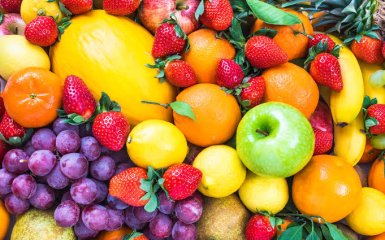
Grapes do contain about three times more natural sugars than raspberries, and sweet-tasting watermelon contains less than an apple. However, the “grams of sugar per 100 g” figure alone does not determine whether a product is healthy or not.
Points of attention
- Raspberries and blackberries have the least sugar, grapes are the sweetest.
- The amount of sugar is only one aspect of assessing the usefulness of a product.
- For most people, the natural sugar in fruit is healthy without restrictions.
- It is better to limit free sugars from products and drinks with added sugar.
- Variety in nutrition and diet is more important than over-investigating the amount of sugar in fruit.
The sugars in a whole fruit come along with water, fiber, vitamins, minerals, and plant compounds. This makes it unfair to rate an apple, a handful of raspberries, and a glass of apple juice the same, even if they contain similar amounts of sugar.
Among the popular August fruits and berries, raspberries and blackberries contain the least sugar — approximately 4–5 g per 100 g. Watermelon — about 6 g, peaches and nectarines — about 8 g, and apples — about 10 g. The sweetest on this list are grapes — approximately 16 g of sugar per 100 g.
How much sugar is in popular August fruits?
Approximate content of total natural sugars in 100 g of fresh product:
| Fruit or berry | Sugars per 100 g |
| Raspberry | about 4.4 g |
| Blackberry | about 4.9 g |
| Watermelon | about 6.2 g |
| Cantaloupe melon | about 7.9 g |
| Nectarine | about 7.9 g |
| Peach | about 8.4 g |
| Pear | about 9.8 g |
| Plum | about 9.9 g |
| Apple with skin | about 10.4 g |
| Grape | about 16 g |
The figures are approximate. The actual composition depends on the variety, degree of ripeness, growing conditions and the specific batch of fruit.
It's also important to distinguish between total sugars and total carbohydrates . For example, a piece of fruit may contain 10 grams of sugars but 13–15 grams of total carbohydrates, as they also include fiber and other compounds.
Should we be afraid of natural sugar in fruit?
For most healthy people, no.
Fruits naturally contain mainly:
fructose;
glucose;
saccharose.
Chemically, these are the same sugar molecules that can be found in other foods. The difference lies in the food matrix in which they enter the body .
Whole fruit contains water and fiber, requires chewing, and usually has a relatively low energy density.
For example, eating two large oranges is a significant amount of food. Drinking juice from several oranges is much easier.
That's why recommendations to limit "free sugars" don't mean you have to count every gram of natural sugar in a whole apple or raspberry.
Natural and added sugar are not the same thing from a dietary perspective
The World Health Organization recommends limiting free sugars .
These include:
sugar added by the manufacturer;
sugar, which is added during cooking;
honey;
syrups;
fruit juice sugars;
sugars of juice concentrates.
Natural sugars that remain within the cellular structure of whole fresh fruit do not fall into this category.
So, 15 g of sugars from grapes and 15 g of added sugar from a sweet drink are the same mass of sugars, but completely different products in terms of nutritional value.
Grapes provide water, potassium, and plant compounds. Sweet soda mostly adds free sugars and energy.
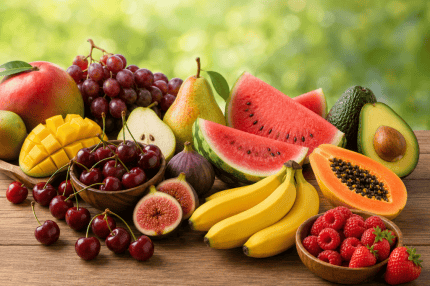
1. Raspberries — about 4.4 g of sugar
Raspberries are one of the least sweet options on this list.
In 100 g approximately:
4.4 g of sugars;
about 6.5 g of fiber;
a little over 50 kcal.
It is the high fiber content that makes raspberries particularly interesting.
A large bowl of berries can be relatively low in calories and goes well with natural yogurt, cottage cheese, or oatmeal.
However, it is not worth grinding raspberries with a lot of sugar and considering the resulting jam the equivalent of fresh berries. After adding sugar, the nutritional profile changes significantly.
2. Blackberries — about 4.9 g
Blackberries are almost as good as raspberries in terms of their low content of natural sugars.
100 g of fresh berries contain about 4.9 g.
Blackberries are also high in fiber and anthocyanins, pigments that give berries their dark color.
It can be:
eat fresh;
add to porridge;
mix with natural yogurt;
freeze.
Freezing does not turn berries into an “empty product.” Frozen blackberries without added sugar remain a good option even out of season.
3. Watermelon — about 6.2 g
Watermelon seems very sweet, but approximately 91% of its mass is water.
100 g of pulp contains about:
6.2 g of sugars;
7–8 g of total carbohydrates;
about 30 kcal.
Therefore, in terms of sugar concentration, watermelon is inferior to apples, pears and grapes.
But there is an important practical detail: 100 g of watermelon is a small portion.
It's easy to eat 400–500 g at a time, and therefore get about 25–30 g of natural sugars.
Therefore, when assessing the diet, it is not the number per 100 g that matters, but the actual portion size.
Watermelon and high glycemic index: should you worry?
Watermelon is often mentioned as an example of a product with a relatively high glycemic index.
Because of this, people sometimes mistakenly conclude that watermelon is "almost like sugar."
The glycemic index measures the rate of change in glucose after a standardized amount of available carbohydrates is consumed. It does not take into account how much of those carbohydrates is actually contained in a typical serving.
There are relatively few of them in watermelon due to its high water content.
Therefore, for practical assessment, both the glycemic index and the amount eaten are important.
4. Melon — about 8 g
The amount of sugar in melon depends on the variety.
In cantaloupe, it is approximately 7.9 g per 100 g, and in some other varieties the figure may be slightly higher or lower.
Melon contains a lot of water and is relatively low in calories.
The main mistake is to evaluate it in large everyday categories like "half a small melon."
For a person who is monitoring their carbohydrate intake, it is more convenient to focus on a serving in grams or cups of chopped pulp.
5. Nectarine — about 7.9 g
100 g of raw nectarine contains approximately:
7.9 g of sugars;
10–11 g of total carbohydrates;
about 1.7 g of fiber.
Nectarine should hardly be considered a "sweet dessert" that should be avoided when controlling weight.
A single piece of fruit can be a convenient snack, or combined with yogurt, nuts, or cottage cheese, it can be a more filling meal.
6. Peach — about 8.4 g
Peach is close to nectarine in composition.
100 g contains approximately 8.4 g of natural sugars.
An average peach weighs more than 100 g, so there will be a little more of them in the whole fruit.
However, most of the mass of a peach is water, and the calorie content is low.
The biggest difference occurs after cooking.
Fresh peach and:
peach jam;
canned peach in syrup;
peach pie;
sweet peach drink
have completely different concentrations of free or added sugars.
7. Pear — about 9.8 g
Pear contains approximately 9.8 g of sugars per 100 g.
At the same time, it contains about 3 g of fiber, so it is inappropriate to evaluate it solely by its sweetness.
Ripe varieties can seem very sweet, although the difference in total sugar content between varieties is not always as great as taste sensations suggest.
Sweetness also depends on:
ratio of glucose, fructose and sucrose;
acidity;
aromatic substances;
degree of ripeness.
Therefore, the tongue is not an accurate "glucometer" for fruit.
8. Plum — about 9.9 g
Fresh plums contain approximately 9.9 g of sugars per 100 g.
One small plum weighs much less than 100 g, so the amount of sugar in one fruit will be moderate.
The situation with prunes is completely different.
During drying, most of the water is removed and the natural sugars are concentrated.
Because of this, 100 g of fresh plums and 100 g of prunes cannot be directly compared.
This also applies to other dried fruits.
9. Apple — about 10.4 g
100 g of raw apple with skin contains approximately 10.4 g of sugars and about 2.4 g of fiber.
An average apple weighs about 180 g, so it can contain approximately 19 g of natural sugars.
Is that a lot?
In the context of a whole fruit, this is a perfectly normal amount for most people.
A medium apple also provides about 4 g of fiber and requires chewing, so it is significantly different in terms of satiety than a drink with the same amount of sugar.
Do you need to peel an apple?
If the skin is tolerated normally, there is no reason to remove it.
It and directly below it contain some fiber and plant compounds.
Wash the fruit well enough.
10. Grapes — about 16 g
Grapes are the sweetest product on this list.
100 g contains approximately 16 g of natural sugars.
At the same time, grapes are very easy to eat: small berries do not need to be peeled or cut, so a portion can imperceptibly turn into 300–400 g.
It is the portion size, not the status of "forbidden fruit," that is the main practical point.
For most healthy people, grapes can be part of the diet.
And if you need to control your carbs, it's best not to eat it straight from the big bag. Put a portion in a separate bowl.
Which fruits contain the least sugar?
If the criterion is the amount of sugars per 100 g, the following stand out favorably among August products:
raspberry;
blackberry;
watermelon;
melon;
nectarines.
But such a rating does not mean that you should always choose only them.
For example, a pear contains more sugar than watermelon, but also significantly more fiber per 100 g.
Therefore, evaluating a fruit based on a single nutrient is too simplistic.
Can you eat fruit while losing weight?
Yes.
The fruit does not turn into a "fat-burning" product, but whole fruits fit well into a weight-control diet.
In most of them:
plenty of water;
there is fiber;
relatively low energy density;
high taste appeal.
Much more important is the overall energy balance.
For example, 200 g of watermelon is about 60 kcal, while a small pastry dessert can easily contain several times that much.
However, fruits can also exceed energy needs if eaten in very large quantities on top of your regular diet.
Can you eat sweet fruits with diabetes?
In most cases, yes.
Diabetes does not mean an automatic ban on fruit.
Current recommendations favor whole fresh, frozen, or canned fruit without added sugar.
At the same time, you need to take into account the amount of carbohydrates.
A practical guideline for people counting them is often a serving of about 15 grams of carbohydrates.
This could be:
small whole fruit;
about a cup of berries;
about a cup of chopped melon;
a small portion of grapes.
The specific serving depends on the type of product.
When using insulin therapy or an individual nutrition plan, you should focus on your doctor's recommendations and your own glucose levels.
Is it better to eat fruit with protein or fat?
This is not a mandatory requirement for a healthy person.
But the combination can be practical.
For example:
apple + natural yogurt;
pear + a small amount of nuts;
raspberries + cottage cheese;
peach + Greek yogurt.
This snack contains more protein or fat and often keeps you fuller longer than fruit alone.
For people who monitor their glucose response after eating, a mixed meal may also produce a different glycemic response than a large serving of fruit alone.
Is juice the same as fruit?
No.
Even if the packaging says "100% juice" and there is no added sugar, the structure of the product has already changed.
In juice:
significantly less fiber;
it is easier to drink quickly;
There can be several fruits per glass.
The World Health Organization classifies fruit juice sugars as free sugars, the amount of which is recommended to be limited.
Therefore, a whole orange, apple, or peach for everyday meals is usually a better option than a glass of juice.
And smoothies?
Smoothies occupy an intermediate position.
If the fruit is crushed whole, much of the fiber remains. But its structure is destroyed, and drinking large amounts of fruit becomes much easier.
For example, in a large smoothie it is easy to fit:
banana;
apple;
peach;
grape;
juice or honey.
Such a drink can contain an amount of carbohydrates that a person would hardly eat in the form of whole fruit in a few minutes.
Therefore, it is better not to perceive a smoothie as water that can be drunk without restrictions.
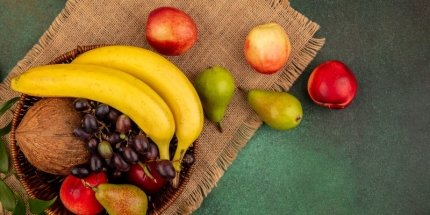
Dried fruits - why do they have so much sugar?
Drying mainly removes water.
Sugars do not disappear anywhere, so their concentration per 100 g increases sharply.
That is why:
raisins are sweeter than grapes on an equal weight basis;
prunes are more concentrated than plums;
dried apricots - for apricot.
Dried fruits can be a healthy product, but their normal serving size is much smaller.
It's especially important for people with diabetes to remember this difference: a few tablespoons of dried fruit can contain about the same amount of carbohydrates as a much larger serving of fresh fruit.
Do you need to count all the sugar from fruit?
A healthy person usually doesn't need to accumulate grams of natural sugars from apples, peaches, and berries every day.
It is much more beneficial to control the main sources of free and added sugars:
sweet carbonated drinks;
energy;
confectionery;
sweet cheeses;
desserts;
syrups;
large portions of juices.
The WHO recommends limiting free sugars to less than 10% of daily energy, and further reductions to around 5% may have additional benefits.
This limit does not directly apply to the natural sugar inside whole fresh fruit.
How much fruit can you eat per day?
There is no universal norm in grams of fruit for each person.
WHO recommends that people over 10 years of age consume a total of at least 400 g of vegetables and fruits per day.
This does not mean 400g of grapes or 400g of apples.
It is better if the main part of the plant food consists of various vegetables, fruits and berries.
For example, during the day it could be:
apple;
a portion of berries;
salad;
vegetables for the main course.
Variety is more important than trying to find the single “healthiest” fruit.
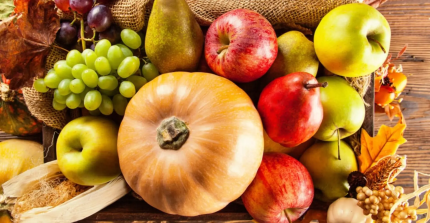
5 mistakes when estimating sugar in fruit
1. Consider sweet taste as an accurate indicator of sugar content
Watermelon seems very sweet, although it has significantly less sugar than an apple or grapes.
2. Compare only 100 g and don't look at the portion
One hundred grams of watermelon is very little. One hundred grams of grapes is also easy to eat without noticing. The actual portion is often more important than the table.
3. Equating fruit with a sweet drink
Whole fruit contains fiber and water, and the structure of the product affects the speed of its consumption and satiety.
4. Consider freshly squeezed juice to be infinitely beneficial
The lack of added sugar does not negate the fact that the juice contains free sugars and little fiber.
5. Completely giving up grapes or bananas due to diet
Weight control depends on overall diet and energy balance. A reasonable portion of sweet fruit can safely remain on the menu.
Conclusion
Among the popular August fruits and berries, raspberries and blackberries contain the least natural sugars, followed by watermelon, cantaloupe, nectarines and peaches. Apples, pears and plums are in the range of about 10 g per 100 g, and the most concentrated in sugars on this list is grapes - about 16 g per 100 g.
However, the amount of sugar is only one characteristic of a product. For most people, it is much more important to eat a variety of whole fruits and berries, consider portion sizes, and not replace them with large volumes of juices, sugary drinks, or desserts.
Important: the material is for informational and educational purposes only and does not constitute medical advice, diagnosis, or individual dietary or treatment recommendations. Self-medication and drastic dietary changes on your own can be harmful to your health. If you have diabetes, insulin resistance, digestive system diseases, or other chronic conditions, be sure to consult your doctor before making any significant dietary changes.
FAQ
Which fruit has the least sugar?
Among popular August foods, raspberries are very low in sugar — about 4.4 g per 100 g — and blackberries, which have about 4.9 g.
How much sugar is in watermelon?
100 g of watermelon contains approximately 6.2 g of natural sugars. Due to its high water content, their concentration is lower than in apples, pears or grapes.
How much sugar is in grapes?
Approximately 16g per 100g depending on the variety. Grapes are one of the sugariest fresh fruits on this list, so portion size is especially important when controlling carbs.
Which is sweeter, an apple or a watermelon?
Per 100 g, an apple contains more sugars: approximately 10.4 g compared to approximately 6.2 g in watermelon. Subjectively, watermelon may seem sweeter due to the ratio of sugars, acids, and aromatic substances.
Can I eat grapes while losing weight?
Yes. Grapes can be included in a weight loss diet. Due to the high concentration of sugars and the convenience of consumption, it is worth controlling the portion, and not banning the product completely.
Can I eat fruit with diabetes?
In most cases, yes. It is best to choose whole fruits and consider the total amount of carbohydrates in a serving. An individual nutrition plan should be coordinated with a doctor.
Does fructose from fruit turn into fat?
The body can use excess energy from various nutrients to form fat stores. But this does not mean that a normal portion of fruit automatically turns into fat tissue. What is crucial is the overall energy balance.
What is healthier - fruit or freshly squeezed juice?
Whole fruit is usually better for everyday eating. It contains more fiber, requires chewing, and is more filling. The sugars in juice are free sugars.
How much sugar is in an apple?
100g of apple with skin contains approximately 10.4g of natural sugars. A medium apple can contain around 19g, but along with them, a person gets water and fiber.
Do I need to give up fruit because of sugar?
For most healthy people, no. Whole fruit is a recommended part of a balanced diet. Much more attention should be paid to added and free sugars from sugary drinks, juices, syrups, and confectionery.
undefined

