
Eggs can look perfectly fine even when their freshness is questionable. The shell remains intact, the color does not change, and an unpleasant odor does not always appear. That is why it is important to understand how to check the quality of eggs before making an omelet, baking or homemade sauce.
Points of attention
- The water test helps to roughly estimate the age of an egg: floating does not necessarily mean spoilage, and sinking does not guarantee safety.
- Before using, check the expiration date, storage conditions, and shell integrity. Break the egg into a separate bowl and assess the smell and appearance.
- A strong unpleasant odor, mold, or an unusual color of the egg white are reasons to throw out an egg. A runny egg white or colored yolk alone does not prove spoilage.
The most famous home method is to drop an egg into a glass of water and see if it floats. However, this method has a significant limitation: it helps to roughly estimate the age of the egg, but does not confirm its safety.
The most reliable household approach is to check the expiration date and storage conditions, inspect the shell, and before using, break the egg into a separate clean bowl and assess its condition. However, even a normal smell and appearance do not guarantee the absence of salmonella.
We'll look at five ways to test eggs, explain why they can float in water, what changes in the white and yolk are natural, and when eggs should be thrown away without reservation.
How to quickly determine if an egg has gone bad
If you need to check an egg before cooking, the first thing to do is to find out if it was stored properly.
There is no point in conducting home tests if the product has a damaged shell, is of unknown origin, or has been kept warm for a long time contrary to storage requirements.
For a routine home inspection, you can proceed in the following sequence:
Check the date and storage conditions of the eggs.
Inspect the shell for cracks, contamination, and damage.
If necessary, use the water test only to roughly estimate the age of the egg.
Break the egg into a separate clean bowl and check the smell and appearance.
If the product meets safety requirements, heat treat it properly.
It is important to distinguish between two concepts - freshness and safety.
Freshness describes the changes in the quality of an egg over time. Safety depends, in particular, on the presence of dangerous microorganisms, proper storage and preparation.
A fresh-looking egg is not necessarily free of bacteria, and an older egg is not always spoiled.
1. Testing an egg in water: what it means when it sinks or floats
The water test is popular because it does not require special equipment.
A deep, transparent container with plain cold water is enough for it.
The egg is carefully lowered into the water and the position it occupies is observed.
How to decipher the result
| Egg behavior | What could this mean? |
| Lies horizontally on the bottom | The air chamber is relatively small, the egg is usually younger |
| Lies on the bottom, but one end is raised | The air chamber has increased, the egg is older |
| Stands almost upright but does not float | The age of the egg is probably older |
| Floats on the surface | The air chamber is large enough to float; this is a sign of aging, not evidence of damage |
The United States Department of Agriculture (USDA) explains: An egg floats when its air chamber expands so much that its buoyancy changes.
However, even an egg that floats is not necessarily spoiled.
The British Food Standards Agency also does not recommend using the water test as proof of egg safety, as it does not detect the presence of dangerous bacteria.
Why do old eggs float?
The shell has microscopic pores.
Over time, gas exchange occurs through them, and the egg gradually loses some of its moisture.
The air chamber inside increases, changing the average density of the egg.
That is why the egg can gradually change position in the water.
However, the speed of these processes depends on temperature, humidity, and storage conditions.
Therefore, the water test does not allow you to accurately determine how many days old the egg is.
Can you eat an egg that has floated?
The mere fact of surfacing does not prove spoilage.
However, if the expiration date has passed, the storage conditions are unknown, or the egg raises other doubts, it is not worth taking the risk.
If an egg floats, but its origin and storage conditions are known, the assessment should still be based primarily on labeling and food safety regulations, not water.
An egg that sinks is not automatically considered safe either. The water test does not detect salmonella and other dangerous microorganisms.
2. Checking the shell: what damage is dangerous
Before breaking an egg, you need to inspect its surface.
The shell performs a protective function, but it is not a completely impenetrable barrier.
According to the State Food and Consumer Protection Service of Ukraine, damaged eggs should not be purchased, as cracks increase the risk of contamination.
What to look out for
Unwanted signs include cracks, leaking contents, traces of mold, and severe contamination.
Even a small crack can be important if it is not known when it appeared and how long the egg was stored in that condition.
Eggs that were already cracked when purchased or after prolonged storage are safer not to use.
You should also not buy eggs with contaminated or damaged packaging without being able to check their condition.
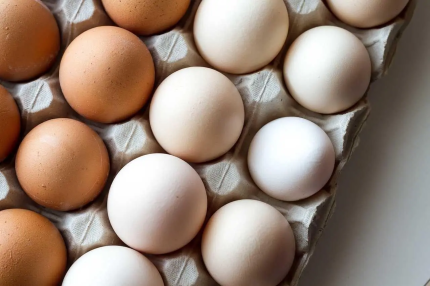
Does the color of the shell determine freshness?
No. A white or brown shell does not indicate that an egg is fresher, more nutritious, or safer.
Color is largely determined by the genetic characteristics of the chickens.
Therefore, brown eggs do not have an automatic advantage over white eggs.
More important are the origin, shell integrity, date, and storage conditions.
3. How to check an egg after breaking it: smell and consistency
If the egg has a whole shell and is safe to store, it can be broken into a separate clean bowl.
This is convenient when preparing a dish with several eggs.
For example, if one egg turns out to be spoiled, it will not immediately go into the general mixture for an omelet or dough.
What does a fresh egg smell like?
A regular raw egg should not have a distinct unpleasant odor.
A sharp putrid, rotten or other unusual smell is reason enough to refuse use.
You don't need to taste an egg to confirm your doubts.
However, there is an important nuance: the absence of an unpleasant odor does not guarantee microbiological safety.
For example, salmonella can be present in eggs without any noticeable changes in appearance or flavor.
What should protein be like?
In a relatively fresh egg, the white part is usually denser and stays closer to the yolk.
With aging, it gradually becomes thinner and can spread more.
This is a natural change in quality that does not always mean spoilage.
The USDA notes that as an egg ages, the white becomes more watery and the yolk membrane weakens.
Therefore, liquid egg white in itself is not proof that the egg is dangerous.
Why is protein cloudy?
Slightly cloudy whites are sometimes surprising, although this can be a sign of a very fresh egg.
This feature is associated, in particular, with the presence of dissolved carbon dioxide.
Over time, some of the gas escapes through the shell, and the protein becomes more transparent.
At the same time, an unusual pink, greenish, or iridescent color of the protein may indicate microbiological spoilage.
Such eggs cannot be used.
4. What the yolk can tell you about the freshness of an egg
The condition of the yolk also changes during storage.
In a relatively fresh egg, it more often retains a rounded shape and clear contours.
In older eggs, the yolk sac gradually weakens, which can make it appear flatter or tear more easily.
However, it is not enough to judge freshness only by the shape of the yolk.
Its appearance can be affected by the way the egg is broken and other factors.
Does a bright orange yolk mean the egg is fresh?
No.
The color of the yolk depends largely on the chicken's feed.
For example, pigments that come from corn, green plants, and other components of the diet can make the yolk richer.
The bright color does not allow you to determine either the exact age of the egg or the absence of dangerous bacteria.
Similarly, a light yellow yolk does not mean that the egg is spoiled.
Is the red spot in the yolk dangerous?
A small blood spot is not necessarily a sign of illness in the bird or spoilage in the egg.
According to the USDA, such inclusions can occur due to damage to a small blood vessel during egg formation.
With proper storage and preparation, a small blood spot on its own does not make an egg unsafe.
It can be carefully removed before cooking.
However, this does not apply to cases where the white has an unusual color, there are large bloody inclusions in the egg, or other suspicious changes.
5. Checking the date and storage conditions: the most important step
Home tests are not a substitute for information about the origin of a product.
It is the date, packaging condition, and storage conditions that help you make a reasonable assessment of whether eggs are worth using.
The recommendations of the State Service for Food and Consumer Protection of Ukraine state that buyers need to check the labeling, expiration date, and shell integrity.
How long do raw eggs last?
According to FoodSafety.gov, raw eggs in their shells can be stored in the refrigerator for approximately 3–5 weeks at a temperature no higher than +4 °C.
However, these American recommendations apply to eggs that have been kept under proper refrigeration conditions.
They do not mean that any eggs of unknown origin can be safely stored for five weeks after purchase.
In Ukraine, you must first focus on the manufacturer's labeling and the established expiration date.
Conditions may vary depending on the method of processing, transportation and sale of products.
How long do boiled eggs last?
| Product | Approximate storage time in the refrigerator |
| Raw eggs in the shell | 3–5 weeks with proper, constant refrigeration, but not beyond the stated expiration date |
| Raw egg whites or yolks without shells | 2–4 days |
| Hard-boiled eggs | Up to 7 days |
| Ready meals with eggs | Usually 3–4 days |
The guidelines provided assume refrigerated storage at a temperature not exceeding +4 °C and compliance with hygiene rules.
If the product has been kept warm for a long time, these periods cannot be used as a guarantee of its safety.
Can you eat eggs after the expiration date?
This question often arises if the packaging shows a date that has recently passed.
It is important to distinguish between designations related to product safety and labeling that characterizes its best quality.
For example, in the UK, eggs have a best before date, which is mainly a quality issue. The UK Food Standards Agency allows eggs to be used for one to two days after this date, provided they have been thoroughly cooked.
However, such rules cannot be automatically transferred to any eggs sold in Ukraine.
Local labeling, product origin, and storage conditions are important.
If the expiration date has passed and the storage conditions are questionable, it is best not to use the eggs. The water test does not make an expired product safe.
Why an egg may look fresh but be dangerous
The main risk associated with raw eggs is contamination with Salmonella bacteria.
They can get on the shell or, under certain circumstances, be inside the egg.
The problem is that contamination does not necessarily change the appearance of the product.
An egg can smell normal, have a dense white and an intact shell, but still contain dangerous bacteria.
That's why checking freshness and complying with food safety rules are different tasks.
How to reduce the risk of salmonellosis
The FDA recommends properly refrigerating eggs, keeping kitchen utensils clean, and preparing foods thoroughly.
For the most careful approach, eggs should be cooked until the white and yolk are completely set.
Egg-based dishes should be heated to a safe internal temperature, which according to American recommendations is at least 71 °C.
For recipes that leave eggs raw or undercooked, a safer option is to use pasteurized eggs or egg products.
This is especially important for children, pregnant women, the elderly, and people with weakened immune systems.
How to properly store eggs in the refrigerator
Appropriate conditions help preserve the quality of eggs for longer and reduce the risk of developing microorganisms.
For refrigerated eggs, it is safest to maintain a stable low temperature.
Where is the best place to keep eggs?
While many refrigerators have dedicated door trays, the main compartment usually provides a more consistent temperature.
The door is more likely to come into contact with warm air when opened.
Therefore, it is best to store eggs in the main part of the refrigerator, preferably in their original packaging.
It protects against damage and allows you to store expiration date information.
Do you need to wash eggs before storing them?
You should not wash the entire egg package in advance before placing it in the refrigerator.
The shell has a natural protective layer, and improper washing can increase the risk of contamination.
However, recommendations for processing eggs before direct cooking may vary depending on the country and the condition of the product.
Ukrainian food safety authorities recommend hygienic handling of eggs before cooking. If the shells need to be peeled, this should be done immediately before use, not before long-term storage.
After contact with raw eggs, you should wash your hands and clean kitchen surfaces.
Why you shouldn't test an egg by shaking it
Sometimes it is advised to shake the egg near your ear: if you hear the movement of liquid inside, it is supposedly spoiled.
However, this method is not reliable.
As an egg ages, the consistency of the egg white and the size of the air chamber change.
This may affect the sensation when shaking, but does not allow you to determine the presence of dangerous bacteria.
Additionally, vigorous shaking can damage the internal structures of the egg.
Therefore, this method should not be used to make decisions about the safety of a product.

How to tell if a boiled egg has gone bad
For boiled eggs, the water test for determining freshness is no longer of practical importance.
More important are the date of preparation, temperature and storage duration.
Hard-boiled eggs should be cooled and refrigerated within two hours of cooking.
According to FDA guidelines, they should be used within one week, regardless of whether the shell is still on or has been removed.
Is the green ring around the yolk dangerous?
No, a green-gray rim in a hard-boiled egg does not by itself mean spoilage.
It can occur as a result of the reaction of sulfur and iron compounds during prolonged heating.
The USDA explains that this discoloration is usually related to digestion.
If the egg has been stored and cooked properly, a green rim alone does not make it unsafe.
Can you eat a boiled egg that has been sitting on the table overnight?
No, if an egg has been at room temperature for a long time without proper refrigeration, it should not be consumed.
A general rule for perishable prepared foods is not to leave them out of the refrigerator for more than two hours.
If the ambient temperature exceeds +32 °C, the allowable time is reduced to one hour.
This is especially important for Easter eggs, egg salads, and dishes that last a long time on the holiday table.
What to do if eggs were stored without a refrigerator during a power outage
During long power outages, it is important to assess the actual temperature of the products, not just the time the light was out.
According to food safety guidelines, a closed refrigerator typically maintains safe conditions for up to about four hours.
However, this is an approximate value.
The actual temperature depends on the refrigerator model, room temperature and how often the door is opened.
If eggs that required refrigerated storage have been kept at temperatures above +4 °C for a long time, their safety may be questionable.
In such a situation, you can't rely on them sinking in water or smelling normal.
What changes in an egg do not necessarily mean spoilage?
Some natural features of eggs are often mistakenly perceived as dangerous.
| Sign | What could it mean? |
| Dark yellow or orange yolk | Features of the chicken diet |
| Pale yellow yolk | Also depends on the feed |
| Slightly cloudy protein | Often characteristic of fresh eggs |
| Thinner transparent protein | May indicate aging |
| Small blood spot | Can occur naturally during egg formation |
| White twisted strands near the yolk | Chalazae - normal structures of the egg |
| Green-gray rim in boiled yolk | Often a consequence of prolonged cooking |
None of these characteristics alone confirm microbiological safety.
However, an unusual pink or greenish color of raw protein, mold, and a distinct unpleasant odor are reasons to reject the product.

Common mistakes when checking eggs
Most often, errors occur due to misinterpretation of home tests.
Consider the egg at the bottom of the glass to be guaranteed fresh. The test reflects mainly the size of the air chamber, not the presence of bacteria.
Consider every egg that floats to be rotten. Floating is an indication of aging, but in itself is not proof of spoilage.
Rely on the color of the yolk. Its saturation depends primarily on the chicken's feed.
Throwing out an egg because of a small spot of blood. This feature does not always mean a problem.
Consider a normal odor as a guarantee of safety. Salmonella does not necessarily cause noticeable changes.
Trying to save a spoiled egg by cooking it for a long time. Cooking should not be used as a way to make an obviously spoiled product usable.
How to choose the right eggs in the store
Preventing problems is easier than trying to determine the freshness of a questionable purchase at home.
First of all, you need to check the manufacturer, date, and condition of the packaging.
The State Food and Consumer Protection Service of Ukraine recommends not buying eggs with damaged shells or without proper information about the product.
You should be especially careful with spontaneous trade, where it is difficult to verify the origin of the goods and the conditions of their storage.
Should I buy eggs in large packages?
It depends on how many eggs the family actually uses.
A large package may have a lower price per unit, but it will not be profitable if some of the products have to be thrown away.
It is better to buy an amount that can be used within the specified expiration date.
It is also worth keeping the packaging until all the eggs are used up so as not to lose information about the date.
Conclusion
There are several ways to determine the approximate freshness of an egg at home, but none of them guarantee the absence of dangerous bacteria.
The water test primarily shows age-related changes, the smell and appearance help to notice individual signs of spoilage, and the color of the yolk is not a reliable indicator of freshness.
The most important thing is to buy eggs with their shells intact, check the labeling, follow storage conditions, and cook them properly.
If the origin, date, or condition of an egg is in serious doubt, it is safer to refuse to use it than to attempt to confirm suitability through home experiments.
FAQ: Frequently asked questions about egg freshness
What is the fastest way to check if an egg has gone bad?
Check the expiration date, shell condition, and storage conditions. Before using, break the egg into a separate clean bowl and assess the smell and appearance. However, the absence of signs of spoilage does not guarantee the absence of salmonella.
What does it mean if an egg floats in water?
This means that its air chamber has expanded enough to float. Usually, such an egg is older, but this is not direct evidence of spoilage. The water test does not determine microbiological safety.
Is an egg fresh if it lies at the bottom of the glass?
A horizontal position on the bottom is often characteristic of younger eggs with a small air chamber. However, this result does not confirm the absence of dangerous bacteria.
How to identify a spoiled egg by smell?
A rotten, putrid, or other strongly unpleasant odor after breaking is a sign that the egg should be thrown away. However, an egg infected with salmonella may not have a foreign odor.
Can I eat an egg with liquid white?
A thinner white can be a natural sign of aging. It does not in itself prove spoilage. However, the decision to use it depends on the expiration date, storage conditions, the condition of the egg and subsequent proper heat treatment.
Why is there a red spot in the egg?
A small blood spot may be caused by damage to a small blood vessel during egg formation. In the absence of other problems, it is not a sign of danger in itself. Large bloody inclusions and other unusual changes require caution.
How long can you keep raw eggs in the refrigerator?
According to FoodSafety.gov, raw eggs in their shells can be stored for approximately 3–5 weeks when properly refrigerated. However, in Ukraine, it is important to follow the expiration date on the package and the manufacturer's instructions.
Can you eat eggs after their expiration date?
This depends on the type of labeling, origin, and storage conditions. If the date has passed or it is unknown whether the eggs were stored properly, it is safer not to use them. The water test cannot confirm the suitability of an expired product.
How do you know if a boiled egg has gone bad?
First of all, you need to know when it was prepared and how it was stored. Hard-boiled eggs are recommended to be used within seven days of refrigerated storage. A distinct unpleasant odor or other signs of spoilage are a reason to throw away the product.
Is the green yolk in a boiled egg dangerous?
A greenish-gray ring around the yolk is often caused by prolonged cooking and the reaction of sulfur and iron compounds. It is not, in itself, an indication of spoilage if the egg has been properly cooked and stored.
The material is for informational purposes only and is not a substitute for medical advice. Self-medication can be harmful to health. If you experience symptoms of food poisoning, including diarrhea, vomiting, fever, or severe abdominal pain, you should first consult a doctor. Symptoms in children, pregnant women, the elderly, and people with weakened immune systems require special attention.

