
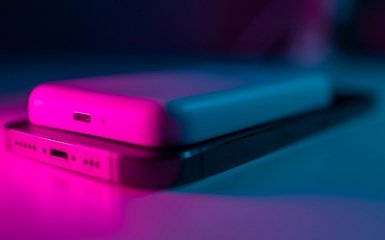
A 20,000 mAh power bank is not always better than a 10,000 mAh model, and the inscription “65 W” does not guarantee that the device will charge any laptop. When choosing a portable battery, it is important to consider not only its capacity, but also the actual available energy, the power of the ports, the supported charging standards and compatibility with a specific device. For everyday use, a compact 10,000 mAh model is often enough. If you need to charge several smartphones during power outages, a 20,000–30,000 mAh power bank may be more practical. And for a laptop, you need to check separately for USB Power Delivery support and output power.
A universal guideline for most users is a 20,000 mAh power bank with USB-C Power Delivery with a power of 20–30 W. A modern laptop often requires a 65–100 W model, and the correct voltage and connection compatibility are important for powering a router.
At the same time, a large energy reserve has its drawbacks: the device becomes heavier, takes longer to charge, and may not comply with air transportation regulations.
Let's look at how to choose a good power bank in 2026, how many times it will charge your phone, what the number of watts affects, and what characteristics you should check before buying.
What is a power bank and how does it work?
A power bank is a portable battery with an electronic control system that stores electrical energy and transfers it to other devices.
Inside are battery cells, a charge controller, a voltage conversion circuit, and protective components.
Most modern models use lithium-ion or lithium-polymer batteries. Some devices have other chemistries, such as lithium iron phosphate.
After connecting the smartphone, the power bank converts the voltage of the internal elements to the voltage required to charge the device.
During this process, some energy is lost as heat.
That is why a power bank labeled 20,000 mAh does not transfer all 20,000 mAh to the smartphone in the same sense as the capacity of its internal battery.
How to choose a power bank capacity: 10,000, 20,000 or 30,000 mAh
Capacity determines the amount of electrical charge a battery can hold. In practice, it is often used as a benchmark for comparing the operating time of different models.
However, milliamp-hours alone are not enough to accurately compare devices with different battery voltages.
For this, it is better to use watt-hours - kWh for large systems and Wh for small batteries.
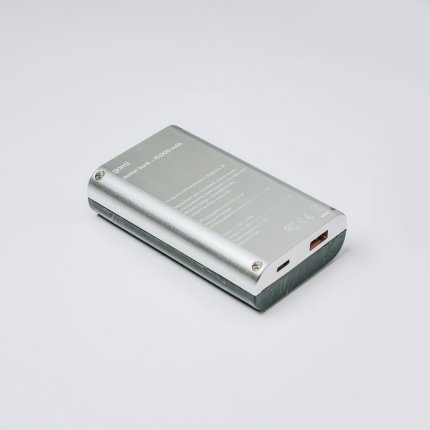
5000 mAh power bank
This is a compact option for short trips and everyday use.
Such a device can provide an additional partial charge for a smartphone or approximately one charge for a small phone under favorable conditions.
The main advantage is small size and weight.
However, for long power outages, the reserve is usually not enough.
Power bank for 10000 mAh
One of the most convenient formats for the city.
You can carry it in a bag or backpack and use it to charge your phone, headphones, and small gadgets.
Depending on the smartphone's battery capacity and energy losses, it can provide approximately one to one and a half full charges for a modern phone with a battery of about 5,000 mAh.
For compact smartphones, the number of charges may be greater.
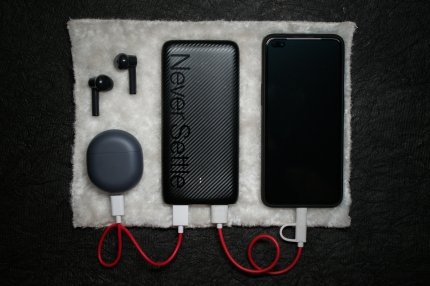
Power bank for 20000 mAh
A practical choice for travel and power outages.
Such a power bank has approximately twice the energy reserve as a 10,000 mAh model with the same nominal voltage of the battery cells.
It can be used for multiple smartphones or one phone for a longer period of time.
However, increasing capacity is usually accompanied by an increase in weight.
Power bank for 30,000–50,000 mAh
These models are designed for situations where a large energy reserve is required.
They can be useful during long power outages, car trips, or powering multiple devices.
It is important to consider their dimensions, weight, charging time, and air carrier restrictions.
Large capacity also does not automatically mean high output power.
For example, a 50,000 mAh power bank with a 20 W output will not be a complete replacement for a 20,000 mAh model with USB-C PD 100 W for charging a laptop.
What is the difference between mAh, Wh and W
These are the three characteristics that are most often confused.
Milliampere-hour (mAh) characterizes the electrical charge of a battery.
Watt-hour (Wh) indicates the energy reserve.
Watts (W) define power—the rate of energy transfer or consumption.
For example, two power banks may have the same capacity of 20,000 mAh, but different output power: 20 and 65 W.
Their energy reserves will be similar at the same nominal voltage, but the charging capabilities of laptops will differ significantly.
How to convert mAh to watt-hours
The formula used is:
Wh = mAh × nominal voltage / 1000.
If the nominal voltage of the battery cells is 3.7 V, we get:
| Capacity | Nominal energy reserve |
| 5000 mAh | 18.5 Wh |
| 10000 mAh | 37 Wh |
| 20000 mAh | 74 Wh |
| 25000 mAh | 92.5 Wh |
| 30000 mAh | 111 Wh |
| 50000 mAh | 185 Wh |
These are calculated values for a voltage of 3.7 V.
If the manufacturer uses a different voltage rating, the result will be different. For an accurate comparison, you should check the labeling of the specific product.
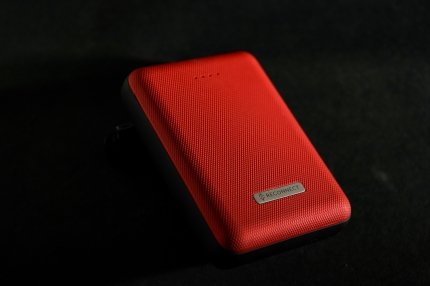
Why doesn't a 20,000 mAh power bank charge a phone four times?
For example, a smartphone has a 5,000 mAh battery, and a power bank has a 20,000 mAh battery.
It seems logical that the charge should last exactly four cycles.
However, this is a miscalculation.
The capacity of a power bank is usually specified for internal battery cells with a nominal voltage of about 3.7 V.
The device converts this energy to another voltage, and the phone's controller additionally manages the charging of its own battery.
Both processes are accompanied by losses.
How much energy is available at the output
According to the manufacturer Anker, a 10,000 mAh power bank with a nominal reserve of 37 Wh can deliver approximately 30–35 Wh at the USB output, depending on the conversion efficiency.
For a 20,000 mAh model, this could be approximately 60–65 Wh.
However, even less energy is delivered to the phone's battery due to losses during charging.
Example of calculating the number of charges
Let's say the phone has a 5000 mAh battery with a nominal voltage of 3.85 V.
Its energy consumption is approximately 19.25 Wh.
If the power bank can output 61 Wh, and the phone's charging efficiency is 85%, we get:
61 × 0.85 / 19.25 = approximately 2.7 full charges.
This is a theoretical example, not a guaranteed characteristic of a specific model.
The actual amount depends on temperature, battery condition, charging power, and whether the phone is being used during the process.
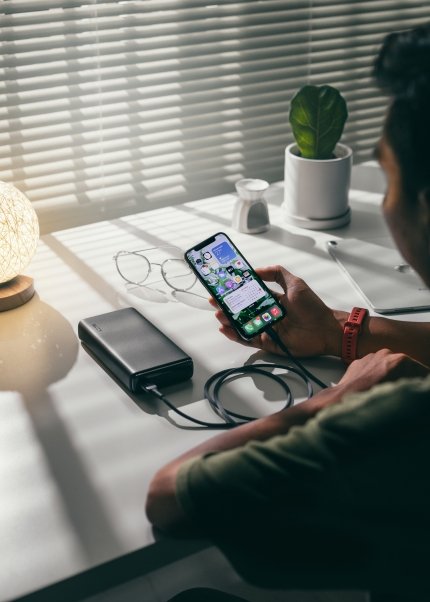
What power bank capacity is needed for fast charging?
Output power determines how much energy a power bank can transfer per unit of time.
For modern phones, 20–30 W models are common.
Tablets and some laptops may require 45, 65, 100 watts or more.
However, charging speed does not only depend on the power bank.
It is important that the phone itself, portable battery, and cable are compatible.
| Power bank capacity | What is it usually suitable for? |
| 10–15 W | Basic charging for smartphones and small devices |
| 20–30 W | Fast charging for many phones |
| 45 W | Part of tablets and compact laptops |
| 65 W | Many laptops with USB-C Power Delivery |
| 100 W | Laptops with higher power requirements |
| Over 100 W | Individual powerful devices with support for the corresponding standard |
The specified values do not guarantee compatibility with any device in the corresponding category.
For example, a laptop may have a USB-C port but not support charging through it.
What are USB Power Delivery, PPS and Quick Charge?
Modern power banks support various fast charging protocols.
They determine whether the connected device can use the maximum available power.
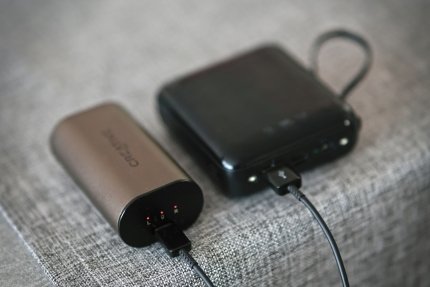
USB Power Delivery (USB PD)
USB Power Delivery is a standard for transferring power over a compatible USB connection.
It allows devices to negotiate power settings.
The USB PD 3.1 specification provides for the ability to transfer power up to 240 W in the appropriate configuration.
However, this is the maximum capability of the standard, not the capacity of every power bank with USB-C.
PPS — programmable power supply
PPS allows for more flexible adjustment of voltage and current according to the needs of a compatible device.
This is especially important for some Samsung smartphones.
The manufacturer notes that for Super Fast Charging to work, a high rated power is not enough: support for the corresponding USB PD PPS mode is required.
Quick Charge and other standards
Quick Charge is a fast charging technology used by compatible devices.
Individual brands have their own protocols.
When buying, you need to check not just the Fast Charge label, but the specific standards that both devices support.
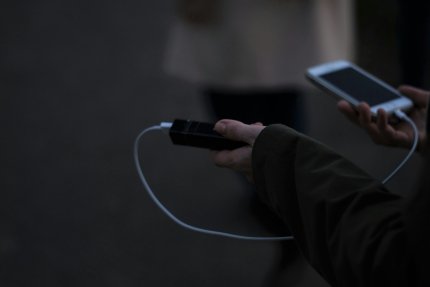
Which power bank to choose for iPhone and Android
For iPhones, a convenient choice is often a power bank with USB-C Power Delivery.
Apple confirms support for fast charging via compatible USB PD adapters, and the required power depends on the generation of the smartphone.
For example, the iPhone 17 Pro models are claimed to be able to charge up to approximately 50% in 20 minutes using a suitable adapter with a power of 40 W or more.
However, actual speed depends on battery condition, temperature, and other conditions.
What you need for Android
For Android smartphones, you need to check the specific charging standard.
If your phone supports USB PD PPS, a power bank with this mode can provide better compatibility.
At the same time, a device with a 100W output will not force a phone designed for lower power to charge at a 100W rate.
During normal operation, compatible devices negotiate acceptable power parameters.
Therefore, buying a power bank with excessive capacity exclusively for your phone is not always advisable.

How to choose a power bank for a laptop
Charging a laptop has much higher requirements than charging a smartphone.
Here you need to check two independent characteristics: energy reserve and output power.
Check USB-C charging support
Not every USB-C port on a laptop is designed to receive power.
In some models, it is used only for data transfer or connecting peripherals.
If your laptop supports USB-C Power Delivery, you need to find out the required charging power.
For example, for a device with a standard 65W adapter, it is often worth considering a power bank capable of delivering the appropriate power through a single USB-C port.
It is important to check the supported voltage and current profiles.
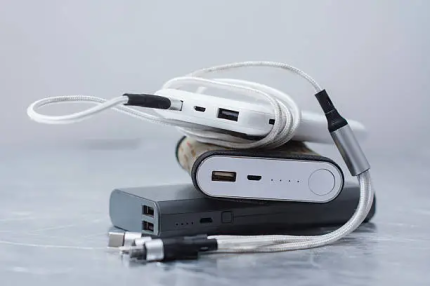
Why a 100W power bank isn't always better than a 65W one
If your laptop only supports charging up to 45W, the excess power from the power bank won't speed up the process beyond the device's limitations.
At the same time, a powerful laptop under heavy load can consume more than the power bank can deliver.
In this case, the laptop battery sometimes continues to gradually discharge even when external power is connected.
How long will a laptop run on a power bank?
Let's say the power bank has a reserve of 74 Wh, and after losses it can transfer approximately 60 Wh.
If the average laptop consumption is 30 watts, this will be enough for about two hours of additional work.
However, during video conferencing, gaming, or video processing, consumption can be significantly higher.
Therefore, autonomy should be assessed based on real-world usage conditions, not just the rated power of the charging adapter.
What power bank is needed for a router during power outages?
For home Internet, not only capacity and battery life are important, but also the correct supply voltage.
Many routers use 9V or 12V DC adapters, although other options exist.
A regular 5V USB output cannot always directly power such equipment.

What to check
Before connecting, you need to find out:
The rated power supply voltage of the router.
Required current.
Connector type.
Contact polarity.
Ability to operate from USB-C PD or a special adapter.
Consumption of additional optical terminal ONT, if any.
For example, if the router is designed for 12 V, you cannot apply arbitrary voltage to it.
To power a power bank, special converters or compatible cables can be used with the desired mode selected.
However, their characteristics must match the equipment exactly.
How long will Wi-Fi work from a power bank?
Let's say the router and optical terminal together consume an average of 20 watts.
If the power bank can deliver about 60 Wh, the theoretical operating time would be about three hours.
If both devices consume 10 watts together, the battery life can be approximately twice as long.
The actual time will depend on the efficiency of the converter and the devices' own consumption.
Important: A power bank does not always provide continuous power when switching between mains and battery. For equipment that does not need to be rebooted, a dedicated uninterruptible power supply may be required.

USB-C, USB-A and the number of ports: what you need to know
The presence of multiple connectors does not mean that each of them operates at maximum power at the same time.
For example, a manufacturer may specify 65W for a single USB-C output, but when a second device is connected, the power will be divided between the ports.
Why is this important?
Let's say you're charging your laptop and your phone at the same time.
If the total power of the power bank is 65 W, it can distribute it between two connected devices.
The laptop may charge more slowly in this case.
When buying, you need to look at the port power distribution table, not just the large inscription on the case.
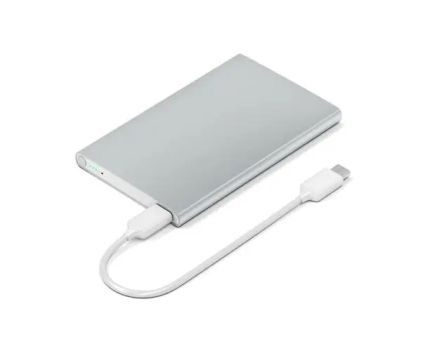
Is a special cable needed?
Yes, for high-power charging, cable characteristics matter.
USB-IF sets requirements for labeling certified USB-C cables according to the power they support.
In particular, categories 60 and 240 W are used.
For high current work, a cable with an appropriate electronic marker may be required.
An unknown or damaged cable may limit charging and create additional risks.
Wireless power bank or regular power bank: which is better?
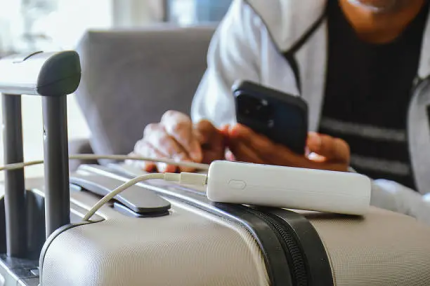
Power banks with wireless charging are convenient because they allow you to charge a compatible smartphone without a cable.
Some models have magnetic fixation.
However, convenience comes at a price: additional losses occur during wireless energy transmission.
Because of this, the number of available charges may be less than with a wired connection.
What to look out for
You need to check for support for Qi, Qi2, MagSafe, or another appropriate standard, as well as compatibility with a specific phone.
The magnetic mount itself does not guarantee maximum wireless charging power.
The thickness of the cover, the correct placement of the coils, and heating are also important.
To make the most efficient use of your battery, wired charging is usually more practical.
How much does a good power bank cost in 2026?
Models of various price levels are available on the Ukrainian market: from budget external batteries to powerful devices for laptops.
As of November 2026, current sales offers include 20,000 mAh power banks with charging of about 20–22.5 W for approximately UAH 1,000–1,600.
10,000 mAh models with magnetic or wireless charging can cost approximately UAH 1,300–2,300.
Power banks with USB-C PD 65 W for laptops are presented, in particular, in the price range of about UAH 2,500–4,200.
These are examples of market offers, not set prices for all devices. The cost depends on the brand, configuration, warranty, capacity and store.
Should you buy the cheapest power bank?
Low price does not necessarily mean poor quality.
However, suspiciously cheap models with very large declared capacities require special attention.
You need to check the actual specifications, manufacturer, battery labeling, and availability of a warranty.
You should not buy a device with unverified characteristics just because it says 50,000 or 100,000 mAh.
How to check a power bank before buying
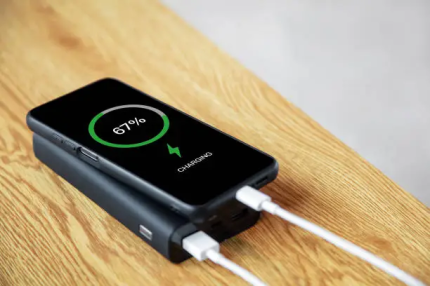
A good power bank should have clear technical specifications.
First of all, pay attention to the rated energy capacity in watt-hours, available output power, and supported charging standards.
What should be stated
It is important to check:
Manufacturer name and exact model.
Nominal capacity in mAh.
Energy reserve in Wh.
The output power of each port.
Total power during simultaneous charging.
Support for USB Power Delivery and PPS as needed.
The charging input power of the power bank itself.
Protection against overload, overheating and short circuit.
Warranty conditions.
It is also worth checking whether a specific model or its batch has been recalled for safety reasons.
This applies even to products from well-known brands.
For example, in 2025–2026, the US Consumer Product Safety Commission published notices of recall of certain power bank models due to the risk of overheating and fire.
Can I take a power bank on a plane?
For air travel, it is not the number of mAh per se that is important, but the energy density in watt-hours.
According to the US Federal Aviation Administration (FAA) regulations, spare lithium batteries and power banks must be carried in carry-on luggage.
The general restrictions are as follows:
| Energy consumption | Regulations |
| Up to 100 Wh | Usually allowed in hand luggage |
| Over 100 to 160 Wh | Airline approval required; quantity restrictions apply |
| Over 160 Wh | Not allowed as a regular spare lithium-ion battery on a passenger flight |
Airlines may impose stricter rules, including regarding the number of power banks, their use, and charging in the cabin.
Therefore, before flying, you need to check the current requirements of a particular carrier.
For example, a 20,000 mAh battery with a nominal voltage of 3.7 V has approximately 74 Wh and is usually within the overall limit of 100 Wh.
A 30,000 mAh model at the same voltage will have about 111 Wh, so it may require a separate permit.
How to use a power bank properly so that it lasts longer
Lithium batteries gradually lose capacity due to calendar aging and charging cycles.
The speed of this process depends on temperature, battery design, and operating mode.
The most important thing is to avoid excessive heat.
Do I need to fully discharge a new power bank?
No.
Modern lithium batteries do not require special full discharge and charge cycles to eliminate the so-called memory effect.
It is better to follow the manufacturer's recommendations.
How to store a power bank when not in use
Anker recommends maintaining approximately 60% charge for long-term storage and checking the battery approximately every three months.
This is an example of manufacturer-specific recommendations; rules may vary for other devices.
Do not leave the power bank in an overheated car, in direct sunlight, or in a humid room for a long time.
Can I leave the power bank charging overnight?
Modern high-quality devices have charging control systems, but the risk of malfunction does not completely disappear.
For safety reasons, it is better to charge the power bank in a dry, ventilated place, on a stable, non-flammable surface, and not cover it with a cloth.
If the case becomes unusually hot, deformed, or emits an odor or strange noise, use should be stopped immediately.
A damaged or swollen lithium battery cannot be disassembled or disposed of in regular trash.
Seven mistakes when choosing a power bank
1. Choose only by mAh
Capacity does not determine charging speed or laptop compatibility.
2. Don't check USB Power Delivery
The presence of USB-C does not yet guarantee the support of the necessary power.
3. Ignore conversion losses
A 20,000 mAh power bank won't necessarily charge a smartphone with a 5,000 mAh battery four times.
4. Confusing the power of one port with the total
Charging speed may decrease when devices are connected simultaneously.
5. Buying a battery that is too big for daily use
A 50,000 mAh power bank can be inconvenient due to its weight and size.
6. Ignore the input charging power
A model with a large battery but weak input can take many hours to charge.
7. Buying a device without a security check
Unknown origins, lack of clear labeling and guarantees increase uncertainty about quality.
Which power bank to choose for different needs
| Scenario | Practical guideline |
| Charging your phone daily | 10000 mAh, USB-C PD 20–30 W |
| Trips and smartphone backup | 20000 mAh, USB-C PD 20–30 W |
| Multiple gadgets during blackouts | 20,000–30,000 mAh, multiple ports |
| Charging the tablet | 10000–20000 mAh, capacity according to model requirements |
| Laptop operation | 20000–30000 mAh, USB-C PD 65–100 W as needed |
| Router power supply | Correct voltage, compatible connection, sufficient power capacity |
| Air travel | Preferably up to 100 Wh, taking into account airline regulations |
| Minimum weight | Compact 5000–10000 mAh |
These parameters are guidelines for initial selection.
The final decision should be made according to the characteristics of the devices you plan to charge.
Conclusion
A good power bank is not necessarily the model with the highest capacity.
For a phone, a compact battery with support for the desired fast charging standard is sufficient. For long power outages, it is advisable to increase the power reserve, and for a laptop, the output power of USB-C Power Delivery is key.
Before buying, you need to check the watt-hours, power of individual ports, PD and PPS support, cable specifications, and warranty.
The most practical choice is a power bank that meets real needs and provides the necessary energy supply without excess weight and overpayment.
FAQ: frequently asked questions about choosing a power bank
Which power bank is best to buy in 2026?
For most users, a practical choice is a 20,000 mAh model with USB-C Power Delivery of 20–30 W. For a laptop, you should choose a device with an appropriate power rating, often 65 W or more.
How many times will a 10,000 mAh power bank charge a phone?
This depends on the smartphone's battery and charging efficiency. For a modern phone with a battery of around 5000 mAh, you can expect about one to one and a half full charges under typical conditions.
Will a 20,000 mAh power bank be enough for a laptop?
It can provide additional runtime if it supports the required output power and charging standard. However, 20,000 mAh does not mean that the laptop is guaranteed to be fully charged.
What is the difference between a 20W power bank and a 65W one?
The main difference is the maximum output power. The 65W model can charge compatible devices that require more power, including many laptops. The capacity may be the same.
Which is better: a 10,000 or 20,000 mAh power bank?
For everyday use, a compact 10,000 mAh device is more convenient. For travel, blackouts, and multiple gadgets, a 20,000 mAh option is often more practical.
Can I charge my laptop from any USB-C power bank?
No. Your laptop must support USB-C charging, be compatible with the USB Power Delivery standard, and have sufficient output power. The USB-C connector alone is not sufficient.
Can I power the router from a power bank?
Yes, as long as the correct voltage, current, polarity, and connector are provided. For 9V or 12V routers, a special compatible adapter or converter may be required. You cannot supply any voltage.
Is it allowed to take a 30,000 mAh power bank on a plane?
This depends on its watt-hour capacity and airline regulations. At a nominal voltage of 3.7 V, this capacity corresponds to approximately 111 Wh, which may require carrier approval.
Does fast charging damage your phone's battery?
Compatible devices have current and temperature management systems. However, excessive heat can accelerate the aging of lithium batteries. You should use appropriate chargers and cables and avoid overheating.
How do you know if a power bank has the right capacity?
Check the watt-hour label, manufacturer data, and independent measurements. Testing the USB output with appropriate measuring equipment provides a more accurate estimate of the available energy. Simply comparing the stated mAh without taking into account voltage and losses can be misleading.
This material is for informational purposes only. Prices and specifications are approximate as of November 2026. Charging requirements, air travel restrictions, and usage guidelines may vary by manufacturer and model. Damaged, swollen, or overheated lithium batteries should not be used, disassembled, or charged.

