
Black soot on the bottom of a pan, sticky brown grease on the sides or burnt-on food residue is a familiar problem even for those who wash dishes regularly. Over time, thin layers of grease can turn into a hard coating that is difficult to remove with a regular sponge. The most common mistake is trying to immediately scrub the dirt with a wire brush or a strong chemical agent. What helps clean a stainless steel pan can irreversibly damage the non-stick coating or protective layer of cast iron.
To remove carbon deposits from a pan, you first need to determine the material and type of contamination. Baking soda and water are often effective for stainless steel, a longer soak with detergent for non-stick coatings, and mechanical cleaning without prolonged contact with water for cast iron.
We'll look at how to quickly clean a burnt pan at home, when you can use baking soda and vinegar, how to clean the outer bottom, and why some popular methods do more harm than good.
Why does black carbon build-up form on a frying pan?
Carbon deposits are not just dried fat.
During repeated heating, oil and food residues undergo chemical changes. Some organic substances decompose, darken and stick firmly to the surface of the dishes.
Fats can also polymerize—form a solid film as a result of chemical reactions during heating.
That is why old plaque sometimes resembles varnish or a dense black coating.
It is important to distinguish between several types of pollution.
| Type of pollution | What does it look like? | What usually helps |
| Fresh leftovers | Soft or dried particles | Warm water and detergent |
| Burnt food | Dark crust sticking to the bottom | Soaking or gentle warming with water |
| Old fat | Sticky brown layer | Degreaser approved for coating |
| Hard black carbon deposits | Dense uneven layers | Step-by-step cleaning according to the material |
| Rainbow spots on stainless steel | Blue, gold or purple stains | Gentle cleaning, sometimes diluted vinegar |
| Rust on cast iron | Reddish spots | Rust removal and restoration of the protective layer |
The choice of cleaning method also depends on correct diagnosis.
How to determine what to use to clean your frying pan
The material of the cookware is more important than the thickness of the carbon deposits.
You can't use one recipe for all pans, even if the stains look the same.
Stainless steel
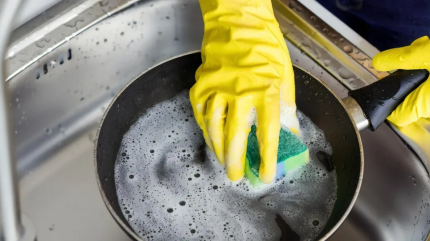
Stainless steel pans without a special coating are relatively resistant to household cleaning methods.
For them, you can use baking soda, warm water, soft brushes, and appropriate stainless steel products.
However, even such dishes can be scratched by coarse abrasives.
Non-stick coating
Pans with PTFE coating or other non-stick systems require more careful care.
Metal scrapers, abrasive powders and hard brushes can damage the surface.
For them, the main cleaning method is warm water, mild dishwashing detergent, and a non-abrasive sponge.
Ceramic coating
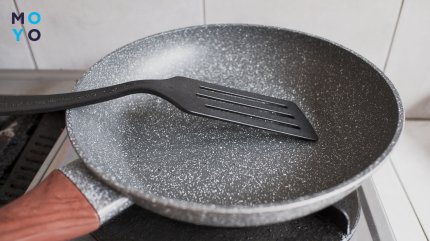
Ceramic non-stick coatings are different from traditional PTFE coatings, but can also lose their properties due to overheating and improper cleaning.
Especially often a thin layer of burnt oil forms on them.
Cast iron without enamel
A traditional cast iron skillet has a protective layer of polymerized oil.
It is called a natural non-stick coating, or seasoning .
This layer needs to be preserved, so you shouldn't polish cast iron to a shine after each use.
Enameled dishes
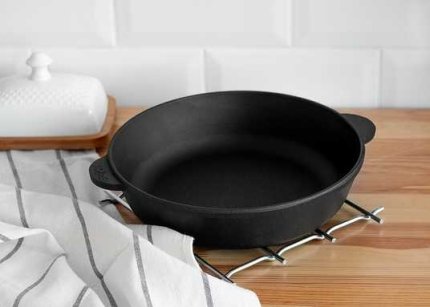
Enamel is a glassy coating that protects a metal base.
It can be quite resistant to food acids, but is sensitive to impacts, sudden temperature changes, and coarse abrasives.
What to do first if the pan is badly burnt
The most effective strategy is not to try to scrape off all the carbon deposits at once.
First, you need to let the dishes cool down and soften the dirt.
The first five steps
Turn off the burner and remove the pan from the heating surface.
Wait until the cookware has cooled to a safe temperature.
Remove any available food residue with a plastic or wooden spatula, if the material allows it.
Determine the type of coating and check the manufacturer's recommendations.
Choose a cleaning method that is compatible with the specific surface.
Do not pour cold water into a hot pan. The sudden change in temperature can cause the metal to warp or damage the coating.
You should be especially careful with enameled products, multilayer dishes, and pans with non-stick coating.
Method #1. How to clean a stainless steel pan with baking soda
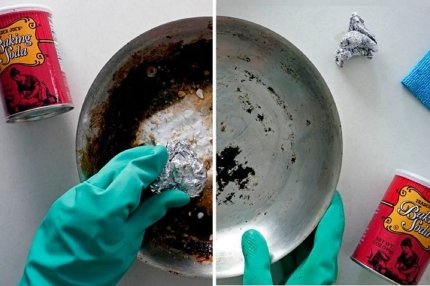
Baking soda is one of the most convenient ways to remove burnt-on residue from stainless steel.
It has weak alkaline properties and helps soften some contaminants.
The best results usually come from a combination of baking soda, water, and moderate heat.
Step-by-step instructions
For a regular frying pan with a diameter of 24–28 cm, you will need:
baking soda - 1–2 tablespoons;
water - enough to cover the burned area;
soft sponge;
wooden or silicone spatula.
Pour water into a pan and add baking soda.
Place the pan on the stove and bring the solution to a gentle boil.
Heat for about 5–10 minutes, making sure the water does not boil completely.
Turn off the heat and let the pan cool.
After that, try to carefully separate the softened food residue with a spatula.
Wash the dishes with regular dishwashing detergent and dry thoroughly.
If carbon deposits remain, the procedure can be repeated.
What to do with old brown stains
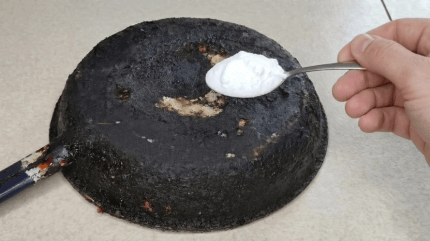
For stubborn grease stains, you can make a thick paste of baking soda and a small amount of water.
Apply it to the contaminated surface, gently scrub with a soft sponge and rinse thoroughly.
For polished stainless steel, it is important not to use rough scouring pads.
They can leave noticeable scratches.
Method #2. How to clean a non-stick frying pan
Non-stick pans require a more delicate approach.
If food has burned onto the surface, do not immediately try to remove it with a knife or metal scraper.
Even minor mechanical damage can impair the properties of the coating.
The safest way to clean
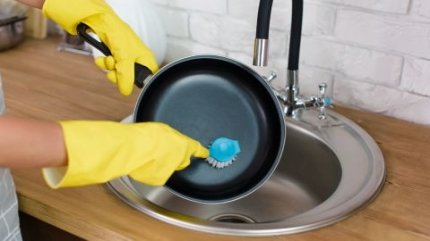
Pour warm water into a cooled pan and add a small amount of dishwashing detergent.
Leave for about 30–60 minutes.
During this time, some of the dried food residue may soften.
After soaking, clean the surface with a soft sponge.
If the dirt does not disappear, repeat the procedure.
Some non-stick pans allow the careful use of baking soda paste, but this is not a universal rule, so you should check the instructions for your specific product first.
What you absolutely should not do
Do not use:
metal brushes;
knives and sharp scrapers;
steel wool;
aggressive abrasive powders;
concentrated oven cleaners without the direct permission of the manufacturer.
If the coating is already peeling or has deep damage, cleaning will not restore it to its original properties.
It is better to replace such a pan.
Method #3. How to remove burnt fat from a ceramic pan
Ceramic non-stick pans can lose their ease of cleaning due to thin layers of oil.
This is especially common after regular frying at high temperatures.
The plaque may be almost invisible, but products begin to stick more strongly to the surface.
How to clean ceramic coating
Wait for the pan to cool completely.
Pour warm water with a small amount of detergent.
Leave for 15–30 minutes, then wash gently with a soft sponge.
If brown oil stains remain, check the manufacturer's specific recommendations.
For certain ceramic coatings, the use of a special melamine sponge is allowed, but this method cannot be automatically transferred to all models.
Do not use hard abrasives without confirming their compatibility.
Why does a ceramic frying pan start to burn?
The cause may be polymerized oil residue, overheating, or gradual wear of the non-stick properties.
If, after thorough cleaning, products continue to stick badly, the problem is not always solved by additional washing.
Sometimes the coating has already lost some of its properties.
Method #4. How to clean a cast iron skillet from carbon deposits
Cast iron pans need to be cleaned differently than stainless steel cookware.
It is important to distinguish between burnt food residue and the protective layer of polymerized oil.
The dark, uniform surface of a cast iron skillet is not necessarily dirt.
On the contrary, the protective layer formed helps reduce food sticking and protects the metal from rust.
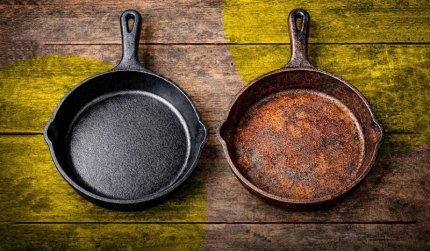
How to clean cast iron from burnt food
After cooling, remove any food residue with a plastic or special scraper.
If they are stuck tightly, you can pour a small amount of water and briefly heat it on the stove.
After cooling, carefully clean the surface with a brush or sponge.
If necessary, use a little regular dishwashing detergent.
Modern mild detergents usually do not destroy the properly formed protective layer of cast iron during normal washing.
After cleaning, dry the pan thoroughly.
Then apply a very thin layer of cooking oil, if recommended for your cookware.
Why cast iron cannot be soaked for a long time
Prolonged contact of unprotected cast iron with water increases the risk of rust formation.
Therefore, you should not leave the pan in water overnight.
Also, traditional cast iron cookware with a protective layer is usually not dishwasher safe.
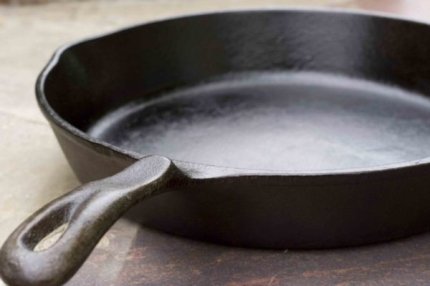
How to distinguish a protective layer from carbon deposits
A uniform dark coating that holds firmly to the metal can be a normal result of using cast iron.
Instead, thick, uneven layers that peel, chip, or leave black particles on food need cleaning.
If the protective layer is significantly damaged, it can be restored according to the manufacturer's instructions.
Method #5. How to clean an enameled pan
Enameled surfaces are particularly sensitive to sudden temperature changes and mechanical shocks.
Therefore, there is no need to pour cold water over hot dishes or scrape off burnt food with metal tools.
For difficult stains, gradual softening is suitable.
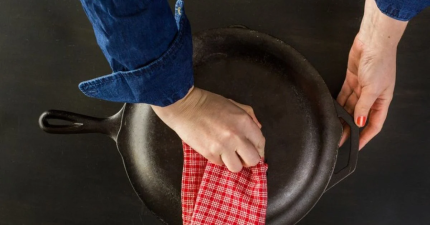
Cleaning with warm water
First, let the pan cool completely.
Pour warm water with detergent and leave for 15–20 minutes.
Then clean the surface with a soft sponge.
If food residue does not separate, for some enameled dishes, manufacturers allow for gentle boiling of water with baking soda.
As a rough guide, you can use 1–2 tablespoons of baking soda per sufficient amount of water.
The solution is gently heated for approximately 8–10 minutes, then allowed to cool.
Use this method only if it matches the instructions for your pan.
What enamel doesn't like
Metal brushes, abrasive powders and sharp blows can damage the enamel coating.
If the enamel inside the pan has chipped away and exposed the metal base, the further suitability of the cookware should be assessed according to the manufacturer's recommendations.
Do not continue cooking on a surface with large chips.
Method number 6. How to clean an aluminum pan
Aluminum cookware also requires careful selection of products.
Not all aluminum pans are the same: they can be made of untreated, anodized, or coated with a special protective layer of metal.
The permissible cleaning method depends on this.
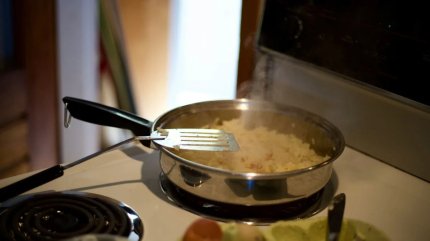
How to clean uncoated aluminum
To start, use warm water, mild dish soap, and a non-abrasive sponge.
If the food is burnt, let it soften with a short soak.
Do not use highly alkaline products without confirming compatibility.
Aluminum can react with aggressive alkaline and acidic substances, sometimes causing the surface to darken or become damaged.
What is important for anodized aluminum
Anodizing creates a special protective layer on the metal surface.
However, this does not mean that such dishes can be cleaned with any abrasives.
You need to be especially careful with pans that additionally have a non-stick coating.
If the material of the outer surface is unknown, it is safer to start with a gentle wash.
Method #7. How to remove black carbon from the outside of a frying pan
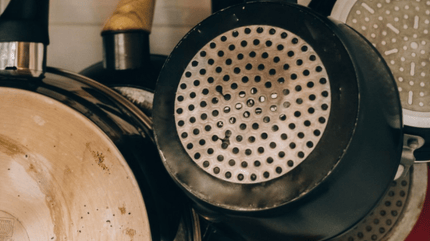
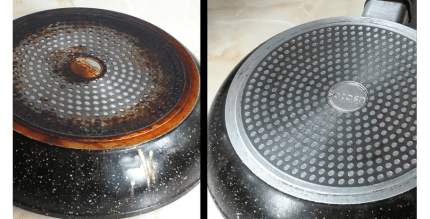
The most difficult contaminants often accumulate not inside, but on the outer bottom.
During frying, oil gets on the sides and bottom of the pan.
After repeated heating, it can form a dense black layer.
This problem is especially noticeable on gas stoves.
If the outer bottom is made of stainless steel
For stainless steel without additional coating, you can use a paste of baking soda and water.
Apply it to the cooled bottom.
Leave for 15–20 minutes, then rub gently with a soft sponge.
If the plaque is very persistent, you can use a special cleaner for cleaning stainless steel dishes without chlorine components, following the instructions.
After cleaning, thoroughly rinse off any remaining detergent and dry the dishes.
If the outer bottom has a coating
The situation is more complicated if the bottom is enameled, painted, or has a non-stick layer.
Baking soda paste or a specialized stainless steel cleaner may not be suitable.
Therefore, you need to check the material first.
Don't try to make the outer surface perfectly shiny at the cost of damaging the protective layer.
Can I use a metal scraper?
For most modern pans, this is an undesirable method.
A scraper can leave deep scratches, damage the coating, or change the properties of the outer surface.
Even if the dishes are made of stainless steel, mechanical cleaning must follow the manufacturer's recommendations.
Do baking soda and vinegar help with carbon deposits?
The combination of baking soda and vinegar is often called a universal way to clean kitchen utensils.
When these substances are mixed, an active fizzing occurs.
However, foaming does not mean that the mixture automatically becomes a stronger cleaner.
What happens during mixing?
Baking soda is sodium hydrogen carbonate.
Vinegar contains acetic acid.
During their interaction, water, carbon dioxide, and sodium acetate are formed.
It is the release of carbon dioxide that causes the characteristic hissing sound.
In this case, the acid and alkaline substance partially neutralize each other.
Therefore, for many types of carbon deposits, using baking soda alone may be more practical than mixing it with vinegar at the same time.
When vinegar can really be useful
Diluted white vinegar is sometimes used to remove rainbow stains or mineral deposits from stainless steel.
However, it is not a universal remedy for removing thick black carbon deposits.
Vinegar should also not be used for prolonged soaking of traditional cast iron or carbon steel with a protective layer.
Acids can affect this layer.
For aluminum and specially coated surfaces, the possibility of using vinegar must be checked separately.
Can oven cleaners and strong degreasers be used?
Some oven cleaners contain highly alkaline components that effectively break down grease stains.
However, such products may be incompatible with the materials of the pans.
You need to be especially careful with non-stick, aluminum, painted, and other special coatings.
Do not use oven cleaner on surfaces unless the manufacturer specifically allows such use.
You also shouldn't mix household cleaners with each other.
Chlorine bleach should not be mixed with vinegar, acidic products, ammonia or other cleaning agents. This may cause the release of dangerous gases.
When working with chemicals, ensure ventilation and use appropriate protective gloves.
Why you shouldn't clean a frying pan with salt and a hard sponge
Coarse salt is sometimes recommended as a natural abrasive.
However, its crystals can mechanically affect the surface of the dishes.
For traditional cast iron or carbon steel, some manufacturers allow the use of salt during cleaning.
But this method cannot be transferred to non-stick and ceramic coatings.
The same goes for metal sponges and powders with large abrasive particles.
The external result may look convincing, but along with the carbon deposits, the surface of the pan is sometimes damaged.
When a burnt frying pan is no longer worth restoring
Not every damaged dish should be used again.
Before spending time cleaning, check the condition of the pan itself.
The following signs are especially important:
peeling or swelling of the non-stick coating;
deep scratches with exposed base;
large enamel chips inside;
severe deformation of the bottom;
damaged handle attachment;
cracks in the body;
other signs that the manufacturer identifies as grounds for discontinuing use.
For example, a frying pan with a small burnt mark can be cleaned.
But if the non-stick coating peels off, no home remedy will restore its original integrity.
Traditional cast iron and carbon steel can often be restored after rust appears or the protective layer is damaged.
However, cracks in the metal and serious structural damage are a completely different situation.
How to prevent carbon deposits from forming again
It is easiest to remove dirt when it has not yet turned into a solid layer.
Therefore, prevention is more important than finding the strongest cleaner.
Do not overheat an empty pan.
This is especially true for non-stick cookware.
Prolonged heating without food can raise the coating temperature to undesirable values.
For many non-stick pans, manufacturers recommend low or moderate heat.
Stainless steel and traditional cast iron have different performance properties, but also do not require uncontrolled overheating.
Remove grease after each use
It's not always enough to simply wipe the pan with a paper towel.
A thin film of oil may remain on the surface, which will turn into a sticky coating during the next heating.
For non-stick, ceramic and stainless steel cookware, it is important to use the appropriate detergent regularly.
For traditional cast iron, you need to follow the rules for caring for its protective layer.
Watch the outer bottom
Drops of oil and sauce residue may fall on the outside of the pan.
If you leave them until the next time you cook, they will heat up again and gradually stick to the surface.
After the dish has cooled, check not only the inside, but also the sides and bottom.
Store your pans properly
If you stack several pans on top of each other, their surfaces may be damaged upon contact.
This is especially true for non-stick and enameled cookware.
You can use special soft pads between the pans.
Before storage, the dishes must be clean and dry.
The most common mistakes when cleaning pans
Pour cold water over a hot pan. Sudden changes in temperature can damage the metal or coating.
Use a metal scouring pad on a non-stick surface. This creates a risk of scratches.
Leave the cast iron in water overnight. Prolonged soaking can promote rust.
Apply vinegar to any material. Acid is not suitable for all surfaces.
Mixing several strong remedies at the same time. Such combinations can be dangerous.
Clean cast iron to a bright metal after each use. This can destroy the beneficial protective layer.
Using too much heat when cleaning can cause the water to boil over and further burn the dirt.
Ignore damage to the coating. If the surface is peeling, regular washing will not solve the problem.
Do not rinse away any cleaner residue. After cleaning, the dishes should be rinsed thoroughly according to the instructions.
Conclusion
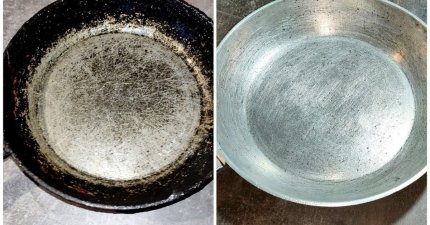
It is quite possible to clean a frying pan of carbon deposits at home, but the best method depends on the material.
For stainless steel, baking soda and water are often suitable. Non-stick and ceramic pans are best cleaned with mild detergents without excessive rubbing. Cast iron requires special care to maintain or restore its protective layer.
The main principle is to first soften the dirt and then carefully remove it. This way, even stubborn food residues can be removed without the risk of damaging the dishes.
FAQ: Frequently asked questions about cleaning a frying pan from carbon deposits
How to quickly clean a frying pan from black carbon deposits?
First, determine the material. For stainless steel, you can heat water with 1-2 tablespoons of baking soda for about 5-10 minutes, then cool and clean with a sponge. For non-stick coatings, it is better to use a soak in warm water with detergent.
How to remove old carbon deposits from the outside of a frying pan?
If the outer bottom is made of uncoated stainless steel, you can use a paste of baking soda and water or a special stainless steel cleaner. Enameled, anodized, and painted surfaces require a different method.
Can I clean a frying pan with baking soda and vinegar?
This combination is not always more effective than using baking soda alone. Baking soda and vinegar react with each other, partially neutralizing each other. For burnt-on food on stainless steel, it is often more practical to use baking soda and water without vinegar.
How to clean a non-stick frying pan if the food is badly burnt?
Let the pan cool down, pour warm water with a little dishwashing liquid and leave for about 30-60 minutes. Then clean carefully with a soft sponge. Do not use metal scrapers or harsh abrasives.
How to clean a cast iron skillet from thick carbon deposits?
Use a brush or a suitable scraper for cast iron. Burnt-on residues can be softened with a little water beforehand. After cleaning, dry the cookware thoroughly and, if necessary, restore the thin protective layer of oil.
Can I use a metal sponge for a frying pan?
This is undesirable for non-stick, ceramic and enamel coatings. A metal sponge can damage the surface. For certain types of cast iron or steel cookware, mechanical cleaning is allowed, but only in accordance with the manufacturer's instructions.
How to clean a burnt ceramic frying pan?
Start by soaking in warm water with a mild detergent. Then use a non-abrasive sponge. If traces of burnt oil remain, check the coating manufacturer's specific recommendations.
Can you boil soda in a pan?
This method is acceptable for many uncoated stainless steel pans and some enameled products. However, it should not be automatically applied to all cookware. Check the material and manufacturer's recommendations before cleaning.
How do you know if the non-stick coating is already damaged?
Signs of damage may include peeling, swelling, deep scratches, and exposed base. If the coating is peeling, it is impossible to clean it back to its original condition. It is best to replace such a pan.
Why does the bottom of the pan turn black even after regular washing?
Drops of oil, grease and food residue can accumulate on the outer bottom. When reheated, they form a persistent dark layer. To prevent this, it is important to clean the outer surface after each use and to prevent re-baking of dirt.

