
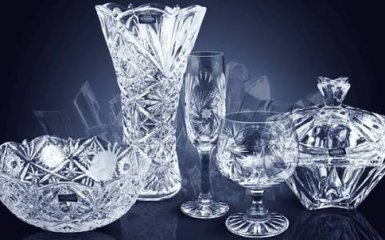
A crystal vase, glass, or salad bowl can look almost the same as regular glassware. It can be especially difficult to determine the material of old tableware that has been inherited, purchased at a flea market, or preserved without its original packaging. Bright shine, intricate cuts, and a characteristic ringing sound are often perceived as undeniable signs of crystal, but none of them alone guarantees the correct result.
Points of attention
- Crystal is a type of glass: traditional glass contains lead oxide, while modern glass can be lead-free.
- Markings and manufacturer information help identify the material; the designation 24% PbO indicates the lead oxide content.
- Weight, shine, sound, and cut provide only indirect clues and do not confirm the composition of the ware.
The main difference is in the composition of the material. Traditional lead crystal contains lead oxide, which changes the optical and physical properties of the glass. At the same time, modern crystal can be lead-free and look no less impressive.
To distinguish crystal from regular glass, it is worth checking the markings, comparing the weight of products of the same size, assessing the refraction of light and the quality of the finish. Sound and appearance can be additional clues, but it is impossible to accurately determine the chemical composition using home methods alone.
It is especially important to know whether antique tableware contains lead. This affects not only its value, but also the rules for use in beverages and foods.
Let's consider the difference between crystal and glass, how to check a glass or vase for damage, what the designations 24% PbO and Lead Free Crystal mean, and what mistakes most often lead to incorrect conclusions.
What is crystal and how is it different from glass?
The common belief that crystal and glass are two completely different materials is not entirely correct.
Crystal, which is used to make glasses, vases, and decorative objects, is a special type of glass. Its properties are determined by its chemical composition and production technology.
Conventional soda-lime glass is mainly made from silica and compounds of sodium and calcium.
Lead oxide is added to traditional crystal. It affects the density, optical characteristics, and suitability of the material for decorative cutting.
As the Corning Museum of Glass explains, lead glass has a higher refractive index than regular soda-lime glass, which is what helps create the characteristic shine and play of light on polished facets.
Does all crystal contain lead?
No.
Modern manufacturers also use lead-free formulations with other metal oxides.
They allow you to obtain a transparent, shiny material with the properties necessary for making dishes.
For example, Austrian manufacturer Riedel notes that since 2015 it has been manufacturing crystal glass products without using lead oxide as a main component.
The Irish company Waterford has also switched to a new lead-free crystal formula, replacing lead compounds with other components.
Therefore, an old heavy glass and a modern thin-walled crystal glass can differ significantly, although both products belong to crystal glassware.
1. Check the labeling: the most informative home method
If you have the original packaging, label, or documentation, you should start with them.
Unlike sound or shine, markings can directly indicate the composition of a material.
Particular attention should be paid to the designation of lead oxide.
What do 24% PbO and 30% PbO mean?
In the European Union, crystal glass categories are defined by Council Directive 69/493/EEC.
It establishes requirements for the composition and characteristics of the material for the use of the corresponding names.
| Marking | Value |
| Lead Crystal 24% | Lead crystal with a lead oxide content of at least 24% |
| Full Lead Crystal 30% | Crystal with a lead oxide content of at least 30% |
| PbO | Chemical formula of lead oxide |
| Lead Free Crystal | Crystal, which is positioned by the manufacturer as lead-free |
| Crystalline or Crystallin | A category of crystal glass, the composition of which is determined by relevant standards |
The European system also provides for other categories of crystal glass, which take into account certain metal oxides and physical properties.
Important: the inscription Crystal by itself does not mean that the product contains exactly 24% lead oxide.
Can you trust the sticker?
Factory marking from a well-known manufacturer is a strong argument, but not an absolute guarantee.
Labels on old dishes could be lost, and errors in descriptions can occur on the secondary market.
Therefore, it is advisable to check the conformity of the marking to a specific series, design and production period.
If the scale says 24% PbO, it is significantly more informative than just the word "crystal" on the store price tag.
2. Compare the weight of crystal and regular glass
Traditional lead crystal usually has a higher density than regular soda-lime glass.
This is one reason why old crystal salad bowls and vases can seem surprisingly heavy.
According to the European classification, a minimum density of about 2.9–3.0 g/cm³ is set for certain categories of lead crystal.
Typical soda-lime glass has a density of approximately 2.5 g/cm³, although exact values depend on composition.
How to check your weight at home
You need to compare two products of approximately the same volume, shape, and wall thickness.
For example, if there are two similar glasses, one of them may feel heavier due to the use of lead crystal.
However, comparing a thick-walled glass vase with a thin crystal glass will prove nothing.
The total weight is affected by:
Thickness of walls and bottom.
Product dimensions.
The shape and number of decorative elements.
Chemical composition.
Manufacturing technology.
Why a light glass can also be crystal
Modern lead-free crystal is sometimes specially made to be thin and light.
For example, manufacturers of premium tableware use special glass compositions and molding technologies to combine transparency with thin walls.
Therefore, the statement "real crystal is always heavy" is incorrect.
Weight is a useful proxy for traditional lead crystal, but not a universal test for all modern products.
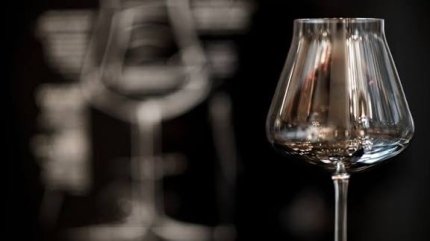
3. Look at how the material refracts light
Crystal is often valued for its ability to interact effectively with light.
This is especially noticeable on faceted vases, glasses, and decorative chandelier pendants.
Traditional lead glass has a higher refractive index than regular soda-lime glass.
Because of this, polished edges can appear brighter under appropriate lighting.
How to check gloss at home
Place the clean product near a window or other uniform light source.
Slowly turn it and watch the reflections change.
The intricate polished facets of lead crystal can create vibrant lighting effects.
Sometimes the separation of white light into colored components is noticeable.
This phenomenon is called dispersion.
Why rainbow reflections don't prove authenticity
The decomposition of light into colors is possible not only in crystal.
Ordinary optical glass and other transparent materials are also capable of producing colored reflections given the appropriate geometry.
The shape of the edges, the angle of illumination and the quality of polishing are of great importance.
Therefore, a beautiful rainbow effect is a sign of the optical properties of the product, not an accurate confirmation of lead content.
Do I need to shine a flashlight?
A flashlight can help you better see the facets, internal inclusions, and transparency of the material.
However, it does not convert a home test into a laboratory test.
Even if an object sparkles very brightly, it is impossible to determine its chemical composition.
4. Check the sound, but don't consider it proof
A long melodic ringing is often associated with crystal glassware.
If you lightly tap the rim of some crystal glasses, they can actually produce a clear sound with a noticeable aftertaste.
However, acoustic properties depend not only on the material.
The shape of the object, wall thickness, dimensions, method of holding, and presence of damage also affect it.
How to safely test sound
For a strong glass without cracks, you can very carefully touch the edge with a soft, non-metallic object.
No need to use force.
During the inspection, it is worth paying attention to the duration and nature of the sound.
But it is better to compare products of similar design.
It is incorrect to judge a heavy crystal vase and a thin glass glass by the same expectations.
Does crystal always ring longer?
No.
Waterford explains that even changing the thickness and shape of a crystal product affects its sound.
In addition, quality lead-free glasses can also have a long melodic aftertaste.
Therefore, the sound is just an additional clue.
Do not tap antique vases, old glasses with thin edges, or objects with microcracks. The risk of damage does not justify the result of such a test.
5. Evaluate the cut and quality of the finish
Classic crystal glassware often has intricate geometric patterns.
These can be rhombuses, vertical grooves, stars and other decorative elements.
Traditional lead crystal lends itself well to cutting and polishing, allowing craftsmen to create expressive facets with high optical quality.
How to distinguish cut from pressed
In manual or mechanical cutting, the pattern is formed by processing an already manufactured workpiece.
Pressed glass acquires the desired relief directly in the mold.
The signs may vary, but in practice the technology is not always easy to identify without experience.
Pressed products sometimes have lines connecting the parts of the mold, and cut faces may have characteristic geometry and polish.
However, this is not a universal criterion.
Can a pressed product be crystal?
Yes.
Crystal products can be made using various technological methods.
Similarly, ordinary glass can have high-quality decorative cutting.
Therefore, the presence of a seam from the mold does not prove that you have ordinary glass in front of you.
And the absence of such a seam is not confirmed by lead crystal.
6. Inspect the bottom, leg, and edge of the product
Construction details can help determine the method of manufacture and the approximate level of finish.
This is especially useful for glasses, decanters, and antique vases.
What can you see on the bottom?
On the bottom of the product there is sometimes:
Factory logo.
Manufacturer's engraving.
Series number.
Traces of technological processing.
Decorative polishing.
Remains of the original label.
The presence of a manufacturing mark can help establish the origin of an item.
However, not all manufacturers label each product directly on the glass.
The absence of a logo does not mean that the tableware is not crystal.
Do crystal glasses necessarily have a thin rim?
No.
Vintage lead crystal glasses often have fairly thick walls.
Modern lead-free models can be extremely thin.
Therefore, the edge thickness primarily reflects the design and manufacturing technology, not the exact chemical formula of the material.
7. Check the manufacturer and origin of the dishes
If an item has a logo or comes from a well-known service, it is useful to compare it with the characteristics of the corresponding collection.
This is especially important for antique tableware.
For example, old and new products of the same brand may differ in composition.
Waterford gradually transitioned from lead crystal to lead-free, so the manufacturer's name alone does not determine the composition of the product without taking into account the date.
Does Bohemian crystal always contain lead?
No.
The name "Bohemian crystal" is primarily associated with the traditions of glassmaking and the origin of the products from the respective region.
Various products, including lead-free ones, can be sold under this name.
Therefore, the inscription Bohemia Crystal should not be automatically equated with the designation 24% PbO.
To establish the composition, information about a specific series is required.
Is it possible to determine the material by price?
Only approximately.
The value is influenced by the brand, age of the item, complexity of the decoration, condition, and rarity.
An expensive glass may be made of lead-free glass.
And old lead crystal is sometimes sold inexpensively due to damage, lack of a set, or unknown origin.
Price is not a reliable method of establishing composition.
Crystal and regular glass: the main differences
For a quick comparison, it is worth considering several characteristics at once.
| Criterion | Traditional lead crystal | Ordinary soda-lime glass |
| Composition | Contains lead oxide | Does not require the addition of lead oxide |
| Density | Usually higher | Usually lower |
| Weight | Often larger than comparable sizes | Often smaller |
| Refraction of light | Usually more expressive | Usually less pronounced |
| Sounding | May have a long aftertaste | Depends on shape and thickness |
| Faceting | Well suited for decorative cutting | Can also be faceted |
| Use for beverages | There are restrictions due to possible lead migration | Depends on purpose and compliance with regulations |
| Care | Usually delicate hand wash | Depends on the specific product |
All of the above differences relate to typical material properties.
Modern lead-free crystal may have characteristics that do not fully match this comparison.
Which home tests do not allow you to accurately identify the crystal?
Common verification methods sometimes create a false sense of confidence.
For example, a person hears a ringing sound, sees rainbow reflections, and immediately concludes that the dish is made of lead crystal.
In fact, both properties are possible in products of different composition.
Magnet check
A magnet will not reliably determine whether lead oxide is present in glass.
Lead in crystal does not exist as individual metal particles that should be attracted by a magnet.
Touch test
Sometimes it is advised to judge which object seems colder longer.
However, the sensation is affected by the ambient temperature, mass, thickness, and thermophysical characteristics of the product.
This does not allow the determination of lead oxide content.
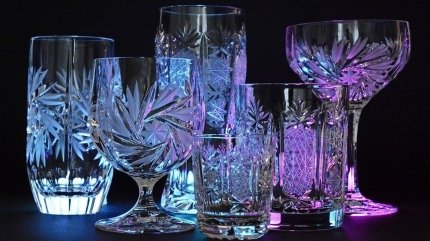
Checking with an ultraviolet flashlight
The glow of glass under ultraviolet light can depend on various components of its composition.
But it does not in itself confirm that it belongs to lead crystal.
For home identification, such a test is not reliable enough.
Scratching with a metal object
You should not examine the crystal with a knife, needle, or other sharp instrument.
The result will not be reliable, but irreversible damage may remain on the surface.
It is especially dangerous to conduct such experiments with antique objects.
How to accurately determine if crystal contains lead
If it is necessary not only to assume the material, but also to establish its composition, instrumental analysis is used.
One method is X-ray fluorescence analysis, or XRF.
It helps determine the presence of certain chemical elements in a material without having to destroy the product.
What does XRF analysis show?
With the help of appropriate equipment, it is possible to detect lead and other elements present in glass.
However, the accuracy of quantification depends on the calibration of the instrument, the characteristics of the material, and the analysis technique.
Specialized laboratory methods may be required to officially confirm the composition.
Common household tests for lead on surfaces do not necessarily detect lead inside the glass.
When laboratory testing is warranted
It may be appropriate if the item has significant collector's value, is planned to be sold as a specific type of crystal, or there is a need to accurately determine the composition.
For an ordinary decorative vase, it is often sufficient to establish the manufacturer and approximate period of manufacture.
But if old dishes of unknown origin are planned to be used regularly for food or drinks, the issue of their safety requires special attention.
Is it safe to drink from lead crystal?
This is an important question that cannot be answered by the appearance of the glass alone.
Lead from crystal glassware can leach into food and drinks under certain conditions.
Health Canada notes that the risk depends on the composition of the material, the type of product, and the duration of contact.
A particularly important factor is acidity.
Why it is undesirable to store wine in a crystal decanter
Wine, juices, and other acidic beverages can help lead migrate from the glass into the liquid.
The longer the contact lasts, the greater its income may be.
Therefore, lead crystal decanters should not be used for long-term storage of wine, brandy, juices or other beverages.
Health Canada recommends limiting the use of lead crystal to short-term serving and not leaving food in it for storage.
For daily use, it is more practical to choose lead-free cookware intended for contact with food.
Can children be served drinks in crystal glasses?
For children, pregnant women, and breastfeeding mothers, Health Canada recommends using lead-free cookware.
Lead can negatively affect the nervous system and other organs.
Children are especially sensitive to its effects.
Therefore, an antique crystal glass of unknown composition is not the best choice for children's drinks, even if it looks perfectly clean.
Is all crystal glassware dangerous?
No.
It is important to distinguish between lead and lead-free crystal.
Modern tableware made from appropriate lead-free material and intended for contact with food does not have the same risk of lead migration that is typical of traditional lead crystal.
At the same time, the quality and safety of dishes are determined not only by the name of the material.
The composition, production technology, compliance with food contact requirements, and the condition of the product are important.
How to care for crystal so it doesn't lose its shine
Improper cleaning can leave scratches, dull areas, and other damage.
For antique crystal, it is especially important to avoid sudden temperature changes and mechanical friction.
How to properly wash crystal glassware
For most old crystal items, delicate hand washing is suitable.
Use warm, but not hot, water, a small amount of mild detergent, and a non-abrasive sponge.
After washing, the dishes should be rinsed thoroughly and gently wiped with a soft, lint-free cloth.
Do not use metal sponges, coarse powders, or aggressive cleaners.
Can crystal be washed in the dishwasher?
It depends on the manufacturer and the specific collection.
Antique lead crystal is best washed by hand.
Instead, some modern lead-free glasses are specifically designed for dishwashers.
For example, Riedel allows many of its products to be machine washed, provided that the loading and care conditions are followed.
Waterford also notes that new lead-free products may be dishwasher safe, although it recommends a delicate wash to maintain the shine for a long time.
Therefore, the rule "any crystal cannot be washed in the dishwasher" is too categorical.
Why does crystal become cloudy?
Cloudiness can occur due to mineral deposits from the water, detergent residue, or surface damage.
If the cause is plaque, it can sometimes be removed with a suitable product approved by the manufacturer.
If the surface has been chemically damaged or covered in micro-scratches, regular washing will not necessarily restore its original transparency.
There is no need to use acids uncontrollably to restore old dishes, especially when their composition and condition are unknown.
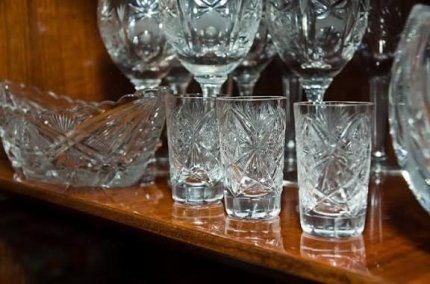
How to determine the value of antique crystal
Real lead crystal is not necessarily an expensive antique.
Similarly, high-quality lead-free glass can have significant collectible value.
The price of vintage items is influenced by the manufacturer, rarity of the series, age, authorship of the design, condition, and completeness of the set.
What to check before the assessment
The factory mark, the nature of the cut, the original packaging and documents are important.
You also need to check:
Are there any chips on the edges?
Has transparency been maintained?
Is the stem of the glass damaged?
Are there any cracks?
Do all the items in the service belong to the same series?
There was no noticeable unprofessional restoration.
For example, a set of six undamaged glasses from a particular collection may be valued differently than a single glass from the same set.
At the same time, a complex carved pattern in itself does not confirm a high market value.
How not to make a mistake when buying crystal glasses
Before buying, it is worth determining what you need the dishes for: daily use, holiday serving, or collection.
For regular use, it is practical to check not only the design, but also the care and safety characteristics.
What to look for in the store
First of all, check the manufacturer's name, exact series, and material description.
If Lead Free Crystal is indicated, it is worth making sure that this applies to the selected model.
For tableware intended for food and beverages, it is important to confirm the appropriate purpose of the product.
If dishwasher cleaning is planned, direct confirmation of compatibility is required.
Should you buy old crystal without markings?
For decoration, such a product can be quite interesting.
But if you plan to use it regularly for drinks, the unknown composition creates additional uncertainty.
Therefore, an antique vase without confirmation of the material is practically considered primarily as a decorative object.
Do not assume that the absence of labeling means the absence of lead.
Conclusion
You can distinguish traditional crystal from ordinary glass by a combination of characteristics: marking, density, nature of light refraction, quality of processing, and origin of the product.
However, weight, melodious ringing, and bright reflections are not indisputable evidence. Modern lead-free crystal can be light, thin, and very transparent, while regular glass can have intricate cuts.
For accurate identification of the composition, manufacturer documentation or appropriate instrumental analysis is required.
It is especially important to find out whether antique glassware contains lead before using it to store beverages.
FAQ: Frequently Asked Questions about Crystal and Glass
What is the easiest way to distinguish crystal from glass at home?
First, check the product's markings and origin. You can also assess its weight compared to similar glass objects, the nature of the shine, and the quality of the cut. But no single external characteristic guarantees an accurate determination of composition.
What does real crystal sound like?
Some crystal glasses produce a clear, melodic ringing sound with a long aftertaste. However, the sound depends on the shape, thickness, and construction of the product. Good quality regular or lead-free glass can also ring.
Is crystal heavier than regular glass?
Traditional lead crystal is usually denser, so it is often heavier for the same size and thickness. However, modern lead-free crystal can be lightweight, while regular thick-walled glassware can be heavy.
What does the inscription 24% PbO on crystal mean?
It indicates the lead oxide content. In the European classification, Lead Crystal 24% means lead crystal with a PbO content of at least 24%.
Is there real lead-free crystal?
Yes. Modern crystal can be made without the addition of lead oxide as a main component. Such products can have high transparency, bright shine and characteristic cuts.
How to distinguish Bohemian crystal from regular glass?
The most informative signs are the marking, manufacturer and characteristics of a particular collection. The name Bohemia Crystal in itself does not prove the presence of lead. Bohemian products can have different compositions.
Is it okay to drink wine from antique crystal glasses?
If the glassware contains lead, prolonged contact with wine and other acidic beverages can cause the lead to leach into the liquid. For everyday use, and especially for children and pregnant women, it is safer to choose certified lead-free glassware. Wine should not be stored in lead decanters.
Can I wash crystal in the dishwasher?
This depends on the specific product. Vintage lead crystal usually requires hand washing. Some modern lead-free glasses are dishwasher safe if specified by the manufacturer.
Why does crystal shine brighter than glass?
Traditional lead crystal has a higher refractive index, which contributes to expressive optical effects. The quality of polishing and the geometry of the facets play an additional role. However, bright shine is possible in other types of glass.
Is it possible to accurately identify a crystal from a photograph?
A photograph can help identify the model, manufacturer, approximate date of manufacture, and design features. However, it is not possible to accurately determine the presence or concentration of lead from an image alone. Documentation or appropriate analysis is required for confirmation.
The material is for informational purposes only and is not a substitute for medical advice. Lead can have adverse effects on health, especially for children and pregnant women. If you suspect significant or prolonged exposure to lead, you should first consult a doctor. Self-medication can be harmful to your health.

