

Coffee in a geyser coffee maker can be rich, aromatic, with a pleasant sweetness and a distinct aftertaste. But sometimes, instead of a balanced drink, the result is too bitter, sour or watery coffee. Moreover, even high-quality beans and an expensive coffee maker do not guarantee the desired result.
Points of attention
- For the classic preparation method, use cold or room temperature water - this is the approach suggested by many manufacturers' instructions, including the classic Bialetti Moka Express.
- Tight packing increases the resistance to water flow. This can cause uneven extraction and excessive pressure inside the coffee maker.
- The flame should not extend beyond the bottom of the coffee maker. This prevents the body from overheating and damage to the handle.
To make delicious coffee in a geyser coffee maker, you need to choose the right grind, fill the filter without tamping it down, pour water below the safety valve, and monitor the heating. It is also important to remove the coffee maker from the stove in time, without waiting for the drink to start bubbling intensely.
We understand how a geyser coffee maker works, how much coffee is needed per serving, what water to use, and what to do if the taste of the drink disappoints. We also explain nuances that even coffee maker owners with many years of experience often forget.
How a geyser coffee maker works and why it affects the taste
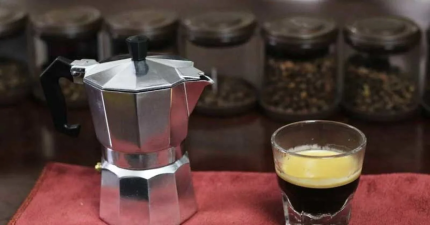
A geyser coffee maker, also called a moka pot, brews coffee using the pressure created when water is heated in the lower tank.
The classic design consists of three main parts:
The lower tank is a water container with a safety valve.
A filter funnel is a metal basket into which ground coffee is poured.
The upper tank is the part where the finished drink accumulates.
As the water heats up, the pressure of the air and water vapor in the lower tank increases. The water flows upward through the layer of ground coffee, becomes saturated with soluble substances, and enters the upper part of the coffee maker.
This process is called extraction—the transfer of flavor and aroma compounds from coffee particles into water.
Contrary to popular belief, water does not necessarily have to boil to start percolating through the coffee. Studies of the thermodynamics of geyser coffee makers show that extraction can begin at temperatures below 100 °C.
How is coffee from a geyser coffee maker different from espresso?
Moka is often called the home alternative to an espresso machine. However, they are different methods of preparation.
Professional espresso machines usually operate at a pressure of around 9 bar, while a geyser coffee maker operates at a much lower pressure. This results in different extraction intensity, beverage concentration, and crema formation, the characteristic foam on the surface of the espresso.
Mocha coffee is usually stronger than regular filter coffee, but less concentrated than classic espresso.
Its main features are a denser flavor, a rich aroma, and the distinct character of roasted beans. That is why the method of preparation is of great importance here.
How to properly brew coffee in a geyser coffee maker: step-by-step instructions
Making good coffee doesn't require complicated techniques. The most important thing is to follow the correct sequence of actions and understand when to stop heating.
Step 1. Prepare the water
Fill the lower tank with fresh drinking water to a level just below the safety valve.
Never fill the tank above the valve. This will affect the coffee machine's operation and may pose a safety hazard due to improper pressure relief.
For the classic preparation method, use cold or room temperature water - this is the approach suggested by many manufacturers' instructions, including the classic Bialetti Moka Express.
There is also an alternative method with preheated water, which we will consider separately.
Step 2. Pour ground coffee into the filter
Fill the metal basket with ground coffee almost to the brim and carefully level the surface.
Do not press the powder with a spoon or a special tamper, as is done when making espresso.
Tight packing increases the resistance to water flow. This can cause uneven extraction and excessive pressure inside the coffee maker.
After filling the filter, check that there are no coffee particles on its edges and sealing surfaces.

Step 3. Assemble the coffee maker correctly
Place the filter funnel into the lower tank. Screw the top part tightly, but without excessive force.
Make sure the gasket is installed correctly and the threaded connection is clean.
Do not use the coffee maker handle as a lever when turning - it may be damaged.
Step 4. Place the coffee maker on the stove
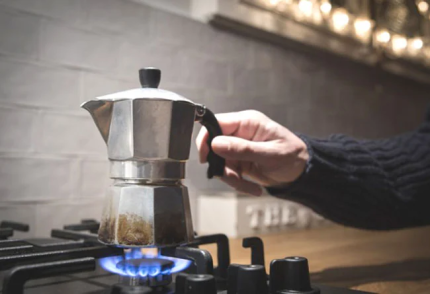
For a gas stove, choose a small burner and set it to moderate heat.
The flame should not extend beyond the bottom of the coffee maker. This prevents the body from overheating and damage to the handle.
On an electric or glass ceramic surface, it is also better to avoid maximum power.
Do not leave the coffee maker unattended during brewing.
Step 5. Watch for coffee to appear
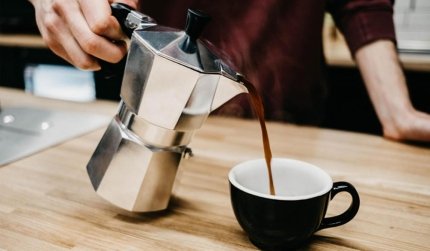
First, the first drops will appear in the upper tank, and then the drink will begin to flow through the central tube in a more even flow.
It is desirable that the coffee rises smoothly, without intense splashing.
When the top starts to fill, reduce the heat slightly if necessary.
Step 6. Remove the coffee maker from the stove in time
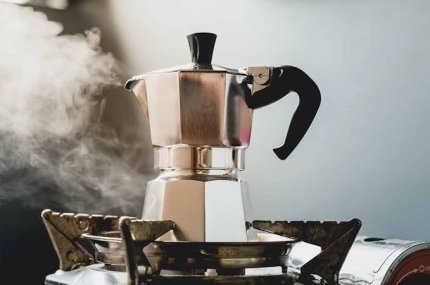
At the end of brewing, the coffee flow becomes uneven, bubbles and a characteristic gurgling sound may appear.
This is a signal that the process is nearing completion.
You don't need to wait for a long, loud hiss. Remove the coffee maker from the heat when the beverage has almost completely reached the top or when the characteristic intermittent flow begins.
After removing from the stove, the residual heat will continue to support the process for some time.
Stir the finished coffee in the upper tank before pouring to even out the concentration of the drink.
How much coffee and water is needed for a geyser coffee maker
One of the features of a moka pot is that its design already determines the approximate amount of water and ground coffee.
Unlike a French press or pourover, you can't always arbitrarily change the proportions here.
The filter is usually filled almost completely, without tamping, and water is poured to the level set by the design.
Approximate quantities for common coffee maker sizes:
| Coffee maker size | Ground coffee | Water |
| 1 cup | 6–8 g | 50–70 ml |
| 2 cups | 10–13 g | 90–120 ml |
| 3 cups | 15–18 g | 130–160 ml |
| 6 cups | 25–32 g | 250–300 ml |
| 9 cups | 35–45 g | 400–450 ml |
These are approximate values, not universal instructions. The actual capacity depends on the specific model, so the water level mark and manufacturer's recommendations take precedence.
Why three cups doesn't mean three large servings
The designation "for three cups" often misleads buyers.
Manufacturers of geyser coffee makers usually mean small coffee portions, not standard mugs of 200–300 ml.
For example, a three-cup model can make approximately 90–130 ml of finished coffee, depending on the design and the amount of water remaining in the lower tank.
If you are used to drinking a large cup of black coffee, the ready-made concentrated drink can be diluted with hot water.
At the same time, you should not try to obtain a larger volume by filling the lower tank above the safety valve.
What kind of coffee grind is needed for a geyser coffee maker?
The degree of grinding is one of the most important factors that determines the taste of the finished drink.
Water passes through a layer of coffee particles under relatively low pressure. Therefore, powder that is too fine creates unnecessary resistance, and particles that are too large may not release enough flavor.
For most geyser coffee makers, the optimal starting point is a medium grind: finer than for regular filter coffee, but coarser than a typical espresso machine grind.
It can then be adjusted depending on the result.
| Grinding degree | Cooking features |
| Too fine, almost like powder | High flow resistance, risk of filter clogging |
| Medium-fine | Typically provides balanced extraction |
| Average | May give a lighter taste, especially with fast water flow |
| Rude | Often results in under-extraction and a weak drink |
Can I use coffee for espresso?
Yes, if its grind is suitable for a specific geyser coffee maker.
However, a very fine grind, intended for professional espresso machines, may be a poor choice.
If you are buying ground coffee, the easiest way is to look for packaging marked "for geyser coffee makers" or "moka."
If you have a coffee grinder, it is best to grind the beans just before brewing. This helps to better preserve the volatile aromatic compounds.
Why does coffee in a geyser coffee maker turn out bitter?
Bitterness doesn't always mean that the coffee is of poor quality. Some bitter compounds are naturally present in roasted coffee beans.
The problem arises when bitterness becomes excessive and overwhelms other flavor nuances.
There may be several reasons.
Excessive heating
If you keep the coffee maker on high heat, the process can become too intense. At the end of the brewing process, the water and steam pass through the coffee layer unevenly, which can degrade the taste.
The solution is to use moderate heat and remove the coffee maker from the stove until it sizzles for a long time.
Grinding too fine
Small particles have a large contact area with water, so soluble substances pass into the drink faster.
If the grind is too fine, water passage may slow down and the taste may become heavy and harsh.
Try increasing the particle size a little next time without changing the other parameters.
Very dark roast
Dark roasted coffee often has distinct notes of dark chocolate, caramel, and toasted nuts. With intense roasting, smoky and bitter undertones can predominate.
If you don't like this taste, try medium roast beans.
It is important to distinguish between the natural bitterness of coffee and the unpleasant aftertaste caused by improper preparation.
Why does coffee turn out sour or watery?
Acidity is a normal part of the flavor profile of many Arabica varieties. It can be reminiscent of citrus, apples, or berries.
However, a sharp, unpleasant acidity sometimes indicates insufficient extraction.
What to do if the coffee is too sour
Check three parameters:
Grind: If the particles are too large, the water may not have enough time to dissolve the flavor compounds. Try grinding them a little finer.
Flow pattern: If the coffee is coming in too quickly, check the heating intensity and the even filling of the filter.
Roast level: Lightly roasted beans may have more pronounced fruity acidity. If you don't like that, try a medium roast.
At the same time, acidity in itself is not evidence of an error: sometimes it is a characteristic feature of a particular coffee.
Why is the coffee weak even though the filter is full?
A watery taste can be caused by coarse grinding, poorly selected beans, or water passing through too quickly.
It is also worth checking whether the filter is installed correctly and whether there are any problems with tightness.
If the coffee is weak, don't immediately pour more powder than the basket can hold. It's better to start by adjusting the grind and heat.
Cold or hot water: which is better for a geyser coffee maker?
Among coffee lovers, there are two main approaches to the initial water temperature.
Cold water is the classic option. It is included in the standard instructions of many manufacturers. It is convenient, safer during assembly, and does not require additional equipment.
Preheated water is an alternative method. It reduces the time the coffee maker is on the stove and changes the temperature profile of the extraction.
However, hot water does not guarantee a tastier result. Modern experimental studies show that the degree of extraction can be influenced by grinding much more than the initial water temperature.
If your coffee maker manufacturer allows the use of preheated water, you can compare the two methods. When assembling with hot water, the lower part of the housing heats up quickly, so there is a risk of burns.
For beginners, it is best to refer to the standard instructions for a specific model.
How to determine the cause of unsuccessful brewing by the taste and behavior of the coffee maker
It is not always necessary to change the entire recipe. Often, it is enough to correct one parameter.
| Problem | Possible cause | What to change |
| Too bitter coffee | Intense heat, fine grind, dark roast | Reduce heat or adjust grind |
| Sharp sourness | Insufficient extraction or grain characteristics | Try a finer grind or a different roast. |
| Watery taste | Coarse grind, insufficient extraction | Check the grind and flow rate |
| Foreign taste | Coffee maker contamination, old coffee or bad water | Clean parts, replace water and grains |
| Coffee comes out in spurts | Excessive heating, resistance in the filter | Check heating and filter condition |
| The couple is leaving the connection. | Damaged gasket or leaky assembly | Stop heating, check the seal after cooling |
| The coffee does not rise at all | Clogging, improper assembly or insufficient heating | Turn off the heat, let it cool down and check the parts |
If the coffee maker is not working properly, do not attempt to unscrew it while it is heating up. There may be pressure inside.
What coffee to choose for a geyser coffee maker
The geyser method emphasizes the character of the coffee beans quite well, so the choice of variety and roasting has a noticeable impact on the taste.
Arabica or robusta
Arabica usually has a more complex aromatic profile, which may include fruity, floral, chocolate, or nutty notes.
Robusta is often characterized by a denser, earthier flavor, more pronounced bitterness, and higher caffeine content for the same weight of dry coffee.
For mocha, you can use both types or a mixture of them.
If you prefer coffee with milk, blends of Arabica and Robusta can create a rich base for milky drinks.
What degree of roasting is best?
For your first introduction to a geyser coffee maker, it is convenient to use medium-roasted beans.
They often provide a balance between acidity, sweetness, and bitterness.
A light roast can better emphasize fruit notes, but requires more careful adjustment of the grind.
Dark roast is suitable for those who like intense chocolate and toasted shades.
There is no single correct roast level for all geyser coffee makers - the choice depends on the desired flavor profile.
How to properly clean and care for a geyser coffee maker
Residual coffee oils gradually oxidize. If you don't clean your coffee maker regularly, they can cause an unpleasant odor and a rancid taste.
Allow the appliance to cool completely after each use.
Then disassemble it, remove the used coffee and clean the tanks, filter and accessible sealing surfaces according to the manufacturer's instructions.
Basic care rules
Wash the parts by hand unless the model instructions allow another method.
Do not use metal brushes or abrasives.
Check the filter holes regularly.
Make sure the safety valve remains clean.
Check the elasticity and integrity of the sealing gasket.
Dry all parts completely before storing.
For classic aluminum models, Bialetti recommends hand washing with warm water. Other manufacturers may require the use of mild detergents, so it is worth checking the care instructions for your specific coffee maker.
There is no need to deliberately leave old coffee residue on the interior surfaces. It is not a prerequisite for obtaining good taste.
How often to change the pad
The sealing gasket ages over time due to heat and mechanical stress.
If it has become hard, cracked, deformed, or no longer provides a tight seal, it must be replaced.
When purchasing, be sure to consider the model and size of the coffee maker.
If steam escapes through the tank connections, it is dangerous to continue use without eliminating the cause.
Can a geyser coffee maker be used on an induction hob?
Compatibility depends on the material and design of the bottom.
Classic aluminum geyser coffee makers usually do not work directly on induction hobs because aluminum does not provide the necessary interaction with the magnetic field.
Some stainless steel models are specifically designed for induction.
However, even a steel body does not guarantee compatibility: the ferromagnetic properties of the bottom, its diameter, and the requirements of the hob are important.
There are special induction adapters for certain models. They can only be used if they are compatible with the stove and coffee maker.
Common myths about making coffee in a moka pot
The stronger the fire, the stronger the coffee.
No. Higher heat does not automatically mean higher concentration or better extraction.
On the contrary, excessive power can make the flow uneven and impair the taste of the drink.
The coffee needs to be pressed tightly in the filter.
No. A geyser coffee maker is structurally different from an espresso machine. Tamping creates unwanted resistance to the flow of water and may disrupt the normal operation of the appliance.
The coffee should boil for a long time in the upper tank
No. Prolonged heating after extraction is complete does not improve the quality of the drink.
The coffee maker must be removed from the heat source in a timely manner.
You can pour milk into the lower tank
This cannot be done for standard geyser coffee makers. The lower part is intended for water.
Milk contains proteins, fats, and other components that can burn, form deposits, and contaminate the system.
For milk drinks, prepare the coffee separately and then add the heated milk.
How to make coffee with milk in a geyser coffee maker
Mocha is a good base for homemade milk drinks.
For example, for a coffee similar in character to a latte, you can use 50–70 ml of ready-made coffee and 120–160 ml of heated milk.
The milk is heated separately, whipped with a cappuccino maker if desired, and added to a cup of coffee.
For a richer drink, reduce the amount of milk. For a milder taste, increase it.
You can also add a pinch of cinnamon or a little vanilla. Sugar, syrups, and other additives should be added to the finished drink, not to the coffee maker's reservoir.
How to improve the taste of coffee: a simple tuning method
If the coffee turns out different every time, it is useful to record the basic brewing parameters.
Start with the same type of beans, the same filter filling, and a consistent heat level.
After the first try, evaluate the taste:
If it's too harsh and bitter, try a slightly coarser grind or a milder heat.
If the drink is weak and watery, check if the coffee is ground too coarsely.
If the acidity is excessive, try a finer grind or a different roast.
If a rancid taste appears, check the cleanliness of the coffee maker and the freshness of the beans.
The main rule is to change only one parameter at a time. If you change the grind, coffee type, water temperature, and heating all at the same time, it will be difficult to determine the cause of the improvement or deterioration in taste.
Even a few consecutive attempts will help you find the settings that best suit your coffee machine and taste preferences.
Conclusion
Delicious coffee in a geyser coffee maker depends on four key factors: the quality of the beans, proper grinding, controlled heating, and timely completion of preparation.
It is best to start with medium roast coffee, medium grind, and moderate stove temperature. The filter should be filled without tamping, and the water should be poured below the safety valve.
A properly configured geyser coffee maker can prepare rich, aromatic coffee every day without complicated equipment and unnecessary steps.
FAQ: Frequently asked questions about coffee in a geyser coffee maker
How many minutes does it take to brew coffee in a geyser coffee maker?
For smaller models, brewing often takes about 3-6 minutes, but the exact time depends on the volume, initial water temperature and heating power. Focus primarily on the nature of the coffee flow, not the timer.
How many spoons of coffee are needed for three cups?
A standard geyser coffee maker typically uses about 15–18 g of ground coffee for three small servings. The exact amount depends on the capacity of the filter and the fineness of the grind. It is best to fill the basket to the brim without tamping it down.
Why does coffee in a geyser coffee maker taste bitter?
Possible causes include excessive heat, grinding too fine, prolonged hissing at the end of brewing, or dark roasting of the beans. Residues of old coffee oils inside the appliance can also increase bitterness.
What coffee is best for a geyser coffee maker?
A good starting point is freshly roasted Arabica or a blend of Arabica and medium roast Robusta. It is important that the grind is suitable for mocha. The specific variety is chosen based on the desired flavor profile.
Do I need to tamp the coffee in a geyser coffee maker?
No. Ground coffee should be poured loosely into the filter and carefully leveled. Strong compaction increases water resistance and may disrupt the normal operation of the coffee maker.
Can I pour boiling water into a geyser coffee maker?
Some experienced coffee lovers use preheated water to reduce brewing time. However, this method is not suitable for all models. First of all, you should follow the manufacturer's instructions and consider the risk of burns when assembling a hot appliance.
Why does the geyser coffee maker produce little coffee?
Some water naturally remains in the lower tank. If the beverage is unusually low, check the water level, grind, condition of the filter, gaskets and tightness of the connection. Do not increase the amount of water above the permissible level.
Can I use instant coffee in a geyser coffee maker?
No. A standard moka pot is designed for ground, natural coffee. Instant coffee does not require water to pass through a filter and can contaminate the coffee maker's components. It should be brewed directly in the cup.
Can I wash a geyser coffee maker in the dishwasher?
This depends on the model. Most classic aluminum geyser coffee makers recommend hand washing, as a dishwasher can damage the metal surface. For stainless steel models, you should check the manufacturer's instructions.
When should you remove a geyser coffee maker from the heat?
The coffee maker should be removed when the bulk of the beverage has already passed into the upper tank and the flow begins to become intermittent. Do not wait for a long, intense gurgling or hissing sound: this can negatively affect the taste of the finished coffee.

