
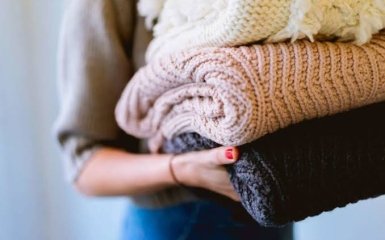
A wool sweater can shrink in size after one incorrect wash. A cardigan can stretch out during drying, and your favorite scarf can lose its softness and become covered in pile. The reason is not necessarily the poor quality of the product: natural wool requires special care due to the structure of its fibers.
Points of attention
- Before washing, check the label: it specifies the permissible temperature, washing method and spin cycle.
- For most wool items, water around 30°C is suitable, but the manufacturer's recommendations take precedence.
- Use a special product for wool and avoid excessive rubbing and wringing.
However, woolen items can be washed not only by hand. Many modern sweaters, socks, and merino wool products are designed for machine washing. The main thing is to choose the right temperature, program, and detergent.
The safest approach is to follow the manufacturer's label, use a wool-specific detergent, avoid excessive rubbing, and dry the knitwear horizontally. For most items that are machine washable, water temperatures around 30°C are suitable, but the final decision is made by the label.
We'll figure out how to wash a wool sweater in a machine and by hand, whether you can use conditioner, which spin cycle is safe, why wool shrinks, and whether it's realistic to return the garment to its original size.
Why do woolen things shrink after washing?
Wool is composed primarily of the protein keratin. Its fibers have microscopic scales on their surface that affect the material's behavior when wet and mechanically processed.
When wool fabric is rubbed, agitated, or washed in an inappropriate manner, the fibers can shift and gradually become intertwined.
This process is called staking, or felting.
As a result, the tissue becomes denser, less elastic, and shrinks in size.
Does hot water really shrink wool?
Hot water can contribute to damage to wool products, but temperature itself is not the only factor.
The combination of heat, moisture, and intense mechanical stress is especially dangerous.
For example, a sweater that is repeatedly turned over in the drum on a regular cotton program risks falling apart even without extremely high temperatures.
At the same time, some specially treated woolen items can be machine washed at 40 °C.
Therefore, the universal statement that any wool will definitely shrink at temperatures above 30 °C is incorrect.
The combination of temperature, mechanical stress and the properties of the specific product are crucial.
How to decipher a wool clothing label
Check the inside label before washing.
Even two 100% wool sweaters can have different recommendations due to the manufacturing method, knitting density, fiber treatment, or decorative elements.
The most important designations:
| Symbol or inscription | What does it mean? |
| Bowl of water and 30 °C | Wash at a temperature not exceeding 30 °C |
| One line under the bowl | Gentle wash mode |
| Two lines under the bowl | Especially delicate mode |
| Hand in a bowl | Handwash |
| Crossed out bowl | Do not wash in water. |
| Crossed out triangle | Do not bleach |
| Crossed out square with circle | Do not tumble dry. |
| Horizontal line in a square | Dry flat. |
If the label says "Dry Clean Only", you should not replace professional cleaning with home washing yourself.
Some wool items have linings, glued details, or complex construction that can deform when wet.
Can I wash an item marked "hand wash" in a machine?
The machine program "Hand wash" should not automatically be considered equivalent to machine wash permission.
A thing marked as hand-wash only may not withstand the mechanical effects of a particular machine.
An exception may be specially tested modes for which the equipment manufacturer directly confirms compatibility with such products.
If there is no relevant information, it is safer to follow the label instructions.
At what temperature should you wash woolen clothes?
For most household wool products that are washable, a practical guideline is a temperature of around 30 °C.
However, for certain items, the manufacturer may recommend cold water, and for machine-washable wool, even 40°C on a special setting.
It is important that the temperature corresponds to the label and remains fairly stable throughout the wash.
Why sudden temperature changes are undesirable
A sudden change in temperature can place additional stress on the fabric structure, especially when combined with friction.
Therefore, you should not wash a sweater in very warm water and then immediately rinse it intensively in ice water.
It is better to use water of the appropriate temperature and to carry out all steps carefully.
If the manufacturer specifically recommends a specific rinsing order, follow its instructions.
How to properly wash woolen clothes in a washing machine
Machine washing is suitable for wool products that have the appropriate permission on the label.
The presence of a "Wool" mode in a washing machine does not in itself mean that you can safely wash any sweater in it.
Step-by-step instructions
Check the label. Make sure it is machine washable.
Turn the item inside out. This helps reduce friction of the front surface against the drum.
Separate colors. It is best to wash light and dark items separately, especially during the first few cycles.
Use a laundry bag. This is especially useful for fine knitwear and items with decorative elements.
Add wool detergent. Follow the dosage indicated on the packaging.
Select the “Wool” mode. If the manufacturer of the item allows delicate machine washing, but there is no special program, the possibility of using an alternative mode should be checked in the machine instructions.
Set the appropriate temperature. This is usually 30 °C or another value allowed on the label.
Check the spin setting. It must meet the product requirements.
Remove the items when finished. Don't leave a wet sweater in the drum for too long.
Dry properly. Lay your knitwear flat on a clean towel or mesh dryer sheet.
How many things to put in the drum
For very delicate wool washing, it is recommended not to fill the drum more than about a third of its volume.
This allows you to reduce unwanted mechanical stress and ensure the movement of things.
Do not wash a thin wool sweater with jeans, towels, clothes with metal fasteners, or coarse fabrics.
Such things can create additional friction.
Which spin speed is suitable for wool?
Machine spin modes vary depending on the design of the washing machine.
There is no single spin speed that is guaranteed to be safe for all wool products.
For some items, the manufacturer allows for a gentle machine spin. Others should be carefully squeezed by hand without wringing.
It is best to use the settings of the special “Wool” program if it meets the recommendations on the label.
Do I need to completely turn off the spin?
Not necessarily.
In some special programs, a short controlled spin helps remove water without excessive friction.
But for particularly delicate or loose products, it is worth checking the manufacturer's recommendations.
If the item cannot be wrung out in the machine, it is better to remove excess water with a towel.
How to wash a wool sweater by hand
Hand washing is suitable for delicate items that are not intended for machine care but are approved for washing in water.
At the same time, the manual method does not guarantee safety if you rub, stretch, or wring the fabric too much.
Step-by-step hand washing
Step 1: Prepare the water. Fill a clean basin with water at a temperature of approximately 30°C or as recommended on the label.
Step 2. Dissolve the detergent. Use a small amount of special wool detergent.
Step 3. Submerge the item. Carefully lower the sweater into the water so that it is evenly wet.
Step 4. Leave it for a short time. For many products, about ten minutes is enough, unless the instructions require otherwise.
Step 5: Clean gently. Gently move the product in the water without rubbing the cloth between your hands.
Step 6. Rinse. Use clean water at the appropriate temperature until all product residue is removed.
Step 7. Remove excess water. Gently support the item without wringing it out.
Step 8: Dry horizontally. Shape the sweater while it is still damp.
There is no need to leave a wool product soaked for several hours without special need.
Prolonged exposure to water can deteriorate the condition of certain types of knitwear.
Which detergent is best for washing wool?
For woolen items, mild detergents designed specifically for this material are recommended.
Wool is a protein fiber, so it is sensitive to some aggressive components of household chemicals.
Strongly alkaline agents and bleaches are especially undesirable.
Why you shouldn't use regular laundry detergent
Some universal products contain enzymes, in particular proteases, which help remove protein contaminants.
However, under certain conditions, such enzymes can also affect the protein structure of wool fibers.
Therefore, for regular care, it is better to choose products without aggressive enzyme systems, unless they are specifically approved by the manufacturer for wool.
It is also not recommended to use chlorine and oxygen bleaches if the care of the product does not allow this.
Gel or powder
Liquid wool detergent is convenient because it is easier to distribute evenly in water.
If a special powder is used, it is advisable to completely dissolve it first.
Concentrated detergent particles that fall directly on the fabric can damage individual areas or deteriorate the appearance of the product.
Can you wash wool with baby shampoo?
A popular home tip is to replace wool conditioner with baby shampoo.
However, shampoos are designed primarily for hair and skin, not for textiles.
They may contain fragrances, conditioning ingredients, and additives that are difficult to completely rinse out of the fabric.
Therefore, for an expensive sweater or cardigan, it is safer to use a product with the appropriate purpose.
Do you need conditioner for woolen items?
Regular fabric softener is not necessary when washing wool.
Some products can leave a coating on the fibers that changes the feel of the fabric, its properties, and its behavior when worn.
Excessive use of conditioner can also contribute to dandruff.
If you want to use fabric softener, check that it is intended for wool and that it is approved by the clothing manufacturer.
You shouldn't add a double dose of fabric conditioner in the hope of making a coarse sweater significantly softer.
If the fibers have already fallen apart, regular conditioner will not restore their original structure.
How to properly dry woolen clothes after washing
Drying is just as important as water temperature.
Wet wool becomes heavy, so when hanging to dry, the knitwear may stretch under its own weight.
This is why sweaters sometimes become longer and the shoulder line loses its shape after improper drying.
How to dry a wool sweater without warping it
After washing, carefully remove excess water.
Lay the sweater out on a large clean towel.
If necessary, roll the towel together with the sweater into a loose roll.
Press lightly to absorb the moisture.
Unfold and transfer the product to a dry towel or horizontal mesh dryer.
Straighten the shoulders, sleeves, and bottom edge.
Leave to dry at room temperature.
Replace the wet towel with a dry one if necessary.
Do not try to stretch a wet sweater with forceful movements if it does not return to its original shape.
To maintain the size, it is enough to gently straighten the fabric.
Why you shouldn't dry wool on a battery
Direct contact with a hot surface can cause uneven drying and deteriorate the appearance of wool fibers.
In certain cases, changes in color and structure are possible.
Therefore, you should not put the sweater on a radiator, heater, or dry it with hot air from a hair dryer.
It is also advisable to avoid prolonged exposure to direct sunlight.
Can I use a dryer?
Some modern wool products can be dried in a dryer on a special setting.
But this should be clearly stated on the label.
If there is no appropriate permit, it is safer to choose natural horizontal drying.
How to wash cashmere, merino and wool blends
Not all items made from natural fibers have the same care requirements.
The result is affected by the thickness of the thread, the knitting method, the processing of the fibers, and the presence of other materials.
Merino wool
Merino wool is known for its fine fibers, which can make clothing soft and comfortable against the skin.
Some merino wool products have special treatment that allows machine washing.
Therefore, thermal underwear, socks or sweaters made of merino wool can only be machine washed if there is appropriate permission on the label.
Cashmere
Cashmere is made from the undercoat of goats, so it's not technically sheep's wool. However, the principles of delicate care are similar in many ways.
Cashmere items can be particularly sensitive to friction and stretching.
It is important to follow the manufacturer's recommendations for them. Some cashmere knitwear can be hand washed, while others require professional cleaning.
Wool with acrylic or polyester
The addition of synthetic fibers can change the strength, elasticity, and ability of the fabric to retain its shape.
However, the presence of acrylic does not mean that the item can automatically be washed on a regular basis.
The overall composition and design of the product are important.
For example, a sweater made of 50% wool and 50% acrylic may still require delicate care.
How to remove stains from woolen clothes
Not every stain requires a complete wash.
If a small stain appears on a sweater, sometimes local cleaning is enough.
This reduces the number of washes and mechanical stress on the fabric.
What to do with a fresh stain
First, carefully blot the liquid with a clean, lint-free cloth or tissue.
Do not rub the dirt: this can cause it to penetrate deeper into the fibers.
If the label allows wet cleaning, use a small amount of diluted wool detergent.
First, test its effect on an inconspicuous area.
Carefully treat the stain from the edges to the center so as not to increase the area of contamination.
After cleaning, remove any remaining product according to the instructions and dry the item.
What not to do
Do not use chlorine bleach, concentrated vinegar, aggressive stain removers or hot water without confirming their compatibility with the material.
Delicately dyed items, cashmere, and items with decorative trim require especially careful care.
If the stain is complex, such as from paint, cosmetics, or oil, there is no universal home remedy.
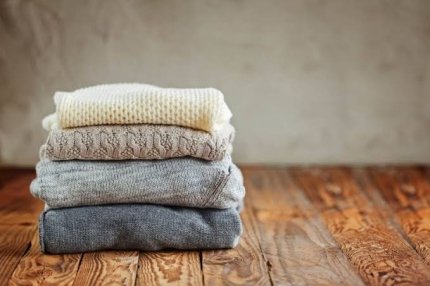
Why do woolen things get shaggy after washing?
Piling, or pilling, occurs when individual fibers come to the surface of the fabric and become tangled.
Most often this happens due to friction.
Pimples can appear under the armpits, on the sides of a sweater, sleeves, or where the fabric comes into contact with a bag or outerwear.
Washing can also aggravate this process if the product is subjected to excessive mechanical stress.
However, the mere appearance of wrinkles does not prove that the sweater is of poor quality.
How to reduce the formation of lumps
Turn knitwear inside out before washing.
Use a special delicate program.
Do not wash wool with coarse fabrics.
Avoid excessive use of air conditioning.
Do not rub the fabric vigorously with your hands.
Try to reduce constant friction from bags and accessories.
How to safely remove spills
For dense knitwear, you can use a special machine to remove tangles or a suitable comb.
Work carefully, without applying too much pressure.
On fine cashmere or loose knits, overly intensive cleaning can damage the threads.
Do not forcefully tear off large pieces as this can pull out the fibers.
What to do if a wool sweater has shrunk after washing
This is one of the most difficult problems in home care.
If the wool fibers have fallen and become tightly intertwined, it is usually impossible to completely return the item to its original size.
However, it is important to distinguish between a true slump and a temporary loss of form.
If the sweater is only slightly deformed
Gently moisturize the product according to the approved care regimen.
Lay it horizontally and try to give it the correct shape, focusing on the seams, sleeves, and bottom edge.
Do not stretch the fabric with sudden movements.
After drying, the shape may partially recover if the fibers have not undergone irreversible collapse.
If the sweater has become dense, like felt
This may indicate significant fiber interweaving.
In this case, soaking with conditioner, shampoo, or other home remedies does not guarantee recovery.
Advice about full size recovery using a specific mixture should be taken critically.
A severely damaged product usually cannot be restored to its original properties.
How often should you wash a wool sweater?
Woolen items do not need to be washed after every wear.
Wool has natural properties that help it resist odor buildup for a period of time.
It is often enough to let the sweater rest and air out after wearing it.
The frequency of washing depends on whether the item comes into direct contact with the skin, how intensively it is worn, and whether it is dirty.
For example, a thick sweater worn over a T-shirt usually needs washing less often than thin wool thermal underwear.
Focus on the state of the product, not on a strict schedule.
If the item has no stains or foreign odors, additional washing may not be necessary.
How to properly store woolen items after washing
Woolen clothing should be clean and completely dry before seasonal storage.
Food residue, sebum, and other contaminants can attract pests.
It is especially important to protect woolen items from clothes moths.
Why it's better to fold sweaters rather than hang them
Knitted items can gradually stretch under their own weight, especially if they are heavy.
Therefore, it is better to neatly stack sweaters and cardigans on shelves.
Instead, wool coats and woven jackets can be stored on wide hangers that support the shape of the shoulders.
For long-term storage, use clean, dry containers or suitable covers.
Do not pack wet wool in airtight bags.
Periodically check your clothing for insects and signs of damage.
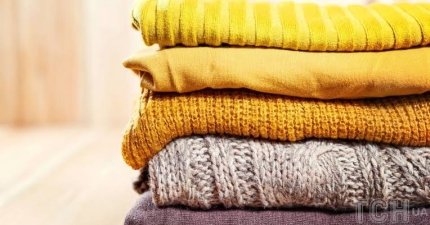
The most common mistakes when washing wool
Washing without checking the label. Even similar sweaters may require different care.
Using a regular intensive program. It can cause sagging and loss of shape.
Wrong detergent. Aggressive components can damage protein fibers.
Excessive friction. Intensive hand washing can also worsen the condition of the fabric.
Wringing out a wet sweater. This increases the risk of stretching and deformation.
Hang dry. Heavy, wet knitwear can stretch.
Contact with a hot battery. Uneven heating can damage the fabric.
Excess conditioner. Can change surface properties and contribute to the formation of lumps.
Storing something damp creates conditions for unpleasant odors and mold growth.
Wash after every short wear. Airing is often sufficient if the item is clean.
Conclusion
Proper care for wool starts with the label. If the manufacturer allows machine washing, use a special program and detergent for wool. If hand washing is recommended, avoid excessive rubbing and wringing.
Moderately warm water is suitable for most washable items, but the temperature and spin speed should always be appropriate for the specific item.
The most important step after washing is drying. It is best to lay wool sweaters and other knitwear horizontally, away from radiators and direct sunlight. This helps to maintain the shape, softness, and appearance of the garment.
FAQ: Frequently asked questions about washing woolen items
At what temperature can woolen clothes be washed?
For many woollen items, a temperature of around 30°C is suitable. However, some items can only be washed in cold water, while specially treated wool can withstand 40°C in the appropriate setting. Always check the label.
Can I wash a wool sweater in a washing machine?
Yes, if the manufacturer allows machine washing. Use the Wool program, appropriate detergent and spin setting. Do not machine wash items marked "hand wash only" unless the special cycle is confirmed to be compatible.
At what speed should I spin the wool?
There is no universal safe value. Refer to the label and the settings of the special washing machine program. For delicate items, machine spinning may be prohibited.
How to wash woolen clothes to keep them soft?
It is best to use a mild detergent specifically designed for wool. Avoid harsh bleaches and unsuitable enzyme detergents. Do not exceed the recommended dosage.
Can I wash wool with regular shampoo?
This is not the best option. Shampoos may contain ingredients that are not intended for fabrics. For expensive and delicate wool items, it is safer to use a special wool detergent.
Why did the wool sweater shrink after washing?
The cause may be the fiber pilling caused by moisture, heat, and mechanical friction. The microscopic scales of the wool intertwine, causing the fabric to become denser and smaller. Severe pilling is usually irreversible.
How to dry a wool sweater so it doesn't stretch?
Gently remove excess water with a towel, lay the sweater flat and shape it properly. Do not dry heavy wet knitwear on a hanger or near a hot radiator.
Can cashmere be washed in a washing machine?
Only if expressly permitted by the manufacturer. Some cashmere items can be washed at home, but many require hand or professional care. The label on a specific item is crucial.
How to remove pilling from a wool sweater?
You can use a special machine or comb for delicate fabrics. Work without applying too much pressure and first test the effect on an inconspicuous area. Special care is required on fine knitwear.
Do you need to wash woolen clothes after every wear?
Not always. If the sweater is clean and odor-free, airing it out often is enough. The frequency of washing depends on how much you wear it, how much it comes in contact with your skin, and how dirty it is.

