
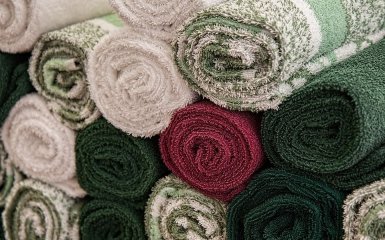
You don't always have to throw out an old towel right away. If it's stiff, has lost its fluffiness, smells bad, or absorbs water less well, the reason is often not the worn-out fabric, but rather the accumulated residue of detergent, conditioner, hard water minerals, sebum, and moisture.
Points of attention
- Excessive detergent, conditioner, and hard water minerals often cause towels to become stiff and lose softness, affecting their absorbency.
- Vinegar helps remove detergent residue and odors, while baking soda freshens up towels and supports the cleaning process.
- Proper washing techniques, including avoiding overloading the drum and using the correct amount of detergent, play a crucial role in maintaining towel softness.
A terry towel works best when its loops are open, elastic, and clean. If the fibers are coated with film from air conditioning, overloaded with powder, or overdried on the battery, the towel may look clean but feel unpleasant and have poor absorbency.
In this article, we will analyze how to restore softness to towels at home, when vinegar and soda will help, why you shouldn't abuse fabric softener, how to properly dry terry towels, and in which cases the fabric can no longer be completely restored.
Why do towels become stiff?
Towels often become rough due to improper care. At first glance, it seems that the more detergent and fabric softener you use, the cleaner and softer the fabric will be. In fact, for towels, it often works the other way around.
Terry cloth has many small loops. They are what create volume, softness and the ability to quickly absorb water. When product residue accumulates between these loops, the towel becomes dense, heavy and rough.
The main causes of stiffness:
excess washing powder or gel;
frequent use of fabric conditioner;
washing in hard water;
poor rinsing;
overfilled drum;
drying on a hot battery;
overdrying in a dryer;
washing together with synthetics, zippers and coarse items;
long-term storage of wet towels;
natural wear and tear of fibers.
If the towel is stiff but still dense, intact and holds its shape well, it can often be refreshed. However, if it has become thin, “bald”, with torn loops, gray spots and an unpleasant odor even after washing, it is difficult to completely restore the product to its new condition.
Why air conditioning can ruin towels
Fabric softener creates a thin coating on the fibers that makes the fabric appear smoother. This can be a nice effect for T-shirts, bed linens, or some clothing. The problem with towels is that this film gradually reduces the fabric's ability to absorb water.
A towel should not slide over your skin, but should absorb moisture. If the fibers are covered with conditioner residue, water will not penetrate as well. As a result, the towel will feel soft after washing, but will not dry well after a shower, will take longer to dry, and will quickly develop a damp smell.
The problem is especially noticeable if conditioner is used with every wash. After a few months, the terry cloth becomes “sealed”: the towel may feel smooth to the touch, but not fluffy, and it may be less effective during use.
To restore old towels, it is worth completely removing the conditioner for a few cycles. In the future, it is better not to use it on terry textiles or use it very rarely and in minimal quantities, if the towel manufacturer allows it.
How to restore softness to towels using vinegar
White table vinegar helps to wash away some of the detergent residue, neutralize odors, and soften the fabric if the problem is due to buildup in the fibers. It doesn't need to be used as an aggressive agent. Just a moderate amount and the correct wash cycle are enough.
For normal recovery:
Load the towels into the drum without overfilling it.
Do not add conditioner.
Add less detergent than usual.
Pour 100–150 ml of white vinegar into the rinse aid compartment.
Choose the temperature allowed on the towel label.
Run a full cycle with rinse.
After washing, remove the towels immediately and dry them thoroughly.
The vinegar should not leave a lingering odor if the towels are thoroughly rinsed and dried. If the odor is noticeable, run an extra rinse cycle without detergent.
Do not use vinegar with chlorine bleach. This can be dangerous due to the formation of irritating gases. Also, do not pour large volumes of vinegar with each wash: constant contact with an acidic environment is undesirable for rubber parts of the washing machine.
How to use baking soda for old towels
Baking soda can help if your towels have a musty smell, have become heavy, or seem “clogged” after multiple washes. It works more gently than harsh detergents, helping to freshen the fabric and support the action of your detergent.
For one cycle, 2-4 tablespoons of baking soda without a slide are enough. It can be added directly to the drum or to the detergent compartment, if the design of the machine allows it.
Soda is suitable for:
towels with a damp smell;
terry cloth after excess powder;
textiles that have been lying in the closet for a long time;
towels after the gym, pool or sauna;
cases when you want to refresh the fabric without air conditioning.
Don't put a lot of baking soda and vinegar in the same cycle. They react and partially neutralize each other. It's better to use them separately: first a cycle with vinegar, then a separate wash with baking soda if necessary.
Deep towel restoration in two cycles
If your towels have lost their softness, smell bad, and barely absorb water, you can do a deeper cleaning. This is not a daily method, but a “reboot” for the fabric that has accumulated a lot of residue.
First cycle: wash away plaque
Load towels separately from other laundry. Do not add fabric softener. Use less detergent or run the cycle without it if the towels are clean but stiff. Add 100-150 ml of white vinegar to the rinse aid compartment.
Choose the temperature according to the label. White cotton towels often withstand hotter water, while colored and decorative towels may need a lower temperature.
Second cycle: remove odor and fluff fibers
After the first cycle, run a second wash with 2-4 tablespoons of baking soda. Do not add conditioner again. If the towels are very dense or the washing machine does not rinse well, turn on the extra rinse.
Remove towels immediately after you’re done. Shake each towel before drying to straighten the terry loops. It’s a simple step, but it makes a big difference in fluffiness.
How to properly wash towels so they don't become stiff
Regular care is more important than rare “rescue” treatments. If you wash your towels incorrectly every time, vinegar and baking soda will only have a short-term effect.
Basic rules:
Wash towels separately from clothes with zippers, hooks and Velcro;
do not overload the drum;
dose the product according to the level of contamination and water hardness;
do not add conditioner with every wash;
choose the temperature according to the label;
do not leave wet towels in the drum;
dry well before storing in a closet;
Periodically run an additional rinse.
An overcrowded drum is one of the most common causes of stiffness. Towels absorb a lot of water, become heavy, and take up space. If they are packed tightly, the water and detergent do not pass evenly through the fabric, and the rinse becomes weaker.
For terry towels, it is better to wash a smaller batch, but with better quality. After such a wash, the fabric will be cleaner, lighter and softer.
How much detergent do you need for towels?
More detergent does not mean cleaner. Excess powder or gel can remain in the fibers, especially if the water is hard, the drum is overloaded, or the rinse cycle is short. After several washes, the towel becomes rough and dries more slowly.
Follow the instructions on the package, but be realistic about your situation. If your towels are not very dirty, you may not need the “heavily soiled” dosage. If the fabric is slippery, soapy, or has a strong odor after washing, you are probably adding too much.
Signs of excess detergent:
towels are stiff after drying;
the fabric does not absorb water well;
there is a lot of foam in the drum;
after washing there is a strong smell of powder;
towels seem heavy;
light marks are visible on dark fabrics;
A musty smell quickly appears after getting wet.
In this case, washing with a lower dosage of detergent and an extra rinse will help. For very “clogged” towels, it is better to do a separate recovery cycle.
Hard Water: The Hidden Cause of Rough Fabric
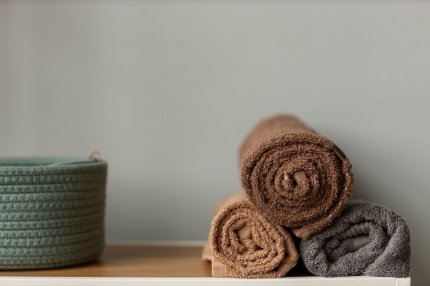
Hard water contains a lot of minerals, including calcium and magnesium. These can leave deposits on your fabric, in your washing machine, on the heating element, and in the fibers of your towels. This can make even the right detergent work less effectively, and your towel will gradually become rougher.
How to understand that the problem may be in the water:
white plaque quickly appears on taps and shower heads;
the kettle is covered with scale;
the powder dissolves worse;
towels are stiff after washing;
white linen turns gray;
marks remain on the fabric;
The washing machine needs frequent descaling.
In such a situation, it is worth using a product that is suitable for hard water, correctly dosing the powder and periodically cleaning the washing machine. If the problem is constant, water softeners for washing or a household water softening system can help, but the choice depends on the budget and the quality of the water in a particular home.
How to dry towels so they are fluffy
Drying affects softness just as much as washing. If a towel is hung uncurled, remains damp for a long time, or is dried on a very hot radiator, the fibers become stiffer.
Before drying, shake the towel. This will straighten the loops of the terry cloth and help the fabric dry more voluminously. If drying on a line or in a dryer, hang the towels in a single layer, with space between items.
Air drying in a well-ventilated area works well. However, if the air is very dry and the towel hangs for a long time, the fabric can become “cardboard.” In this case, a short drying in the dryer on a delicate or medium setting helps.
If you have a dryer, use the setting recommended on the label. Do not overdry towels to the point of being hot dry. It is best to remove them immediately after the cycle is complete and fold them after they have cooled completely.
Why do towels smell damp after washing?
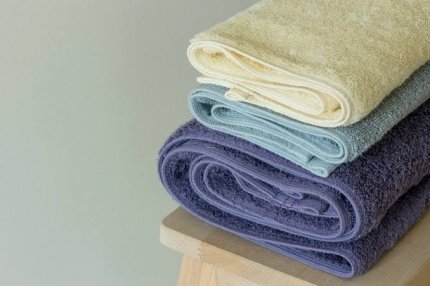
A musty smell occurs when a towel remains damp for a long time. This can happen in a laundry basket, a washing machine drum, a bathroom without ventilation, or a closet where you put unfinished textiles.
Typical causes of odor:
the towel was thrown wet into the basket;
after washing it lay in the washing machine for several hours;
the bathroom is poorly ventilated;
the towel hangs folded in half and takes a long time to dry;
there is a musty smell in the washing machine;
too much air conditioner is used;
towels are stored in a damp closet;
The fabric does not dry out between uses.
To remove the smell, first wash the towels without conditioner. Add baking soda or run a vinegar cycle, then dry thoroughly. If the smell returns, check the washing machine: rubber cuff, detergent drawer, filter, drain, and drum.
After each wash, leave the washing machine door open to allow moisture to escape. It is also a good idea to pull out the detergent drawer and dry it.
How to restore the color of old towels
Dull appearance of towels is often associated with detergent residue, hard water, improper sorting, and washing with items that shed. White towels can turn gray, colored towels can lose their brightness, and dark towels can become covered with a light coating.
What helps:
sorting by color;
washing without excess powder;
additional rinsing;
detergent for colored laundry;
oxygen bleach for white and light-colored towels, if allowed by the label;
avoiding chlorine bleach for delicate and colored fabrics;
Wash towels separately from jeans, dark clothes, and items that shed.
White towels can be freshened with oxygen-based products, but it is important to follow the instructions. Colored towels should not be bleached with aggressive substances: they may lose their color and become stained.
If your towel has become discolored due to old stains, grease, makeup, or hair dye, it may be difficult to completely restore the color. In this case, it is better to work on a specific stain rather than subjecting the entire fabric to a harsh cleaning.
Can towels be boiled?
Boiling may seem like an old-fashioned, reliable method, but it's not always appropriate for modern towels. High temperatures can damage colored fabrics, decorative embroidery, trims, synthetic additives, elastic threads, or weak fibers in older products.
Boiling should only be considered for sturdy, white, undecorated cotton towels if the label allows high temperatures. For most household situations, washing at the highest temperature allowed by the manufacturer and using the correct detergent is sufficient.
For colored terry towels, it's best to avoid boiling. It can make the fabric even stiffer and the color uneven.
How to care for new towels to keep them soft for longer
New towels often have manufacturing residue, dust, packaging odors, or a finish that makes the fabric look nice in the store but can temporarily reduce absorbency. They should be washed separately before first use.
It is best to wash the first few times without conditioner. This will help the terry open up and absorb water better. Wash colored towels separately or with similar shades, as new fabric may shed a little.
For a long life of towels:
do not throw a wet towel into a closed basket;
dry after each use;
do not use air conditioning regularly;
do not wash with rough things;
do not overfill the drum;
do not overdry on batteries;
do not store in a damp closet;
Give your towels a “clean” cycle every few weeks without any unnecessary additives.
Such simple habits often work better than expensive mitigation tools.
Which towels are easier to restore?
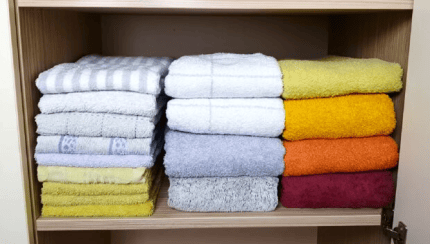
The best way to restore thick cotton towels is to use a towel that has become stiff due to improper washing but has not lost its structure. If the loops are intact, the fabric is not see-through, there is no strong odor after drying, and the towel is not fraying at the edges, the chances are good.
Towels that are restored worse are:
dried on a hot battery for many years;
often washed with chlorine;
have a worn-out towel;
became thin;
lost loops;
have old grease stains;
they lay in dampness for a long time;
they smell unpleasant even after a deep wash.
If the towel is physically worn out, vinegar and baking soda may remove some of the stain and odor, but will not create new fibers. Such textiles are best repurposed into household towels, cleaning wipes, and rags for the bathroom, kitchen, balcony, or car.
What not to do with old towels
There are methods that sound effective but can damage the fabric or the washing machine.
It is not worth it:
mix vinegar with chlorine bleach;
pour excessive amounts of soda;
pouring vinegar into every wash unnecessarily;
use conditioner after each cycle;
wash towels together with items with zippers;
to overfill the drum;
dry wet towels in a thick layer;
put unfinished towels in the closet;
use chlorine for colored fabrics;
rub the terry cloth with stiff brushes;
Boil towels with decor or synthetic admixtures.
Home care should not be aggressive, but regular. Mahra likes space in the drum, enough water, a good rinse, and complete drying.
Step-by-step plan: how to make old towels soft
If you need to quickly bring your towels into better condition, follow these steps.
Sort the towels by color.
Discard any that are badly worn or damaged.
Load the drum no more than two-thirds full.
Wash towels without conditioner.
Add 100-150 ml of white vinegar to the rinse aid compartment.
Run the cycle at the temperature allowed by the label.
If necessary, run a second cycle with 2–4 tablespoons of baking soda.
Turn on the extra rinse if the fabric seems heavy.
Remove towels immediately after washing is complete.
Shake each towel well.
Dry in a ventilated area or in a dryer on an appropriate setting.
Store in a closet only after it is completely dry.
After this recovery, do not go back to the old routine of using a large amount of detergent and conditioner with every wash. Otherwise, the stiffness will quickly return.
How to keep towels soft every day
The softness of towels is not maintained by a single “magic” wash, but by a care system. After a shower, the towel should be hung out flat, not lying in a lump in the washing machine. It can only be put in the laundry basket when it is dry or almost dry.
Ventilation is important in the bathroom. If towels are left to dry for a long time, they will develop an odor and the fabric will become rough. After a shower, turn on the extractor fan, open the door, or provide air circulation.
Periodically check the closet where towels are stored. It should be dry. Do not fold towels too tightly: textiles should “breathe”. If the closet is located near a cold wall or in a room with high humidity, a musty smell may appear even after proper washing.
Conclusion
You can restore softness to old towels if the fabric is not physically worn out yet. Most often, the problem is caused by detergent residue, conditioner, hard water minerals, moisture, and improper drying. The solution starts with a simple one: less detergent, no conditioner for several cycles, washing with vinegar or baking soda separately, high-quality rinsing, and complete drying.
Terry towels don't like an overcrowded drum, aggressive bleaching, constant drying on a hot radiator, and storage in a damp closet. They need space, the right temperature, a clean washing machine, and proper ventilation.
If after all the procedures the towel remains thin, rough and does not absorb water well, its fibers have already lost their resource. Such textiles can be used for cleaning or household needs. But most hard towels that have simply accumulated product residues can actually be made softer, fresher and more pleasant to the touch.
FAQ
How to quickly restore softness to old towels?
The easiest way is to wash towels without fabric softener by adding 100-150 ml of white vinegar to the rinse aid compartment. If the fabric is very stiff or has an odor, you can use 2-4 tablespoons of baking soda in a separate second cycle. After washing, the towels should be immediately removed, shaken, and dried thoroughly.
Why do towels become stiff after washing?
Most often due to excess detergent, conditioner, hard water, poor rinsing, an overfilled drum, or improper drying. Residues of detergents and minerals accumulate in the fibers, causing the terry cloth to lose its fluffiness.
Can towels be washed with fabric softener?
It's best not to use conditioner regularly. It can create a film on the fibers, making the towel less absorbent. If you want softness, it's safer to use the correct amount of detergent, rinse the towels well, and dry them without overdrying them.
What is better for towels — vinegar or baking soda?
They perform different tasks. Vinegar helps remove some of the detergent residue and mineral deposits, while baking soda works well against odors and helps freshen fabrics. It's best to use them in separate cycles, not together.
Can you mix vinegar and bleach?
No. Vinegar should not be mixed with chlorine bleach or other harsh chemicals. Such mixtures can release dangerous, irritating gases. If you need to bleach white towels, use the bleach according to the instructions and separately from the vinegar.
How to remove musty odor from towels?
Wash the towels without conditioner, add baking soda or run a vinegar cycle, run an extra rinse, and dry the fabric completely. Also check the washing machine: the smell may be coming from the cuff, detergent drawer, filter, or drum.
Why does a towel absorb water poorly?
The fibers are likely coated with conditioner, detergent, makeup, sebum, or hard water minerals. To restore absorption, remove the conditioner, reduce the dosage, and run a cleaning cycle.
Can towels be dried on a radiator?
You can only do this carefully and for a short time, if there is no other option. Constant drying on a very hot radiator makes the fibers stiffer. It is better to dry the towels spread out in a ventilated place or in a dryer on the mode allowed by the label.
How often should towels be washed?
Bath towels should usually be washed after a few uses, provided they dry well between showers. If the towel stays damp for a long time, has an odor, is used after the gym, or is shared by multiple people, it should be washed more often.
When can an old towel no longer be restored?
If the fabric has become thin, the loops have worn out, the edges are fraying, the towel does not absorb water even after cleaning and retains an odor after it has completely dried, the fibers are probably already worn out. It is better to use such a towel for cleaning or household purposes.

