
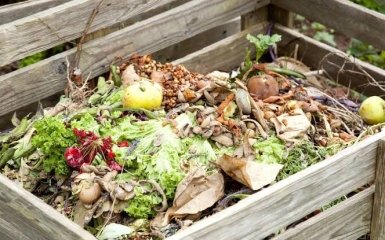
A compost pile can sit for almost a year, and the leaves, grass, and vegetable scraps inside will remain virtually unchanged. In another garden, the same organic matter turns into dark, crumbly compost in just a few months. The difference usually lies not in the special additives, but in the decomposition conditions.
Points of attention
- For quick composting, mix approximately 2–3 parts dry brown materials with one part greens by volume.
- Grinding waste, sufficient humidity, and access to oxygen help microorganisms more actively decompose organic matter.
- For hot composting, it is advisable to form a separate pile with a volume of about a cubic meter and mix it as needed.
To speed up compost maturation, microorganisms need to be provided with four main components: organic materials with a balanced carbon and nitrogen content, moisture and oxygen. The size of the compost pile, temperature and the degree of shredding of the waste also play an important role.
With proper organization, active composting can last about 6–8 weeks, but additional time is often needed for the compost to fully mature. Without regular maintenance, the process usually stretches for many months, and sometimes one to two years.
We'll figure out what to add to a compost pit for quick decomposition, how to mix dry leaves with fresh grass, whether yeast and special activators work, why compost stops heating, and how to determine that the fertilizer is ready.
Why does compost take a long time to decompose?
Composting is a biological process in which bacteria, fungi, and other organisms decompose plant debris.
Microorganisms use organic matter as a source of energy and nutrients. During the process of active aerobic decomposition, heat is released.
That is why a properly formed compost pile sometimes heats up so much that it is noticeably warmer inside than outside.
However, biological activity may slow down.
The most common reasons:
too many dry leaves, straw or branches;
insufficient amount of nitrogen-containing materials;
drying out of organic matter;
excessive humidity and lack of oxygen;
large uncrushed plant residues;
small volume of pile, which quickly loses heat;
low ambient temperature.
It is important to identify the cause, not just add new ingredients.
For example, if the compost is too wet and smells bad, an additional portion of fresh grass can only make the situation worse.
What to add to compost for quick decomposition
Two main types of organic materials are used for effective composting: "green" and "brown".
These names are conditional and characterize not so much the color as the ratio of nutrients.
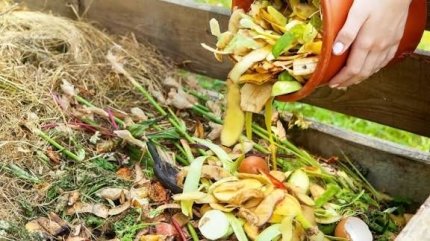
Green materials are a source of nitrogen
These include fresh plant residues, which usually contain relatively high levels of nitrogen.
Nitrogen is needed by microorganisms for growth and reproduction.
You can add the following to compost:
freshly cut grass;
leftover vegetables and fruits;
coffee grounds;
green tops of healthy plants;
young weeds without seeds and persistent rhizomes;
vegetable kitchen waste.
Despite the brown color of coffee grounds, they are usually classified as nitrogen-containing components.
Brown materials are a source of carbon
Microorganisms need carbon as an energy source.
Brown materials also help maintain a loose compost structure and prevent excessive compaction.
Dry leaves, straw, shredded branches, untreated wood chips, paper and cardboard without plastic coatings are suitable for this.
| Green materials | Brown materials |
| Fresh grass | Dry fallen leaves |
| Vegetable cleaning | Straw |
| Fruit leftovers | Shredded branches |
| Coffee grounds | Untreated wood chips |
| Green plant residues | Shredded cardboard |
For home composting, it's convenient to start with about 2–3 parts by volume of brown materials to one part of green materials.
This is a practical guideline that needs to be adjusted depending on the moisture content and composition of the organic matter.
It should not be confused with the optimal ratio of carbon to nitrogen — C, which for active composting is often around 25–30:1 by weight of the respective elements.
Three buckets of leaves and one bucket of grass do not automatically mean that you will get this chemical ratio.
1. Shred organic waste before composting
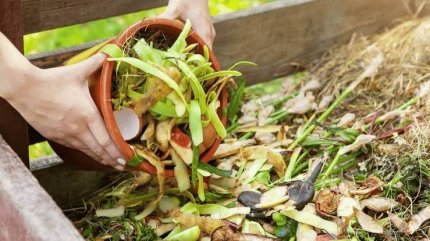
One of the easiest ways to speed up decomposition is to reduce the size of plant debris.
Microorganisms decompose organic matter by interacting with its surface.
The larger the available area of the material, the easier it is to decompose.
For example, a whole corn stalk or a thick branch can remain in a pile for a very long time.
If you chop it into small pieces, the process will usually speed up.
What is worth shredding?
Large stems, thin branches, and tough tops are best cut with garden shears or a shredder.
Dry leaves can be shredded with a lawn mower.
It is also advisable to cut large vegetable scraps into several pieces.
However, you don't need to turn everything into a fine powder.
A mass that is too fine and dense may not allow air to pass through well, especially in conditions of excessive humidity.
It is best to combine shredded soft residues with some coarser materials that maintain air spaces.
2. Maintain a balance of dry and wet materials
A compost pile that consists mostly of dry leaves usually decomposes more slowly.
The reason is the relatively small amount of available nitrogen.
If you pile only freshly cut grass, the material can quickly compact, lose access to oxygen, and start to smell unpleasant.
Therefore, it is important to mix different types of organic matter.
Practical example
Let's say that after autumn cleaning of the site, there are six buckets of chopped dry leaves left.
For the initial mixture, you can add about two to three buckets of fresh grass or other green plant debris.
The materials need to be mixed evenly and checked for moisture.
If the compost becomes slippery and too wet, add more dry leaves or shredded cardboard.
If it remains dry and barely changes, check the moisture content and add green ingredients if necessary.
The proportions do not need to be measured with laboratory precision: the state of the pile will tell you in which direction to change them.
3. Maintain the correct moisture content of the compost
Without water, microorganisms cannot actively decompose organic matter.
But excessive water also hinders the process because it fills the air spaces.
As a result, less oxygen reaches the inner layers of the compost.
How to check humidity without special devices
Use a simple test.
Take a handful of material from the middle of the compost pile and squeeze it in your hand.
Properly moistened compost should resemble a well-wrung sponge.
The material should be noticeably damp, but the water should not drain freely between your fingers.
If it crumbles and seems completely dry, you need to add a little water.
If the liquid flows out in a stream, the compost is over-wetted.
In this case, it is worth adding dry porous materials and mixing the mixture.
During prolonged rains, the pile can be covered, leaving room for ventilation.
4. Provide enough oxygen to the compost
Rapid aerobic composting requires air.
If the organic mass is compacted, oxygen does not penetrate well.
Because of this, the activity of aerobic microorganisms decreases, and conditions become more favorable for processes that may be accompanied by unpleasant odors.
How to mix compost properly
Garden forks are suitable for a small pile.
During mixing, it is advisable to move material from the outer layers closer to the center, and the central layers outward.
This helps to decompose organic matter more evenly.
In active hot composting systems, stirring may be required approximately every few days or once a week — depending on the temperature and condition of the material.
For a typical home composter, much less frequent mixing is sufficient.
It is important not to turn the pile continuously.
Each stirring leads to the loss of some of the accumulated heat.
This is especially noticeable in autumn and winter.
5. Create a sufficient volume of compost pile
Size affects the compost's ability to store heat.
A small pile cools quickly, so active decomposition usually occurs more slowly.
For hot composting, a practical guideline is a volume of approximately one cubic meter.
For example, you can form a pile about one meter wide, long, and high.
This volume helps retain the heat that is released during the work of microorganisms.
Can the pile be made much larger?
Yes, but excessive height and compaction can impair the flow of oxygen to the interior.
Therefore, large volumes of organic matter need to be properly organized and mixed as needed.
If there is not much waste, it is not necessary to specifically collect a cubic meter of materials.
Composting will also occur in a smaller container, but the speed may be slower.
6. Monitor the temperature inside the compost
During active hot composting, the temperature in the center of the pile can rise to approximately 55–65 °C.
This is the result of the activity of thermophilic microorganisms, which work well at elevated temperatures.
You can use a long compost thermometer to monitor.
What do the temperature readings mean?
| Temperature inside | What could this mean? |
| Close to air temperature | The process is slow, the pile is small or the compost is already maturing |
| 30–45°C | Active decomposition is taking place |
| 55–65°C | Intense thermophilic stage |
| Above 70 °C | Possible overheating, check conditions |
These are approximate values. The temperature depends on the volume, composition of the organic matter and the weather.
If the temperature has dropped, check the humidity and air access.
However, a cold pile doesn't always mean there's a problem.
If organic materials have already decomposed, a natural drop in temperature is a normal part of the process.
7. Choose the right place for your composter
For a compost pile, it is advisable to find a sheltered location where there is no constant overheating and excessive accumulation of water.
A convenient option may be an area in light shade.
It is advisable to place the composter so that it is easy to approach with a bucket or wheelbarrow.
If an open composter is used, contact with the soil can help earthworms and other soil organisms penetrate the organic matter.
But you don't need to put the compost pile directly in a place where a puddle forms after every rain.
Under such conditions, the lower layers can remain constantly wet.
Is a lid needed?
The cover helps control precipitation and partially retain heat.
However, the composter needs ventilation.
There is no need to hermetically seal a regular aerobic pile.
The design must provide air access and the ability to remove excess moisture.
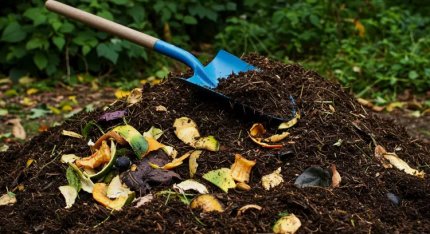
8. Use finished compost as a supplement
Sometimes it is advised to add a little mature compost or garden soil to start a new pile.
This can help introduce additional microorganisms to the fresh organic matter.
However, most of the necessary microorganisms are already naturally present on plant residues and in the environment.
Therefore, adding ready-made compost is not a prerequisite.
How much finished compost to add
For a small home composter, you can use a few handfuls of mature compost, evenly distributing it between the new materials.
But the exact number is not crucial.
If the pile is dry or consists only of branches, adding microorganisms alone will not ensure rapid decomposition.
First you need to balance the components, humidify and ventilate.
9. Don’t add too much fresh grass to the pile at once
Freshly cut grass can be a useful source of nitrogen, but in large quantities it often causes problems.
Wet grass can clump together into dense layers.
Because of this, air does not penetrate well inside, and the material begins to decompose in conditions of insufficient aeration.
How to compost grass properly
Do not pile all the freshly mowed material in one thick layer.
It is better to immediately mix it with dry leaves, straw, or chopped branches.
This helps maintain a loose structure.
If there is a lot of grass, some can be left for the next batch of compost.
There is no need to try to fit all your waste into a small container in one day.
10. Separate finished compost from new waste
A common reason for slow fertilizer production is the constant addition of fresh organic matter to the same pile.
In this case, some of the material has already decomposed, and nearby are new vegetable scraps or leaves that are just starting to rot.
This makes it difficult to determine when all the compost is ready.
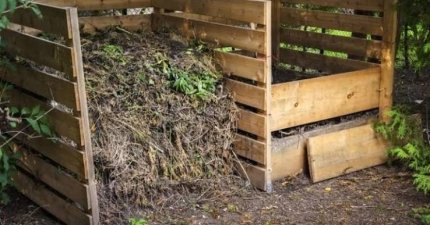
Why is it better to use two containers?
The first container can be used to accumulate new plant debris.
The second is for active composting and maturation of an already formed batch.
When the first pile reaches the desired volume and composition, new waste is no longer added.
This allows for a controlled decomposition process to be maintained.
For a small garden, you can also use a single container with the option to collect mature compost from the bottom, if its design allows it.
How to make quick compost in 6–8 weeks
The fastest result is usually obtained with the hot composting method, when the required volume of organic matter is formed immediately.
This approach differs from a conventional composter, where waste is added little by little over the course of a year.
Step-by-step diagram
Step 1. Prepare the materials. Gather enough dry leaves, shredded branches, fresh grass, and vegetable kitchen scraps.
Step 2: Chop up large pieces. Stems, leaves, and branches should be of a size that is easy to blend.
Step 3: Mix the ingredients. Start with about two to three parts by volume of brown organics to one part of green.
Step 4. Form a pile. For active heating, a volume of about one cubic meter is desirable.
Step 5. Moisten. The material should resemble a well-wrung sponge.
Step 6. Check the temperature. Under the right conditions, the pile may start to heat up noticeably within the first few days.
Step 7: Stir as needed. When the temperature starts to drop after active heating and the material has not yet decomposed, stir the pile and check the moisture content.
Step 8. Let the compost mature. After the active stage is complete, leave the material to stabilize.
Under favorable conditions, intensive decomposition can take approximately 6–8 weeks.
However, this does not guarantee that the compost is already fully mature and suitable for any plants.
The final maturation phase sometimes requires several more weeks or months.
Do yeast, sugar and special compost accelerators help?
Home recommendations often suggest filling the compost pile with yeast solutions, adding sugar, or purchasing special preparations.
But such methods do not eliminate the main causes of slow decomposition.
Does yeast work?
Yeasts are microorganisms that can utilize available sugars.
However, composting is a complex process involving numerous species of bacteria, fungi, and other organisms.
Adding regular baker's yeast does not guarantee that leaves, straw, or wood will decompose faster.
If the pile lacks oxygen or moisture, a yeast solution will not solve the problem.
Do I need to add sugar?
Adding sugar may temporarily affect the activity of certain microorganisms.
However, there is no need to specifically sweeten the compost if it is properly formed.
An excess of easily accessible substances with poor ventilation can contribute to undesirable processes and the appearance of odors.
Therefore, sugar should not be considered a universal accelerator.
Is it worth buying biologics?
Commercial activators may contain microbial cultures or nutritional components.
But their effectiveness depends on the composition, conditions of use, and the condition of the compost pile.
With the right balance of organic materials, additional treatments are usually not necessary.
Before spending money, it's worth checking the humidity, aeration, and ratio of green to brown components.
What not to add to home compost
Not all organic waste is suitable for a regular compost pile.
Some materials attract rodents, cause unpleasant odors, or may contain dangerous contaminants.
For home composting, it is better not to use:
meat, fish and bones;
dairy products;
fats, oils and fatty food residues;
cat and dog excrement;
plants treated with herbicides that are unsafe for composting;
wood with paint or chemical impregnation;
plants with serious diseases;
weeds with mature seeds or persistent rhizomes;
plastic and other inorganic waste.
In industrial systems, some of these materials can be processed under special technological conditions.
However, a regular garden composter does not provide the same temperature control and sanitary safety.
Why hot compost doesn't always kill weed seeds
Elevated temperatures can reduce the viability of some seeds and pathogens.
But this requires that all areas of the material be at the appropriate temperature for a sufficiently long time.
In a home pile, the outer layers can remain significantly colder than the center.
Therefore, you should not assume that short-term heating automatically disinfects the entire compost.
How to speed up composting in fall and winter
In autumn, the decomposition process usually slows down due to lower temperatures.
However, this does not mean that composting is completely stopped.
In a large pile, with enough fresh organic matter, biological activity can be maintained even when it's cool outside.
What to do in autumn
Chop up fallen leaves and mix them with nitrogen-containing materials.
Don't leave a pile consisting only of dry leaves if you want to get compost faster.
Protect organics from excessive rain, but provide ventilation.
It is advisable to form a sufficient volume of material before the onset of cold weather.
Is it necessary to turn compost in winter?
At low temperatures, frequent stirring can lead to rapid heat loss.
Therefore, in winter it is usually advisable to reduce the intensity of mechanical intervention.
If the pile is frozen, there is no need to try to forcefully break it up for regular mixing.
The activity of microorganisms will resume after warming.
To preserve heat, you can use appropriate external insulation, such as a layer of straw, without completely blocking the air flow.
Why doesn't compost heat up or smell bad?
The condition of the compost often allows you to identify the problem without complex analyses.
| Sign | Possible cause | What to do |
| The pile is cold and dry. | Not enough moisture | Gradually moisten and mix |
| The pile is damp but not heated. | Lack of nitrogen or too little volume | Add green materials, check the size |
| The smell of rotten eggs | Not enough oxygen, overhydration | Add dry porous materials and mix |
| Distinct ammonia smell | Excess nitrogen | Add leaves, straw or other brown materials |
| The material is slippery. | Lots of wet grass, compaction | Loosen and add dry organic matter |
| Branches do not decompose | Too large parts, slow destruction of wood | Shred or return to next batch |
| Many flies | Open food waste | Bury them in the middle and cover with dry organic matter |
| The compost is not heated, but is dark and crumbly. | The active stage may have ended. | Check maturity, not automatically add fertilizer |
If your compost smells bad, there's no need to mask the smell with flavorings or cover the pile with lime.
First, determine if it is lacking air or dry components.
How to know when compost is ready
The finished compost should be significantly different from the original plant residues.
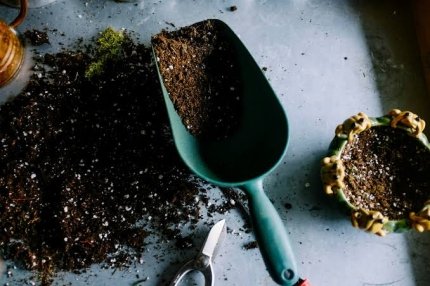
Its structure is usually dark, loose, and crumbly.
Most of the source materials are already difficult to recognize.
The smell should resemble damp forest soil, not ammonia, rot, or fermentation.
Main signs of maturity
dark brown color;
relatively homogeneous, loose structure;
absence of a sharp unpleasant odor;
the temperature is close to ambient temperature;
most of the plant remains have already decomposed;
after mixing and moistening, intense heating is not resumed.
However, the presence of several pieces of wood does not mean that the entire batch is unsuitable.
Larger residues can be sifted out and returned to the next compost pile.
Why you shouldn't use immature compost for seedlings
Active decomposition processes may be ongoing in immature material.
Under certain conditions, this leads to temporary binding of available nitrogen, the appearance of organic acids, or other factors unfavorable to young plants.
Therefore, for seedlings and growing in containers, it is especially important to use a substrate that is sufficiently mature and suitable for the respective application.
Homemade compost cannot always completely replace specialized soil for seedlings.
How long does it take for compost to mature?
The duration depends on the composting method.
With the active hot method, the main stage of decomposition can be completed in a few weeks.
But the material often needs additional time to stabilize.
A typical compost pile, with periodic stirring, often matures within several months.
If organic waste is simply piled up without care, the process can take a year or longer.
| Way | Estimated duration |
| Active hot composting | Approximately 6–8 weeks of active decomposition plus maturation |
| Regularly maintained home pile | Several months |
| Passive composting without stirring | From many months to 1–2 years |
No deadline is guaranteed.
In cool climates, with a lack of nitrogen or a large amount of woody materials, composting can take much longer.
Conclusion
You can speed up the maturation of compost without expensive additives and complex equipment.
The greatest effect is provided by the correct ratio of green and brown materials, shredding of organic matter, sufficient moisture, access of oxygen, and appropriate pile size.
For the fastest results, it is better to form a separate batch of compost rather than constantly adding fresh waste to material that is already maturing.
Active decomposition under favorable conditions may only last a few weeks, but compost should be used after it has stabilized. The main indicator of readiness is not the calendar date, but the condition of the material itself.
FAQ: Frequently Asked Questions about Rapid Composting
How to quickly make compost at home?
Chop up organic waste, mix about 2-3 parts by volume of brown materials with one part of green materials, form a large enough pile, and maintain the humidity at the level of a well-wrung sponge. Check the temperature and air access regularly.
What to add to a compost pile to make it rot faster?
If your compost is mostly dry leaves and wood, you can add fresh grass, vegetable scraps, or coffee grounds as nitrogen sources. If your pile is wet and smells bad, on the other hand, you need dry brown materials.
Is it possible to get ready compost in one month?
Under very favorable conditions, intensive decomposition can occur rapidly, but full maturation within a month is not guaranteed. Even after the hot composting stage is complete, additional time is often needed for stabilization.
Does yeast help speed up composting?
There is no convincing reason to consider ordinary baker's yeast a universal accelerator. For rapid decomposition, it is more important to ensure the correct composition of organic matter, humidity, air, and sufficient pile volume.
How often should you mix compost?
During active hot composting, stirring may be necessary every few days or about every week, depending on the temperature. For regular home composting, stirring less frequently is sufficient. In winter, excessive stirring can cause heat loss.
Why doesn't the compost heat up?
Reasons may include small volume, insufficient moisture, lack of nitrogen, lack of air, or cold weather. But if the material is already dark, crumbly, and has an earthy odor, the lack of heat may indicate that active decomposition has completed.
Why does compost smell like rotten eggs?
This smell is often caused by a lack of oxygen and overmoistening. You need to loosen the pile, add dry leaves, straw or other porous materials and ensure normal drainage of excess water.
Can fallen leaves be added to compost?
Yes. Dry leaves are a useful source of carbon. To speed up decomposition, it is better to chop them and mix them with fresh grass or other nitrogen-containing plant residues.
Do I need to buy a special compost activator?
Usually not. If the compost pile is properly formed and receives enough moisture and oxygen, the necessary microorganisms are already present in the natural environment. Special additives are no substitute for proper care.
How do you know when compost is ready to be used?
Mature compost has a dark color, a loose texture, and a pleasant earthy odor. Most of the starting materials are no longer recognizable, and the pile does not regain intense heat after stirring. Large, uncomposted pieces can be sifted out.

