
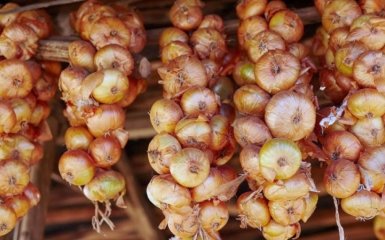
Onions will keep well for months if they are dry, undamaged, have access to air, and are stored in a cool, dark place. But even a quality batch will quickly start to soften, sprout, or rot if placed in a plastic bag, left in a damp basement, placed next to a radiator, or mixed with vegetables that give off moisture.
Points of attention
- Onions need dryness, coolness, ventilation, and proper preparation for long-term storage.
- The main causes of onion spoilage are high humidity, under-dried neck, mechanical damage, and poor ventilation.
- Bulbs with dense outer scales, without signs of germination, mold, or mechanical damage, are best for storage.
The key to long-term onion storage is dryness, coolness, ventilation, and proper preparation. The National Onion Association recommends storing dried onions in a cool, dry, dark, and well-ventilated area; lack of air movement will shorten their shelf life.
If the onions were grown in the garden, they must first be dried and “ripened” after harvesting. If you bought a bag for the winter, you should sort through the batch, set aside the damaged bulbs for quick use, and transfer the rest to a container with ventilation. The worst solution is to leave everything in a tight bag or a damp corner “until needed.”
Why onions spoil during storage
The onion does not become “dead” after harvesting. It continues to breathe, reacting to temperature, humidity, damage and surrounding conditions. If the place is too warm, the onion can sprout. If it is too wet, it can soften, mold and rot. If there is no air, condensation builds up, and one spoiled onion quickly spoils the neighboring ones.
The most common causes of damage:
the onions were put into storage underdried;
the cervix remained thick, green or moist;
the bulbs have bumps, cuts, dents;
the container is airtight;
high humidity in the room;
potatoes or other vegetables that release moisture are lying nearby;
the temperature is too high or unstable;
The batch is not moved during the winter.
UC IPM explains that blue mold on onions and garlic often develops during harvest and storage, and the fungi usually enter through wounds, bruises, or under-dried necks; moderate temperatures and high relative humidity contribute to the problem.
Which onions are best stored?
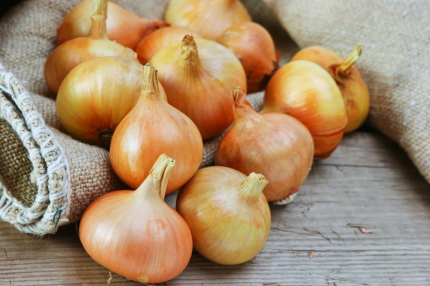
Not every onion is suitable for long-term storage. The best onions are fully ripe, firm, dry bulbs with dense outer scales, a thin dry neck, and no signs of mold, sprouting, or mechanical damage.
The National Onion Association recommends that you choose dry onions that are firm for their size, have little to no odor, and are free of cuts, bruises, or blemishes. If the onion already has a strong odor, soft spots, or wet spots, it is not suitable for storage for months.
The following are less suitable for long-term storage:
a very large onion with a thick neck;
sweet varieties with high water content;
immature bulbs;
specimens after rain without complete drying;
onions with cuts or dents;
bulbs that already have green sprouts visible;
batches with a musty or damp smell.
Sweet and mild onions often taste better in salads, but they have a shorter shelf life. The National Onion Association notes that sweet varieties have a higher water content, making them more susceptible to spoilage and have a shorter shelf life; to extend their shelf life, you can wrap each onion in a paper towel or newspaper and keep it dry in the refrigerator.
How to prepare onions after harvest
After harvesting, onions should not be immediately stored in a box for the winter. They need to be dried, or cured. During this stage, the outer scales, roots, and neck dry out, and the bulb becomes more resistant to moisture loss and rot.
The University of Minnesota Extension recommends harvesting onions when about half of the tops have fallen and dried, then storing them in a warm, well-ventilated area at 75–90°F (24–32°C) for two to four weeks, until the outer scales have dried and the neck is firm. Poor drying increases the risk of rotting during storage.
Practical procedure after collection:
Dig up the onion carefully without damaging the bulb.
Do not wash it before storing.
Shake off the dry soil with your hands or a soft brush.
Spread in a single layer in a dry, ventilated place.
Protect from rain and direct heat.
Let dry for 2–4 weeks, depending on the weather and the condition of the onion.
After drying, trim the dry tops, leaving a small tail.
Sort out damaged, soft, and thick-necked bulbs for quick use.
Iowa State University Extension also recommends drying onions in a warm, dry, and well-ventilated area for two to three weeks, until the tops and necks are completely dry and the outer scales begin to rustle.
Do you need to wash onions before storing?
Onions are not washed before long-term storage. Water gets between the scales, moistens the neck, can remain near the root and create conditions for rotting. If there is soil on the onion, it must be removed dry after drying.
It's a good idea to wash onions before cooking, especially if they're going to be cut raw for a salad after peeling. The FDA recommends washing fresh vegetables under running water before preparing and eating, even if you don't plan to eat the skin, to prevent dirt and bacteria from being transferred from the surface during peeling or cutting.
For storage, the rule is the opposite: dry onions keep better, wet ones spoil faster.
Where is the best place to store onions?
The ideal place is cool, dry, dark and ventilated. For a house, this could be a dry basement, a pantry, a cool hallway, an insulated balcony without freezing, a garage without severe frosts or a separate rack in a utility room.
The National Onion Association recommends that you keep dried onions at a temperature of 45–55°F (7–13°C), not wrap the onions in plastic, store them in plastic bags, and keep them away from direct sunlight and heat sources.
For garden onions that need to be stored for as long as possible, specific recommendations often indicate a lower temperature range. Iowa State University Extension recommends storing onions in a cool, moderately dry place after drying at 32–40°F (0–4°C) and 65–70% relative humidity; under good conditions, the average storage life can be 5–8 months.
It's difficult to maintain such conditions in an apartment. Therefore, a realistic goal is to find the coolest, dry area without condensation, sun, and batteries.
What to store onions in
The container should be air-permeable. Onions do not like a tight, closed space where moisture accumulates.
Suitable:
mesh bags;
wicker baskets;
wooden boxes with holes;
plastic boxes with ventilation;
wire baskets;
cardboard boxes with holes;
old nylon stockings for small batches;
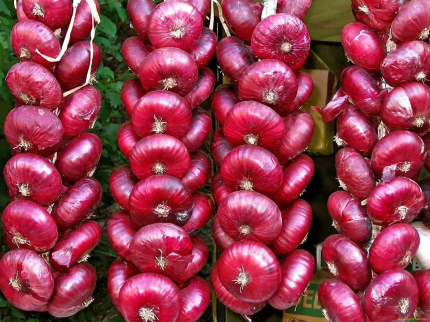
braids of dry tops, hung in a cool place.
Iowa State University Extension recommends placing the onions in a mesh bag, old nylon stocking, wire basket, or box after drying, and the container should allow air to circulate through the bulbs.
Not suitable:
plastic bags;
tightly closed plastic containers;
buckets without holes;
large deep drawers without ventilation;
wet bags;
places where onions lie in a thick layer without air access.
The National Onion Association specifically advises against storing whole onions in plastic bags, as the lack of air movement shortens the shelf life.
Can you store onions in the refrigerator?
Whole, dry onions are not usually kept in the refrigerator as a primary storage method. Refrigerators are cold but often humid, and onions need dry air. Moisture can soften the skin, encourage spoilage, and create an unpleasant odor in the refrigerator.
There are exceptions. A refrigerator is appropriate for sweet onions with a high water content if you want to extend their shelf life, but they should be kept dry, preferably individually wrapped. A refrigerator is also needed for peeled, chopped, or already cooked onions.
The National Onion Association notes that whole peeled onions should be refrigerated after purchase, while chopped onions should be stored in a sealed container for up to 7 days. In another FAQ, the organization clarifies that chopped or minced onions can be stored in a sealed container in the refrigerator at 40°F or below, or 4°C or below, for 7 to 10 days.
The FDA also advises storing refrigerated foods in closed containers or airtight bags and maintaining refrigerator temperatures at 40°F or below.
Can I keep onions on the balcony?
A balcony can be a good place if it is dry, dark, ventilated and does not freeze. But this is not a universal solution. On an open balcony, onions can get wet from rain or snow, overheat in the sun, freeze in frost or suffer from sudden changes in temperature.
The University of Minnesota Extension warns that onions should be stored in a cool, dry place and not allowed to freeze; they will start to sprout if stored above 40°F. The Iowa State University Extension recommends moving onions from an unheated garage to another location if the temperature drops below 32°F, or 0°C.
Three rules are important for a balcony: the container should not stand directly on a cold stove, the onions should be protected from the sun and precipitation, and during frosts, they should be moved indoors or to a warmed area.
Is a basement or cellar suitable?
A basement is only suitable if it is dry and well ventilated. If it is damp, smells musty, has condensation on the walls or is moldy, the onions will quickly start to soften and spoil. A damp basement, which works well for carrots or beets in sand, is often not suitable for onions.
The University of Minnesota Extension explains that different vegetables require different conditions, and onions are a cold and dry storage crop; basements should be well ventilated and rodent-proof.
If your basement is cool but damp, it's best to keep onions off the floor and away from potatoes, cans of condensation, or wet walls. Use shelves, boxes with holes, hanging nets, and regular inspection.
Can you store onions next to potatoes?
Onions should not be kept next to potatoes. They both need a cool, dark place, so they are often placed in the same cupboard or basement. But the conditions for long-term storage are not the same: potatoes need higher humidity, and onions need drier air.
The National Onion Association specifically advises against storing onions with potatoes or other moisture-producing foods. The University of Illinois Extension also notes that onions and potatoes “don’t mix”: the ethylene released by onions can cause potatoes to sprout.
A practical solution is to separate them into at least different drawers, different shelves, or different corners of the pantry. If space is limited, place onions higher in a mesh or air-tight basket, and potatoes separately in a dark paper or wooden container.
How to store different types of onions
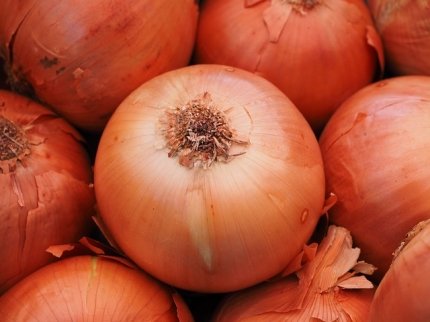
Yellow onion
Yellow onions are most often suitable for long-term storage. If they are well-dried, firm, without blemishes and have a dry neck, they can be kept in a net, basket or box in a cool, dry place.
Red onion
Red onions store similarly to yellow onions, but often have more delicate skins. They should be transported with extra care and not stacked too deep. Damaged bulbs should be used first.
White onion
White onions may have a shorter shelf life depending on the variety and water content. It is best to buy them in smaller batches and change them more often.
Sweet onion
Sweet varieties have more water and do not store well. They are best stored in a refrigerator with a lower humidity setting or individually wrapped in paper. It is better not to buy such onions in large quantities for the whole winter.
Green onion
Green onions do not store as well as dried onions. They should be kept in the refrigerator and used quickly. If the greens are damp, it is best to dry them, wrap them in a paper towel, and place them in an airtight bag or container.
How to store peeled and chopped onions
Peeled or chopped onions no longer have the natural protection of dry scales. They lose moisture more quickly, have a stronger odor, and need to be refrigerated.
The rules are simple:
keep peeled onions in a closed container;
do not leave chopped onions on the table for a long time;
use a clean knife and cutting board;
do not place it next to raw meat or fish;
store at 4°C or below;
use within a few days.
The FDA recommends that you refrigerate peeled or cut vegetables to maintain freshness and prevent spoilage, and keep your refrigerator at 40°F or below. Cut onions should be stored in an airtight container to prevent odors from transferring to other foods.
Can you freeze onions?
Whole onions are generally best stored in a cool, dry place rather than frozen. However, chopped onions can be frozen for future use in soups, stews, sauces, stir-fries, and stuffings. Once thawed, they will no longer be crisp, so they are not suitable for salads.
The National Center for Home Food Preservation notes that onions store well in a cool, dry place, and freezing whole onions is generally not recommended. Diced onions can be frozen without blanching, packaged in recommended freezer bags or containers.
To freeze onions:
Clean it.
Cut into cubes or half rings.
Spread in a thin layer on a tray for primary freezing.
Transfer to a bag or container.
Remove excess air.
Sign the date.
Use for heat treatment.
How to understand that onions can no longer be eaten
Onions need to be sorted regularly. One spoiled bulb can moisten the neighboring ones, give off an odor, and accelerate the spoilage of the entire batch.
Throw away an onion if it:
soft or watery;
has wet spots;
smells like rot;
covered with blue, green, black or gray mold;
crumbles under your fingers;
has mucus;
darkened inside;
When cut, rot is visible between the layers.
The FDA advises against using vegetables that have noticeably changed color, consistency, or texture, and that damaged or rotten areas of fresh vegetables should be cut off before preparation; produce that appears rotten should be discarded.
If the onion has just sprouted a small green sprout but remains firm, odorless, and rot-free, it can often be used after cleaning and removing the sprout. However, such an onion is no longer suitable for long-term storage.
How often to restock
Onions should be checked more frequently during the first two weeks after storage. This is when hidden damage, under-dried necks, and bulbs that were damaged during transportation become apparent.
Then, inspect the batch every 2–3 weeks. If the area is humid, warm, or the batch is not uniform, do it more often. Sorting should not be difficult: lift the top layer, check the smell, look for soft bulbs, remove those that are sprouting or have spots.
Don't wait until the smell becomes noticeable throughout the entire pantry. Onions spoil locally, and removing problem onions early will save the rest of your supply.
Does storing in sand help?
Sand is often used for carrots, beets, parsnips, and other root vegetables that require a moister environment. This is a controversial method for onions, as they need dryness and air circulation. If the sand is not perfectly dry or the container is poorly ventilated, the risk of rot can increase.
Onion storage guidelines often recommend mesh bags, stockings, wire baskets, or ventilated boxes rather than tight bedding. Iowa State University Extension specifically states that the onion container should allow for air circulation.
If you do use sand, it should be completely dry, clean, and the bulbs should be well-dried and undamaged. But for an apartment, pantry, or basement, it's easier and safer to choose a ventilated container.
Common mistakes when storing onions
The first mistake is to leave onions in a plastic bag. Moisture accumulates inside, and without air, the bulbs spoil faster.
The second mistake is storing under-dried onions. A wet neck is one of the main pathways for rot. USU Extension warns: If onions are to be stored, the tops should be completely dry; cutting off the green or wet part can lead to neck rot in storage.
The third mistake is to stack the onions in too thick a layer. The lower bulbs can be injured, and air cannot pass between them.
The fourth mistake is to place the box near a radiator, oven, or on a sunny windowsill. Heat and light stimulate germination and loss of quality.
The fifth mistake is keeping onions next to potatoes. Potatoes give off moisture, while onions need dryness.
The sixth mistake is to ignore one soft bulb. It should be removed immediately, and the neighboring ones should be checked.
The seventh mistake is washing onions before planting. For long-term storage, they must be dry.
Practical scheme for an apartment
If you live in an apartment and have bought 5–10 kg of onions, you don't need to look for the perfect cellar. It is enough to create the best available conditions.
Do this:
Sort through the batch.
Use soft, damaged, and sprouted bulbs first.
Put the rest in nets, a basket, or a box with holes.
Do not fill the box too deep.
Place in a cool, dark place.
Do not keep near a stove, radiator, or damp window.
Do not place next to potatoes.
Check your supplies every few weeks.
If your apartment is warm, don't buy a big bag right away. It's better to buy smaller batches that you can actually use before germination.
Practical scheme for a private house
In a private house, there are more opportunities, but also more risks: the basement can be damp, the garage can freeze, the attic can overheat during the day and get dramatically cold at night.
Optimal scheme:
After harvesting, dry the onions for 2–4 weeks.
Sort only firm, healthy bulbs.
Fold into nets, boxes or braid into braids.
Place on shelves or hang.
Do not place the container directly on the concrete floor.
Provide ventilation.
Protect from rodents.
Control temperature and humidity.
During frosts, do not allow freezing.
Regularly sort through.
If part of the crop has a thick neck or is suspected of poor ripening, do not mix it with the main stock. It is better to use such onions in the first weeks or process them.
Conclusion
To prevent onions from rotting and sprouting, they need dryness, coolness, darkness, and air movement. For garden onions, the key stage is complete drying after harvesting: dry outer scales and a tight neck significantly reduce the risk of rotting. For purchased onions, it is important to sort through the batch immediately and not leave it in a tight bag.
The best containers are a net, basket, perforated box, or hanging basket. The worst conditions are polyethylene, a damp basement, heat near a radiator, direct sunlight, and storage next to potatoes. Whole dry onions are best kept in a cool, dry place, and peeled, sliced, or sweet onions are best kept in the refrigerator under appropriate conditions.
If you regularly inspect your supplies, remove soft bulbs, and maintain ventilation, onions can last much longer without rot, odor, or sprouting.
FAQ
Where is the best place to store onions at home?
Best in a cool, dry, dark, and well-ventilated area: a pantry, dry basement, cool hallway, frost-free garage, or insulated balcony. The National Onion Association recommends storing dried onions at 45–55°F (7–13°C), away from sunlight and heat.
Can you store onions in the refrigerator?
It is generally best not to refrigerate whole, dry onions, as they can become too moist. Refrigeration is required for peeled, sliced, or sweet onions with a high water content. Sliced onions should be stored in a sealed container at 4°C or below.
Why do onions rot during storage?
The most common causes are high humidity, poor ventilation, under-dried bulb necks, mechanical damage, plastic bags, heat, or one bad bulb in a batch. UC IPM notes that mold often enters through wounds, bruises, or under-dried bulb necks.
How to store onions after harvest?
It should be carefully dug up, not washed, dried in a warm, dry, ventilated place for 2–4 weeks, wait for the outer scales to dry and the neck to become dense, then cut off the tops and sort out the damaged bulbs. The University of Minnesota Extension calls curing a mandatory step for onions that are planned to be stored.
What can't you store onions in?
Don't store onions in plastic bags, airtight plastic containers without holes, wet bags, or deep, unventilated boxes. The National Onion Association warns that lack of air movement shortens the shelf life of onions.
Can onions be stored next to potatoes?
Better not. Onions need dry air, and potatoes give off moisture. The National Onion Association advises against storing onions with potatoes or other foods that give off moisture.
How long can onions be stored?
Under good conditions, garden-dried onions can last for several months. Iowa State University Extension indicates an average shelf life of 5–8 months for onions when properly prepared and stored at 32–40°F and 65–70% humidity. In an apartment, the shelf life may be shorter due to heat and unstable humidity.
Can you eat sprouted onions?
If the onion is firm, free of mold, rot, slime, and an unpleasant odor, it can usually be used after cleaning and removing the sprout. However, it is no longer suitable for further storage. Soft, wet, or moldy onions should be thrown away.
Do you need to wash onions before storing?
No. For long-term storage, onions should be dry. Washing adds moisture and increases the risk of rotting. It's best to wash onions before cooking: The FDA recommends rinsing vegetables under running water before cooking to prevent dirt and bacteria from being transferred during cleaning or chopping.
Can onions be frozen?
Yes, but it's best to freeze chopped onions for future cooking rather than whole onions. The National Center for Home Food Preservation notes that whole onions store well in a cool, dry place, and diced onions can be frozen without blanching in freezer bags or containers.
undefined

