

The windows have just been washed, but as soon as sunlight hits the glass, white streaks, cloudy spots and marks from the rag become noticeable. Sometimes you have to wipe the entire surface again, although it seems that there is no dirt on it anymore. To wash windows without streaks, you need to correctly dose the detergent, use clean water, prevent the solution from drying out prematurely and completely remove residual moisture with a rubber squeegee or microfiber. It is best to work in dry, cloudy weather, when the glass is not heated by direct sunlight.
The result depends not so much on the cost of household chemicals as on the sequence of cleaning. Even a high-quality product will leave streaks if you apply it to dusty glass, use a dirty cloth, or allow the liquid to dry on its own.
Let's look at why streaks appear on windows, how to properly clean double-glazed windows, how to remove grease and lime stains, and which home remedies are really appropriate.
Why do streaks remain after washing windows?
Streaks occur when a thin, uneven layer of dirt, detergent, or substances dissolved in water remains on the surface of the glass.
When the water evaporates, these components remain on the glass. Under certain lighting conditions, they become visible as white streaks, spots, or a cloudy film.
Cleaning equipment manufacturer Kärcher explains that one of the reasons for the appearance of marks after cleaning is the remnants of the cleaning solution that were not completely removed from the surface.
Andersen Windows also recommends avoiding washing windows in direct sunlight, as the product can dry faster than it can be removed.
How to determine the cause of divorces by their appearance
| What do the traces look like? | Possible cause | What will help? |
| White dots and spots | Mineral impurities in water | Purified water, timely removal of drops |
| Oily or cloudy film | Excess detergent | Re-cleaning with a less concentrated solution |
| Long parallel stripes | Dirty or worn water drain rubber | Cleaning or replacing the nozzle |
| Traces in the form of circles | Dirty fabric, product residue | Clean microfiber and proper rinsing |
| Smudges near the frame | Liquid leaks from the joints | Pre-cleaning the frame, drying the edges |
| Lint on glass | Inappropriate rag | Lint-free microfiber |
| Stains do not disappear after washing | Damage to the coating or contamination between the glass panes | Checking the window structure |
Don't try to wash every type of stain with a stronger product. First, you need to understand what exactly is left on the surface.
Mistake #1. Washing windows in direct sunlight
A sunny day seems ideal for washing windows: the light allows you to see every stain and the glass dries quickly.
However, it is the rapid evaporation of water that often prevents a clean surface from being obtained.
Sun-heated glass dries the cleaning solution before a person has time to remove it with a hose.
As a result, product components and minerals from the water remain on the surface.
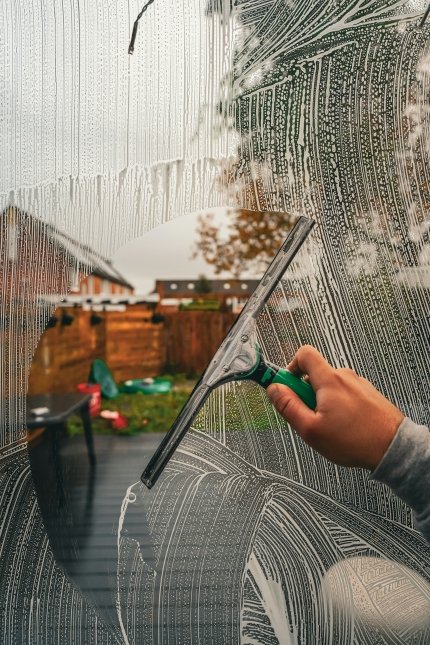
When is the best time to wash windows?
The best option is dry, cloudy weather without strong winds.
Kärcher recommends choosing a cloudy day when the glass does not overheat.
If it's sunny outside, you can clean windows on the side of the house that is in the shade.
For example, it is more convenient to wash windows on the east facade after the direct morning sun has stopped hitting them.
What is important is not the specific time, but the temperature of the glass and the speed at which the solution dries.
Mistake #2: Adding too much detergent
A common belief is that the more household chemicals you use, the cleaner the windows will be.
In fact, too much product can create a persistent film.
This is especially true for concentrated formulations and dishwashing liquid.
Surfactants help to separate grease and dirt from surfaces, but they must be removed after cleaning.
If the solution is too concentrated, it is more difficult to remove it without residue.

How much glass cleaning product is needed?
There is no universal amount: it all depends on the concentration of the specific product.
The safest thing to do is to follow the dosage specified by the manufacturer.
For routine cleaning of household windows, a weak solution of neutral detergent is often sufficient, if its use is permitted by the instructions for the window.
There is no need to add several different cleaners at the same time.
If a slippery or cloudy film remains after washing, try cleaning the glass again with clean water and immediately remove it with a dry tool.
Mistake #3. Using dirty or hard water
Tap water may contain dissolved calcium and magnesium salts.
After evaporation, they can leave light traces on the surface.
This is especially noticeable in regions with hard water.
The condition of the water itself in the wash tank also affects the result.
If you dip a rag into it several times after cleaning dirty frames, the solution will gradually accumulate dust, sand, and other impurities.
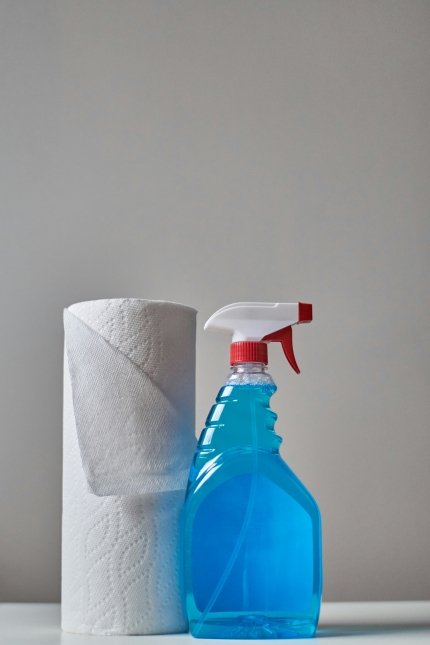
Should you use distilled water?
Distilled or other demineralized water can be used for a final rinse of small glass surfaces.
It contains fewer mineral impurities that leave stains after drying.
However, this is not a prerequisite for every wash.
If the tap water is moderately hard and the remaining liquid is immediately removed with a water jet, the result can also be of high quality.
It is more important to not let dirty water dry on the glass than to constantly use expensive special solutions.
Mistake #4. Starting to wash the glass without cleaning the frame
Dust, small particles of soil, and street dirt accumulate on window frames, seals, and window sills.
If you wet the glass immediately, the water can transfer these contaminants to the already cleaned surface.
This happens especially often when washing the outside of the window.
Correct cleaning sequence
First, remove any available dry dirt from the frame without rubbing abrasive particles on the glass.
Then wash the frame and window sill with a product compatible with the profile material.
Clean accessible joints and dust accumulation areas separately.
Only after that, move on to the glass.
It is advisable to use different wipes for frames and glass surfaces.
This will reduce the risk of transferring small contaminants and the appearance of new marks.

Mistake #5. Wipe dusty glass with a dry cloth
Sand, road dust, and other solid particles can accumulate on the outer surface of windows.
If you rub such glass vigorously with a dry cloth, the dirt will not necessarily be removed.
Some dust will be scattered across the surface, and hard particles may cause scratches.
Glass manufacturer Guardian emphasizes the need to use sufficient clean water to avoid the abrasive effects of contaminants.
How to properly remove heavy street dirt
First, carefully wet the surface with clean water.
Allow dried dirt to soften without applying strong friction.
After that, remove the dirt with a soft sponge or suitable cloth.
If the water becomes dirty, replace it.
Do not use metal sponges, hard brushes and abrasive powders.
Even if regular glass seems strong, special coatings can be sensitive to mechanical damage.

Mistake #6. Using one rag for all cleaning
One cloth for the windowsill, frame, glass, and final polishing is not the best solution.
After contact with a dirty surface, the fabric accumulates dirt particles.
In addition, microfiber that is too wet is less effective at removing residual moisture.
For a quality result, it is advisable to have at least three separate wipes:
For frames and window sills.
For cleaning glass.
For final drying of edges and polishing.
It is especially important that the last napkin remains clean and dry.
Which microfiber is best for windows?
Choose a soft fabric without lint, rough seams, and decorative elements.
For final polishing, smooth cloths designed for glass are convenient.
Avoid fabrics that have fabric softener or greasy stains on them.
When washing microfiber, follow the manufacturer's recommendations. Conditioners can reduce the absorbency of the fibers.
If the napkin leaves lint or smears moisture, it is better to replace it.
Mistake #7. Not removing water after washing
You can thoroughly wash away the dirt, but you will still get streaks if you leave the glass to dry naturally.
Water droplets flow unevenly, and after they evaporate, traces of dissolved substances remain.
Therefore, the final step should be mechanical removal of the liquid.

How to use a water hose correctly
A rubber squeegee allows you to remove water from a large area of glass in just a few movements.
Start at the top of the window and gradually move down.
For home cleaning, it is convenient to use vertical passages with a small overlap.
Wipe the rubber nozzle with a clean cloth after each pass.
Do not leave the corners and bottom edge near the frame uncleaned.
Kärcher recommends removing residual water with a squeegee, window vacuum cleaner or a clean, lint-free cloth.
It is not necessary to rub the glass until it squeaks. It is much more important to remove the solution evenly while it is still wet.
Mistake #8. Using a worn-out water pump
Even the correct technique won't help if the rubber nozzle is damaged.
Over time, its edge may lose its smoothness or accumulate solid particles.
In this case, after each pass, characteristic stripes remain on the glass.
How to check the drain hose
Inspect the working edge in good light.
It should be smooth, clean and without visible damage.
If the rubber is cracked, deformed or uneven, the nozzle must be replaced.
Before working, also check if there are any sand particles left on it.
Too much pressure will not compensate for a worn rubber band.
On the contrary, it can impair the contact of the tool with the glass.

Mistake #9. Using inappropriate home remedies
Vinegar, citric acid, baking soda, alcohol, and dish soap are often mentioned among home methods for cleaning glass.
However, their effects are different, and compatibility depends on the window design.
For example, weak vinegar solutions are sometimes used to clean ordinary glass.
But that doesn't mean vinegar is suitable for any double-glazed window, decorative coating, or window film.
Manufacturer Andersen allows certain mild products for its windows, while Guardian sets stricter requirements for certain specialty coatings.
Can you wash windows with vinegar?
For regular glass without a special coating, a weak vinegar solution may be acceptable, as long as it does not conflict with the manufacturer's instructions.
However, it is not a universal solution for all divorces.
It is also necessary to avoid contact of unsuitable acid solutions with sensitive frame materials, seals and decorative elements.
Do not mix vinegar with chlorine-based cleaners—this combination can release dangerous gases.
Why baking soda isn't always good for glass
Baking soda has mildly abrasive properties.
On certain surfaces, it helps remove dirt, but for glass with special coatings, mechanical friction may be undesirable.
It is especially not recommended to use dry soda as a powder for intensive rubbing.
It is better to choose a non-abrasive product that is compatible with the specific type of glazing.
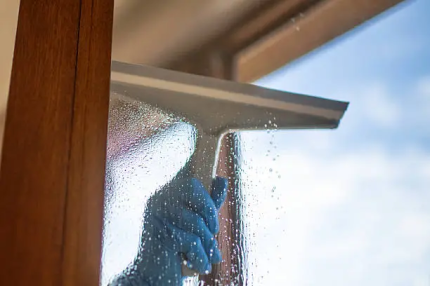
Mistake #10. Ignoring the type of glass and its coating
On the outside, two windows may look the same, but have different surface characteristics.
Modern double-glazed windows can be equipped with energy-saving, sun-protective, self-cleaning or decorative coatings.
Some coatings are located inside the sealed glass unit and are not accessible for normal cleaning.
Others may be on the exposed surface of the glass.
Therefore, before using strong cleaners, it is necessary to determine the type of product.
How dangerous are abrasives and metal blades?
Andersen specifically warns against using metal blades to clean glass surfaces.
Guardian also recommends avoiding abrasive materials and sharp objects that can damage the glass or its coating.
It is especially dangerous to try to scrape off dried mortar, paint, or cement without taking into account the characteristics of the window.
In such cases, improper cleaning can leave irreversible scratches.
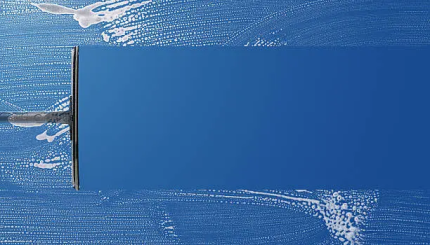
How to properly wash windows without streaks: step-by-step instructions
For most common household windows, water, a mild detergent, a few wipes, and a good quality water hose are sufficient.
It is not necessary to purchase a large amount of specialized chemicals.
Step 1. Prepare the tools
For cleaning you will need:
A container with clean water.
Mild glass cleaner or neutral detergent.
A soft sponge or window cleaning nozzle.
Rubber water pump.
Two or three clean microfiber cloths.
Separate fabric for frames and window sills.
If the water is very hard, demineralized water can be prepared for final purification.
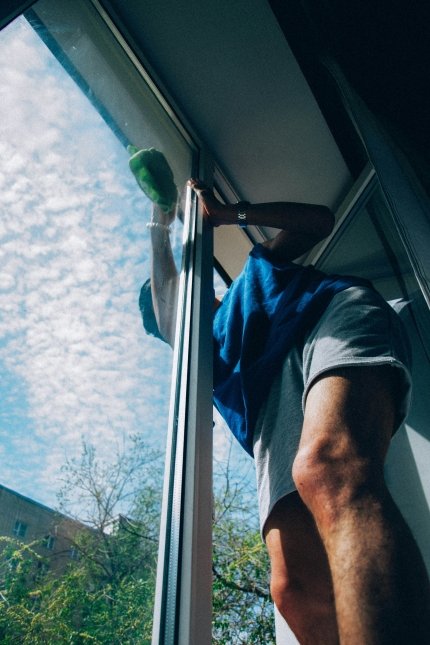
Step 2. Clean the frame and sill
Remove any available dust and dirt.
Then wipe the frame with a product approved for the profile material.
Different restrictions may apply to plastic, wooden and aluminum structures.
Do not allow large amounts of water to accumulate at joints and near seals.
Step 3. Wet the glass
Apply a small amount of cleaning solution to the glass surface.
For heavily soiled windows, first use clean water to wash away the main layer of dust.
There is no need to rub dry solid particles.
Move from the top to the bottom.
Step 4. Remove dirt
Clean the surface evenly with a soft sponge or suitable nozzle.
Pay special attention to the areas near the bottom edge, where dust and rain marks often accumulate.
If the solution becomes dirty quickly, replace it.
Do not apply contaminated water repeatedly to already cleaned glass.
Step 5. Remove the water with a hose
Start at the top of the window.
Remove the solution with smooth movements with a slight overlap.
Clean the rubber nozzle after each pass.
Try not to stop moving in the middle of the glass surface to avoid water accumulating in one place.
Step 6. Dry the edges
Take a clean, dry microfiber cloth and gently wipe the corners, bottom edge, and areas near the frame.
This is where water often remains, which later drains onto clean glass.
After that, examine the window from different angles.
If a single stain is visible, it is not necessary to re-wash the entire surface - local cleaning with an appropriate agent is sufficient.
The best way to wash windows: a comparison of methods
The choice depends on the area of the glazing, the type of contamination and the tools available.
| Way | Advantages | Limitation |
| Water and microfiber | Simplicity, minimum means | May not be enough for greasy stains |
| Special glass cleaner | Convenient for regular maintenance | Excess leaves a film |
| Weak neutral detergent solution | Helps remove common dirt | It is necessary to carefully remove the remains |
| Water extraction | Quickly removes water from large areas | Requires proper technique |
| Window vacuum cleaner | Collects moisture without dripping | The device needs to be charged and cleaned. |
| Demineralized water | Reduces the risk of mineral stains | Does not replace the removal of grease and dirt |
For a small window, microfiber and glass cleaner are often enough.
For large glass surfaces, a water jet or a special window vacuum cleaner may be more convenient.

How to clean windows from greasy deposits
Grease can gradually accumulate on kitchen windows, especially near the stove.
Plain water does not always effectively remove such contaminants.
In this case, you can use a weak solution of a compatible detergent, which helps to separate the grease from the surface.
Test the product on a small area first, especially if the glass has a special coating.
After cleaning, remove any product residue and dry the surface.
Do not use aggressive kitchen degreasers without confirmed compatibility with glass, frames and seals.
Their components may be too strong for certain window materials.
How to remove white water stains on glass
White spots often appear after hard water droplets dry.
They can be seen on windows after rain, washing, or water from sprinklers.
If it is fresh mineral residue, re-cleaning with an appropriate product may help.
For regular glass without special coatings, mild anti-mineral deposits are sometimes allowed.
However, you should not use concentrated acids or descaling agents without checking the instructions.
It is especially important to prevent such substances from getting on aluminum profiles, seals and sensitive coatings.
If stains remain after proper cleaning, it may not just be a surface coating, but a change in the condition of the glass itself.

Why do microfiber marks remain on windows?
The reason may be poor quality fabric, contamination or incorrect use.
For example, if a napkin is already saturated with water, it begins to spread the remaining moisture instead of absorbing it.
Another common case is that microfiber was washed together with pile fabrics.
After that, small fibers may remain on its surface.
It is also undesirable to use a cloth contaminated with grease or conditioner residue.
For final polishing, a clean, dry cloth is required.
If the glass is very wet, first remove the main water with a water jet, and only then use microfiber.
Should you use newspaper to wash windows?
Washing glass with newspaper is a well-known home method, but modern printing products are not necessarily suitable for this.
Paper can leave fibers and printing ink can transfer to individual surfaces and frames.
In addition, different types of newsprint have different properties.
Therefore, there is no reason to consider newspaper better than high-quality microfiber.
For regular care, it is more convenient to use special lint-free fabrics or water jets.
This allows for better control of the process and prevents foreign substances from being transferred to the frame.
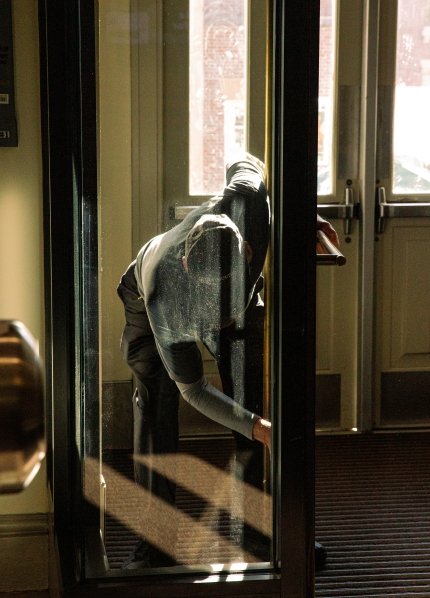
How to clean plastic windows without damaging the seals
Plastic windows are not only made of glass.
The structure includes PVC profiles, rubber seals, fittings, drainage elements and other components.
Separate recommendations may apply for each of them.
The profile is usually cleaned with a soft cloth and a compatible non-abrasive cleaner.
No need to use stiff brushes or strong solvents.
Be especially careful with seals.
The Fenestration and Glazing Industry Alliance (FGIA) warns against using harsh chemicals that can damage window materials.
The organization also does not recommend cleaning windows with high-pressure water jets, as this can damage seals and structural elements.
How to clean windows with tinted film or special coating
Additional rules apply to windows with film.
For example, the manufacturer 3M recommends that for certain architectural window films, no cleaning be performed within the first 30 days after installation.
The exact time frame and permitted means depend on the type of film.
Do not use metal scrapers or abrasive sponges.
Before using products containing alcohols, ammonia or acids, you must check their compatibility with the specific coating.
Some films allow certain household cleaners, others have stricter restrictions.
There is no universal rule that all window films can be cleaned with vinegar, alcohol, or any glass cleaner.
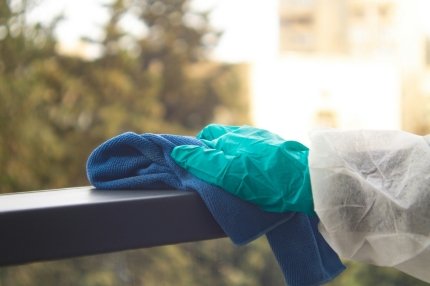
How to wash windows in winter and is it possible to do it in frost?
During the cold season, it is important to consider the temperature of the glass and operating conditions.
If it is frosty outside, the water on the outer surface may freeze.
This makes cleaning more difficult and fluid residue can accumulate near seals and joints.
Sharp temperature changes are also undesirable for glass structures.
There is no need to pour hot water onto a very cold glass.
For regular home washing of exterior surfaces, it is better to choose a day with temperatures above freezing and without strong winds.
If the window has a special coating, you must also consider the temperature limitations of the detergent.
Indoors, windows can be cleaned at a comfortable temperature, preventing excess water from getting into the joints.
Why are stains only visible in the evening or in the sun?
After washing, the glass may seem perfectly clean.
But when the angle of illumination changes, spots appear that were not visible before.
This is due to the way light passes through glass and reflects off thin surface films.
Even small amounts of detergent residue can become more noticeable when exposed to slanted light.
That is why it is advisable to check the result from different angles.
However, you should not expect that every defect can be removed by polishing.
If the stain is between the panes of a sealed double-glazed window, external cleaning will not help.
In such a situation, it may be necessary to check the condition of the double-glazed window.
How often should windows be washed?
There is no universal frequency.
It depends on the location of the house, the amount of dust, the proximity of the road, weather conditions, and the characteristics of the room.
For example, windows near a busy road may get dirty faster than in an apartment located in a quiet courtyard.
Manufacturer Pella recommends cleaning windows at least twice a year as a guideline for regular maintenance.
However, if necessary, the glass can be washed more often.
Don't wait until a thick layer of dirt accumulates on the surface, which will have to be removed with intense friction.
Regular delicate cleaning is usually easier than dealing with old deposits.

How to safely clean large and panoramic windows
Additional safety measures are required for tall windows and hard-to-reach exterior glazing.
You should not lean far from an open window or stand on unstable furniture.
When working at height, there is a risk of falling, even if only a small area of glass needs to be cleaned.
For accessible surfaces, tools with extension handles can be used according to their intended purpose.
However, they are not always suitable for cleaning the outside of panoramic windows in high-rise buildings.
In such situations, it is advisable to use professional services in compliance with safety requirements.
Clean windows should not be achieved at the cost of risking life.
What to do if stains reappear after washing
If the problem recurs, do not increase the amount of cleaner each time.
It is better to check the process consistently.
First, try washing a small area of the glass with clean water and drying it with a new lint-free cloth.
If the result is better, the cause could be detergent residue.
Then check the rubber water pump.
If it leaves the same streaks after each pass, the problem is likely with its working edge.
If white spots appear after the water dries, it is worth checking its hardness and the method of removing the drops.
If the marks do not change after repeated proper cleaning, you should consider the possibility of surface damage, special coating, or a problem within the glass unit.

Conclusion
Streaks on windows most often occur due to detergent residue, contaminated water, the wrong fabric, or premature drying of the liquid.
To get clean glass, it is important to follow the correct sequence: first wash the frames, then remove the main dirt from the glass, use a moderate amount of product, and completely remove the water.
It is best to wash windows in the shade, use a clean microfiber, and regularly check the rubber nozzle of the squeegee.
The main secret to streak-free windows is not stronger household chemicals, but proper cleaning and timely removal of water and detergent residues.
FAQ: Frequently asked questions about streak-free window cleaning
1. What is the best way to wash windows so that there are no streaks?
For most regular windows, clean water with a mild compatible detergent or a special glass cleaner is suitable. The most important thing is not to exceed the dosage and to completely remove the liquid with a water jet or a clean microfiber.
2. Why do white spots remain after washing windows?
The cause may be mineral impurities in the water, especially calcium and magnesium salts. After evaporation, they leave traces. Prompt removal of drops and use of water with a lower mineral content help.
3. Can I wash windows with dishwashing liquid?
Yes, if the window manufacturer allows this method of cleaning. Use a small amount of product and carefully remove any residue. A solution that is too concentrated can leave a cloudy film.
4. Why can't you wash windows in the sun?
Heated glass accelerates the evaporation of water and cleaning solution. This can leave streaks on the surface. It is better to choose dry, cloudy weather or clean windows in the shade.
5. Does vinegar help with stains on windows?
For regular glass, weak vinegar solutions are sometimes acceptable, but they are not suitable for all coatings, frames and films. Check the manufacturer's instructions before use. Do not mix vinegar with chlorine-based products.
6. What is the best cloth to use to clean glass?
It is best to use a clean, lint-free microfiber cloth designed for glass. For the final polishing, the cloth should be dry and free of conditioner residue, grease, or dirt.
7. Why does water jetting leave streaks on glass?
The cause may be a dirty, damaged or worn rubber edge. Streaks also appear if the nozzle is not wiped after use. Check its condition and replace if necessary.
8. Can plastic windows be cleaned with a steam cleaner?
The possibility depends on the type of glass, profile design, seals and manufacturer's recommendations. Not all windows allow intense local heating or steam exposure. Before use, you need to check the compatibility of the method.
9. How to wash windows in winter without streaks?
For exterior surfaces, it is best to choose a dry day with temperatures above freezing. Do not use hot water on very cold glass. After cleaning, remove moisture immediately, especially around frames and seals.
10. What to do if the windows remain cloudy even after washing?
Try cleaning a small area with clean water and drying with a new microfiber. If the cloudiness persists, the cause may be persistent deposits, damage to the coating, or dirt between the panes of the double-glazed window. The latter problem cannot be solved by regular washing.

