

Conversations between colleagues, phone calls, endless discussions around the desk, and constant movement of people are common in an open office environment. However, what creates a sense of teamwork for some people can make it difficult for others to focus on even simple tasks.
To work productively in a noisy open space, you need not only to reduce the number of sound stimuli, but also to properly organize working hours, agree on rules for communication, and create conditions for focused work. The best result usually comes from a combination of personal habits and changes in the organization of the office space.
Scientific studies confirm that extraneous conversations can impair performance on tasks that require memory, information analysis, and sustained concentration. However, not all sounds are equally disruptive, and regular headphones don't always solve the problem.
We'll figure out why open offices can be exhausting, how to learn to work amidst constant noise, and what solutions really help reduce distractions.
Why noise in an open space interferes with work
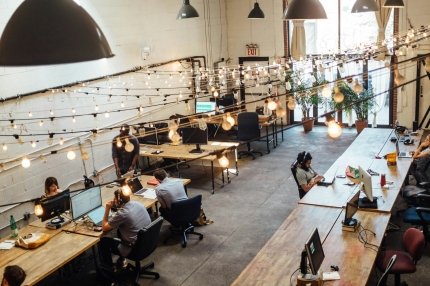
Open space is an office organization format in which several employees or teams are located in a common space without separate offices.
This arrangement can facilitate rapid communication, information sharing, and collaboration between employees. However, the lack of physical barriers creates additional challenges for work that requires concentration.
The main problem is not always the volume of sounds.
A particularly strong stimulus is clear human speech. When someone is nearby discussing a work project or talking on the phone, the brain can involuntarily process the information it hears, even if it has no relation to your task.
In psychology, this effect is studied within the framework of the influence of extraneous speech on cognitive activity.
Experimental studies show that intelligible extraneous conversations particularly interfere with tasks that involve memorizing information and its sequential reproduction.
For example, an accountant may find it more difficult to review financial documents when meeting results are being discussed nearby. An editor may find it more difficult to work on a complex text if they constantly hear someone else talking.
This does not necessarily indicate a lack of discipline or poor concentration. The ability to concentrate is influenced by the characteristics of the work environment and the specifics of the task.
How office noise affects productivity and well-being
Researchers view office noise not only as an acoustic problem, but also as an organizational problem.
A study published in the Journal of Environmental Psychology in 2020 compared cognitive task performance in different office environments.
Participants who worked in quiet rooms or areas performed better than those in active open spaces. In the specific study conditions, the difference in performance was approximately 17–22%.
This does not mean that every company automatically loses a fifth of its productivity due to open space. The effect depends on the nature of the work, the layout of the space, and other factors.
However, the results demonstrate the importance of access to quiet areas for tasks that require concentration.
Constant sound stimuli may also be accompanied by:
feeling tired at the end of the working day;
difficulties with memorizing information;
increased irritability;
subjective feeling of stress;
an increase in the number of interruptions in the workflow;
difficulties in performing intellectual tasks.
At the same time, ordinary office noise is usually well below levels that pose an immediate danger to hearing. Its negative impact is more often associated with distraction, discomfort, and additional cognitive load.
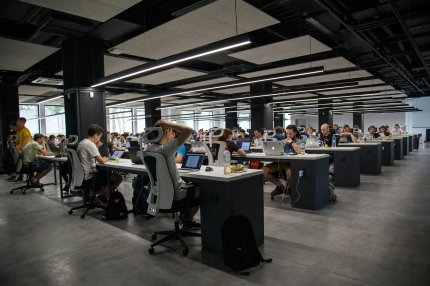
What sounds are the most distracting in the office?
Different noise sources require different ways to solve the problem.
| Noise source | Why does it bother you? | What can help? |
| Colleague conversations | Distracts attention from the content of the speech | Quiet zones, communication rules |
| Phone calls | Unpredictable sounds and voice changes | Separate places for calls |
| Office equipment | Makes a repetitive mechanical noise | Moving equipment |
| Movement of people | Causes audio and visual distractions | Changing the location of the workplace |
| Video conferences | Combines voices, notifications, and background sounds | Meeting rooms, headsets |
| Ventilation systems | Can create a constant hum | Maintenance, acoustic tuning |
| Device notifications | Interrupts concentration | Silent mode, notification settings |
Before purchasing headphones or changing your workplace, it's worth determining which irritants are causing the most problems.
If the main cause is constant phone conversations from a neighboring team, personal noise-cancelling devices may only partially help. Sometimes a more effective solution is to transfer calls to a separate room.
12 ways to work productively in a noisy open space
It's difficult to completely eliminate sounds in an open office. However, you can reduce their impact and create a more predictable work environment.
1. Schedule difficult tasks for quieter hours
The level of activity in the office varies throughout the day.
Some teams have the most conversations after morning meetings, while others have them closer to lunch or at the end of the workday.
Over the course of a few days, observe when your office is most quiet.
It is during this period that you can plan tasks that require significant mental effort: writing texts, programming, financial calculations, data analysis, or preparing complex documents.
Less demanding tasks — correspondence, organizational issues, and some work discussions — should be left for more active hours.
2. Use headphones with active noise cancellation
Headphones with Active Noise Cancellation (ANC) technology can reduce some of the ambient noise.
The technology works using microphones and a sound processing system that creates a signal to compensate for certain external vibrations.
The best active noise cancellation usually works against relatively stable low-frequency sounds, such as the hum of ventilation.
Human voices, harsh sounds, and unpredictable conversations may be less effectively blocked by ANC. The result also depends on the specific model of headphones and the tightness of their fit.
It is important not to try to drown out office noise with excessively loud music.
The World Health Organization recommends controlling listening volume and duration of sound exposure. Noise-canceling headphones can be helpful precisely because they reduce the need to turn up the volume.
3. Choose the appropriate background sound
Some people find it easier to work with consistent background sound than in an environment with constant volume changes.
White, pink or brown noise is sometimes used for this.
These types of sound signals have different energy distributions across frequencies.
However, there is no sufficient evidence to claim that one specific type of noise universally improves concentration in all people.
Some people find natural sounds helpful, others instrumental music, and some people work best in silence.
For tasks related to reading and writing texts, music with words can create additional speech load.
Therefore, the background sound should be selected according to personal needs and the nature of the work.
4. Divide your workday into periods of concentration
One practical time management technique is to schedule separate time blocks for specific tasks.
For example, you can allocate 60 minutes for analytical work without unnecessary meetings and messages.
After that, allow time for answers to colleagues and organizational questions.
This approach is sometimes called time blocking.
The main thing is not the duration of the block itself, but the ability to perform one task without constantly switching attention.
If the work involves responding quickly to important messages, it is necessary to separately identify channels for urgent communication.
5. Agree with colleagues about periods without interruptions
An open office often creates the illusion of constant availability of each employee.
If a person is sitting nearby, it seems natural to immediately ask them a question.
However, even a short address can interrupt a complex thought process.
To reduce the number of such situations, the team can agree on a simple rule: send non-urgent questions to the work chat or discuss them at a designated time.
At the same time, it is worth clearly explaining which situations truly require an immediate response.
This helps avoid creating a conflict between the need for concentration and the need for team interaction.

6. Change your workplace location
Sometimes even moving a few meters can reduce distractions.
The least comfortable places are often those near aisles, kitchens, printers, or informal conversation areas.
The direction of the desktop is also important.
If people are constantly passing in front of the monitor, visual movement can be an additional distraction.
If possible, it is better to choose a location away from the main routes of movement of employees.
However, distance alone does not guarantee silence: sound can travel well in large rooms with hard surfaces.
7. Use separate rooms for complex tasks
If your office has meeting rooms, small offices, or special areas for focused work, they should be used for more than just meetings.
For example, preparing an important financial report or editing a complex document may require more silence than regular correspondence.
The ISO 22955:2021 standard, dedicated to the acoustic quality of open offices, requires consideration of different types of activities when planning a workspace.
The basic principle is that the space should match the nature of the work, rather than forcing all workers to perform different tasks in the same acoustic conditions.
8. Reduce digital distractions
In a noisy office, it's difficult to control all external stimuli. But you can eliminate some of the interruptions yourself.
For example, turn off notifications from unimportant work chats, remove sound alerts for new emails, or close tabs that are not needed for the current task.
If you are distracted by both colleagues' conversations and phone messages for an hour, the load on your attention may increase further.
Therefore, the organization of the digital environment is no less important than acoustic comfort.
9. Take breaks away from noisy environments
A break does not always provide recovery if a person remains among the same stimuli.
For example, after an hour of intense work, you can go to a quieter room or leave your workplace for a while.
A short walk also helps change the environment and break up prolonged sitting.
It is not necessary to establish a universal break schedule for all employees.
Their frequency depends on the nature of the tasks, the length of the working day, and individual needs.
10. Agree on rules for phone conversations
One of the most common problems with open offices is multiple employees making calls at the same time.
It is especially difficult to concentrate when someone is holding a long video conference or constantly communicating with clients.
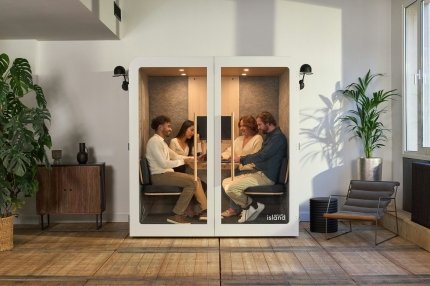
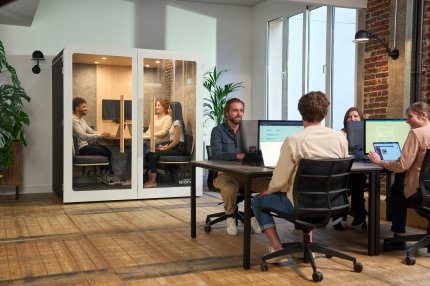
For such tasks, it is advisable to provide special telephone booths, meeting rooms, or active communication areas.
If there are no separate rooms, you can divide the space into teams with different types of work.
For example, salespeople who regularly call customers and analysts who work with large amounts of information have different acoustic needs.
11. Use a hybrid format if possible
Some tasks are easier to perform at home or in a separate office.
The hybrid format allows you to distribute work depending on its nature.
For example, team meetings and joint planning should be held in the office, and tasks that require prolonged concentration should be done remotely.
However, working from home doesn't always guarantee a quiet environment. It's important to evaluate the real environment rather than assuming a certain format is universally better.
The decision also depends on professional responsibilities and employer policies.
12. Discuss the problem with your manager based on specific examples
A general complaint about noise does not always help to understand what changes are needed.
Instead, it is worth describing specific situations.
For example: the neighboring team's daily video conferences coincide with reporting preparation times, making it difficult to perform document verification.
After that, you can suggest a solution: change the location, use a meeting room, or introduce joint concentration hours.
This approach moves the conversation from the plane of personal dissatisfaction to the organization of work processes.

Do open offices really improve teamwork?
One of the main arguments in favor of open space is the ability to communicate and exchange ideas faster.
However, scientific research results do not always confirm this effect.
A study by Harvard University researchers published in 2018 analyzed the behavior of employees at two companies after switching to open office space.
In both cases, the number of in-person interactions decreased by approximately 70%, while the use of electronic communication channels increased.
This doesn't mean that any open office is bad for communication. The study looked at specific companies and settings.
However, it showed that the absence of partitions does not guarantee more active cooperation.
Sometimes, on the contrary, constant visibility and a large number of people around encourage employees to limit personal contacts.
Therefore, an effective office must provide a balance between the ability to communicate and the right to focused work.
How to properly organize quiet areas in an open space
Personal concentration skills are useful, but they cannot fully compensate for poor room layout.
Therefore, employers should pay attention to the acoustic organization of the work environment.
Dividing space by type of work
One of the most practical approaches is to create functional zones.
The office can be divided into three parts.
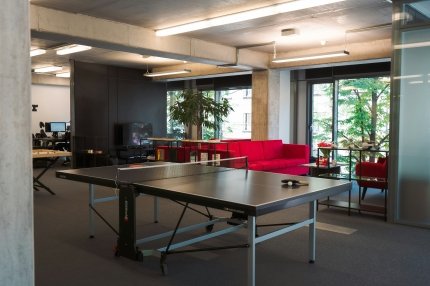
Concentration zone. Designed for individual work, reading, information analysis, and document preparation.
Team interaction area. Used for discussions, short meetings, and collaborative tasks.
Call area. Equipped for telephone conversations and video conferences.
This separation helps reduce conflict between different work needs.

Acoustic panels and sound-absorbing materials
Hard surfaces—glass, concrete, tile—can help reflect sound waves.
To reduce echo and noise propagation, special acoustic panels, suspended structures, sound-absorbing ceilings, and other materials are used.
However, it is important to distinguish between sound absorption and sound insulation.
An acoustic panel can reduce sound reflections inside a room, but it does not necessarily create a reliable barrier between employees.
Similarly, tabletop partitions can partially limit sound propagation and visual stimuli, but their effectiveness depends on the design and location.
Decorative plants improve the perception of an interior, but usually cannot replace special acoustic solutions.
Sound masking systems
Some offices use sound masking technology — the controlled addition of uniform background sound.
Its task is not to make the room completely quiet, but to reduce the intelligibility of outside conversations.
A study published in Applied Acoustics in 2024 showed that an adaptive sound masking system can reduce distractions to intelligible speech and improve certain measures of subjective well-being.
At the same time, improper setup of such a system can create additional acoustic discomfort.
Therefore, sound masking requires professional design and should not replace the elimination of the main sources of noise.

What rules of conduct help reduce noise in the office?
Even a well-designed space can remain uncomfortable if the team does not have communication agreements.
Effective rules must be clear and the same for everyone.
For example:
Long calls are made in specially designated areas.
Phones and computers work without unnecessary sound notifications.
Non-urgent issues are resolved through notifications or during scheduled discussions.
Colleagues respect agreed-upon periods of focused work.
Team meetings are not held directly near other employees' workstations.
Important oral discussions are moved to meeting rooms whenever possible.
At the same time, you should not establish a rule of absolute silence for the entire office.
It may be incompatible with the work of employees who need to constantly communicate with clients or colleagues.
A more effective solution is to coordinate the acoustic needs of different teams.
What to do if colleagues are constantly talking and interrupting
Noise problems often escalate into personal conflicts.
One person perceives conversations as an integral part of work, while another cannot complete an important task because of them.
It's best to start with a specific request, rather than by evaluating your colleagues' behavior.
For example, instead of accusing someone of being too loud, you can explain that you need to finish a complex document now and ask to move the long conversation to another location.
If the situation recurs, it is advisable to discuss it at the team level.
It is important that rules do not depend solely on personal agreements between individual employees.
In large teams, common standards for organizing meetings, calls, and periods of concentration may be more effective.
How to understand that noise in the office has become a serious problem
Not every discomfort requires major changes. However, there are situations when it is worth systematically reviewing the organization of the work environment.
Pay attention if:
employees are regularly unable to complete complex tasks without moving to other premises;
most employees constantly use headphones to isolate themselves from colleagues;
telephone conversations of one team interfere with the work of the other;
it is impossible to have a confidential conversation in an open space;
workers do not have access to quiet places;
Noise complaints are recurring regularly.
Professional measurements can be used to assess acoustic conditions.
However, noise level in decibels is not the only indicator of comfort. Speech intelligibility, distance between workstations, echoes, and the nature of the tasks performed also have significance.
A regular smartphone app can help you roughly estimate the volume, but it is no substitute for a full acoustic examination.
Can office noise be harmful to health?
Most regular offices have noise levels that are not dangerous to hearing.
However, this does not mean that the acoustic environment does not affect well-being.
Constant unwanted noise can be associated with stress, irritability, and a feeling of overload.
Comcare, the Australian government organization that deals with occupational safety issues, lists distraction, stress and headaches among the possible problems associated with office noise.
At the same time, acoustic discomfort should be distinguished from noise exposure that can damage hearing.
The US National Institute for Occupational Safety and Health (NIOSH) recommends limiting occupational noise exposure to an average level of 85 dB(A) over an eight-hour workday.
This indicator refers to the prevention of hearing damage, not the acceptable noise level for comfortable office work.
If the noise is accompanied by a persistent headache, ringing in the ears, hearing loss, or other symptoms, medical evaluation is necessary.
Why headphones don't always solve the open space problem
Headphones can be a useful tool, but they shouldn't be the only way to protect yourself from an uncomfortable work environment.
First, they do not eliminate the source of the noise.
Secondly, prolonged wearing may cause physical discomfort for some users.
Third, the employee may miss important calls or warning signals.
In addition, constant isolation through headphones can make spontaneous communication difficult, which is why open offices are often created.
Therefore, it is best to consider them as an auxiliary tool along with zoning, communication rules, and proper organization of tasks.
Common mistakes when working in a noisy office
Some habits that seem beneficial can actually create additional difficulties.
Try to ignore any noise. If sounds regularly interrupt your work, self-control alone may not be enough.
Constantly listening to loud music. Excessive volume creates additional strain on the hearing and does not always improve concentration.
Blaming colleagues without offering specific suggestions can worsen relationships without addressing the organizational cause of the problem.
Perform all tasks in the same conditions. Team discussion and complex analytical calculations require different environments.
Believe that you have to get used to noise. People differ in their sensitivity to sound stimuli, and different professions have different requirements for concentration.
Ignore systemic causes. If dozens of employees are experiencing the same difficulties, the problem is unlikely to be solved by simply purchasing headphones.
How to improve concentration in an open space in one work week
Changes can begin with a brief observation of your own work.
Monday: Identify the main sources of noise and the times when distractions are greatest.
Tuesday: Divide tasks into those that require concentration and those that can be done in an active environment.
Wednesday: Try to schedule one period without non-urgent messages or interruptions.
Thursday: See if changing your work location or using a quiet room helps.
Friday: Evaluate which decisions really improved performance and identify changes that need to be agreed upon with the team.
Simple indicators can be used for evaluation: the number of unplanned interruptions, the time spent on a specific task, and the subjective difficulty of concentration.
It is important to compare similar work tasks because their complexity also affects productivity.
Conclusion
A noisy open space doesn't have to be an obstacle to productive work. However, comfort in such an environment depends not only on the discipline of the individual employee.
The most effective solutions combine proper task planning, limiting unnecessary interruptions, using quiet zones, and clear team communication rules.
Noise-canceling headphones, background sounds, and time management techniques can help, but they are no substitute for good organization.
The main principle of a comfortable open space is to provide the opportunity to communicate for those who need it for work, and to focus for those who are performing tasks without constant interruptions.
FAQ: frequently asked questions about working in a noisy open space
1. How to focus on work when everyone is talking around you?
It’s best to combine several solutions: schedule a difficult task for a quieter time, temporarily turn off unnecessary notifications, and use headphones or a separate room. If the problem persists, it’s a good idea to agree on phone rules and concentration periods with your team.
2. Which headphones are best for working in a noisy office?
Active noise-canceling headphones can reduce some background noise, especially steady low-frequency noise. However, they don't always cut out human speech well enough. Comfort, passive sound isolation, and the ability to control volume are also important.
3. Does white noise help you focus?
Some people find that a steady background noise helps them to be less distracted by outside conversations. However, the effect varies depending on the person, the task, and the characteristics of the sound. There is no scientific evidence to support the idea that white noise is a universal productivity enhancer.
4. Why do I get annoyed by my colleagues' conversations, even if they are quiet?
The brain can involuntarily process the content of understandable speech. Therefore, extraneous conversation is sometimes more disruptive than even background sound. This is especially noticeable when reading, memorizing, and working with text information.
5. How to politely ask colleagues to keep quiet?
It’s best to explain a specific work need. For example, let them know that you’re completing a difficult task and need some uninterrupted time. Instead of making general remarks, you can suggest moving the long conversation to a conference room.
6. Is it harmful to work in an open space every day?
The open office format itself does not mean that it is harmful to health. However, unwanted noise, lack of privacy and constant interruptions can create discomfort and additional stress. The impact depends on the conditions of the room, the nature of the work and individual characteristics.
7. Does open space really reduce productivity?
Scientific studies show that open workspaces can impair performance on certain tasks that require concentration. However, the effect is not the same for all professions and spaces. Proper zoning and access to quiet spaces can reduce the negative impact.
8. What is better for work: a separate office or an open space?
It depends on the task. A private office usually provides more opportunities for acoustic privacy and concentration. An open space can be convenient for quick team interaction. The best solution is often a combination of different types of work areas.
9. What to do if it is impossible to work without complete silence?
Consider using a separate room, changing your work location, or working a flexible schedule. If your high sensitivity to sound significantly affects your daily life or is accompanied by other symptoms, it is a good idea to see a doctor to evaluate possible causes.
10. How can an employer make an open space quieter?
First of all, it is necessary to identify the main sources of noise, separate areas for individual work and communication, provide places for calls and use appropriate acoustic materials. Also important are agreed rules of conduct and the ability to work in a quiet room when the task requires it.
Important: The article is for informational purposes only. Self-medication can be harmful to your health. If office noise is accompanied by persistent headaches, ringing in the ears, hearing loss, severe stress, or other symptoms, you should first consult a doctor.

