
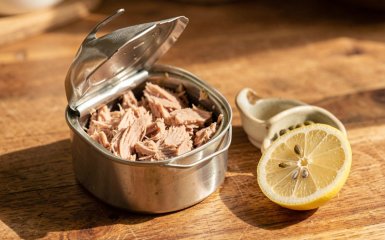
Tuna is often seen as a near-perfect food: high in protein, convenient canning, minimal preparation, and the ability to whip up a salad, sandwich, or full meal in minutes. Yet tuna is regularly at the center of discussions about mercury in fish.
Points of attention
- The correct question is not "is tuna harmful?" but "what kind of tuna, in what quantity, and who eats it?"
- Tuna is a source of complete protein, vitamin B12, and omega-3 fatty acids, but it can contain mercury, so it's important to choose safe types.
- Canned light tuna, like skipjack, is one of the least dangerous options, and the easy processing makes it convenient to use.
There is reason to be cautious. Tuna is a predatory marine fish that can accumulate methylmercury over its lifetime. But the amount of this contaminant varies significantly between types of tuna. Canned light, albacore, yellowfin, and bigeye tuna are all far from the same in terms of mercury content.
Therefore, the correct question is not "is tuna harmful?", but "what kind of tuna, in what quantity, and who eats it?"
As of this writing, international and U.S. food safety authorities do not recommend that healthy people avoid tuna altogether. Instead, they advise rotating fish types and limiting large predatory species with higher methylmercury levels.
The material is for informational purposes only. Self-medication can be harmful to health. Pregnant women, women planning to become pregnant or breastfeeding, children, and people with chronic diseases should first consult a doctor before making any significant changes to their diet.
What are the benefits of tuna?
It would be wrong to start a conversation about tuna just with mercury. Fish remains an important part of a balanced diet.
Tuna is a source of complete protein, vitamin B12, selenium, and other micronutrients. It also contains the omega-3 fatty acids EPA and DHA, although the amounts vary depending on the specific type and product.
Fish and seafood as part of a balanced diet are associated with cardiovascular health benefits. This is why current guidelines do not suggest avoiding fish due to possible contaminants, but rather advise choosing the right species based on the benefit-risk ratio.
The practical advantage of canned tuna is obvious: it is easy to store, does not require cooking, and a can can quickly provide a significant amount of protein. The problem arises when tuna becomes almost the only fish in the diet and is consumed almost daily.

Where does mercury in tuna come from?
Mercury enters the environment from both natural and human sources. In the aquatic environment, microorganisms can convert it to methylmercury, an organic form that readily accumulates in living organisms.
Then the food chain works.
Small aquatic organisms accumulate small amounts of methylmercury. They are eaten by small fish. These fish are eaten by larger ones. The longer a large predator lives and the higher it is in the food chain, the more methylmercury can potentially accumulate in its tissues.
Tuna is a predatory fish, especially large, long-lived species.
This process is called bioaccumulation and biomagnification, and it causes large predatory fish, including some tuna, shark, and swordfish, to contain more mercury on average than sardines, salmon, or most smaller fish.
Why is methylmercury dangerous?
The main target system for methylmercury is the nervous system.
High or prolonged exposure can cause neurological damage. The developing brain is most vulnerable, so controlling mercury intake is especially important during pregnancy and childhood.
This is primarily a cumulative risk. A regular serving of tuna from the store does not mean that a person will get acute mercury poisoning.
A problem can arise when fish with relatively high levels of methylmercury regularly appears in the diet over a long period of time.
The European Food Safety Authority uses a tolerable weekly intake of 1.3 micrograms per kilogram of body weight for methylmercury. In 2026, EFSA confirmed that this guideline remains valid, although the assessment of methylmercury may be updated in the future as new data become available.
Which tuna has the most mercury?
One of the main mistakes is to perceive all tuna as one product.
The actual mercury level depends on the type of fish, its size, age, and where it was caught.
According to the FDA, average mercury concentrations vary markedly:
| Type of tuna | Estimated average mercury level | FDA Category |
| Canned light, mostly skipjack | about 0.13 ppm | the best choice |
| Albacore, or white tuna | about 0.35 ppm | moderate consumption |
| Yellowfin tuna | about 0.35 ppm | moderate consumption |
| Bigeye tuna, bigeye | about 0.69 ppm | avoid risk groups |
The FDA notes that albacore has, on average, about three times more mercury than canned light tuna.
This is one of the most important details for the buyer.

Which canned tuna contains less mercury?
On the can, you should look not only at the words "tuna in its own juice" or "tuna in oil."
A much more important type of fish.
Light tuna
Canned light tuna is most often made from skipjack, a relatively small species, so it tends to accumulate less mercury.
The FDA classifies canned light tuna as a fish with lower mercury content — “Best Choices.”
Albacore or white tuna
Albacore is larger and lives longer, so its average mercury concentration is significantly higher.
If the can says albacore or white tuna, this product should not be equated with regular light tuna.
Yellowfin
Yellowfin tuna is often sold as fresh or frozen fillets, steaks, and is also used in some canned foods.
In terms of mercury levels, the FDA places it in the same moderate consumption category as albacore.
Bigeye
Bigeye tuna is one of the species with the highest average mercury levels among tuna.
In FDA/EPA guidelines, it is classified as a fish that pregnant women, women who may become pregnant, and children are advised to avoid.
How much tuna can you eat per week?
For a healthy, non-pregnant adult, there is no universal limit beyond which the next serving automatically becomes unsafe. The risk depends on the type of tuna, the amount, body weight, and other sources of mercury in the diet.
The FDA/EPA guidelines, which are designed primarily for pregnant women, women of childbearing potential, nursing mothers, and children, can be used as a practical guide, and can also be used as a prudent principle for fish selection for other adults.
For canned light tuna, 2–3 servings per week are allowed. A standard adult serving in these guidelines is about 113 g.
Albacore or yellowfin tuna falls into the category for which about one serving per week is recommended, based on the FDA/EPA guideline for sensitive groups.
These numbers should not be taken as an exact toxicological threshold for all people. The best long-term strategy is to alternate tuna with fish that contain less mercury.
Can you eat tuna every day?
It is not advisable to make tuna your daily main source of fish.
Even when it comes to light tuna with relatively low mercury levels, variety allows you to simultaneously reduce regular exposure to one pollutant and obtain a different set of nutrients.
Instead of seven servings of tuna per week, it makes more sense to alternate it with:
salmon;
sardines;
herring;
trout;
cod;
shrimp;
other types of fish and seafood with lower mercury content.
The FDA classifies, among others, salmon, sardines, shrimp, cod, pollock, trout, and canned light tuna as fish with lower mercury levels.
Is tuna safe during pregnancy?
Pregnancy is a time when the type of tuna is especially important.
Current recommendations do not recommend completely eliminating all fish from the diet due to concerns about mercury. Fish is a source of protein, DHA and EPA, iodine, choline, iron, vitamin B12, and other nutrients important for the mother and the development of the baby.
The FDA/EPA recommends approximately 2–3 servings per week of lower mercury fish during pregnancy and breastfeeding.
Canned light tuna is included in this group.
Albacore and yellowfin are recommended to be limited to about one serving per week within this guideline framework.
Bigeye tuna is one of the species that is advised to be avoided.
EFSA also emphasizes that it is worth benefiting from fish during pregnancy, preferring species with lower levels of methylmercury and not making large predatory species the basis of the diet.

Can I give tuna to children?
Yes, but taking into account the type and size of the portion.
Children's brains continue to actively develop, so excessive exposure to methylmercury is especially undesirable.
The FDA/EPA recommends that children have approximately two servings of lower-mercury fish per week, with serving sizes depending on age.
As a guide:
1–3 years — about 28 g at one time;
4–7 years old - about 57 g;
8–10 years old - about 85 g;
from 11 years old - approximately 113 g.
Canned light tuna is in the lower mercury category, while bigeye is not recommended for children.
Does the mercury content decrease after cooking?
No.
Methylmercury is found directly in the tissues of fish. It cannot be effectively removed by washing, freezing, frying, baking, or canning.
The FDA explicitly states that cleaning and cooking fish does not reduce its mercury content.
That is why choosing the type of fish is more important than the method of preparation.
Tuna in its own juice or in oil: which is better?
There is practically no difference in mercury: it is determined mainly by the species and specific fish, and not by whether the can is filled with water or oil.
The difference primarily concerns nutritional value.
Tuna in its own juice is usually lower in calories. Tuna in oil is higher in fat and energy, especially if the oil is not drained.
Neither option is automatically “bad.” The choice depends on the overall diet.
It's also worth looking at the amount of salt. Canned foods can be quite high in sodium, so people who are advised to limit their salt intake should compare labels and choose lower-sodium options.
Is tuna dangerous because of the can?
The main specific problem with tuna is methylmercury, not the fact that the product is in a metal can.
Mercury accumulates in fish while still in the sea and does not appear in it through canning.
Undamaged industrial canned fish is one of the most convenient formats for ready-made fish. Suspiciously bloated, severely deformed, leaking, or damaged cans should not be used.
Once opened, tuna should be stored in the refrigerator and treated like a ready-to-eat perishable food.
There is another risk - histamine poisoning.
Mercury isn't the only potential problem with tuna.
If fresh tuna is not properly refrigerated after it is caught, bacteria can convert the natural histidine in the fish's flesh into histamine, resulting in what is known as scombroid, or histamine, poisoning.
Symptoms often begin quickly — about 10–60 minutes after eating — and may resemble an allergic reaction:
facial flushing, headache, rash, itching, palpitations, nausea, vomiting, diarrhea, or wheezing.
An important feature: histamine that has already formed is not destroyed by ordinary cooking, freezing, or canning.
Therefore, a proper cold chain is critically important for fresh and frozen tuna.
If you experience severe swelling, difficulty breathing, or other severe symptoms after eating fish, seek immediate medical attention.
Can you get mercury poisoning from one can of tuna?
For a typical industrial product and single-use, this is not a typical scenario.
Dietary risk of methylmercury is assessed primarily based on regular intake over time.
Even if a person accidentally eats a type of fish with higher mercury levels once, the FDA does not recommend panicking. It is more important to choose fish with lower levels in the future.
Another situation is the habit of regularly eating bigeye, albacore, or other large predatory fish many times a week.
How to choose tuna in the store
If tuna appears in the diet regularly, the name of the species is of the greatest importance.
For frequent use, it is more practical to choose canned light tuna, preferably with the specification skipjack.
If you see albacore, white tuna, or yellowfin, it's worth remembering that the average mercury level in them is higher.
Bigeye is an undesirable choice for pregnant women and children, and it also doesn't make sense for adults who eat fish frequently to make it a regular item.
After that, you can compare:
composition;
amount of salt;
your own juice or oil;
mass of fish without filling;
packaging integrity.
The most common myths about tuna
"Any tuna has a lot of mercury"
No. The difference between species can be several times. Light tuna and bigeye cannot be evaluated the same.
"Canned tuna is more dangerous than fresh"
Not necessarily. Canned light tuna is often made from smaller species, so its average mercury content may be lower than that of fresh large tuna.
"Mercury can be removed by cooking fish thoroughly"
No. Conventional cooking does not remove methylmercury from fish tissues.
"Because of mercury, it's better not to eat fish at all"
This conclusion is also incorrect. Fish provides important nutrients, and current recommendations are based on choosing species with lower mercury levels, not on eliminating seafood altogether.
Conclusion
Tuna should not automatically be considered a dangerous food. The main risk is associated with methylmercury, and its amount depends greatly on the type of fish.
The most practical choice for regular consumption is canned light tuna, which is usually made from skipjack. Albacore and yellowfin have higher mercury levels on average, so they should be eaten less often. Bigeye is a high-mercury species and is not recommended for pregnant women or children.
The main principle is variety. It is better to alternate tuna with salmon, sardines, trout and other fish with lower mercury content. This way you can get the benefits of seafood without unnecessary regular exposure to methylmercury.
FAQ
How many times a week can you eat canned tuna?
For canned light tuna, the FDA/EPA guidelines for pregnant women and other sensitive groups allow 2–3 servings per week. For albacore or yellowfin, the guideline is much stricter — about one serving per week.
Which tuna contains the least mercury?
Among the common choices, canned light tuna, especially skipjack, has one of the lowest averages. Albacore and yellowfin tuna have more, and bigeye has significantly more.
Can you eat a can of tuna every day?
It is not advisable to make tuna a daily item, especially if the type of fish is unknown or if it is albacore or yellowfin. It is better to alternate different types of seafood with lower mercury content.
Is there mercury in canned tuna?
Yes. Canning does not remove methylmercury. The amount depends primarily on the type and size of the fish.
Which is better: tuna or salmon?
These are different foods. Salmon usually contains much less mercury and is a good source of omega-3. Tuna is convenient as a protein product, but if consumed frequently, you need to pay more attention to its type.
Can pregnant women eat tuna?
Yes, but you should choose lower mercury varieties. The FDA/EPA recommends canned light tuna, while bigeye should be avoided. Albacore and yellowfin should be severely limited.
Can I give canned tuna to my baby?
It is possible in small age-appropriate portions, preferring light tuna and alternating it with other fish with low mercury content. Large predatory species are undesirable for children.
Can mercury be removed from tuna by cooking or frying it?
No. Mercury is found in the tissues of fish, so cooking, frying, freezing, and canning do not significantly remove it.
What can I replace tuna with if I eat it often?
For variety, you can use salmon, sardines, herring, trout, cod, shrimp, and other fish with lower average mercury levels.
How do you know what kind of tuna is in a can?
Look for the species name on the label. Light or skipjack usually indicates a lower-average mercury level. Albacore or white tuna is a higher-level white tuna. If the species is not listed at all, it’s harder to accurately estimate potential mercury levels.
undefined

