
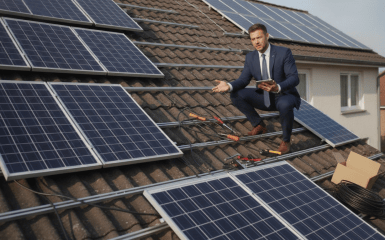
Incorrectly installed solar panels can not only produce less electricity, but also create additional load on the roof, cause leaks and damage to electrical equipment. Moreover, most problems arise not because of the quality of the modules themselves, but because of errors made during the design and installation stages.
Points of attention
- Inappropriate fastenings and incorrect load calculations can damage the roof and solar panels.
- The orientation, tilt angle, shading, and ventilation of the modules affect electricity production.
- High-quality cables, compatible connectors, protective devices, and a properly selected inverter are necessary for the safe operation of a solar power plant.
A solar power plant is a complex engineering system. Even the most expensive panels will not provide the expected result if the mounting structures do not match the type of roof, the modules are regularly shaded, and the electrical components are selected incorrectly.
The most dangerous mistakes in installing solar panels are unreliable fasteners, incorrect calculation of wind and snow loads, violation of roof tightness, poor-quality electrical connections, and lack of system testing before launch.
Some of these shortcomings become apparent within the first year of operation. Others may remain unnoticed, gradually reducing electricity production or accelerating equipment wear.
Let's consider what mistakes are most often made when installing home solar power plants, how they affect the operation of the system, and what needs to be checked to avoid additional costs.
Why the correct installation of solar panels is no less important than the quality of the equipment
Modern photovoltaic modules are designed for long-term operation. Many manufacturers provide guarantees that a certain level of power will be maintained for 25–30 years.
However, the warranty characteristics of the panels do not mean that the entire power plant will automatically operate for the same amount of time without repair.
Mounting structures are constantly exposed to wind, snow, rain and temperature fluctuations. Cables and connectors work under electrical load, and the inverter converts direct current to alternating current every day.
If even one of the components is installed incorrectly, the consequences can spread to the entire system.
For example, loose mounting poses a risk of mechanical damage to the panel, and poor electrical contact can cause local overheating.
At the same time, incorrect orientation of the modules or regular shading will not necessarily lead to failure, but can reduce the amount of electricity produced for years.
Therefore, when installing a solar power plant, three factors must be simultaneously assessed: mechanical reliability, electrical safety, and energy efficiency.
Mistake #1. Choosing fasteners without taking into account the type and condition of the roof
Solar panel mountings are often perceived as secondary components. The main focus is on the performance of the modules and inverter, while mounting profiles, clamps and supports are chosen based on price.
In fact, it is the mounting structure that should hold the equipment on the roof for many years.
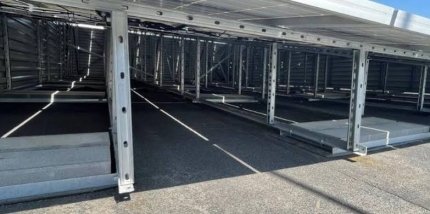
Why universal mounts are not suitable for every roof
The method of installing solar panels depends on the roofing material and the structure of the building.
Different types of fasteners are used for metal tiles, folded roofing, corrugated roofing, bitumen or ceramic tiles.
For example, for some hipped roofs, there are clamps that allow you to secure mounting structures without damaging the coating.
On tiled roofs, special hooks can be used to transfer the load to the supporting elements.
Ballasted or mechanically fastened systems are often used for flat roofs. Their choice is determined by the roof's load-bearing capacity and design loads.
Using the wrong type of fasteners can lead to deformation of the coating, loss of tightness, or gradual weakening of the structure.
Why is it important to check the condition of the rafters?
Before installing a solar power plant, it is necessary to assess not only the roofing material, but also the condition of the supporting structures.
This is especially true for old houses, where wooden rafters may have been exposed to moisture, fungus, or mechanical deformation.
The weight of solar panels and mounting profiles creates an additional constant load. Added to this are snow and wind.
For proper design, it is necessary to consider:
Type of roofing.
Condition and load-bearing capacity of the roof structure.
Load transfer points from fasteners.
Snow and wind loads of a specific region.
Requirements of the mounting system manufacturer.
If the roof is scheduled to be repaired in the coming years, it is advisable to carry out this work before installing the panels. Otherwise, replacing the coating may require dismantling a significant part of the power plant.
Mistake #2. Incorrect calculation of wind and snow loads
Solar panels have a significant surface area, so they are subject to significant mechanical forces during strong winds.
The lifting load is especially important when the air flow creates a force aimed at separating the structure from the roof.
Why fasteners can loosen
The reliability of the installation depends not only on the number of bolts or the thickness of the metal profiles.
The distance between the supports, the location of the panels relative to the edges of the roof, the geometry of the structure, and the correct tightening of the fasteners are important.
In the edge and corner areas of the roof, wind loads may be higher than in the central part.
Therefore, the same fastening scheme for all sections of the roof does not always meet the design requirements.
An additional factor is snow. Its accumulation depends on the slope of the panels, the characteristics of the roof and local climatic conditions.
The reliability of the mounting structure must be confirmed by calculation, and not just by a subjective assessment of its strength.
What are the dangers of improper tightening of fasteners?
Insufficient tightening torque can lead to gradual loosening of connections due to vibrations and temperature fluctuations.
Excessive tightening is also undesirable: it can deform the module profile or frame.
Solar panel and mounting system manufacturers specify acceptable clamping areas and mounting requirements.
Self-drilling of frames or changing the intended fixing points without consulting the manufacturer may reduce the mechanical strength of the structure.
Mistake #3. Incorrect orientation of solar panels and tilt angle
Even a properly installed solar power plant can produce less electricity than expected if the location of the modules does not match the lighting conditions.
The orientation of solar panels determines what hours they will receive the most solar radiation.
For Ukraine, the southern direction usually provides high annual production. However, this is not a universal rule for every house.
Do the panels always have to face south?
If the main goal is to maximize annual generation in the absence of shading, a southerly orientation is often advantageous.
However, for a home where electricity is heavily consumed in the morning and evening, an east-west location may better match the load schedule.
For example, panels on the eastern slope begin to receive more intense lighting earlier, while those on the western slope maintain generation longer in the afternoon.
This will not necessarily increase the total annual output, but it may increase the proportion of electricity that the house uses directly.
What angle of inclination is considered optimal?
Many rooftop solar power plants in Ukraine use tilt angles of approximately 25–40 degrees.
However, the optimal value depends on geographical location, orientation, shading, and seasonal needs.
A smaller angle may be advantageous for summer generation, while a larger tilt under certain conditions makes better use of the low winter sun.
On flat roofs, you also need to consider the distance between the rows so that the front panels do not shade the rear ones.
The correct approach is to calculate the expected output under different configurations and compare it to the household's needs.
Mistake #4. Ignoring shading from trees, chimneys, and neighboring buildings
Shading is one of the most underestimated causes of reduced solar power plant performance.
The shadow may only appear at certain hours, but regularly affect production.
For example, a chimney can shade several modules in the afternoon, and a tall tree can block part of the roof in the winter.
Why a small shadow sometimes causes significant losses
In a traditional string system, solar panels are connected in series.
With this connection, the electrical characteristics of one module may affect the operation of the others.
If part of the panel receives significantly less sunlight, this can limit the current in the corresponding part of the electrical circuit.
Modern modules are equipped with bypass diodes that help reduce the negative effects of partial shading.
However, they do not eliminate all losses.
It is important to understand that there is no universal relationship between shadow area and generation loss. The result depends on the electrical design of the module, the location of the shadow, and the wiring diagram.
How to avoid the problem
Shading needs to be analyzed for different seasons.
In winter, the sun is lower above the horizon, so the shadows from trees and buildings become longer.
For complex roofs, power optimizers, microinverters, or separate MPPT inputs can be used.
However, installing additional electronics is no substitute for proper module placement. The most effective solution is to minimize shading during the design phase.
Mistake #5. Lack of ventilation gap and incorrect distance between panels
Solar modules heat up during operation. In sunny weather, the temperature of the photovoltaic cells can significantly exceed the ambient air temperature.
For most common silicon panels, increasing the temperature of the elements leads to a decrease in power.
That is why ventilation of the rear surface of the modules is of practical importance.
How overheating affects generation
Let's say the temperature coefficient of the panel's power is −0.35% per degree Celsius.
If the temperature of the photovoltaic cells increases by 20 °C relative to standard test conditions, the power at the same illumination can decrease by approximately 7%.
This is a simplified calculation that illustrates the temperature dependence.
During installation, it is necessary to leave a gap between the panels and the roof in accordance with the manufacturer's requirements.
Too dense an arrangement can impair natural cooling.
At the same time, an arbitrary increase in the height of the structure is also undesirable, as it can affect wind loads.
On flat roofs, sufficient spacing between rows should be provided to reduce mutual shading and provide access for maintenance.
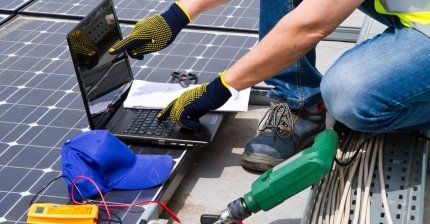
Mistake #6. Saving on cables, connectors and protective equipment
The electrical part of a solar station requires no less attention than the mechanical part.
Incorrectly selected cables or poor-quality connections can cause power loss, overheating, and damage to equipment.
Why solar panels need special cables
Outdoor cable lines operate under the influence of ultraviolet radiation, moisture, and temperature changes.
For photovoltaic systems, cables designed for appropriate operating conditions and operation with direct current are used.
The conductor cross-section is determined by the current, line length, routing method, and permissible voltage losses.
Using an insufficient cross-section can cause excessive heating.
Cables also need to be securely fastened, protected from mechanical damage, and prevented from coming into contact with sharp edges of structures.
How dangerous are incompatible connectors?
MC4 connectors are often used to connect modules.
However, the external similarity of connectors from different manufacturers does not guarantee compatibility.
An incorrectly made contact may have increased electrical resistance, which leads to local heating.
Under adverse conditions, this creates a risk of electric arcing.
Therefore, it is necessary to use compatible components, crimp contacts correctly, and follow manufacturers' instructions.
Why is surge protection important?
A solar power plant may experience surges due to lightning and other electrical events.
Depending on the system configuration, appropriate protection measures are provided on the DC and AC sides.
At the same time, ordinary AC devices cannot be arbitrarily used instead of equipment designed for DC circuits.
Protective earthing, switching devices and surge protection must comply with the electrical diagram and applicable regulatory requirements.
Mistake #7. Incorrect choice of inverter and string configuration
The inverter determines how the electricity from solar panels is converted for use in the home network.
One of the common mistakes is to choose it solely based on its rated power.
In fact, it is necessary to check the input voltage, allowable current, number of MPPT inputs, and the ability to work with different module configurations.
Why the number of panels in a thong matters
A string is a group of solar modules connected in series.
When connected in series, the voltage of the panels is added.
If there are too few modules, the voltage may not be sufficient for stable MPPT operation of the inverter.
If there are too many modules, there is a risk of exceeding the maximum allowable input voltage.
It is especially important to consider low temperatures, as the open circuit voltage of photovoltaic modules usually increases during cooling.
Therefore, a string that works normally in the summer, if incorrectly calculated, can create dangerous conditions in the winter.
Inverter manufacturers, in particular SMA, explicitly stipulate the need to check the maximum string voltage at the lowest design temperature.
Why you shouldn't mix different panels without calculation
Modules with different power, current, or lighting conditions can create additional losses in a series circuit.
Similarly, it is not always advisable to connect panels located on eastern and western slopes to the same MPPT input.
Equipment compatibility should be checked based on technical specifications, not just the total power of the station.
Mistake #8. Lack of inspection and regular maintenance
Solar panels have no moving mechanical parts, but that doesn't mean the power plant is completely maintenance-free.
Dirt, damaged cables, loose fasteners, or electronics malfunctions can gradually affect its operation.
How pollution reduces output
Dust, bird droppings, leaves and other pollution partially block solar radiation.
The amount of loss depends on the location, amount of precipitation, and nature of the pollution.
For example, in the PVWatts model, which is used to calculate the performance of solar power plants, pollution is taken into account as one of the factors of system losses.
However, there is no universal loss percentage for all stations.
In some conditions, rain will sufficiently clean the surface of the modules. In other cases, special cleaning may be required.
How to properly care for solar panels
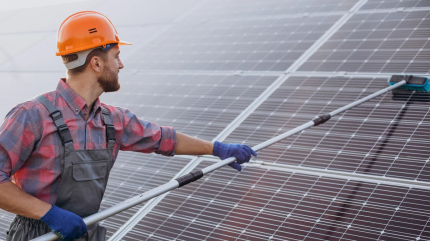
Cleaning should be performed according to the manufacturer's recommendations.
Do not use abrasive materials, harsh chemicals, or methods that could damage the protective glass.
It is especially dangerous to work on a sloping roof without proper insurance.
In addition to cleaning, you need to monitor the condition of the fasteners, electrical connections, and inverter.
The frequency of professional technical inspection is determined by the characteristics of the station, operating conditions, and manufacturer requirements.
How much electricity can be lost due to improper installation?
Even if errors do not lead to breakdowns, they can reduce the economic efficiency of the power plant.
Let's consider a hypothetical example.
Let's say a properly designed solar power plant should produce 6,000 kWh of electricity per year.
If, due to poor location, shading, or other additional losses, its annual output turns out to be 8% lower than the reasonable forecast, the under-obtained energy will be:
6000 × 0.08 = 480 kWh per year.
Over ten years, this would correspond to 4,800 kWh, assuming that annual losses remain constant.
Actual figures may vary due to weather conditions, equipment aging, and changing shading patterns.
Not all losses can be completely eliminated. For example, module heating and energy conversion losses are natural features of the system operation.
However, losses due to design and installation errors can often be significantly reduced.
How to check the quality of solar panel installation
Acceptance of work should include not only a visual inspection of the installed modules, but also a review of documentation and test results.
For safe operation, it is important to obtain confirmation that the mechanical and electrical parts comply with the design.
| What to check | What to look out for |
| Mounting structures | Roof compatibility and correct mounting |
| Roof tightness | No damage or improperly executed passes |
| Panel layout | Design compliance and shadow minimization |
| Cable routes | Secure fixation and protection against damage |
| Electrical connections | Connector compatibility and correct installation |
| Inverter | Compliance with panel parameters |
| Protective equipment | Availability of devices provided for by the project |
| Monitoring | Correct display of generation and errors |
The international standard IEC 62446-1 defines approaches to documentation, inspection and acceptance testing of grid-connected photovoltaic systems.
Depending on the configuration, the checks may include polarity control, string voltage measurement, insulation testing, and verification of protective connections.
Such work must be performed by qualified specialists in accordance with established procedures.
Important: Even after the inverter is turned off, exposed solar modules may still be a source of dangerous DC voltage. It is dangerous to disconnect DC connectors or check electrical contacts yourself.
What documents should remain after installing a solar power system?
A well-executed installation must be accompanied by technical documentation.
The owner should be able to establish what equipment was used, how it was connected and what checks were carried out before start-up.
The main documents include:
Electrical diagram of a solar power plant.
List of installed equipment.
Technical data sheets of panels and inverter.
Warranty documents.
Operating instructions.
Protocols of the prescribed acceptance tests.
Documentation for the installation structure.
Information about monitoring system settings.
If the power plant is connected to an external grid, the applicable requirements of the distribution system operator and the applicable connection rules must additionally be met.
Conditions may vary depending on the type of generating plant, its capacity and operating mode.
How to tell if solar panels are installed incorrectly
Individual problems can be identified by changes in the operation of the power plant.
For example, if one string's output is significantly lower than another under similar conditions, this may indicate shadowing, misconfiguration, or a fault.
Frequent inverter shutdowns may be related to external network parameters, overheating, or electrical problems.
Traces of moisture under the roof, where the mounting supports are installed, may indicate a leak.
At the same time, a decrease in output in cloudy weather or in winter does not in itself mean improper installation.
For an objective assessment, it is necessary to compare actual indicators with forecasted generation under appropriate weather conditions.
If there are reports of insulation failure, electrical arcing, or other dangerous malfunctions, professional diagnostics are required.
If smoke, sparking, or the smell of burning insulation appears, the system must be shut down following the safe procedure provided by the manufacturer.
Conclusion
The biggest problems of a solar power plant often start with details that are not given enough attention during installation: fasteners, cable connections, ventilation gaps, and the correct placement of panels.
To avoid electricity losses and expensive repairs, it is necessary to check the condition of the roof, calculate mechanical loads, select compatible components, and conduct acceptance tests.
A properly installed solar power plant does not require constant intervention, but its safe and efficient operation depends on the quality of the initial installation and proper technical control.
FAQ: frequently asked questions about solar panel installation
What are the most dangerous solar panel installation mistakes?
The biggest risks are improperly selected fasteners, insufficient strength of supporting structures, poor electrical connections, damaged cables and inadequate protective devices. They can lead to equipment damage, roof leaks, electrical arcing or fire.
What are the best mounts to use for solar panels?
The type of fastening depends on the roofing material, roof structure and design loads. Different mounting solutions are used for folded roofs, metal tiles, corrugated iron and flat roofs. Fasteners must meet the requirements of the panel manufacturer and the project.
Can solar panels be installed on an old roof?
It is possible if the supporting structure is in good condition and can withstand additional loads. Before installation, it is necessary to check the roof. If it requires major repairs, it is advisable to carry them out before installing the solar power plant.
What is the best angle of inclination of solar panels for Ukraine?
For many systems, a tilt of approximately 25–40 degrees may be practical. However, the optimal angle depends on the region, the orientation of the panels, the nature of shading, and seasonal generation needs. It should be determined by calculation for the specific facility.
Can solar panels be installed horizontally?
Yes, but a completely horizontal position can allow water, dust and other contaminants to accumulate. Some manufacturers specify a minimum allowable mounting angle. In addition, drainage, maintenance and wind loads must be considered for flat roofs.
Is it necessary to leave a gap between the panels and the roof?
The need and size of the ventilation gap depends on the design of the modules and the mounting system. For most traditional rooftop installations, it helps to dissipate heat. Specific distances should be determined according to the manufacturer's instructions.
Can improper installation of solar panels cause a fire?
Yes. Potential causes include poor electrical connections, damaged insulation, arcing, and improperly selected protective equipment. Compliance with electrical safety requirements and professional installation significantly reduce these risks.
How often should solar panel mountings be checked?
The frequency of inspections is determined by the requirements of the mounting system manufacturers, operating conditions and the condition of the structure. Unscheduled inspections may be required after severe storms or other extreme weather events. Roof work must be carried out in compliance with safety requirements.
Do solar panels need to be washed after installation?
Cleaning is required if the contamination significantly affects the generation or the operating conditions require it. Some of the dust is washed away naturally by rain. For cleaning, it is necessary to follow the manufacturer's recommendations and not use materials that may damage the surface.
Can I install solar panels on my roof myself?
Installation involves working at height, mechanical loads and dangerous electrical circuits. Design, connection, testing and commissioning of solar power plants require appropriate qualifications. Work with DC circuits, which can be live even after the inverter is turned off, is especially dangerous.

