

Detergent powder, liquid gel and capsules all perform the same basic task - removing dirt from fabric. However, their effectiveness depends on the type of stain, water temperature, detergent composition and characteristics of the clothing. That is why a product that washes white towels well will not always be the best choice for black T-shirts, tracksuits or wool sweaters.
Points of attention
- There is no universal winner: the quality of washing depends on the composition of the product, type of stains, temperature and dosage.
- Powder is often suitable for heavy cotton and soiled fabrics, while gel is suitable for low temperatures and pre-treating greasy stains.
- Capsules are ready-to-use, but are usually more expensive and less convenient for small loads. They should be stored out of the reach of children.
Powder is often suitable for white cotton, bed linen and soil and dust. Gel is more suitable for washing at low temperatures, colours and pre-treating grease stains. Capsules provide a ready dosage, but are more expensive and do not allow the same flexibility in changing the amount of detergent.
However, neither format is universally the most effective. A quality powder with enzymes may be better at tackling certain organic stains than a regular gel. And a capsule with bleaching ingredients may not be suitable for delicate colored fabrics.
According to the recommendations of the American Cleaning Institute, Whirlpool, LG and Bosch, the washing result is affected not only by the form of detergent, but also by the dosage, water hardness, drum loading and the correctly selected program.
Let's consider the differences between powder, gel, and capsules, which product is best to use at temperatures of 20–30 °C, what to choose for towels and sportswear, and how to avoid detergent residue on clothes.
What is better for washing: powder, gel or capsules?
Each format has advantages and limitations that are important to consider before purchasing.
| Criterion | Powder | Gel | Capsules |
| Washing in cold water | Depends on the formula, possible residues | Usually well distributed | Depends on shell dissolution and formula |
| Soil and clay stains | Often effective | Depends on the composition | Depends on the composition |
| Grease stains | Can be effective | Convenient for pre-processing | Not intended for spot application |
| White things | There are formulas with oxygen bleach | There are special formulas for white | There are suitable multi-component options |
| Colored clothes | Need a formula for colored items | Wide selection of special tools | Need to check the destination |
| Dose adjustment | Convenient | Convenient | Limited number of whole capsules |
| Pre-treating stains | Possible paste from the appropriate powder | Conveniently with the permission of the manufacturer | Not suitable |
| Cost of one wash | Often lower | Depends on concentration | Often higher |
| Risk of residue on fabric | Possible with poor dissolution | Possible due to overdose | Possible with incomplete dissolution of the shell |
Whirlpool notes that powder is often more cost-effective per cycle, while liquid detergents are good for oily stains and cool water.
Capsules are convenient due to the pre-measured dose, but are not always economical for small amounts of laundry.
The right choice depends not so much on the form of the product as on its composition and specific task.
How laundry detergents work and why their composition is more important than the format
Most modern detergents contain surfactants, abbreviated as surfactants.
They help water wet the fabric, separate dirt from the fibers, and hold it in the washing solution.
Additionally, manufacturers may use enzymes, water softeners, bleaches, stabilizers, and flavorings.
What are enzymes for?
Enzymes help break down certain types of contaminants.
For example:
Proteases act on protein stains, including some blood and food stains.
Amylases help remove starch residues.
Lipases affect certain fatty contaminants.
Cellulases can improve the appearance of some cotton fabrics by acting on the surface cellulose fibers.
The American Cleaning Institute explains that enzymes work with specific groups of contaminants.
However, the presence of enzymes does not mean that the product is suitable for all tissues.
For example, conventional protease products may be undesirable for wool and silk, which are composed of protein fibers.
Why are whitening ingredients in powders?
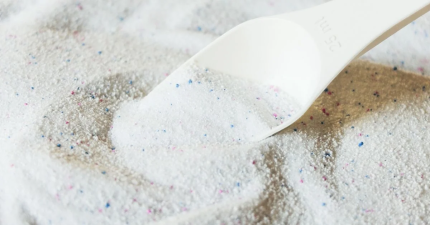
Some powders for white laundry contain oxygen bleaches and activators for their action.
Such components help remove individual stains and maintain the whiteness of light fabrics.
However, they may be undesirable for colored or delicate clothing.
In addition, not all powders contain bleach.
Therefore, not every powder can be considered a product exclusively for white laundry.
Washing powder: advantages, disadvantages and when to use it
Powder is one of the most common formats of machine washing detergent.
Its main advantages are the ability to accurately dose, a wide selection of formulas, and often a lower cost per cycle.
Whirlpool notes that powder detergents can be especially effective at removing dirt from earth, clay, and other dirt particles.
What things is powder best for?
Depending on the composition, it can be used for:
White cotton towels.
Light-colored bed linen.
Cotton T-shirts.
Work clothes with dirt on them.
Jeans and durable everyday fabrics.
Colored items, if the powder is specifically designed for colored laundry.
For example, for white cotton towels with stains, you can choose a powder with oxygen bleaching components if such cleaning is allowed on the label.
For dark jeans, it is better to choose a bleach-free product intended for colored fabrics.
Why does powder sometimes leave white spots?
The powder product must dissolve well enough in water.
If the temperature is low, the drum is overloaded or there is too much powder, particles of the product may remain on the clothes.
LG notes that this problem is especially noticeable on bulky items, such as blankets and throws.
Residue can accumulate in the folds of the fabric and be difficult to rinse out.
The reason is not necessarily the poor quality of the powder.
Temperature, amount of laundry, cycle duration, and condition of the washing machine are also important.
Washing gel: why it is suitable for colored items and low temperatures
A liquid product is already in a flowable form, so it usually disperses more quickly in water.
Whirlpool recommends considering washing gel in cool water and removing greasy stains.
It is also convenient for spot treating stains before the main cycle.
For which things is it better to choose gel?
Provided that it is appropriately labeled, the gel may be suitable for:
Colored T-shirts.
Dark pants.
Synthetic fabrics.
Casual clothes.
Mixed fabrics.
Items that are washed at a temperature of 20–30 °C.
Bulky textiles, if the manufacturer of the product allows its use.
For example, if you need to wash black T-shirts at 30°C, a liquid detergent for dark clothes would be a practical choice.
However, the gel format itself does not guarantee color retention.
The composition of a particular product is important.
Can I wash white towels with gel?
Yes.
To do this, you need to choose a product that is suitable for white cotton and provides the necessary cleaning.
There is no rule that says towels can only be washed with powder.
However, some gels do not contain the whitening ingredients used in the corresponding powder formulas.
Therefore, for difficult stains or maintaining the whiteness of light fabrics, results may vary.
Why does the gel sometimes not rinse well?
It is also possible to overdose on the liquid remedy.
LG warns that excessive amounts of detergent can cause excessive foaming, residue on laundry, and buildup in the washing machine.
This is especially important for concentrated products.
A cap that looks small sometimes holds much more product than is needed for a half load.
Laundry capsules: how do they work and are they better than powder?
A capsule is a pre-measured amount of a concentrated product in a shell that dissolves in water.
Some capsules have multiple compartments with different components.
The American Cleaning Institute explains that this format allows for the combination of detergent components, stain removers, and other additives.
The main advantage is that you don't need to measure the dose of liquid or powder.
When capsules are really convenient
Capsules are suitable for regular machine washing if:
Their formula is compatible with fabric.
The amount of laundry corresponds to the recommended dosage.
The temperature is as instructed.
The washing machine allows this format.
The capsules are stored in a safe place.
For example, for a standard load of everyday clothes, capsules may be more convenient than gel because you don't need to use a measuring cap every time.
However, for two or three T-shirts, a fixed dose may be excessive.
Why capsules are not always the most economical
In gel and powder, you can change the dosage according to the number of items.
The capsule is usually designed for a certain load range.
If less product is needed, the capsule cannot be divided.
Whirlpool notes that capsules are often more expensive per wash cycle.
However, the high price does not guarantee the best result for any stains.
How to use laundry capsules correctly
Incorrect placement of the capsule may worsen the result or leave its shell on clothing.
The American Cleaning Institute and Whirlpool recommend that for most compatible detergents, the capsule be placed directly into the empty drum before loading the laundry.
Step-by-step instructions
Check the recommendations of the capsule and washing machine manufacturer.
Take the capsule with dry hands.
Place it in the drum according to the instructions.
Load the laundry without exceeding the permissible volume.
Select the program and temperature that are suitable for the fabric and detergent.
Start the wash.
When finished, check for any traces of undissolved shell.
Do not place the capsule in the powder compartment unless specifically specified by the manufacturer of the specific machine.
There is no need to pierce, cut, or open it.
Why didn't the capsule dissolve?
Possible reasons:
Too short a program.
Insufficient water for the appropriate product.
Excessive drum loading.
Incorrect capsule placement.
Inappropriate temperature.
Damage or improper storage of the product.
If the shell remains on the clothing, do not iron or dry the area at high temperatures.
First, you need to remove the residue according to the product manufacturer's instructions.
Which product removes stains better: comparison by type of contamination
Different stains require different active ingredients.
Therefore, it is more advisable to choose not the abstract "strongest powder", but a product designed for a specific type of contamination.
| Stain type | What can help? |
| Earth and clay | Suitable powder, preliminary removal of dry dirt |
| Vegetable oil and fat | Liquid product with anti-grease ingredients |
| Blood | Cold water and a suitable enzymatic agent, if the fabric allows |
| Grass | A remedy with appropriate enzymes |
| Sauces and food | Pre-treatment, appropriate formula agent |
| Sweat and sebum | A product with appropriate surfactants and enzymes |
| Coffee and tea on white cotton | Formula with permitted whitening ingredient |
| Makeup | A remedy against oily and pigmented dirt |
The American Cleaning Institute recommends treating stains before the main wash, taking into account their origin and the acceptable care of the fabric.
For example, for a greasy stain on a cotton T-shirt, you can apply a suitable liquid detergent for pre-treatment, if the manufacturer allows such use.
But for a wool sweater, an aggressive enzyme formula may be undesirable.
Not all stains need to be washed immediately with hot water. For some protein stains, high temperatures can make removal more difficult.
The best way to wash white and colored towels
Towels differ from regular clothing in that they must absorb water well and withstand frequent washing.
At the same time, the temperature and choice of product depend on the fabric composition, color, and labeling.
White cotton towels
Powders with oxygen bleaching ingredients may be suitable for them if the label allows bleaching.
Such formulas can help remove certain stains and maintain whiteness.
However, this does not mean that you need to use the maximum temperature every time.
Colored towels
It is better to choose products for colored fabrics.
It can be a gel or powder without components incompatible with dyes.
You should not wash new, bright towels with white ones, as color transfer is possible.
Do you need towel conditioner?
LG recommends avoiding excessive use of towel conditioner.
It can leave a layer of substances on the fibers that impairs their ability to absorb water.
Therefore, the softness of a towel does not always mean that it will perform its primary function better.
Which product to choose for synthetics and sportswear
Polyester, polyamide, elastane, and their blends are often used in sportswear.
Such materials may have special properties: moisture wicking, elasticity, and quick drying.
For them, not only cleanliness is important, but also the preservation of the fabric structure.
Is it necessary to wash synthetics with gel?
No.
Many synthetic items can be washed with appropriate powder detergents if the label allows it.
Gel is often more convenient at low temperatures because it disperses well in water.
But the format itself does not determine compatibility with all synthetic materials.
Why sportswear can smell bad even after washing
Skin sebum and other organic contaminants can accumulate on synthetic fibers.
If the mode or product does not match the nature of the contamination, the smell sometimes persists.
For sportswear, specialized products or appropriate enzyme formulas may be useful if allowed by the manufacturer of the item.
Nike does not recommend using regular fabric conditioner on many performance sports fabrics as it can degrade their properties.
How to wash wool, cashmere and silk
For delicate natural fibers, the specific composition of the product and care instructions are more important than its liquid or powder form.
Woolmark recommends mild neutral detergents designed for wool.
Not all universal gels are suitable for wool knitwear.
Why a conventional enzyme remedy may be undesirable
Wool and silk are composed primarily of protein fibers.
Certain enzymes used to break down protein stains can adversely affect such materials.
Therefore, for delicate items, it is better to choose a product that directly states compatibility with wool or silk.
Woolmark also warns against using chlorine and oxygen bleaches on wool.
You should not replace a special product with a regular all-purpose powder just because you need to add very little of it.
Which product works best at 20, 30, 40 and 60 degrees?
Water temperature affects the dissolution of detergent components and the removal of dirt.
However, modern tools can be designed to work even at low temperatures.
The American Cleaning Institute explains that washing occurs through a combination of chemical action, temperature, mechanical action, and time.
Wash at 20 °C
For lightly soiled items, detergents labeled for cold water may be suitable.
Gel is often convenient, but some modern powders and capsules are also designed for this temperature.
It is especially important to check the manufacturer's instructions.
Wash at 30 °C
This is a common mode for colored clothes, many synthetic fabrics, and delicate items.
Liquid products are usually well suited for such conditions.
Powder can also be used if it dissolves properly at the selected temperature.
Wash at 40 °C
May be suitable for some cotton and blended fabrics if permitted by the label.
At this temperature, some powders dissolve better than in cold water.
But this does not mean that all things need to be set to exactly 40 °C.
Wash at 60 °C
May be appropriate for certain durable cotton items, bed linens or towels, if permitted by the manufacturer.
However, high temperatures can cause shrinkage, discoloration, or damage to some materials.
In addition, not all detergents have the same properties at high temperatures.
The temperature is determined primarily by the fabric label and the purpose of washing, not by the belief that hotter water always cleans better.
How to read the symbols on the label before choosing a powder or gel
The international organization GINETEX explains the rules of textile labeling according to the care symbol system.
Temperature and bleaching ratings are particularly important when choosing a detergent.
What do washing symbols mean?
The number inside the water basin symbol indicates the maximum temperature.
One horizontal line under the pelvis indicates the need for a softer mechanical effect.
Two dashes mean an even more delicate mode.
A crossed-out basin means that washing in water is prohibited.
What does the triangle on the label mean?
Empty triangle - allows for appropriate whitening.
Triangle with two slanted lines - allows only oxygen, non-chlorine bleaches.
Crossed out triangle - bleaching is prohibited.
For example, if a colored T-shirt has a crossed-out triangle, you should not use powder with bleaching ingredients that are incompatible with this restriction.
At the same time, not every all-purpose laundry detergent necessarily contains bleach.
Therefore, you need to read the composition of the product itself.
How much powder or gel is needed for one wash?
Overdosing is one of the most common causes of poor rinsing.
The amount of product depends on:
Masses of laundry.
Degree of pollution.
Water hardness.
Product concentrations.
Program features.
Washing machine manufacturer's recommendations.
Whirlpool recommends using the dosage indicated on the packaging of the specific detergent, taking into account the actual load.
Do not measure out powder or gel at random.
Why more detergent doesn't mean cleaner laundry
When there is too much detergent, the washing machine may not have time to rinse it properly.
As a result, traces of the product remain on the clothes, and deposits gradually accumulate in the drum and tray.
LG also explains that too much detergent can cause excessive foaming and poor rinsing quality.
Therefore, increasing the dose should not be used as a universal way to combat difficult stains.
It is better to apply appropriate pre-treatment for them.
Why water hardness affects the choice of detergent
Water hardness is determined primarily by the content of dissolved calcium and magnesium salts.
It can affect the operation of the washing components.
Some products contain substances that help reduce the undesirable effects of hard water.
Whirlpool notes that water type is one factor to consider when choosing powder or liquid detergent.
Is it necessary to increase the dosage in hard water?
Sometimes manufacturers provide a separate dosage for hard water.
However, this depends on the specific product.
There is no need to double the amount of powder yourself just because limescale appears on the taps.
Use the dosage chart on the package.
If necessary, you can take into account the actual water hardness in your water supply system.
Where to pour powder, pour gel and put capsules
Incorrect placement of the product can worsen the washing result even with the correct dosage.
Many washing machines have separate compartments for the main wash, prewash, and fabric softener.
But the design of the tray depends on the model.

Where to pour the powder
It is usually added to the main wash compartment, often marked with the symbol II.
If the machine has a special insert for liquid detergent, it sometimes needs to be removed before adding powder.
LG warns that the powder in the gel insert may not be easy to rinse out of the tray.
Where to pour the gel
Liquid detergent is usually added to the compartment designated for this purpose or using another method provided for in the washing machine instructions.
Some models have automatic dosing systems.
Do not pour gel into the air conditioner compartment.
Where to put the capsule
For most regular capsules, manufacturers recommend a drum rather than a tray.
In this case, the placement order should be checked on the product packaging and in the machine instructions.
You cannot automatically transfer the rules for using one format to another.
Why do stains remain on clothes after washing?
White streaks on dark items, sticky marks or powder residue can occur for various reasons.
It is not always necessary to change the brand of detergent.
If white marks remain
Insufficient dissolution of the powder, overdose or overloading of the drum are possible.
LG recommends checking the amount of detergent and the temperature according to its instructions.
For bulky items, a liquid detergent is sometimes appropriate.
If greasy or sticky stains remain
The cause may be residues of detergent, conditioner or other contaminants.
You need to check the dosage and cleanliness of the tray.
If the problem persists, it is also possible that the rinsing process is faulty or the programme has been selected incorrectly.
If the capsule shell remains on your clothes
This may indicate its incomplete dissolution.
You don't just need to leave a mark and dry the item with hot air.
First, remove the residue according to the product instructions.
What is more profitable: powder, gel or capsules?
It is wrong to compare only the price of the packaging.
For example, a 3 kg powder may cost more than a liter bottle of gel, but provide more washing cycles.
Conversely, a concentrated gel in a small package may be more economical than a cheaper product with a large recommended dosage.
How to correctly calculate the cost of one wash
Use the formula:
Cost of one cycle = price of the package ÷ number of cycles at the recommended dosage.
For example:
| Conditional means | Packaging price | Number of cycles | Cost of one cycle |
| Powder | 360 UAH | 40 | 9 UAH |
| Gel | 320 UAH | 32 | 10 UAH |
| Capsules | 420 UAH | 28 | 15 UAH |
This is a hypothetical calculation example, not actual market prices.
The actual cost depends on concentration, load size and water hardness.
Additionally, a cheaper cycle does not always provide a better result for difficult stains.
Therefore, cost-effectiveness must be evaluated together with efficiency.
Are capsules more environmentally friendly than powder and gel?
Capsules often have compact packaging and contain a concentrated product.
However, this does not automatically mean less environmental impact.
Their shell is usually made of a water-soluble polymer, particularly polyvinyl alcohol (PVA/PVOH).
The American Cleaning Institute explains that such films are water-soluble and can biodegrade under the right conditions.
However, the overall environmental impact of a product is not determined solely by the dissolution of the shell.
It is important to consider the production of components, packaging, transportation, the composition of cleaning chemicals, and the actual conditions of wastewater treatment.
What is more important for ecological washing
Practical factors:
Do not exceed the recommended dose.
Wash full, but not overloaded loads of laundry.
Choose a lower temperature if it provides adequate cleaning.
Do not use bleach unnecessarily.
Follow the instructions of the clothing and washing machine manufacturer.
You should not assume that any product is "eco-friendly" just because it says so on the packaging.
How safe are laundry capsules in a home with children?
The capsules contain concentrated cleaning chemicals.
Because of their bright color and unusual shape, they can attract the attention of young children.
Poison Control warns that biting or swallowing the capsule can cause severe poisoning, eye irritation, and respiratory distress.
How to store capsules correctly
Keep them in their original, tightly closed packaging.
The storage location should be out of reach of children.
Do not pour the capsules into transparent decorative jars.
Do not leave them on top of the washing machine, in an open basket, or near children's items.
Only handle the capsules with dry hands.
If a child bites or swallows a capsule, seek immediate medical attention. Do not induce vomiting yourself.
If the concentrate gets into your eyes, rinse them immediately with running water and seek medical attention.
The material is for informational purposes only. Self-medication can be harmful to health. If you suspect poisoning with household chemicals, you should immediately consult a doctor.
Which product to choose for a specific type of laundry
In practice, you can focus on the following scenarios:
| What needs to be washed | Optimal reference point |
| White cotton towels | Powder or gel for whites, with permitted bleaching ingredients if necessary |
| Colored T-shirts | Gel or powder for colored fabrics |
| Black jeans | Detergent for dark or colored items |
| Clothes with dirt stains | Powder of the appropriate formula |
| Clothes with grease stains | Pre-treatable gel |
| Sports synthetics | Product compatible with functional fabrics |
| Wool sweater | Special product for wool |
| Cashmere scarf | A product for delicate protein fibers |
| Large plaid | Liquid product, if permitted by the label |
| Normal daily upload | Powder, gel or capsule for the appropriate purpose |
These are guidelines, not requirements to use only one format.
For example, a high-quality powder for colored clothes may be good for cotton T-shirts, and a special gel for whites may be good for towels.

10 mistakes when choosing and using laundry detergents
1. Choose a product based on its form only. The composition is more important than whether it is a powder, gel, or capsule.
2. Use bleach powder for all colored items. This can damage the dyes.
3. Wash wool with an all-purpose enzyme detergent without testing. Not all formulas are compatible with protein fibers.
4. Adding too much gel. Excess makes rinsing difficult and can leave marks.
5. Place the capsule in the regular powder compartment. This may prevent it from dissolving properly.
6. Cut the capsule for half loading. This is not allowed.
7. Using a short program without following the product instructions may cause the capsule or powder to not have time to dissolve properly.
8. Assume that hot water always washes better. Some stains and fabrics require different conditions.
9. Add fabric softener to every wash. It may not be desirable for towels and functional sportswear.
10. Store capsules in an open container. This poses a particularly high risk for young children.
Conclusion
Powder, gel, and capsules are not interchangeable in every situation, although all three formats can provide a quality wash.
Powder is often beneficial for regular cleaning of tough fabrics and removing dirt from the ground. Gel is suitable for low temperatures, colored clothes and pre-treating grease stains. Capsules simplify dosing, but are usually more expensive and require particularly safe storage.
For wool, cashmere, sports fabrics, and items with decorative elements, it is important to choose specially compatible products.
The best result is not the most expensive product, but the correctly selected formula, appropriate temperature, and precise dosage.
FAQ: Frequently Asked Questions about Powder, Gel and Capsules
1. What is better for a washing machine - powder or gel?
Both formats can provide a quality wash. Powder is often suitable for durable cottons and soiled items, while gel is suitable for colored clothes, low temperatures, and greasy stains. The choice depends on the composition of the product and the type of laundry.
2. What washes better - capsules, gel or powder?
There is no single winner. The effectiveness is determined by the active ingredients, temperature, type of stain and dosage. Some powders contain bleaching agents, gels are suitable for oily stains, and capsules can combine several components.
3. What is the best way to wash white towels?
Powder or gel intended for white fabrics. If the towels are cotton and the label allows for appropriate bleaching, you can choose a product with oxygen bleaching components. The temperature should be set according to the label.
4. Can I wash colored clothes with regular washing powder?
Yes, if the powder is intended for colored fabrics and is compatible with the material. It is not recommended to use formulas with bleaching components, which can damage dyes.
5. Why do white stains remain on black clothes after using powder?
Possible causes include insufficient powder dissolution, overdosing, low temperature or overloading the drum. Check the product instructions, reduce the dosage if necessary and ensure proper rinsing.
6. Where to put laundry capsules?
For most conventional capsules, it is recommended to place them directly in the drum before loading the laundry. They should not be added to the powder compartment or cut. Please refer to the instructions for the capsules and the washing machine.
7. Can I use capsules for washing at 30 degrees?
Many modern capsules are designed to be washed at 30°C or in cold water. However, you should check the minimum temperature on the packaging, as the characteristics of the shell and detergent formula may vary.
8. Which product is best for sportswear?
A product designed for synthetic or functional fabrics and compatible with the product label. This may be a specialized gel or other suitable formula. For many sportswear, it is not recommended to use conditioner.
9. Can I wash a wool sweater with regular gel?
Not for everyone. Some universal gels contain components that are undesirable for protein fibers. For wool and cashmere, it is better to choose a special mild detergent designed for the respective material.
10. Which is cheaper - powder, gel or capsules?
Powder often has a lower cost per cycle, while capsules are often more expensive. However, the price depends on the concentration and recommended dosage. It is correct to compare not the cost of packages, but the cost of one wash under the same conditions.

