
A charging station for an apartment should keep your essential appliances running during a power outage and recharge when the power comes back on. However, the most expensive or most powerful model may not always be the best solution for your specific needs.
Points of attention
- For the Internet and electronics, compact stations with 300–500 Wh are suitable, and for a refrigerator and several appliances, more practical models with 1000–2000 Wh are suitable.
- The selection compares nine models from EcoFlow, BLUETTI, Anker, and FOSSiBOT in terms of capacity, power, and approximate price.
- Autonomy depends on average consumption and inverter losses: a 1000 Wh station with a load of 100 W will operate for approximately 8 hours.
A compact 300–500 Wh station may be sufficient for a Wi-Fi router, fiber optic terminal, and laptop. If you need to power a refrigerator, TV, or gas boiler, you should consider models with a larger battery and appropriate output power.
And for long outages of 12–24 hours, not only battery capacity becomes important, but also the inverter's own consumption, charging speed, and system expansion capabilities.
For most apartments, a practical compromise between price, size, and autonomy is a charging station with a capacity of approximately 1000–2000 Wh. However, the optimal choice depends on which devices need to be connected.
We compare nine current models in different price categories, explain their real capabilities, and calculate how many hours the battery will last during a blackout.
Which charging station to choose for your apartment: the main thing in 30 seconds
Before comparing brands, you need to determine your usage scenario.
If the main task is to provide Internet access and charge electronics, a large station with several kilowatt-hours may be unnecessary.
Other characteristics are important for powering a refrigerator, including inverter power and compressor starting load.
| Basic need | Approximate capacity | Desired inverter power |
| Router, ONU, smartphones | 200–500 Wh | 300–600 W |
| Laptop, monitor, internet, light | 500–1000 Wh | 600–1000 W |
| Refrigerator, TV, work space | 1000–1500 Wh | 1000–2000 W |
| Several household appliances | 1500–2500 Wh | 1800–2400 W |
| Long-term backup power for the apartment | From 3000–4000 Wh | According to the total load |
These ranges are guidelines for selection and not a guarantee of a specific operating time.
For example, a refrigerator with low average consumption can operate from a 1000 Wh station much longer than a powerful computer with a constant load of 300 W.
Rating of charging stations for apartments in 2026: comparison of 9 models
The selection includes compact, universal and powerful charging stations presented on the Ukrainian market.
| Model | Capacity | Capacity | Estimated price |
| BLUETTI EB3A | 268 Wh | 600 W | 9–13 thousand UAH |
| EcoFlow RIVER 3 Plus | 286 Wh | 600 W | 13–18 thousand UAH |
| BLUETTI AC50P | 504 Wh | 700 W | 18–23 thousand UAH |
| BLUETTI AC70P | 864 Wh | 1000 W | 27–34 thousand UAH |
| Anker SOLIX C1000 Gen 2 | 1024 Wh | 2000 W | 33–40 thousand UAH |
| EcoFlow DELTA 3 Plus | 1024 Wh | 1800 W | 37–50 thousand UAH |
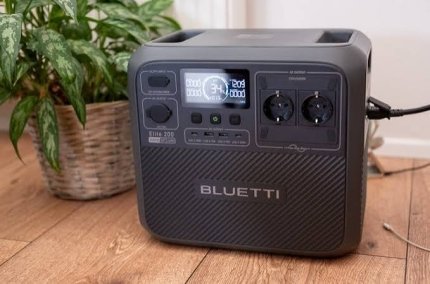
| BLUETTI AC180P | 1440 Wh | 1800 W | 35–53 thousand UAH |
| FOSSiBOT F2400 | 2048 Wh | 2400 W | 42–52 thousand UAH |
| EcoFlow DELTA Pro 3 | 4096 Wh | 4000 W | 120–190 thousand UAH |
Prices are given as approximate ranges of Ukrainian retail offers as of November 3, 2026. The cost depends on the configuration, seller, promotions and warranty. Before purchasing, you need to check the current price of a specific modification.
All of the models listed use LiFePO₄ lithium iron phosphate batteries.
Compact charging stations: for the Internet, laptop and lighting
Small stations are convenient for apartments where basic needs need to be maintained during a power outage.
They take up little space, are relatively easy to transport, and can cost significantly less than 1–2 kWh models.
1. BLUETTI EB3A — a budget option for short outages
BLUETTI EB3A has a 268 Wh battery and a rated output power of 600 W.
This is a compact station for charging smartphones, operating a router, desk lighting, and individual laptops.
It has AC outlets, USB outputs, and the ability to charge from a compatible solar panel.
Advantage: relatively low price and compact dimensions.
Limitations: low power reserve. If you connect a laptop, monitor, and router at the same time, the battery life may only be a few hours.
Also, for low-power loads, it is important to consider the inverter's own consumption. It can significantly reduce the operating time from a small battery.
2. EcoFlow RIVER 3 Plus — compact station with expandability
EcoFlow RIVER 3 Plus has a capacity of 286 Wh and an inverter power of 600 W.
Its feature is the ability to connect a compatible additional battery, which increases the total energy reserve.
The station supports fast charging and automatic switching to battery when external power is lost.
The manufacturer claims a switching time of less than 10 ms in the corresponding mode.
Advantage: small size, fast charging and modular design.
Limitations: The basic capacity is not enough to power a refrigerator or several household appliances for a long time.
This option is primarily suitable for home work and staying in touch.
3. BLUETTI AC50P — more power for a reasonable price
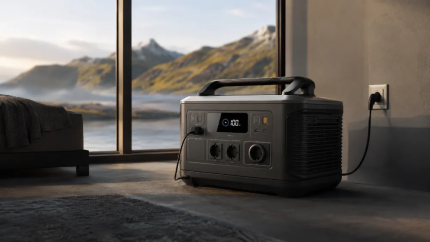
BLUETTI AC50P is equipped with a 504 Wh battery and has a rated output power of 700 W.
According to the manufacturer's specifications, the station can be charged from the mains to 80% in approximately 50 minutes in the appropriate mode.
There is also the possibility of charging from solar panels.
Compared to 268–286 Wh models, it provides almost twice the nominal energy reserve.
Advantage: balanced ratio of capacity, power and price.
Limitations: The 700W inverter is not suitable for most electric kettles, heaters, and other powerful appliances.
For a laptop, internet, TV and lighting, the AC50P can be a practical solution for regular outages lasting several hours.
Universal charging stations for 800–1000 Wh
In this class, you can already consider powering a refrigerator, a TV, several work devices, and other household appliances.
However, it is necessary to take into account the characteristics of specific devices.
4. BLUETTI AC70P — a compromise between power and autonomy
BLUETTI AC70P has a battery capacity of 864 Wh and a rated power of 1000 W.
The station supports fast charging: the manufacturer claims to recharge up to 80% in about 45 minutes in turbo mode.
With this amount of energy, the model can power a home workplace, a TV, and some household appliances for several hours.
Advantage: larger capacity than compact stations, with relatively modest dimensions.
Limitations: 1000 W may not be enough for equipment with high starting or constant load.
A compatibility check is required for a refrigerator, and an additional electrical power supply check is required for a gas boiler.
5. Anker SOLIX C1000 Gen 2 — a powerful inverter in the 1 kWh class
The Anker SOLIX C1000 Gen 2 has a 1024 Wh battery and a rated inverter power of 2000 W.
This is an important difference from the first generation SOLIX C1000, which had different characteristics.
The new model supports fast charging. According to the manufacturer, a full charge in a special mode can take approximately 49 minutes.
Automatic switching to battery power in approximately 10 ms is also claimed.
Advantage: high output power in a compact size and fast charging.
Limitation: Higher inverter power does not increase battery energy storage.
If you connect a 1500 W appliance, the autonomy will be significantly less than an hour.
It is also important to check the version of the station for the European 230 V, 50 Hz power grid.
6. EcoFlow DELTA 3 Plus — a universal station with advanced capabilities
The EcoFlow DELTA 3 Plus has a 1024 Wh battery and an inverter with a rated power of 1800 W.
According to the manufacturer's specifications, the station supports short-term starting loads of up to 3600 W.
This does not mean that a 3600 W appliance can be connected for long-term operation.
The model also has two inputs for solar panels with a total maximum power of up to 1000 W under suitable conditions.
A full charge from the mains can take about 56 minutes.
Advantage: A balanced combination of power, charging speed, and connectivity.
Limitations: In terms of autonomy, it does not exceed other stations with a 1024 Wh battery only due to more expensive electronics.
The DELTA 3 Plus is worth considering when you need not only watt-hours, but also a powerful inverter, fast charging, and advanced management.
High-capacity charging stations for long outages
If power can be out for 8–12 hours or longer, increasing capacity often becomes more important than additional ports or maximum peak power.
7. BLUETTI AC180P — more energy for family use
BLUETTI AC180P is equipped with a 1440 Wh battery and an 1800 W inverter.
In terms of capacity, it is approximately 40% larger than standard stations at 1024 Wh.
This can provide additional hours of operation for your refrigerator, lighting, or home electronics.
The model supports fast charging and has AC and DC outputs.
Advantage: significant energy reserve without switching to heavy 2–4 kWh stations.
Limitations: weight is about 17 kg. For frequent transportation between rooms, this is not the most convenient option.
BLUETTI AC180P is suitable for those who value battery life over maximum portability.
8. FOSSiBOT F2400 — two kilowatt-hours at a competitive price
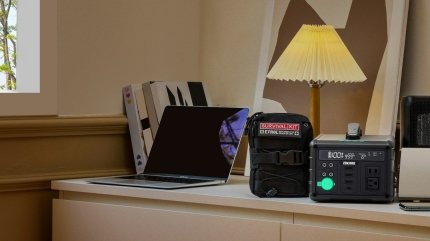
The FOSSiBOT F2400 has a 2048 Wh battery and a rated power of 2400 W.
This allows you to connect more household appliances than most 1 kWh class stations.
The model has AC outlets, USB outputs, and supports charging from solar panels.
According to the specifications, a full charge from the mains takes approximately two hours at a maximum input power of 1100 W.
Advantage: large energy reserve and powerful inverter.
Restrictions: weight of about 22 kg and larger dimensions.
The station can be practical for an apartment where you need to keep the refrigerator and other important equipment running for longer.
However, even a 2048 Wh battery will quickly discharge from a powerful electric heater or boiler.
9. EcoFlow DELTA Pro 3 — for backup power for a significant part of the apartment
EcoFlow DELTA Pro 3 belongs to the class of powerful mobile backup power systems.
The base capacity is 4096 Wh, and the rated power of the inverter is 4000 W.
The battery system can be expanded with compatible additional batteries.
The station also supports charging from the mains and solar panels.
Advantage: large energy reserve and the ability to power several household appliances.
Limitations: high price, weight of about 51.5 kg and the need to properly organize the connection.
Despite its power, DELTA Pro 3 does not guarantee 24–48 hours of normal apartment life without restrictions.
At an average continuous load of 300 W, even 4 kWh will provide approximately 11 hours of operation after taking into account losses.
Longer autonomy is only possible with lower consumption or a larger battery reserve.
How many hours will a charging station last: calculating autonomy
Battery capacity is measured in watt-hours, and device power is measured in watts.
These are different quantities.
For example, a 1000 Wh battery theoretically contains enough energy to operate a 100 W appliance for 10 hours.
However, some of the energy is spent on converting direct current to alternating current, operating electronics, and other losses.
For preliminary calculation, it is convenient to use the formula:
Operating time = capacity × 0.8 ÷ average load.
The coefficient of 0.8 is conditional. The actual useful share of energy depends on the station and mode of use.
Comparing the operating time of different batteries
| Capacity | Load 50 W | Load 100 W | Load 300 W |
| 286 Wh | 4.6 hours | 2.3 hours | 0.8 hours |
| 504 Wh | 8.1 hours | 4.0 hours | 1.3 hours |
| 864 Wh | 13.8 hours | 6.9 hours | 2.3 hours |
| 1024 Wh | 16.4 hours | 8.2 hours | 2.7 hours |
| 1440 Wh | 23.0 hours | 11.5 hours | 3.8 hours |
| 2048 Wh | 32.8 hours | 16.4 hours | 5.5 hours |
| 4096 Wh | 65.5 hours | 32.8 hours | 10.9 hours |
The table shows approximate values for stable load.
At very low consumption, the inverter's own costs can significantly reduce autonomy. For a refrigerator, you need to take into account the cyclic operation of the compressor, and not just the power indicated on the case.
How much do household appliances consume during a blackout?
To choose a charging station, it is important to know not the maximum rated power of all equipment, but its actual consumption.
| Instrument | Estimated consumption during operation |
| Wi-Fi router | 5–15 W |
| Optical Terminal ONU | 3–10 W |
| LED lamp | 5–12 W |
| Office laptop | 30–90 W |
| Monitor | 20–60 W |
| TV | 50–150 W |
| Gas boiler | Often 60–150 W |
| Electric heater | 500–2000 W |
| Electric kettle | 1500–2200 W |
These are typical ranges, not exact specifications for each device.
For example, a gaming laptop under load may consume more power than a regular office laptop.
And the refrigerator works cyclically, so its average consumption per day needs to be estimated separately.
Will the charging station pull the refrigerator?
A refrigerator is one of the most difficult appliances to choose a backup power supply for.
Its compressor can briefly consume significantly more electricity during startup than during stable operation.
Therefore, it is not enough to know only the rated capacity of the refrigerator.
How to check compatibility
First, determine the operating and starting power of a specific appliance.
Then compare these figures with the capabilities of the charging station inverter.
To calculate autonomy, it is best to measure the actual daily energy consumption of the refrigerator with a wattmeter.
For example, if a refrigerator uses 1.2 kWh in 24 hours, its average power is approximately 50 watts.
With such consumption, a station with a capacity of 1024 Wh will theoretically provide about 16 hours of operation with a conditional coefficient of 0.8.
However, the actual result will depend on the temperature, door opening frequency, and inverter losses.
Which charging station is suitable for a gas boiler?
Many gas boilers require power for automation, a circulation pump and a fan.
But compatibility with a charging station is not only determined by power.
In some models, neutral, grounding, and flame control features are important.
Therefore, the boiler may not start even from a powerful station with sufficient energy reserves.
Before connecting a gas boiler, it is necessary to check the compatibility of specific models and power supply requirements.
You cannot install jumpers between the neutral and protective conductor yourself or change the grounding circuit.
Such solutions require proper technical design.
What's more important in 2026: fast charging or high capacity?
This depends on the outage schedule.
For example, if the power supply is only for two hours, a station that charges in an hour may be more practical than a model with a larger battery that takes four hours.
But fast charging also puts additional strain on the power grid.
What to check before buying
Manufacturers often specify a minimum charging time in a special accelerated mode.
It may require activation in the app and significant input power.
Closer to 100%, the charging speed usually decreases.
Therefore, it is important to check not only the stated time from 0 to 100%, but also the ability to adjust the maximum charging power.
For an apartment with old electrical wiring, this can be of significant importance.
UPS and charging station: will the computer reboot?
Some portable stations support automatic switching to battery power during a power outage.
Manufacturers often label this feature as UPS or EPS.
The claimed switching time may be approximately 10–20 ms.
This is enough for many household devices, but not for all.
For example, individual computers, network equipment, and sensitive electronics can reboot even after a short interruption.
Therefore, the UPS function in a portable station is not necessarily equivalent to a dedicated double-conversion online UPS.
If guaranteed uninterrupted power supply is required, the requirements of the specific equipment and the characteristics of the appropriate source should be checked.
Should I choose a charging station with a LiFePO₄ battery?
LiFePO₄ is lithium iron phosphate battery technology.
Its advantages are long cycle life and relatively high thermal stability.
Many modern stations use just such batteries.
However, the manufacturer's stated 3000–4000 cycles do not mean that the battery will remain unchanged throughout this time.
Typically, the resource is indicated up to a certain level of remaining capacity, for example 80%.
Actual aging depends on temperature, depth of discharge, charging and storage conditions.
The battery management system (BMS), the quality of the electronics, and the protective mechanisms are also important.

Why you shouldn't focus only on peak power
In the characteristics of stations you can often see two or three power values.
For example, the nominal power can be 1800 W, the peak power can be 3600 W, and a special high load mode can support another value.
These indicators are not interchangeable.
The rated power determines the continuous permissible load.
Peak load is a short-term load, for example when starting an engine.
Some high power modes may change the output voltage and may not be suitable for all devices.
Therefore, an electric kettle or microwave should not be connected to the station solely based on a high peak power figure.
Can I connect a charging station to the entire apartment?
It is prohibited to connect a portable charging station to a regular household outlet using a homemade cable with two plugs.
This may cause dangerous reverse voltage, damage to equipment, or electric shock.
If you need to power individual apartment lines, a properly designed power source switching circuit is required.
Such a system must include appropriate protective and switching devices.
Installation must be performed by qualified personnel.
Not every portable station is designed for stationary integration into the apartment's electrical network.
Where to safely store and charge the station in winter
The charging station must operate within the conditions permitted by the manufacturer.
Do not block the ventilation holes of the case, do not place the device near batteries, and do not allow water to enter.
It is especially important to adhere to the battery temperature limits.
For many LiFePO₄ models, charging at temperatures below 0 °C is prohibited or limited.
Therefore, an unheated balcony is not always suitable for charging the station.
Do not use damaged cables and do not leave the device in places with high humidity.
If the housing, sockets or battery show signs of damage or unusual overheating, operation should be discontinued.
The most common mistakes when choosing a charging station
Don't confuse watts with watt-hours. Power determines the ability to connect a device, while capacity determines the energy reserve.
Do not take into account the inverter's own consumption. This is especially important for routers and other low-power equipment.
Buying a refrigerator station without checking the starting load. The compressor may not start.
Ignore charging speed. During short power outages, this can be a deciding factor.
Consider peak power constant. It is not intended for continuous operation.
Do not check the device version. For Ukraine, compatibility with a 230 V, 50 Hz network is required.
Ignore warranty and service. Terms and conditions may vary significantly from seller to seller.
Count on powering the entire apartment without limits. Even a large battery has a finite energy reserve.
Conclusion
The best charging station for an apartment in 2026 is the one that corresponds to the actual consumption of appliances and the duration of power outages.
For the Internet and work equipment, compact models with 300–500 Wh are sufficient. For a refrigerator and several household appliances, stations with 1000–2000 Wh with the appropriate output power are more practical.
If long-term backup power is needed for most of the apartment, it is worth considering systems with 4 kWh or more or stationary solutions with the possibility of expanding batteries.
Before purchasing, you need to check the characteristics of specific devices, actual charging speed, compatibility with the electrical network, and warranty terms.
FAQ: Frequently asked questions about apartment charging stations
What is the best charging station to buy for an apartment in 2026?
For general-purpose use, it’s worth comparing models in the 1–2 kWh class, including the Anker SOLIX C1000 Gen 2, EcoFlow DELTA 3 Plus, BLUETTI AC180P, and FOSSiBOT F2400. The optimal choice depends on the required power, autonomy, and budget.
How many kilowatt-hours does a charging station for an apartment need?
For basic lighting, internet, and a laptop, 0.5–1 kWh is often sufficient. For a refrigerator and a few household appliances, a reserve of 1–2 kWh may be more practical. For longer autonomy, a larger capacity is needed.
How many hours will a 1000 Wh charging station last?
At a stable load of 100 W and a conditional useful capacity of 80% - about 8 hours. At a load of 200 W - about 4 hours. The actual result depends on the inverter and the conditions of use.
Which charging station is suitable for a refrigerator?
You need a model whose inverter can handle the operating and starting power of the specific refrigerator. Stations with 1000–2000 W of nominal power may be suitable for many models, but compatibility must be checked individually.
Can I connect a gas boiler to EcoFlow, BLUETTI or Anker?
The possibility depends on the characteristics of a particular boiler and station. Not only watts are important, but also the features of the neutral, grounding and automation. Self-made changes to the electrical circuit are unacceptable.
Will a charging station replace a regular UPS?
Not always. Some stations support automatic switching in about 10–20 ms, but sensitive equipment may reboot. To ensure uninterrupted power supply, you need to consider the requirements of specific devices.
Which is better for blackouts: LiFePO₄ or another lithium-ion battery?
LiFePO₄ is often a practical choice for regular use due to its long cycle life and thermal stability. However, safety and durability also depend on the station design, electronics and operating conditions.
Can I charge the station in cold weather?
For many LiFePO₄ stations, charging at temperatures below 0 °C is prohibited or limited. The temperature requirements of the manufacturer of the specific model must be observed.
Will a 2 kWh charging station per day be enough?
Only with a sufficiently low average consumption. For example, with a constant load of 100 W, a reserve of 2048 Wh will provide approximately 16 hours of operation, taking into account conditional losses. For a full day, you need to reduce the load or increase the capacity.
Can I connect the charging station directly to the apartment's electrical network?
This cannot be done through a regular outlet or a homemade cable. Backup power for apartment lines requires a specially designed source switching system and professional wiring.

