
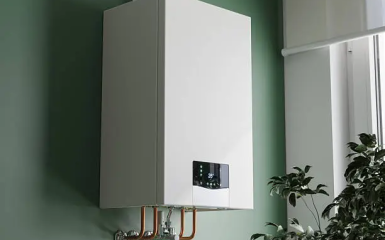
Is the boiler working, the indicator light is on, but the hot water only lasts for a few minutes? Or the water heater used to heat a full tank in two hours, but now it takes much longer? The problem does not always mean that the device is broken and requires expensive repairs.
If the boiler does not heat water well, the most common cause is incorrect temperature settings, insufficient heating time, deposits on the heating element, a faulty heating element or thermostat, or cold water being mixed in. Sometimes the water heater is in good working order, but its power or volume is no longer enough for the needs of the family.
This problem becomes especially relevant in winter and during power outages. After several hours without power, the boiler does not have time to restore the hot water supply, and the lower water temperature in the water supply increases the duration of heating.
Let's consider how to distinguish normal tank cooling from a technical malfunction, how long a 50, 80, or 100 liter boiler should heat, what you can check yourself, and when a technician is needed.
How to understand why the boiler started heating water poorly
Before troubleshooting, it is important to determine exactly how the problem manifests itself.
The water heater may not heat water at all, run for too long, turn off prematurely, or only provide hot water for a short time.
These symptoms often have different causes.
| Symptom | Possible cause | First safety check |
| The water is very cold. | No power, faulty heater or thermostat | Check power supply and settings |
| The water is only warm. | Low heating temperature, faulty thermostat | Check the set temperature |
| The boiler heats longer than before | Scale, problems with the heating element, lower inlet water temperature | Compare heating times under the same conditions |
| Hot water runs out quickly | Small tank volume, high flow rates, cold water mixing | Check consumption and mixers |
| The water in the kitchen is hot, and the bathroom is warm. | Faulty faucet or shower thermostat | Compare temperatures at different points |
| Heating disappears periodically | Thermal protection, faulty sensor or unstable power supply | Check the display and error code |
| The boiler makes noise when heating. | Deposits inside the tank or on the heating element | Find out when maintenance was performed |
| Knocks out a machine gun or RCD | Possible electrical fault | Stop using, do not restart |
One symptom alone does not allow you to accurately determine the breakdown. For example, cold water can be the result of a faulty heating element, but it can also appear after a long power outage.
Therefore, diagnostics should begin with the simplest explanations.
1. The heating temperature is set incorrectly.
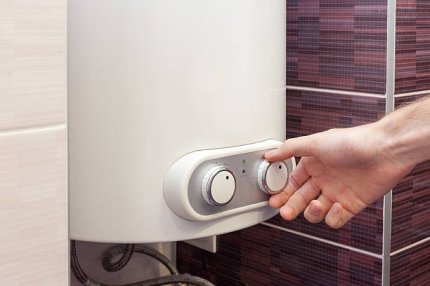
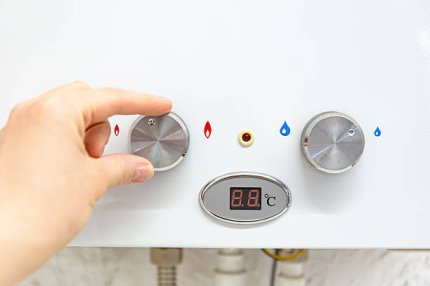
Modern boilers can have a mechanical regulator, an electronic panel, or several operating modes.
If the temperature is set too low, the water may not be hot enough even after the full cycle is complete.
For example, at a tank temperature of 40 °C, the water will be suitable for some household needs, but during a shower there will be almost no reserve for mixing with cold water.
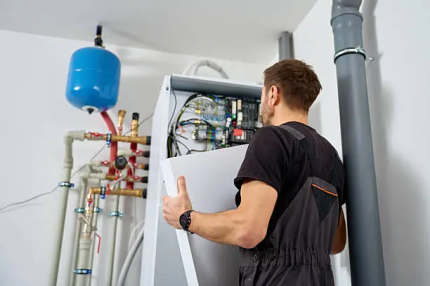
What settings to check
First of all, pay attention to the selected mode:
Eco or economy mode. Depending on the model, it may limit the temperature or change the heating algorithm.
Vacation or holiday mode. Designed for periods of limited use and can reduce heating.
Programmable schedule. Heating can be allowed only during certain hours.
Manual adjustment. The temperature may have changed accidentally.
In some boilers, the indicator shows the set temperature, not the actual water temperature.
Therefore, even a value of 60 °C on the display does not always mean that the tank has already heated to this temperature.
If the settings are correct but the water remains cold after a full cycle, you need to look for another reason.
2. The boiler does not have time to heat the water after the power is turned off
A storage electric water heater takes time to bring the entire volume of water to the set temperature.
If the power is turned off for several hours, and the family has used most of the hot water before that, the boiler may remain cold even after the power is restored.
This is not necessarily a malfunction.
It is especially important to consider the difference between maintaining the temperature of an already heated tank and heating the full volume of cold water.
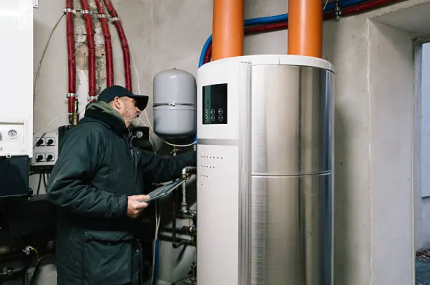
How long does a 50, 80 and 100 liter boiler heat up?
The time depends on the volume, power of the heating element, and the initial and final water temperatures.
For an approximate calculation, you can use the formula:
Energy (kWh) ≈ water volume (l) × temperature difference (°C) × 0.001163.
For example, to heat 80 liters of water from 15 to 60 °C, approximately 4.19 kWh of thermal energy is required.
With a 2 kW heating element, the theoretical time will be about 2.1 hours.
| Boiler volume | Heating element power | Estimated heating time |
| 50 l | 1.5 kW | 1 hour 45 minutes |
| 50 l | 2 kW | 1 hour 19 minutes |
| 80 l | 1.5 kW | 2 hours 48 minutes |
| 80 l | 2 kW | 2 hours 06 minutes |
| 100 l | 1.5 kW | 3 hours 29 minutes |
| 100 l | 2 kW | 2 hours 37 minutes |
The calculation is given for heating from 15 to 60 °C without taking into account heat losses, design features and automation operation. The actual time may be longer.
If your 80-liter boiler with a 1.5 kW heating element has been operating for only an hour after the power supply is restored, it is too early to expect a full supply of hot water.
3. Scale on the heating element
Tap water contains dissolved minerals, particularly calcium and magnesium compounds.
When heated, some of these compounds may form solid deposits.
Over time, scale accumulates on the surface of the heating element and other internal components.
This can happen especially quickly with high water hardness.
How dangerous is scale?
Deposits can impair heat transfer between the heating element and the water.
In some designs, they also cause local overheating and premature operation of thermal protection.
Manufacturer AO Smith notes that the accumulation of sediment and scale may be accompanied by a characteristic noise during operation of the water heater.
And Atlantic draws attention to the importance of regular cleaning and checking the condition of heating system elements.
However, it should not be assumed that any increase in heating time is necessarily caused by scale.
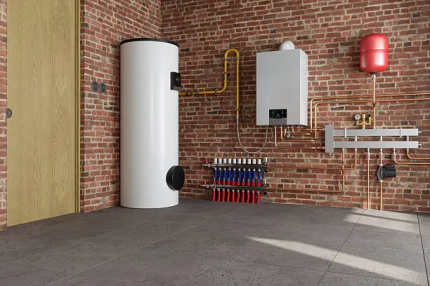
How to determine that the boiler needs cleaning
Possible signs include unusual sounds, frequent thermal protection trips, and gradual deterioration of performance under constant conditions.
If the boiler has not been serviced for many years, the likelihood of significant deposits increases.
However, a final estimate of their number is usually only possible during a service inspection.
Do not pour vinegar, acid or household descaling agents into the boiler yourself. Inappropriate chemicals can damage internal coatings, seals and other components.
The cleaning method depends on the design of the specific water heater.
4. Defective heating element: the boiler is on, but the water is cold
A heating element is a tubular electric heater that converts electrical energy into heat.
Household boilers use different types of heating elements.
A wet heating element is in direct contact with water.
The dry heating element is located in a protective flask and does not come into direct contact with water.
Both types can fail, although the maintenance features are different.
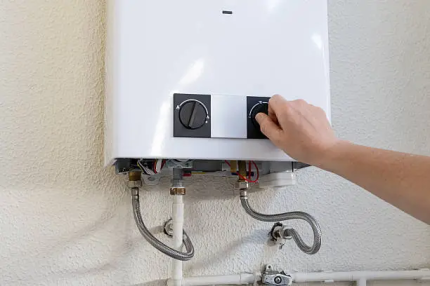
How does a heater malfunction manifest itself?
The boiler can receive power, the display can work, but the water will not heat up.
The reason is that the power indication does not always confirm the health of the heating element itself.
In models with multiple heating elements, the failure of one of them sometimes leads to insufficient heating or a decrease in the amount of hot water.
The exact behavior depends on the electrical circuit.
Checking the health of the heating element requires appropriate equipment and knowledge of electrical safety.
You cannot open the electrical compartment and measure voltage or resistance without proper qualifications.
5. The thermostat is not detecting the temperature correctly
The thermostat controls the heating and stops it when the set temperature is reached.
If it is faulty, the boiler may turn off too early or not start heating at all.
In electronically controlled models, similar symptoms may be related to the temperature sensor, control board, or other components.
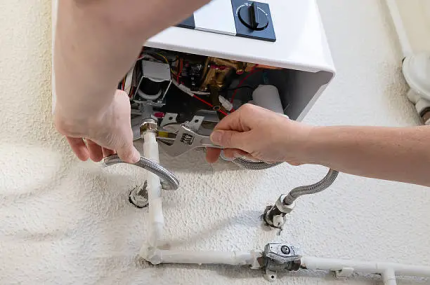
Why does the boiler only heat water to a certain temperature?
Let's say the user has set 60°C, but after the cycle is complete the water remains noticeably cooler.
Possible causes are incorrect temperature measurement, sensor contact failure, or control system malfunction.
In some models, significant deposits around the temperature control elements can also affect operation.
However, it is impossible to determine the specific cause based on the display alone.
If the boiler shows an error, it is worth checking its meaning in the instructions for the model.
Do not bypass protective devices or change electrical connections yourself.
6. Overheating protection has been triggered
Water heaters are equipped with safety devices that stop heating under dangerous conditions.
For example, thermal protection may be triggered due to overheating of the heating element or a temperature control malfunction.
Some models have a manual reset button.
However, its presence does not mean that the user must disassemble the device on their own.
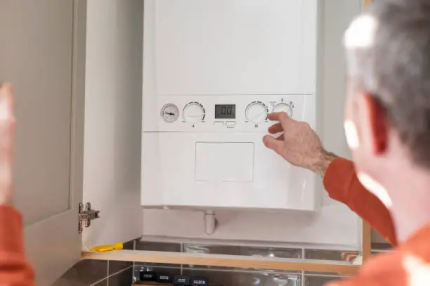
Can the boiler be restarted?
If the manufacturer has provided a safe external reset method via the control panel, it can be used according to the instructions.
But when accessing the button requires removing the protective cover and exposing electrical components, it's better to have the inspection done by a specialist.
It is especially dangerous to repeatedly resume operation after thermal protection has tripped without finding out the cause.
Such protection may signal a malfunction that cannot be eliminated by a simple restart.
7. Cold water is mixed with hot water
Sometimes the boiler heats the water normally, but it only flows warm from the tap.
The reason may not be in the water heater itself, but in the plumbing system.
For example, a faulty faucet cartridge or thermostatic shower mixer can alter the ratio of hot and cold water.
Another possible scenario is unwanted flow between water lines due to a faulty node.
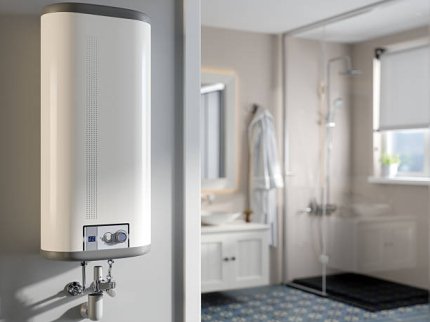
How to distinguish a mixer problem from a boiler malfunction
The easiest way is to compare the water in several points in the apartment.
If there is hot water in the kitchen, but in the shower it is only warm, suspicion first falls on the local faucet or the corresponding section of the pipeline.
If the temperature is equally low at all points, the boiler or common distribution area may need to be checked.
It is also important to consider apartments where the boiler is used as an alternative to centralized hot water supply.
If the shut-off valve is installed incorrectly or is faulty, unwanted mixing of flows is possible.
You should not change the position of unknown valves yourself: incorrect closing or opening may disrupt the operation of the system.
8. Damaged internal cold water supply tube
In many storage water heaters, the design provides for a certain distribution of water temperature inside the tank.
Hot water is usually taken from the top, and cold water is supplied in such a way as to disturb the temperature stratification less.
For this purpose, appropriate internal tubes and flow distributors are used.
If the cold water supply element is damaged, cold water may not flow to the intended location.
As a result, the user receives less hot water than expected.
Manufacturer AO Smith includes damage to the internal water supply tube among the possible causes of insufficient hot water.
However, such a malfunction is not typical for all structures.
To confirm it, diagnostics of a specific model are required.
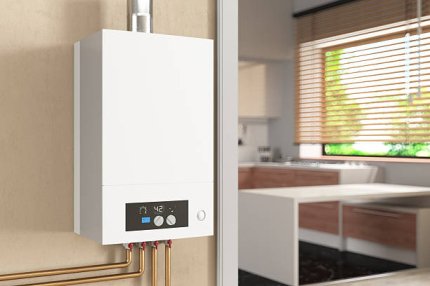
9. The volume of the boiler does not match the water consumption
Even a fully functioning water heater has a limited supply of hot water.
If the shower, kitchen faucet, and another consumer are running at the same time, the tank may empty faster than expected.
For example, a 50-liter boiler does not provide unlimited hot water just because it is connected to the electricity grid.
Why doesn't hot water last long?
The actual duration of use is affected by:
Tank volume.
The temperature of the heated water.
Cold water inlet temperature.
Shower head consumption.
Number of simultaneous consumers.
Features of mixing water in the tank.
Let's assume that the boiler has 80 liters of water at a temperature of 60 °C, and the cold water comes in at a temperature of 15 °C.
Theoretically, when mixed up to 40 °C, approximately 144 liters of water can be obtained.
But this is an idealized calculation. In practice, the amount of usable water depends on the tank design and other factors.
If the shower flow rate is 10 liters per minute, this theoretical reserve corresponds to approximately 14 minutes of use.
So, running out of water quickly does not always mean a breakdown.
Why does the boiler heat water longer in winter?
During the cold season, the temperature of tap water often drops.
Because of this, the boiler requires more energy to heat the same volume.
For example, in summer, water may enter the tank at a temperature of 20 °C, and in winter, at a temperature of 8 °C.
For heating to 60 °C, the difference will be 40 and 52 degrees, respectively.
This means that in winter approximately 30% more thermal energy is required for the same volume and final temperature.
Such a change does not indicate a malfunction.
However, if the heating time has doubled under similar conditions, the cause should be further investigated.
What can you check yourself without disassembling the boiler?
Before contacting a technician, it is advisable to perform several safety checks.
Check the power supply. Find out if there is power in the house and if the appropriate power line is working.
Check the work mode. Make sure that vacation mode or a restricted schedule is not activated.
Wait for the oven to heat up completely. Compare the results only after sufficient operating time.
Assess your water usage. If hot water is used in multiple places at the same time, the supply will deplete faster.
Compare different faucets. This will help identify a possible problem with a particular faucet.
Check for leaks. Inspect accessible external connections without removing the housing.
Pay attention to display errors. Write down the code if it is displayed.
You cannot open the electrical compartment, disconnect wires, or check the heating element under voltage.
If the boiler leaks, emits a burning smell, overheats, or trips the electrical protection, use must be discontinued.
What temperature to set on the boiler
The heating temperature affects the amount of hot water available, electricity consumption and safety.
However, there is no single setting that is optimal for all cases.
The US Department of Energy often cites 49 °C as a guideline for reducing burn risk and energy consumption.
At the same time, the US Centers for Disease Control and Prevention (CDC) draws attention to the risk of Legionella bacteria multiplying in insufficiently hot water.
Higher storage temperatures are used for certain water supply systems, and thermostatic mixing valves are used to protect against scalding.
Why it's dangerous to simply set the maximum temperature
High temperature water can cause serious burns.
This is especially dangerous for small children, the elderly, and people with limited mobility.
Additionally, excessively high temperatures can contribute to faster formation of deposits.
Therefore, the settings should be selected according to the manufacturer's instructions, the characteristics of the water supply and the available means of protection against burns.
You should not constantly keep the water in the tank barely warm just for the sake of economy: this can create undesirable conditions for the development of microorganisms.
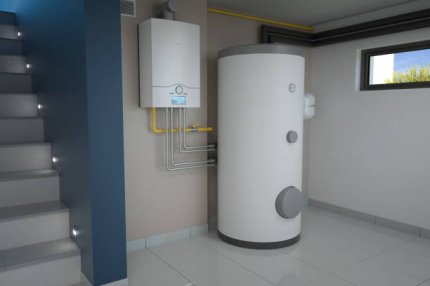
How often should you clean the boiler and check the anode?
Regular maintenance helps detect deposits, the condition of protective components, and possible malfunctions before serious problems occur.
An important part of many storage water heaters is the magnesium anode.
It is intended primarily for additional protection of the inner surface of the tank from corrosion.
The anode gradually wears out, so its condition needs to be monitored.
Do I need to change the magnesium anode every year?
There is no universal interval for all models.
The frequency of inspection and replacement depends on the water heater design, water characteristics, and manufacturer requirements.
Atlantic, under warranty conditions for electric water heaters, provides for service, including cleaning of internal surfaces and replacement of the magnesium anode in accordance with established regulations.
Other manufacturers may have different requirements.
That is why it is better to focus on the instructions for a specific model, rather than on general advice about mandatory cleaning every six months.
How the boiler works during power outages
The storage boiler stores already heated water thanks to the thermal insulation of the tank.
When the power goes out, the water doesn't get cold instantly.
However, after using hot water, cold water enters the tank, and heating does not occur without power.
That is why after long outages, the reserve may not be enough even with working equipment.
If the boiler is used with an inverter or backup power system, the power of the heating element must be taken into account.
For example, a 2 kW heater can create a significant load on the backup system.
Important: never turn on the electric water heater if the tank is not filled with water. Operating the heating element without proper immersion may damage it.
The manufacturer AO Smith directly warns about the risk of the heating element failing when turning on an empty tank.
Is it possible to reduce electricity costs without losing comfort?
The best savings are not always associated with lowering the heating temperature.
Sometimes water usage habits have a more significant impact.
For example, a shower head with a moderate water flow rate allows you to use the tank supply for longer.
It is also useful to avoid opening multiple hot water taps at the same time.
If the boiler has programming, you can use the heating modes provided by the manufacturer according to the family schedule.
However, it is important to consider the risks of long-term storage of water at insufficient temperature.
You should also not expect that a conventional electric heater will start consuming significantly less electricity just after cleaning.
The main amount of energy required to heat a certain volume of water by a given number of degrees is determined by the physical properties of water.
Maintenance primarily helps maintain serviceability, normal heat exchange, and protection.
When to call a master
Professional diagnostics are required if, after checking the settings and completing a full heating cycle, the water remains cold or not hot enough.
You should also not postpone the inspection if the boiler regularly turns off, makes unusual noises, or has lost performance for no apparent reason.
You should stop using it immediately in the following cases:
There was a smell of burning.
Water is leaking from the housing or electrical part.
The circuit breaker or RCD trips regularly.
The boiler is overheating.
Steam or dangerously hot water comes out of the taps.
There are visible signs of melting on the case or cable.
If safe to do so, turn off the power using the appropriate circuit breaker in the panel.
Do not touch wet electrical parts and do not attempt to restart a faulty appliance until it has been checked by a specialist.
Is it worth repairing an old boiler or is it better to buy a new one?
The solution depends on the nature of the fault and the condition of the tank.
If the problem is a separate heating element, thermostat, or worn anode, repairs may be economically justified.
But if the inner tank has lost its tightness due to corrosion, restoration is often impractical or not provided for by the manufacturer.
During the evaluation, it is worth considering:
Age of the water heater.
Availability of spare parts.
Cost of repair.
Condition of the inner tank.
Maintenance history.
Does the volume meet the needs of the family?
If the boiler constantly does not provide the required amount of water due to insufficient volume, replacing the heating element will not solve the problem.
In this case, a model with a different capacity or power may be required.
Conclusion
If the boiler is not heating water well, the first thing to do is check the temperature settings, operating mode, and the time that has passed since the power supply was restored.
Gradual deterioration of heating may be due to scale, a faulty heating element or thermostat. If hot water is only available in individual taps, the cause should also be sought in the mixers and water supply.
It is not necessary to disassemble the boiler for safe inspection. Most root causes can be assessed by settings and operation.
The main thing is to distinguish between insufficient performance of a working water heater and a technical malfunction. This will help avoid unnecessary repairs and timely identify a problem that really requires specialist intervention.
FAQ: Frequently asked questions about a boiler that doesn't heat water well
1. Why is the boiler on but the water is cold?
The cause may be incorrect operating mode, lack of power to the heating element, faulty heating element, thermostat or protection tripping. First check the settings and heating time. If the problem persists, diagnostics are required.
2. Why did the boiler start heating water longer than before?
Possible causes include lower tap water temperature, scale build-up, a faulty heating element or a change in operating mode. Heating times should be compared under the same conditions.
3. How long should an 80 liter boiler heat up?
With a 2 kW heating element, heating 80 liters of water from 15 to 60 °C theoretically takes approximately 2 hours and 6 minutes. The actual time depends on the design, heat loss and operating conditions.
4. Why is there only enough hot water for five minutes?
The reason may be insufficient tank volume, high shower head flow, low heating temperature or mixing in cold water. If the supply was previously sufficient for much longer, it is worth checking the mixers and the condition of the boiler.
5. Can a boiler not heat well because of scale?
Yes. Significant deposits can impair heat transfer and cause local overheating or tripping of the protection. However, the fact of scale alone does not prove that it is the cause of insufficient water temperature.
6. Why does the boiler heat water only to 40 degrees?
Check the set temperature and active mode. If a higher temperature is set but heating stops at approximately 40 °C, there may be a fault in the thermostat, sensor or other components of the control system.
7. Why does the boiler not heat well after the power is turned off?
After a power failure, the heating element does not work, and the hot water gradually runs out and cools down. After the power is restored, it takes time for the tank to heat up completely. If the device does not resume operation, you need to check the display and settings.
8. How do I know if the heating element in the boiler has burned out?
One possible symptom is the lack of heat when power is present and the settings are correct. However, similar symptoms can occur due to the thermostat or safety devices. An accurate diagnosis requires professional electrical diagnostics.
9. How often should I clean the boiler from scale?
The interval depends on the hardness of the water, the design of the heating element and the manufacturer's requirements. There is no universal period for all models. It is necessary to follow the maintenance regulations of a specific water heater.
10. Can I repair the boiler myself?
The user can safely check external settings, indication, operating mode and accessible plumbing components without disassembly. Work with electrical components, replacement of heating elements, thermostat and intervention in the internal structure require appropriate qualifications.

