
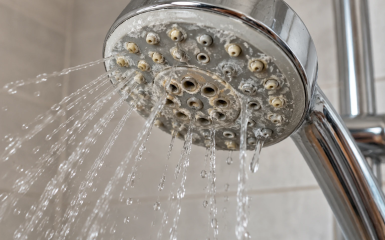
Is the water from your shower head flowing in thin streams, spraying in different directions, or barely coming out of some of the holes? Most often, the problem is due to limescale, a dirty mesh filter, or a kinked hose. However, sometimes the cause lies in the faucet, water heater, or water supply system.
Points of attention
- A weak shower flow can be caused by limescale, a clogged filter, a kinked hose, a faulty faucet, or low water pressure.
- To determine the cause, check other faucets and, if the design allows, compare the flow from the hose with and without the watering can.
- Silicone nozzles can be carefully cleaned with your fingers, and stubborn deposits can be cleaned with a product compatible with the coating according to the manufacturer's instructions.
If the shower head is not flowing well, first check the other faucets in the apartment, the condition of the hose, and the outlet holes of the shower head. When water flows normally from other faucets, but the shower gradually starts to work worse, it is worth checking the shower head for blockages and mineral deposits.
In many cases, the problem can be fixed without replacing the plumbing. For example, manufacturers GROHE and hansgrohe recommend regularly cleaning silicone nozzles from limescale. And Kohler also names dirty filters, faulty valves and inappropriate equipment specifications as possible causes of weak flow.
However, not every shower system requires the same care. Vinegar and concentrated acids can be dangerous for certain finishes, and disassembling a faucet without proper preparation can lead to leaks.
Let's look at how to determine the cause of low pressure, properly clean the shower head, check the mesh filter, and understand when you need the help of a plumber.
Why is the water flowing weakly from the shower head: the main reasons
The first thing you need to do is determine whether the problem is in the shower head itself or in the water supply system.
The most common reasons:
| Reason | Characteristic signs | What to check |
| Limescale | Some of the holes are blocked, the jets are uneven | Shower head nozzles |
| Dirty mesh filter | The pressure is gradually weakening. | Filter in the connection of the watering can and hose |
| Bent hose | The flow varies depending on the position of the funnel | Hose along the entire length |
| Internal hose damage | The water flows weakly even without a nozzle | Inner hose channel |
| Faulty mode switch | One mode works worse than the others | Watering can switching mechanism |
| Clogged faucet | The pressure is weak and there is no watering can | Cartridge, valves, internal channels |
| Problem with the bath/shower switch | Water comes out of the spout and shower at the same time | Mixer diverter |
| Water flow limiter | The new watering can delivers less water than the old one | Specifications of the nozzle |
| Hot water problem | Cold water flows normally, hot water flows weakly. | Mixer, boiler, hot water supply |
| Low system pressure | Weak flow from several faucets | Water supply for an apartment or house |
The nature of the malfunction can often be determined without special tools by comparing the operation of different water intake points.
How to understand that the problem is in the shower head
Before cleaning, it is important to determine exactly where the water is encountering an obstacle.
For example, if the sink and kitchen faucet are working fine, but the shower has gradually lost pressure, the problem may be local.
Another situation is when the water flows weakly in the kitchen, bathroom, and toilet at the same time. In that case, cleaning the watering can is unlikely to solve the main problem.
Checking other cranes
Turn on the cold water in the kitchen and bathroom.
Compare whether the flow intensity has changed.
Then test the hot water separately, if the system allows it.
Several situations are possible:
Weak flow from shower only. Possible local problem with shower head, hose or faucet.
Only hot water flows weakly. The cause should be sought in the hot water supply or the mixing unit.
All the taps are not working properly. The water system needs to be checked.
The pressure drops only at certain hours. Water supply parameters may fluctuate.
These are preliminary signs, not a definitive diagnosis.
How to check the watering can separately from the hose
The manufacturer Mira Showers recommends comparing the flow with and without the shower head.
For a hand shower with a conventional detachable connection, a simple check can be performed.
Completely turn off the water with the faucet.
Wait for hot parts to cool down.
Carefully unscrew the watering can from the hose, if the design allows it.
Do not lose the sealing gasket or mesh filter.
Direct the open end of the hose down into the bathtub or shower tray.
Turn on cool water briefly without strong pressure.
Compare the flow intensity with the previous one.
If the water flows much better without the watering can, the cause is probably related to its internal channels, filter, or nozzles.
If the flow remains weak, you need to check the hose and the water supply to it.
Do not perform this test on non-detachable or complex shower systems without appropriate instructions.
1. Limescale has clogged the holes in the shower head
This is one of the most common reasons for the gradual deterioration of the shower.
Tap water may contain dissolved calcium and magnesium salts.
When water dries on the surface of plumbing fixtures, some of the minerals remain as deposits.
Over time, they accumulate around the injectors and narrow the openings.
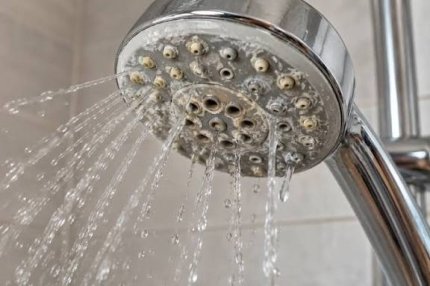
hansgrohe calls reduced flow, uneven jets and white deposits the typical signs of a clogged shower head.
What does a clogged shower head look like?
Pay attention to the following symptoms:
Water does not come out of all holes.
Individual jets are directed sideways.
White or yellowish deposits appear.
The water starts to spray more strongly.
One section of the shower head works noticeably worse.
The total amount of water gradually decreases.
If such changes have occurred over a period of several months, cleaning the mineral deposits is often a reasonable first step.
2. How to clean silicone nozzles without disassembling
Many modern watering cans have flexible silicone protrusions through which water flows.
They facilitate the mechanical removal of deposits.
GROHE uses SpeedClean technology, while hansgrohe uses QuickClean.
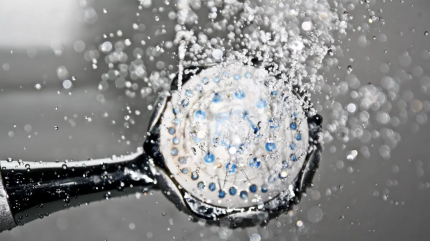
In suitable models, plaque can be removed by lightly wiping the nozzles with your fingers.
Step-by-step cleaning
First, turn off the water.
Inspect the outlet openings and make sure they have flexible silicone elements.
Gently run your fingers over the nozzles without applying excessive pressure.
Rinse off the separated particles with clean water.
After that, turn on the shower and check the uniformity of the jets.
If the plaque was superficial, this is sometimes enough.
What not to do
Do not pierce the nozzles with a metal needle, awl or sharp knife.
This can damage silicone elements, change the shape of the holes, or disrupt internal channels.
There is also no need to rub the funnel with a metal sponge or stiff brush.
For decorative chrome and colored coatings, such actions may leave scratches.
3. How to clean a shower head from stubborn limescale
If regular wiping doesn't help, you may need a special product to remove mineral deposits.
hansgrohe recommends using mild citric acid-based cleaners that are compatible with the material and coating of the sanitary ware.
Important: This is a specially developed product, not an arbitrarily concentrated homemade solution.
How to properly clean a removable funnel
If the manufacturer allows soaking:
Turn off the water and carefully remove the funnel.
Check if there is a removable filter inside.
Prepare the product according to its instructions.
Perform short-term cleaning using an approved method.
Rinse the surface thoroughly with clean water.
Clean the silicone nozzles with a gentle finger movement.
Reinstall all removed parts.
Connect the watering can and check the operation of all modes.
For its products, hansgrohe sets a general limit on contact with the respective cleaner – no more than 10 minutes.
If the instructions for a specific product or product specify a shorter time, you should follow that time.
Do not leave the funnel in the acid solution overnight.
Can I clean a non-removable overhead shower head?
Yes, but the method depends on the design.
For some models, cleaning the injectors in place is sufficient.
Others have a removable distribution plate.
Do not forcefully unscrew decorative elements unless their removal is provided for by the manufacturer.
There is also no need to pour the cleaner inside the shower system.
For the exterior, hansgrohe recommends applying the appropriate product to a soft cloth and not spraying it directly onto the plumbing fixtures.
4. Can vinegar be used to clean a shower head?
Vinegar is often used to remove limescale because acetic acid reacts with carbonate deposits.
However, vinegar is not suitable for all shower heads .
For example, Kohler allows the use of vinegar to clean certain shower heads.
Instead, hansgrohe explicitly warns against using cleaners with acetic acid for its plumbing fixtures.
The reason is possible damage to coatings, seals, or other components.
Why you shouldn't soak a watering can in vinegar overnight
Prolonged contact with an acidic environment can damage materials that are not designed for such cleaning.
This is especially true for colored decorative coatings, individual plastic parts and seals.
Therefore, the universal household recommendation "pour vinegar and leave until morning" is unreliable.
Before using acid, you need to check the instructions for your specific model.
What products are prohibited from mixing
Do not mix acidic cleaners with chlorine bleach.
This combination may cause the release of hazardous gases.
There is also no need to experiment with mixtures of vinegar, household chemicals, and other acids.
To clean plumbing, use one compatible product according to the instructions.
5. The mesh filter in the watering can connection is clogged.
Even if all the holes are clean on the outside, the flow may remain weak.
The cause is sometimes a fine mesh installed between the shower head and the hose.
It traps particles of sand, rust, and other mechanical contaminants.
hansgrohe notes that a dirty filter seal can significantly reduce the amount of water that reaches the nozzle.
How to check the filter
Turn off the water and disconnect the hose if the design allows it.
Inspect the connection point.
In some models, there is a small mesh there, sometimes combined with a sealing gasket.
If the manufacturer has provided for its removal, carefully clean the part from dirt.
After rinsing, reinstall the filter.
Do not replace the special filter seal with a regular rubber gasket.
The manufacturer hansgrohe separately warns that without a suitable mesh, dirt particles can get into the internal mechanism of the watering can.
Why does the filter clog quickly after water shutoffs?
After repair work or interruptions in the water supply, mechanical particles may enter the system.
They can accumulate in faucet filters, aerators, and shower heads.
Therefore, if the shower started working worse immediately after restoring the water, it is worth checking the filter elements.
6. The shower hose is bent or damaged.
The problem is not always related to the watering can.
Water may not flow well through the hose due to kinking, twisting, or internal damage.
Sometimes the outer covering remains intact, but the canal inside is deformed.
How to check the hose
Examine it along its entire length.
Pay attention to areas near joints, where sharp bends most often occur.
Straighten out obvious distortions without applying excessive force.
Check if the flow rate changes when the watering can is in different positions.
If the water starts to flow better after straightening the hose, this indicates a possible mechanical restriction.
When does the hose need to be replaced?
Replacement may be necessary if:
There are cracks or leaks.
There were constant creases.
The tightness of the connections is broken.
The inner channel is deformed.
The pressure remains weak even after cleaning the watering can.
The new hose must be selected based on compatibility with the shower system, length, and type of connections.
Many hand shower systems use the standard G 1/2 thread, but compatibility should be checked before purchase.
7. Weak pressure due to a faulty mixer
If the watering can and hose are clean, the cause may be in the faucet.
Kohler lists problems with valves, seals and internal channels among possible malfunctions.
In some models, contaminants accumulate in the cartridge or temperature control mechanism.
Why did the faucet start dispensing less water?
Possible reasons:
Clogging of internal channels.
Defective cartridge.
Partially closed shut-off valve.
Damage to sealing elements.
Contamination of inlet filters.
Malfunction of the thermostatic mechanism.
For example, if the shower initially works fine, but the pressure drops sharply when the temperature changes, the problem should not be looked for only in the nozzles.
Can I disassemble the mixer myself?
Disassembling a cartridge, thermostatic unit, or concealed mixer requires knowledge of the specific design.
Improper intervention may result in leaks or dangerous changes in water temperature.
Particular care should be taken with thermostatic systems that are designed to maintain a set temperature.
If cleaning the removable elements did not help, it is worth entrusting the diagnosis of the faucet to a plumber.
8. Water flows from the tap and shower head at the same time
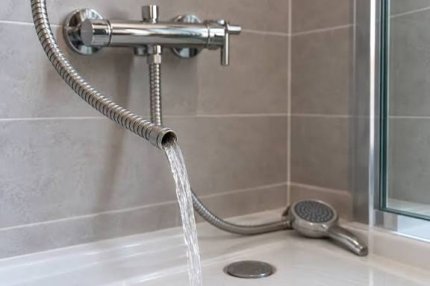
Bathtubs with a mixer that switches the water between the spout and the shower use a special mechanism called a diverter.
If it is not working properly, some of the water may enter the shower while the rest continues to flow from the spout.
As a result, the flow from the watering can noticeably weakens.
How to determine a switch malfunction
Turn on the shower and check if water is coming out of the main faucet spout at the same time.
If this occurs, incomplete flow switching is possible.
The cause may be wear on the mechanism or accumulation of dirt.
There is no need to forcefully pull or twist the switch if it is stuck.
For applicable models, Kohler notes that debris in the diverter channels may restrict flow.
In such cases, cleaning or repair is required according to the design of the mixer.
9. A new shower head uses less water than an old one.
Sometimes a weak flow is noticed immediately after installing a new nozzle.
At the same time, the plumbing is in good condition, the nozzles are clean, and the hose has no kinks.
The reason may be the design characteristics of the watering can.
Many modern models are equipped with water flow limitation systems.
Such solutions help reduce water consumption and energy consumption for heating it.
Why an economical watering can may seem weak
hansgrohe notes that certain models with EcoSmart technology are designed for a flow rate of up to 8 liters per minute, and EcoSmart+ for approximately 6 liters per minute under certain pressure conditions.
Older models can consume significantly more water.
Therefore, after replacement, the difference is sometimes felt even with a fully functional water supply system.
This does not necessarily mean that the new watering can is defective.
Should I remove the water flow restrictor?
It is not recommended to remove such an element yourself.
It can be part of the design and affect the operation of internal mechanisms.
Delta Faucet warns that tampering with the water flow limiter in certain models may void the warranty.
It is better to check the nominal flow rate, working pressure, and compliance of the watering can with the parameters of the water supply system.
10. Low water pressure in an apartment or private house
If water is flowing poorly from several plumbing fixtures, the problem may be systemic.
Possible reasons:
Pressure fluctuations in centralized water supply.
Clogged inlet filter.
Partially closed shut-off valves.
Pressure reducer malfunction.
Insufficient performance of pumping equipment.
Pollution of pipelines.
Leakage.
Simultaneous use of water by several consumers.
For example, in a private house with a pumping station, the flow in the shower may weaken when the washing machine and irrigation are running at the same time.
In an apartment building, a decrease in pressure on the upper floors may be due to the parameters of the water supply system.
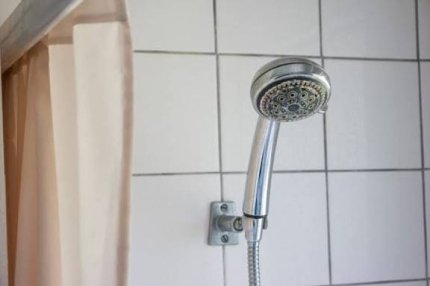
Why is only hot water flowing weakly?
If cold water flows normally, but hot water flows poorly, you need to check the corresponding part of the system.
The cause may be in the water heater, filters, shut-off valves, or faucet.
There is no need to immediately clean the shower head with acidic products.
You should also not disassemble gas water heaters yourself or interfere with the electrical components of the boiler.
How to check your shower water consumption yourself
It is not necessary to have a pressure gauge to roughly estimate the amount of water coming out of the watering can.
You can use a measuring cup and a stopwatch.
This method allows you to determine the water flow rate , not the pressure in the pipeline.
How to measure liters per minute
Take a container of known volume.
Turn on the shower in normal mode and direct the stream into the container.
Record how much water is collected over a certain period of time.
For example, if 2 liters are collected in 15 seconds, the flow rate is:
2 × 60 ÷ 15 = 8 liters per minute .
If 1 liter is collected in the same time, the flow rate is 4 liters per minute.
What do the obtained indicators mean?
4, 6 or 8 liters per minute alone do not allow you to determine whether the watering can is working properly.
Some economical nozzles are specially designed for low consumption.
Therefore, the result should be compared with the passport characteristics of a specific model and measured under the same conditions.
For example, if the shower previously delivered 8 liters per minute, but now only 3 in the same mode, this is a useful sign of a change in the system's operation.
To measure the actual pressure, a suitable device is required.
Why is it important to distinguish between water head, pressure and flow rate?
In everyday life, all these concepts are often called one word - "pressure".
However, technically they are different.
Water pressure characterizes the physical parameter of a water supply system and is usually measured in bars.
Water flow rate shows the amount of liquid that passes through the system in a certain time, for example in liters per minute.
The perceived force of the jet also depends on the shape and number of nozzle outlets.
For example, a shower head with a low flow rate can create quite intense thin jets.
At the same time, a large top funnel with a wide water distribution area may feel softer.
Therefore, replacing the nozzle does not always increase the pressure in the water supply - more often it changes the nature of the jets or the flow rate.
Why does the shower head work poorly in only one mode?
Multi-mode watering cans have an internal flow switching mechanism.
In different positions, water passes through different groups of nozzles.
If one mode works normally, and the other hardly supplies water, there may be a local blockage or malfunction of the mechanism.
For example, a wide rain mode may work well, but a massage jet may only work through half of the holes.
First, check the injectors of the appropriate mode.
If they are clean but the problem persists, the cause may be inside the switch.
It is not necessary to disassemble the sealed unit unless the manufacturer provides for such a procedure.
Will replacing the shower head with a low-pressure model help?
In some cases, yes.
Plumbing manufacturers offer models whose design is optimized for a specific pressure range.
However, the nozzle cannot compensate for all plumbing problems.
For example, if not enough water is flowing into the apartment due to a clogged filter at the inlet, installing another watering can will not eliminate the cause.
What to look for before buying
Check:
Minimum recommended operating pressure.
Nominal water consumption.
Hose compatibility.
Number of modes.
The presence of nozzles for easy cleaning.
Possibility of cleaning the internal filter.
Coating care requirements.
Availability of spare parts.
It is worth considering that a large overhead shower head may require different water supply conditions than a compact hand shower.
Therefore, increasing the nozzle diameter does not guarantee a stronger jet.
How often should you clean your shower head?
There is no single universal schedule.
The frequency depends on the hardness of the water, the intensity of shower use, and the design of the nozzle.
hansgrohe recommends focusing on the actual appearance of limescale deposits.
If the water is hard, cleaning may be required more often.
How to prevent rapid plaque buildup
After showering, you can gently wipe the nozzles if the manufacturer allows it.
It is also useful to remove water droplets from exposed surfaces with a soft cloth.
Do not leave cleaning product residue on chrome parts.
If your watering can has quick-clean silicone nozzles, use this feature regularly as instructed.
In homes with very hard water, water softening systems may be considered, but their selection depends on the actual composition of the water and the characteristics of the water supply.
When to change your watering can, not clean it
Cleaning doesn't always help.
Sometimes the cause of weak flow is due to irreversible damage to internal parts.
Replacement may be appropriate if:
The body is cracking.
There was a constant leak.
Damaged injectors.
The mode switch is stuck.
The internal channels cannot be cleaned in the permitted manner.
The seals have collapsed and cannot be replaced.
Damaged decorative coating.
The manufacturer does not provide for repair of a faulty unit.
If the watering can is expensive and has replaceable components, it is worth checking if it can be repaired before buying a new one.
Separate filters, gaskets, distribution plates and other parts are available for some models.
What mistakes should you avoid when cleaning your shower system?
1. Disassemble the mixer immediately. First, you need to check the simple reasons: the funnel, hose and nozzles.
2. Soak the nozzle in vinegar overnight. This method may damage some coatings and seals.
3. Use concentrated acids without instructions. They are not always compatible with plumbing materials.
4. Pierce the injectors with a needle. This may distort the shape of the outlet holes.
5. Remove the mesh filter permanently. Without it, contaminants can enter the internal mechanism.
6. Remove the water flow restrictor. It may be a structural element and affect the warranty.
7. Not checking the shower hose. A kink sometimes creates the same symptoms as a clogged showerhead.
8. Wash the coating with a hard sponge. This can leave scratches and damage the decorative layer.
9. Mix acidic cleaners with chlorine-based cleaners. Such combinations can release dangerous gases.
10. Assume that a new watering can will definitely increase pressure. A nozzle is not a substitute for repairing a faulty water supply system.
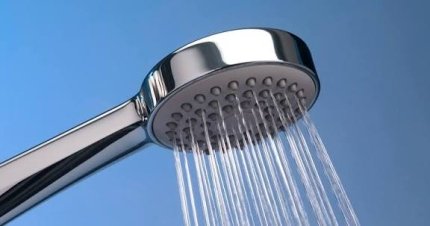
When to call a plumber
Self-cleaning makes sense if the problem is limited to accessible parts and does not require intervention in the plumbing.
A professional check is required if:
Water flows weakly from several taps.
The pressure dropped sharply for no apparent reason.
There is a leak in the wall or near the faucet.
The water temperature changes unexpectedly.
The mixer is making unusual sounds.
There is a suspicion of a malfunction of the thermostatic valve.
Only the hot water supply is weak.
Cleaning the watering can and filter didn't help.
It is necessary to check the pressure in the pipeline.
It is especially important not to tamper with concealed plumbing, gas water heaters, and complex pumping systems yourself.
Conclusion
If the water is flowing weakly from the shower head, it is not necessary to immediately buy a new nozzle or disassemble the faucet.
The easiest way to start is to check other faucets, the shower hose, silicone nozzles, and the mesh filter.
If the problem is limescale, cleaning according to the manufacturer's instructions often helps. For the relevant GROHE and hansgrohe models, it is sufficient to regularly remove deposits from the flexible nozzles.
When the water flow is weak even without a watering can or the problem is observed in several points, the cause should be sought in the faucet or water supply system.
The key is to first identify the location of the flow restriction and then choose a method to eliminate it. This will avoid unnecessary costs, damage to plumbing, and ineffective cleaning.
FAQ: Frequently asked questions about low water pressure in the shower
1. Why is the water flowing weakly from the shower head?
The most common causes are limescale, a dirty mesh filter, a kinked hose, or a faulty faucet. If water is also weak from other taps, there may be a problem with the water supply system.
2. How to quickly increase the water pressure in the shower?
First, check the nozzles and filter of the watering can for blockages. If the design allows, you can compare the water flow from the hose with and without the nozzle. If the cause is a blockage, cleaning may restore normal flow.
3. What is the best way to clean limescale from a shower head?
For the appropriate models, manufacturers recommend mild, specialized products based on citric acid. Cleaning the silicone nozzles with your fingers often helps. The specific product should be selected according to the instructions of the watering can manufacturer.
4. Can I soak a shower head in vinegar?
Only if the manufacturer allows it. For example, Kohler allows vinegar for certain models, while hansgrohe warns against products with acetic acid. Prolonged soaking without considering the material and coating can damage the plumbing.
5. How to clean the shower screen?
Turn off the water, disconnect the funnel and check for a removable filter at the connection point to the hose. If it is allowed to be removed, clean it of mechanical particles and reinstall it. Do not replace the special filter-seal with a regular gasket.
6. Why does water flow well from the shower hose, but poorly from the watering can?
This may indicate that the nozzles, filter, or internal channels of the shower head are clogged. If the flow without the nozzle is much stronger, it is advisable to check the shower head.
7. Why is there only a weak pressure of hot water in the shower?
The cause may be a flow restriction in the hot water system, water heaters or faucets. If cold water flows normally, cleaning the shower holes will not always fix the problem.
8. Can the pressure be increased by removing the water restrictor?
It is not recommended to remove the flow restrictor yourself. It may be part of the design of the watering can, affect the operation of the mechanisms and warranty conditions. It is better to check the characteristics of the nozzle and compatibility with the water supply.
9. Why does a shower head spray water in different directions?
The most common cause is partial clogging of the outlet holes with limescale. In funnels with silicone nozzles, it is sometimes enough to gently wipe them with your fingers and rinse with water.
10. When should I replace my shower head with a new one?
Replacement is advisable if the housing is cracked, the internal mechanisms are damaged, the mode switch is faulty, or the blockage cannot be eliminated by the manufacturer's method. If the cause of the weak flow is in the water supply system, a new watering can may not solve the problem.

