
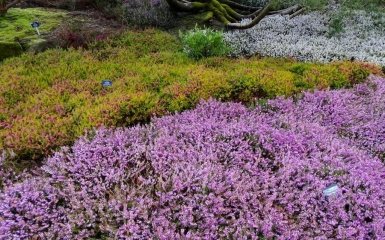
A lawn only looks neat when it is regularly maintained: mowed, watered, fertilized, reseeded, raked dry grass and removed weeds. If the area is small, shaded, dry, uneven or used mainly as a decorative area, classic lawn grass often turns into a constant source of trouble.
Points of attention
- Switching from grass to ground cover plants makes sense if your lawn is constantly burning out, thinning, overgrown with weeds, or needs too much water.
- Creeping thyme is one of the best options for those who want a flowering lawn without regular mowing.
Groundcovers work best in such places. They grow in a low carpet, cover bare ground, suppress weeds, decorate the garden with leaves or flowers, and require much less mowing. Some of them are suitable for sunny, dry areas, while others grow better in the shade under trees, near fences, along paths, or in semi-shaded corners of the garden.
It is important to understand right away: no ground cover plant is a complete replacement for a sports lawn. If children play soccer every day, a dog actively runs around the yard, and adults constantly walk along the same path, a hardy lawn mixture or hard surface is needed. But for decorative areas, slopes, spaces between slabs, garden borders and places where grass grows poorly, a living plant carpet can be much more practical.
When to replace your lawn with ground cover plants
Switching from grass to ground cover plants makes sense if your lawn is constantly burning out, thinning out, overgrown with weeds, or needs too much water. Often, the problem isn't the seeds, but the conditions themselves: there's not enough light under the trees, the soil dries out near the house, water drains quickly on a slope, and the grass gets trampled near the paths.
Ground cover plants are appropriate if you need:
to green the area without frequent mowing;
to cover the bare ground between the bushes;
decorate a slope or edge of a path;
create a flowering carpet in the sun;
replace grass under trees;
reduce watering after plants have rooted;
make the garden more natural and diverse;
plant something lower than bushes, but more decorative than mulch;
reduce the area of a classic lawn without losing greenery.
The best results are obtained with a combined approach. In areas of active walking, leave paths, tiles or a strong lawn, and plant decorative areas with thyme, clover, yarrow, stonecrop, geranium, mountain ash, brunnera or other low perennials.
What to consider before landing
The main mistake is to choose a plant based on a photo alone. A beautiful picture does not show how the culture behaves in the heat, after frost, on heavy clay, in dry shade or underfoot. Before buying, you need to evaluate not the name of the plant, but the conditions of a specific place.
Check five things:
How much sun does the area receive?
What kind of soil: dry, wet, sandy, clayey, fertile or poor.
Will they walk on the plants?
Are there any flower beds, flower beds or a neighbor's plot nearby?
Are you willing to limit growth with a border or pruning?
For a dry sunny spot, thyme, stonecrop, and partially clover are suitable. For shade under trees, mountain ash, brunnera, periwinkle, pachysandra, and some garden geraniums are suitable. For wetter partial shade, zhivuchka, brunnera, and geraniums are suitable. For areas where people sometimes walk, it is better to choose clover, thyme between the slabs, or a mixed low lawn with herbs.
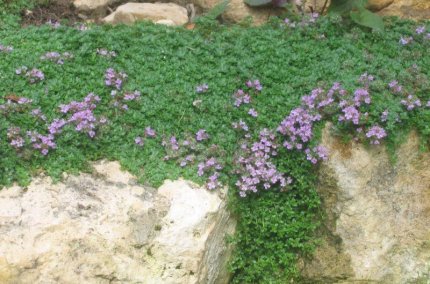
Creeping thyme: a fragrant carpet for the sun
Creeping thyme is one of the best options for those who want a flowering lawn without regular mowing. It forms a low, dense carpet and looks good between paving stones, on sunny slopes, in rockeries, near terraces, and along garden paths.
In spring and summer, thyme produces small flowers in shades of pink, lilac, or purple, attracts bees and other pollinators, and has a pleasant, herbaceous scent when touched. It's a good choice for a natural-style garden that doesn't require a perfectly even green "brush."
Thyme likes:
sun;
light, drained soil;
moderate nutrition;
no stagnation of water;
space without high competitors.
It does not tolerate heavy, wet soil. If you plant it in clay that holds water for a long time after rain, the roots may rot. In such a plot, before planting, it is worth adding sand, fine gravel, a moderate amount of compost and raising the planting level.
Thyme can withstand light occasional foot traffic, but is not suitable for a place where people walk dozens of times a day. It is better to make stone slabs or a stepping stone for the passage, and plant thyme between them.
White clover and microclover: a green carpet without excessive care
White clover has long been a "weed" in lawns, but its properties make it a useful alternative to grass. It is low, fills gaps quickly, blooms with white balls, can withstand moderate foot traffic, and can stay green where regular grass fades.
For a neater look, you can use micro clover. It has smaller leaves, a shorter growth habit, and blends better with lawn grasses. A full clover carpet looks natural and soft, but after flowering it can attract bees. If children often walk barefoot in the yard, this should be taken into account.
Benefits of clover:
covers empty spaces well;
withstands moderate trampling;
does not require as frequent feeding as grass;
attracts pollinators;
suitable for natural lawn;
can grow on poorer soils.
There are also disadvantages. Clover does not give the appearance of a classic English lawn, can spread into neighboring areas, is slippery after rain and looks uneven in winter. If you need a perfect decorative surface, it is better to mix it with low-growing lawn grasses or use it only in part of the garden.
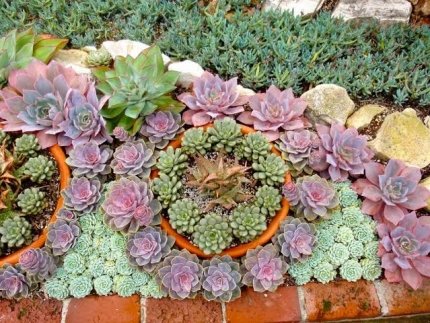
Stonecrop: an option for dry and sunny areas
Stonecrops, or sedums, are well suited for places where classic grass suffers from heat and lack of water. They are succulent plants with fleshy leaves that accumulate moisture. Low-growing species quickly create decorative spots in the sun, in rock gardens, near paths, on slopes and in dry flower beds.
Stonecrop should be chosen for:
sunny areas;
poor soils;
rockeries;
areas near the stone;
dry slopes;
places where irrigation is limited.
It should not be planted where people walk on it all the time. The stems and leaves can break, and after heavy trampling the carpet loses its shape. Stonecrop also does not like stagnant water. On heavy soils, it needs drainage, gravel mulch, or a raised planting area.
In garden design, stonecrop goes well with thyme, juniper, ornamental grasses, lavender, sage, and other dry garden plants. It will not replace a soft lawn for relaxation, but it will perfectly cover difficult sunny areas where the grass has to be constantly renewed.
Persistent creeper: a fast carpet for partial shade
The hardy creeping plant quickly forms a dense, low ground cover thanks to its tendrils. It is often planted under bushes, in partial shade, near paths, and in places where it is necessary to quickly cover the soil. In spring, it blooms with blue, purple, or pink inflorescences, and decorative varieties have burgundy, bronze, variegated, or dark green leaves.
Zhivuchka is suitable for:
penumbra;
moist soil without stagnant water;
edges of flower beds;
space under the bushes;
decorative spots instead of grass.
Its strong point is its rapid growth. But this same trait can be a problem. If you plant a hardy plant next to delicate perennials, it can gradually take over their space. Therefore, it is better to immediately provide a border for it: a border, stones, a path, or regular pruning of excess rosettes.
The plant tolerates light trampling, but does not like constant movement. It is weak for an active path, but very practical for decorative landscaping in partial shade.
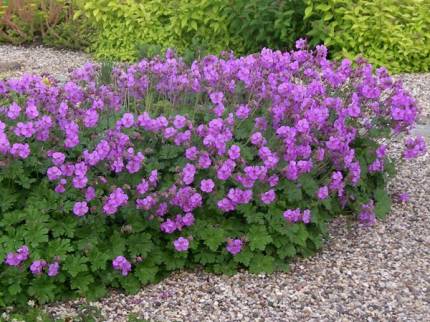
Garden geranium: a flowering lawn replacement under trees and shrubs
Garden geraniums should not be confused with indoor pelargoniums. In the garden, frost-resistant perennial geraniums are used, which grow in clumps, cover the ground, bloom with white, pink, lilac, blue or purple flowers and combine well with shrubs, roses, hostas, ferns and ornamental grasses.
The most interesting species and varieties for lawn replacement are those that grow quickly and create a dense mass of foliage. For example, geranium large-rhizome does well in partial shade and under trees, and some modern varieties can bloom for a long time in sunnier places.
Garden geranium is suitable if you need:
cover the ground near the bushes;
arrange the space under the trees;
get flowering without complicated care;
create a natural, soft edge of the path;
replace grass in the decorative area.
It does not like constantly wet soil. In a too wet place, the roots may suffer and the bushes may collapse. After the first wave of flowering, some of the geraniums can be cut lower - the plant produces fresh leaves and sometimes re-flowering.
Goryanka: a solution for dry shade
Epimedium is a valuable plant for places where the lawn is almost doomed: dry shade under trees, semi-shaded corners, spaces near hedges, areas with roots of large plants. It grows more slowly than clover or sedge, but it behaves neatly and does not aggressively take over the garden.
In spring, the mountain ash blooms with small, delicate flowers, and the leaves can change shades throughout the season: from fresh green to bronze, reddish or copper. It is the leaves that make it decorative for most of the year.
Goryanka is good for:
shadows and penumbra;
planting under trees;
dry places after rooting;
natural style garden;
low decorative cover without constant pruning.
In the first season after planting, it needs watering, especially under trees, where the roots take up a lot of moisture. Further care is simple: in the spring, you can cut off the old leaves so that the new greenery and flowers look neater.
Brunnera: ornamental foliage for cool shade
Brunnera grandiflora is a plant for those who need a nice green mass in the shade. In spring, it blooms with small blue flowers, similar to forget-me-nots, but the main value of Brunnera is its large heart-shaped leaves. In varieties, they can be silver, variegated, veined or brightly patterned.
Brunnera looks good:
under the trees;
near the north wall of the house;
in semi-shaded mixborders;
next to hostas, ferns and mountain ash;
at the edge of a shady path.
It likes coolness, fertile soil and moderate moisture. In the hot sun, the leaves can burn, and in dry soil the plant loses its decorative effect. If the site is southern and open, Brunnera will not be a good replacement for a lawn. It is better to leave it for shaded areas, where other plants look weak.
Brunnera can't stand active walking, so it's planted as a decorative ground cover, not as a surface for games or relaxation. But it does a good job of hiding bare ground and making a shady part of the garden look well-groomed.
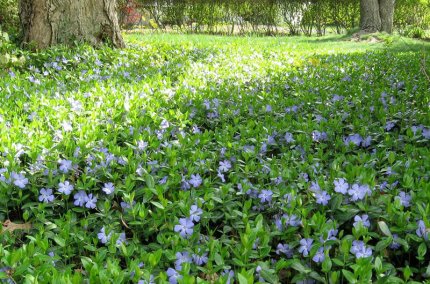
Periwinkle: a dense carpet that needs to be controlled
Periwinkle is one of the most well-known ground covers. It is evergreen or nearly evergreen in mild winters, quickly covers the ground, blooms with blue-violet, white or pink flowers, and grows well in partial shade. It is often planted on slopes, under trees, near fences, and in places where you need to get green cover quickly.
Benefits of periwinkle:
grows rapidly;
covers the soil well;
tolerates partial shade;
decorative after flowering;
suitable for slopes;
does not require complex care after rooting.
But periwinkle needs to be controlled. In favorable conditions, it actively creeps sideways and can enter flower beds, under bushes or into neighboring plots. It is better to plant it where the boundaries are clearly defined: between the path and the fence, on a slope with a curb, under trees in a separate area.
For a small flowerbed with delicate perennials, periwinkle may be too strong a competitor. For problematic partial shade, on the contrary, it is one of the most stable options.
Asian jasmine and mimosa: beautiful, but not for every winter
Asian jasmine and mimosa acuminata are often included in lawn alternatives lists, but they should be considered with caution for Ukrainian gardens. These are ornamental plants from warmer regions, so they will not overwinter safely in open ground everywhere.
Asiatic jasmine forms a dense carpet of glossy leaves and does well in mild climates. But it needs a sheltered location, well-drained soil, and no hard frosts. In colder regions, it is best considered a container plant or experiment for a very sheltered corner.
Mimosa is interesting with its pink fluffy flowers and leaves that react to the touch. It is spectacular, but heat-loving. For most Ukrainian areas, it is more of a seasonal or container crop than a reliable perennial lawn replacement.
If the goal is a stable garden without unnecessary risk, it is better to choose frost-resistant plants: thyme, clover, garden geranium, mountain ash, brunnera, periwinkle, viviparous or stonecrop. Exotics should be left for containers, terraces, winter gardens or regions with a milder climate.
How to prepare the site for planting
Groundcovers are often called unpretentious, but that doesn't mean you can plant them in the weeds and forget about them. The most work comes in the beginning. If you prepare the ground well, the plants will establish faster and provide a dense cover.
Preparation procedure:
Remove old grass and rhizome weeds.
Dig or loosen the topsoil.
Add compost if the soil is poor.
For heavy clay, add materials to improve the structure.
For thyme and stonecrop, create a more drained area.
Level the surface without deep pits.
Water the area before planting if the soil is dry.
Place plants taking into account future growth.
Mulch the spaces between the seedlings.
Water the first season until the roots are established.
The first few months, weeds need to be removed by hand. When the plants are established, care will become easier. But at the start, young seedlings cannot compete with wheatgrass, thistle, birch or other strong weeds.
How to care for a living carpet instead of grass
Care depends on the plant, but the general logic is the same: help it take root, don't overwater, don't overfeed, and control excessive growth in a timely manner.
Basic rules:
water regularly in the first season;
after rooting, reduce watering according to the species;
mulch the open soil between the seedlings;
weed until the cover becomes dense;
prune or trim plants after flowering if they are falling apart;
limit aggressive species with borders;
do not over-fertilize, especially drought-resistant crops;
Do not walk on young plantings until they are fully rooted.
Unpretentiousness doesn't start on the day of planting, but after the plants have taken up space. Until then, they need attention. Most often, problems arise from two extremes: people either don't water young seedlings at all, or water drought-loving crops so much that they rot.
Which plants to choose for different conditions
For sun and dry soil, thyme, stonecrop, some low-growing carnations, yarrow, and drought-tolerant grasses are suitable. They look good next to stone, tiles, terraces, and on slopes.
For partial shade, zinnia, garden geranium, periwinkle, some clover, some types of veronica, and cuffwort are suitable. It is important not to overdry the soil in the first season.
For shade under trees, it is better to choose mountain ash, brunnera, periwinkle, pachysandra, hogweed, shade geraniums, ferns and hostas as a complement. In such places, lawn grass often loses out due to lack of light and root competition.
Thyme, moss in moist shade, low sedums in the sun, and small, slow-growing ground covers work well for the spaces between the slabs. But the slabs should take the brunt of the load.
Slopes require plants that anchor the soil and grow quickly: periwinkle, horizontal juniper, geranium, sedge, stonecrop, ornamental grasses. On steep slopes, it is better to combine plantings with mulch, stones, or terracing.
Common mistakes when replacing lawn
The first mistake is to plant the entire plot with one plant without testing. It is better to plant a small plot first and see how the crop behaves throughout the season.
The second mistake is to choose a sun-loving plant for shade. Thyme in deep shade will stretch out and become thinner, and brunnera in the hot sun will lose the beauty of its leaves.
The third mistake is to expect a ground cover to withstand heavy trampling. Most of these plants are ornamental, but not designed for daily traffic.
The fourth mistake is not removing perennial weeds before planting. If wheatgrass or birch is left in the ground, they will sprout through the young carpet.
The fifth mistake is to ignore the boundaries. Periwinkle, yarrow, clover, and other creeping crops can grow beyond the allotted area.
The sixth mistake is to plant heat-loving plants as a reliable replacement for lawns in regions with freezing winters. Exotic species are best tested in containers or very sheltered areas.
Conclusion
Replacing your lawn with ground cover plants is a practical solution for a garden where grass is not growing well or requires too much maintenance. Thyme, stonecrop and clover are suitable for sun, yarrow, garden geranium and periwinkle for partial shade, and mountain ash, brunnera, pachysandra or other shade-tolerant perennials for shade.
The main thing is to choose a plant for the conditions, not for a beautiful photo. If the area is dry and sunny, you need drought-resistant crops. If the place is under trees, it is better to look for plants for shade. If the area is often walked on, it is worth leaving a path or a strong lawn.
Ground covers don't make a garden completely "maintenance-free," but once established, they significantly reduce mowing, watering, and weed control. A properly selected living carpet can look natural, neat, and decorative throughout the season.
FAQ
What is the best thing to plant instead of a lawn?
Creeping thyme, stonecrop, and white clover are good for a sunny area. For partial shade, yarrow, garden geranium, and periwinkle are good. For shade under trees, yarrow, brunnera, pachysandra, ungulates, or shade-tolerant geraniums are good.
Which ground cover plant can withstand walking?
White clover, microclover, and thyme stand up best to light to moderate foot traffic between the slabs. But for constant passage, it is better to make a path, as most ornamental ground covers cannot withstand daily trampling.
Can I completely replace my lawn with thyme?
Yes, but only in a sunny, well-drained area with light traffic. Thyme is not suitable for deep shade, wet clay, or areas where children are constantly walking or playing.
Should I mow clover instead of lawn?
Clover can be mowed less often than a regular lawn. If you want a shorter, neater look, trim it after flowering or when the cover gets too high. Microclover requires less frequent trimming.
What plants should be planted under trees instead of grass?
It is better to plant mountain ash, brunnera, periwinkle, pachysandra, hogweed, ferns, hostas and some garden geraniums under trees. They tolerate shade and root competition better than regular lawn grass.
Will weeds disappear after planting ground covers?
When the plants form a dense carpet, there will be fewer weeds. But in the first season, weeding is a must. If wheatgrass, thistle, or birch are not removed before planting, they can sprout through the young plants.
What ground cover plants are not afraid of drought?
Thyme, stonecrop, yarrow, some low-growing carnations, and drought-tolerant ornamental grasses are suitable for dry, sunny locations. But even drought-tolerant plants need regular watering in the first season after planting.
Can I plant periwinkle instead of lawn?
It is possible, especially in partial shade, on slopes or under trees. But periwinkle is a fast-growing plant, so it needs to be controlled with a border or pruning. For small beds with delicate plants, it can be too strong a competitor.
When is the best time to plant ground cover plants?
The most convenient time is spring or early autumn, when the soil is warm enough and moist. Autumn planting is good because the plants have time to take root before frost, and in the spring they start growing faster.
Is Asian jasmine suitable for Ukraine?
Asiatic jasmine is beautiful and works well as a ground cover in mild climates, but it is a risky choice for regions with cold winters. In Ukraine, it is best grown in a container or planted only in very sheltered locations as an experiment.

