

Even freshly washed clothes can develop an unpleasant odor after a few weeks in the closet. This is especially common with seasonal items, bedding, sweaters, and outerwear that has been stored for a long time without being used. The reason is not always due to insufficient washing: humidity, air circulation, and storage conditions affect the freshness of fabrics.
Points of attention
- A musty smell in a closet is often caused by humidity, insufficient ventilation, or clothes that haven't been dried yet.
- Silica gel and calcium chloride absorbers help control moisture, while activated carbon, zeolite, and baking soda can reduce certain odors.
- Lavender, cedar, and scented soap give things a pleasant scent, but they do not eliminate the cause of dampness and do not guarantee protection against moths.
To keep things fresher for longer, you don't have to use expensive air fresheners. Simple odor absorbers, humidity control products, natural scented sachets, and proper space organization can help.
The best ways to keep clothes fresh are silica gel desiccants, activated charcoal, zeolite, and regular airing. Lavender, cedarwood, and scented sachets can give clothes a pleasant scent, although they don't eliminate the cause of the mustiness.
Let's consider what exactly should be put in the closet, which home remedies really work, and which popular tips are better to refuse.
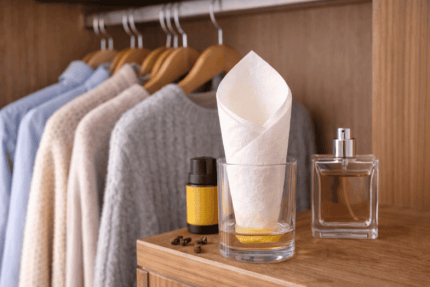
Why do clean clothes start to smell bad in the closet?
An unpleasant smell in your closet doesn't necessarily mean that your clothes are dirty. Even clean fabric gradually absorbs odors from the environment.
This happens especially quickly in a closed space where the air hardly moves.
The most common reasons:
High humidity. Fabrics absorb water vapor from the air, and a humid environment promotes mold growth.
Insufficient ventilation. Odors are trapped between tightly packed items.
Under-dried clothes. Even a little residual moisture after washing can cause mustiness.
Dirty shelves. Dust, cosmetic residue, and other organic contaminants accumulate in hard-to-reach places.
Foreign odors. Tobacco smoke, cooking odors, and perfumes can penetrate fabrics.
Damp wall behind the cabinet. Condensation or hidden leaks sometimes cause a persistent odor.
Furniture installed near cold exterior walls should be checked especially carefully.
If air circulation behind the cabinet is restricted, condensation can form on the wall surface under certain conditions. Over time, this can contribute to the appearance of mold, the smell of which can even penetrate clean items.
Therefore, before using air fresheners, it is important to determine whether it is a normal indoor odor or a moisture problem.
What to put in your closet to keep your clothes fresh: 8 effective options
Different products perform different functions. Some absorb certain odor molecules, others reduce humidity, and still others simply scent the air.
To make the right choice, it is worth considering the nature of the problem.
| Means | Main action | When to use |
| Silica gel | Moisture absorption | Wet closets, seasonal storage |
| Activated carbon | Odor adsorption | Musty air, foreign odors |
| Zeolite | Adsorption of certain substances and moisture | Closed shelves and containers |
| Baking soda | Neutralization of certain odors | Small closed compartments |
| Lavender sachet | Light aromatization | Underwear, casual wear |
| Cedar blocks | Woody aroma | Closets with sweaters and coats |
| Scented soap | Gradual spread of aroma | Drawers and shelves |
| Calcium chloride absorber | More intensive moisture removal | Cabinets with high humidity |
1. Silica gel - when humidity is the main problem
Silica gel is a porous material that can absorb water vapor from the air.
It is often used in packaging shoes, electronics, and other moisture-sensitive goods.
For a closet, it is better to choose ready-made absorbers in durable, breathable packaging.
Small bags can be placed in seasonal clothing compartments, textile organizers, or closed containers.
Silica gel is especially useful where air exchange is limited but there is no active moisture ingress.
It is important to understand: a small bag cannot drain an entire room or eliminate the consequences of a leak.
Some absorbers have a moisture saturation indicator. Others need to be replaced or renewed according to the manufacturer's instructions.
The granules should not come into direct contact with clothing. It is especially important to store such products out of the reach of children and pets.
2. Activated carbon - to absorb odors
Activated carbon has a developed porous surface that is capable of retaining certain gaseous substances.
This process is called adsorption.
For the closet, you can use ready-made textile bags with activated carbon, intended for household use.
They can be useful if clothes are picking up the smell of a closed room or foreign scents.
However, effectiveness depends on the composition of the odor, the amount of charcoal, the humidity of the air, and the duration of use.
Activated carbon is not a complete dehumidifier and will not eliminate mold. If the source of the odor remains, the problem may return even after replacing the absorber.
Do not use loose charcoal without protective packaging. Its particles can stain light-colored fabrics.

3. Zeolite - mineral absorber for closed shelves
Zeolites are a group of porous minerals whose structure allows them to hold molecules of certain substances.
Depending on the type and treatment, zeolite can adsorb moisture and certain compounds associated with odors.
Ready-made zeolite-based absorbers designed for domestic premises are suitable for home use.
They can be placed on a shelf, in a shoe compartment, or in an organizer.
However, not every zeolite is equally effective. Its properties depend on the mineral composition, pore size, and method of preparation of the material.
Therefore, it is worth focusing on the purpose of a specific remedy, and not just on the name of the mineral.
The absorber should be in a closed or sturdy, airtight container to prevent small particles from getting on clothing.
4. Baking soda is a simple remedy for certain odors
Baking soda is often used in everyday life to neutralize unpleasant odors.
Sodium bicarbonate can interact with some acidic substances that cause odor.
However, the effectiveness of baking soda in a closet depends on the specific compounds and the area of contact with air. It does not absorb all odors equally well.
For a small, closed compartment, you can use a sturdy container of baking soda that is protected from tipping and spilling.
There is no need to place the powder directly on the items.
Baking soda can help with certain household odors, but it should not be considered a replacement for a dehumidifier or mold remover.
If the closet has a persistent damp smell, the first priority is to eliminate the moisture.

5. Lavender — for a light natural aroma
Dried lavender flowers can be used to scent shelves with linens, towels, and clothing.
The most convenient format is a small fabric sachet.
Dry plant materials gradually release aromatic compounds, creating a light scent in an enclosed space.
Lavender can be combined with a small amount of other well-dried herbs, such as rosemary.
However, it is important to remember that aromatization does not equal air purification.
If your clothes smell musty, lavender will only partially mask the unpleasant odor.
Do not put fresh flowers, leaves, or insufficiently dried citrus peel in the cupboard. They contain moisture and can spoil in a closed space.
6. Cedarwood – a woody fragrance for your wardrobe
Small cedar blocks, hanger rings, or special wooden inserts are used to scent clothing storage areas.
The wood gradually releases characteristic volatile aromatic substances.
Such accessories are especially often placed in compartments with wool sweaters, coats, and scarves.
Cedar wood is also credited with the ability to protect things from moths.
However, the effectiveness of such protection is limited.
Aromatic wood may affect some insects, but does not guarantee the destruction of larvae and does not provide reliable protection for already infested clothing.
Therefore, cedar blocks are better perceived as an aromatic accessory, rather than as a primary means of pest control.
To avoid stains or snags, wood should not rub directly against delicate fabrics.
7. Scented soap — for drawers with clean laundry
Solid scented soap can gradually spread the scent in a small enclosed space.
This is a simple option for drawers with towels, linens, or casual clothing.
It is better to use a dry bar in paper packaging, which partially lets in the aroma.
Do not put soap directly on the fabric. Some ingredients can leave marks, especially in high temperatures or humidity.
The intensity of the smell should also be taken into account.
Overly scented products can leave a persistent perfumed trace on things, so this option is not always suitable for people sensitive to fragrances.
8. Calcium chloride absorbers - for damp rooms
If the humidity in the closet regularly increases, small silica gel packets may not be enough.
For such situations, there are specialized household absorbers containing calcium chloride.
This substance attracts moisture from the air. During the absorption process, the granules can gradually turn into a liquid solution.
That is why such products are usually supplied in containers with a reservoir for collecting the liquid.
They must be installed vertically on a stable surface, away from clothing and metal parts.
Spilling saline solution can damage items or furniture.
Additionally, a absorber will not solve the problem if moisture is constantly coming in through a wall or a leak. In such conditions, the source of the dampness must be eliminated.
What humidity should be in the closet so that things don't smell musty?
Humidity is one of the most important factors in proper textile storage.
For residential premises, it is usually recommended to maintain relative humidity within approximately 30–50%, and if possible, to prevent it from rising above 60% for a long time.
For the storage of many textiles, moderate, stable humidity is preferable to sudden fluctuations.
How to check the humidity inside a closet
The easiest way is to use a compact hygrometer.
This is a small device that shows the temperature and relative humidity of the air.
It can be left on a shelf for a while, especially if the cabinet is against an exterior wall.
It is important to check the indicators not only immediately after opening the door, but also after the cabinet has been closed for a long time.
If the humidity is consistently high, it is worth checking the room's ventilation, the condition of the wall, and the possible formation of condensation.
Moisture absorbers help control the microclimate in small enclosed spaces, but do not replace normal room dehumidification.
How to properly organize your closet so your clothes stay fresher longer
Even the most effective odor absorber cannot compensate for improper storage of things.
The best result is achieved by a combination of cleanliness, dryness and sufficient space between the fabrics.

Don't fold clothes immediately after washing.
Items must be completely dry before storage.
Particular attention should be paid to dense fabrics, belts, cuffs, pockets, and inner layers of clothing.
Even if the surface appears dry, moisture may remain in the thick seams.
It is also not advisable to fold clothes immediately after steaming while the fabric is still damp.
Leave space between things
A crowded closet impairs air circulation.
In addition, tightly packed items are more difficult to inspect, and accidental contamination may go unnoticed.
It is better to leave small gaps between clothes on hangers, not to overcrowd drawers, and not to press textiles against damp walls.
Do not mix clean clothes with worn ones.
Clothes that have already been worn may contain traces of sweat, sebum, and foreign odors.
Even if the item looks clean, storing it with freshly washed laundry is not always advisable.
It is better to have a separate place for things that you plan to wear again.
Clean shelves regularly
When cleaning, you need to pay attention to corners, joints, drawers, and the space under furniture.
This is where dust, hair, and small fabric particles accumulate.
After wet cleaning, surfaces must be completely dry before returning clothing to them.
How to store seasonal clothes without an unpleasant odor
Most often, a musty smell appears on things that have been unused for several months.
Winter sweaters, coats, blankets, and summer clothes require different storage conditions.
Wool sweaters and cashmere
It is best to keep woolen items clean and dry.
It is advisable to fold heavy sweaters rather than leaving them on thin hangers for a long time, as the fabric can stretch.
Suitable fabric covers or containers, selected taking into account the humidity of the room, are suitable for protection against dust.
If there were already moths in the closet, you need to check the items for damage and pests before storing them.
Bed linen and towels
Cotton and linen fabrics are able to absorb moisture from the air.
Therefore, it is better to store them in dry drawers without pressing tightly against cold surfaces.
For delicate aromatization, a sachet of dried herbs or another product that does not come into direct contact with the fabric is suitable.
Down jackets and winter jackets
Down products should not be left in a highly compressed state for a long time unless the manufacturer provides for such storage.
The down filling must be completely dry.
For long-term storage, it is better to use sufficiently spacious covers or other solutions recommended by the manufacturer.
Can clothes be stored in vacuum bags?
Vacuum bags help save space and isolate things from the outside environment.
However, they are not suitable for all fabrics.
Prolonged strong compression may be undesirable for down products, bulky knitwear and some delicate materials.
Additionally, only completely dry clothes should be placed in the bag.
Hermetic packaging does not remove moisture that is already trapped inside the fabric.
Do lavender and cedar help with moths?
There is a common belief that just putting lavender or a cedar block in a closet is enough to forget about moths forever.
In reality, the situation is more complicated.
The main damage to clothing is caused not by adult butterflies, but by clothes moth larvae.
They can damage wool, fur, feathers and other materials of animal origin.
Contamination with sweat or food residue can also increase the attractiveness of the fabric to pests.
Aromatic plants and wood do not provide guaranteed destruction of larvae.
Better protection involves clean storage, regular inspection, early detection of contamination, and the use of proper cleaning methods.
Special pheromone traps can be used to control the presence of clothes moths. They help detect adult males, but by themselves do not eliminate all larvae.
Chemical mothballs should only be used according to their intended purpose and instructions. Naphthalene and similar insecticides should not be used as ordinary air fresheners in an open cupboard.
What not to put in a fragrance cabinet
Some popular home remedies can have the opposite effect.
Fresh citrus peel. It contains moisture and can spoil in a closed space.
Fresh flowers and herbs. Insufficiently dried plants create an additional source of moisture.
Open containers of essential oils. Accidental spills of essential oils can stain fabrics and furniture.
Excessive amount of perfumed products. Combining several intense scents sometimes creates a heavy smell instead of a feeling of freshness.
Scented wet wipes. These are not intended to be stored next to fabrics for long periods of time and may leave behind moisture or marks.
Unprotected loose absorbents. Soda, charcoal, and mineral granules can spill and stain things.
You should also not place any chemical absorbers in places accessible to small children or pets.

How to get rid of a musty smell if it has already appeared
If your clothes and closet already have an unpleasant odor, simply putting an aromatic sachet inside won't be enough.
It is necessary to determine the cause and eliminate it.
Step 1. Empty the closet completely
Remove clothes, textile organizers, and other items.
Check for damp areas, stains, visible signs of mold, or damage to the furniture.
Pay special attention to the back wall and lower shelves.
Step 2. Clean the surfaces
Remove dust with a vacuum cleaner and wipe the surfaces with a product suitable for the furniture material.
There is no need to over-wet the wood or wood panels.
After cleaning, allow all surfaces to dry completely.
Step 3. Check the condition of the clothing
Items that have developed a musty odor may need to be rewashed or professionally cleaned according to the label.
If there are signs of mold on the fabric, regular fragrance will not make it clean.
For valuable and delicate items, the cleaning method must be chosen especially carefully.
Step 4. Eliminate the cause of the moisture
If the cabinet is next to a cold wall, it is worth checking for condensation.
If necessary, ensure proper ventilation of the room, eliminate leaks, or reduce air humidity.
A persistent musty smell that quickly returns after cleaning may indicate a hidden problem in the construction of the wall or furniture.
Step 5. Add a suitable absorber
Only after eliminating the source of the odor should you place a moisture absorber or a means for adsorbing foreign odors.
If the closet is dry, a small sachet is enough for a light fragrance.
How often to change odor absorbers and air fresheners
The lifespan depends on the material, the amount of absorber and the conditions inside the cabinet.
There is no universal replacement schedule.
Silica gel should be replaced or regenerated according to the instructions. If the package has a saturation indicator, it is worth focusing on it.
Calcium chloride-based absorbers require monitoring of accumulated liquid and timely replacement of consumables.
Activated carbon gradually loses its ability to retain new odor molecules, but the exact period depends on the conditions of use.
Scented sachets can be renewed when the scent becomes weak. However, the absence of scent does not automatically mean that the storage conditions in the cupboard have deteriorated.
The best indicator is not the intensity of the lavender or soap scent, but the absence of dampness, foreign odors, and signs of damage to things.
Conclusion
To keep clothes fresher for longer, it is important to first ensure dryness, cleanliness, and normal air circulation in the closet.
Silica gel and specialized desiccants can help control humidity, while activated carbon and zeolite can help reduce certain odors. Lavender, cedarwood, and scented soaps are good for additional aromatherapy.
However, none of these remedies will replace regular cleaning, thorough drying of clothes, and elimination of moisture sources. It is the correct storage conditions that allow things to remain fresh even after a long stay in the closet.
FAQ: Frequently asked questions about keeping clothes fresh in your closet
What is the best thing to put in a closet to make clothes smell nice?
For a light scent, you can use sachets of well-dried lavender, cedar blocks, or packaged dry scented soap. If there is already an unpleasant odor in the closet, you must first eliminate the source of the odor. Fragrances are not a substitute for cleaning.
How to remove a musty smell from a closet without chemicals?
You need to remove the items, clean and dry the shelves completely, check the back wall for moisture, and ensure ventilation. Activated carbon can be used to absorb certain odors. If the cause is condensation or mold, the moisture problem needs to be addressed.
Does baking soda help get rid of closet odors?
Baking soda can neutralize some odor-causing substances. However, its effectiveness in a closed cabinet is limited and depends on the type of contamination. It is not a substitute for a dehumidifier or for eliminating mold.
What to put in a closet to protect against moisture?
For small closed compartments, you can use silica gel absorbers. In cases of high humidity, special containers with calcium chloride are sometimes used. If the cabinet is constantly damp, you need to check the ventilation of the room and the condition of the wall.
Why do clean clothes smell musty after storage?
The cause may be residual moisture from washing, high humidity in the room, poor ventilation or dirty shelves. Sometimes the source of the smell is not in the clothes, but in the back of the wardrobe or an adjacent wall.
Can I put essential oil in a closet with clothes?
Essential oils can be used for fragrance, but should not be applied directly to fabrics. They can leave stains, and the intense scent may be undesirable for sensitive people. It is safer to use ready-made, sealed fragrances for the appropriate purpose.
Does lavender protect clothes from moths?
Lavender has a distinctive aroma, but does not guarantee protection against clothes moths, especially if larvae are already present in the fabrics. For prevention, clean storage, inspection of woolen items, and timely detection of pests are important.
Can clothes be stored in plastic containers?
Yes, if the items are completely dry and the container meets the storage conditions. However, for delicate and valuable textiles, special archival materials or fabric covers may be better. Hermetic packaging does not remove moisture that is already in the fabrics.
How often should you air out your closet?
The frequency depends on the humidity of the room, the contents of the cupboard and the ventilation conditions. It is useful to open the door regularly when cleaning, to check the condition of things and to prevent moisture from accumulating. If the smell returns quickly, airing alone may not be enough.
How to keep winter clothes fresh until next season?
Before storing, clothes should be cleaned according to the label, dried completely and placed in a dry place. Woolen items should be folded without excessive compression, and down jackets should be folded according to the filling requirements. If necessary, you can add a moisture absorber and periodically check the condition of the items.

