
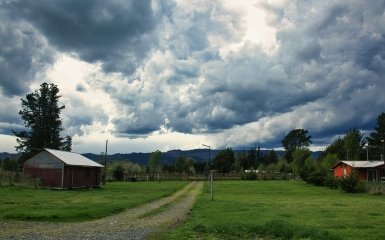
A tree near the house creates shade, protects the yard from the heat, and makes the area more cozy. But a sapling that is only five feet tall today can grow into a large tree with a wide crown and a branched root system in twenty years.
That's why choosing a planting location requires a more careful approach than it seems. Large trees can raise garden paths, complicate the maintenance of underground utilities, shade windows, and create additional load on the soil near the foundation.
Willows, poplars, large maples, oaks, elms, and other trees that grow quickly, reach significant sizes, or actively consume water from the soil require the most attention. However, none of these species can be called dangerous under any circumstances.
The risk depends on the distance to the house, soil type, foundation depth, condition of pipelines, and size of the mature tree.
We analyze which trees are best not to plant near a private house, how roots actually affect the foundation, what distance to keep, and which compact species are suitable for a small yard.
Can tree roots really damage foundations?
It is a common belief that the roots of large trees gradually grow through concrete and destroy the foundation from the inside.
In reality, the mechanism of possible damage is often different.
Roots are usually unable to simply penetrate a solid, intact concrete foundation. However, they can exploit existing cracks, joints, and other weak points in structures.
Even more important is the effect of trees on soil moisture.
How trees affect the soil beneath the foundation
Large trees absorb significant amounts of water through their root system.
If the house is built on clay soil, which changes volume depending on humidity, intensive drying of the soil can contribute to its shrinkage.
During prolonged drought, the soil compresses, and a shallow foundation may experience uneven movement.
This sometimes manifests itself in cracks in the walls, deformation of the finish, or problems with opening doors and windows.
However, in sandy or other soils that do not have significant shrinkage capacity, the risks may be much lower.
So, it is not the roots themselves near the house that are dangerous, but the combination of the characteristics of the tree, the soil, and the building structure.
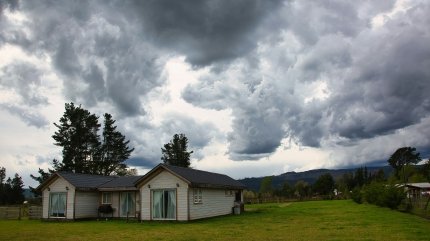
1. Willow: fast growth and extensive roots
Willows are valued for their decorative appearance, rapid growth, and ability to create shade.
However, large tree-like willow species have extensive root systems and require significant amounts of water.
They grow especially well in areas with sufficient moisture.
Because of these features, it is undesirable to plant large willows directly near foundations, underground pipes, and other structures sensitive to changes in soil moisture.
How willow can be problematic
In areas with clay soil, intensive water absorption by roots can increase the risk of soil shrinkage during drought.
Additionally, roots can grow toward wet areas, particularly near faulty drainage or sewer pipes.
But this does not mean that any willow will necessarily damage a house.
Such trees are quite suitable for large areas with a sufficient distance from buildings.
It is also important to distinguish between large willows and compact ornamental forms. Their final sizes can vary significantly.
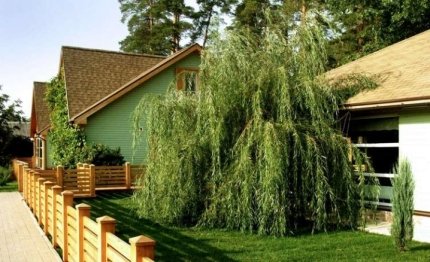
2. Poplar: a large tree that quickly overgrows a yard
Poplars are trees that are able to quickly gain height and form a large crown.
Because of this, they are often used to create green spaces, windbreaks, and shade large areas.
However, for a small private yard, this growth rate can be a disadvantage.
Why you shouldn't plant poplars close to walls
Some species of poplar have very extensive roots and a high need for water.
In soils prone to shrinkage, this can be a risk factor for shallow foundations.
For certain large-growing species, in particular white poplar, specialized gardening recommendations contain a warning against planting closer than 40 meters from buildings.
But this is not a universal legal requirement for all poplars.
The required distance depends on the specific type, soil condition, and building design.
Additionally, it is worth considering the size of the crown and the characteristics of the wood. In some fast-growing poplars, large branches may be more vulnerable to damage during storms.
For a compact garden, it is usually more advisable to choose smaller trees.
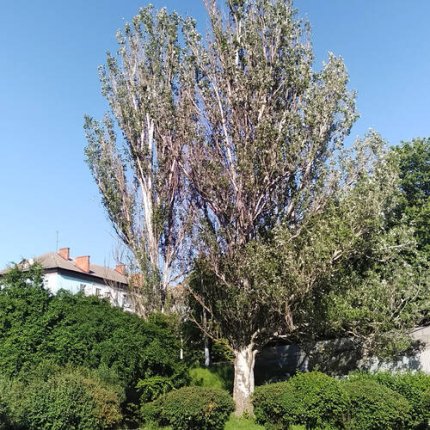
3. Oak: a long-lasting tree that needs a lot of space
Oak is a symbol of durability and strength, but its potential size makes planting near the house a difficult decision.
A common oak can live for centuries, forming a massive trunk and a wide crown.
As an adult, such a tree takes up much more space than the owners anticipate when planting a small seedling.
What risks does an oak tree near a house pose?
First of all, you need to take into account the large root system and water consumption.
On clay soils, mature oaks can affect seasonal changes in soil moisture.
This is especially important for homes with old or shallow foundations.
Another factor is the size of the crown.
If a tree grows too close, its branches can eventually come close to the roof, gutters, and electrical cables.
But a large oak tree in itself is not evidence of danger to a building. With the right distance, it can remain a valuable element of a garden for decades.
To plant it, you need to immediately plan space for many years ahead.
4. Elm: wide crown and active root system
Elms are used in urban landscaping, parks, and large gardens.
They can form a spreading crown that provides significant shading.
However, large elm species require sufficient space for both the crown and roots.
Why is an elm inconvenient near a private house?
In a small yard, a mature tree can shade windows, block part of the garden, and come close to the roof.
The root system is also capable of growing far from the trunk.
Under certain conditions, large roots can affect lightweight walkways or other shallow structures.
On clay soil, you need to additionally consider the tree's water consumption.
At the same time, not all elms have the same size and characteristics.
Before planting, it is important to know not only the genus name, but also the specific species or variety.
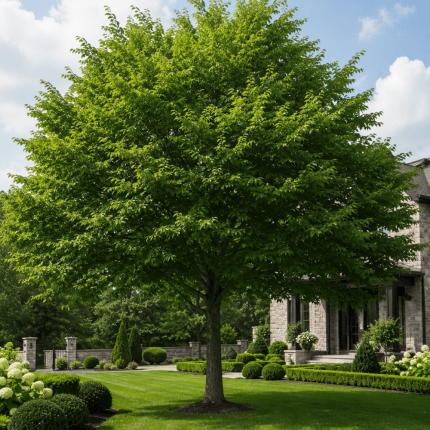
5. Big maples: roots that can lift paths
Maples are often planted for their ornamental foliage, beautiful fall color, and ability to create dense shade.
However, among them there are both compact decorative forms and large trees that require a significant area.
The silver maple and the silver maple require special attention.
Sharp-leaved maple
This is a large tree with a dense crown.
Its roots can spread into the upper layers of the soil and compete with other plants for water and nutrients.
Near light paths, borders and garden surfaces, large surface roots sometimes cause problems.
In addition, a dense crown can significantly shade the area.
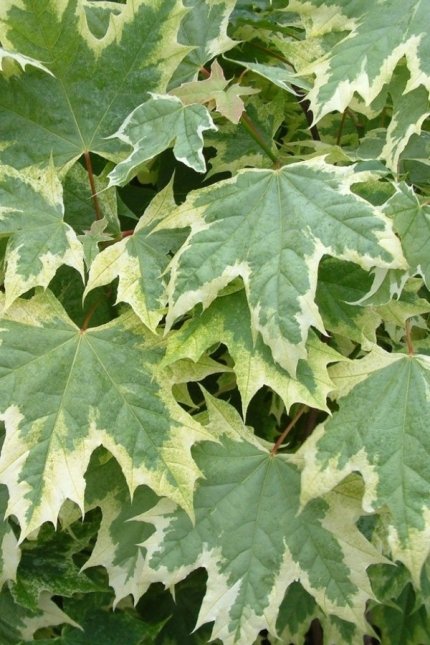
Silver maple
This species is known for its rapid growth and large size.
Its wood is relatively fragile, so individual large branches can break under the influence of strong winds or snow loads.
For a plot near a house, this is an important factor, especially if the tree will eventually hang over the roof.
Silver maple is better considered for large areas.
At the same time, small ornamental maple varieties can be suitable for the garden if placed correctly.
6. Birch: a beautiful tree with a high need for moisture
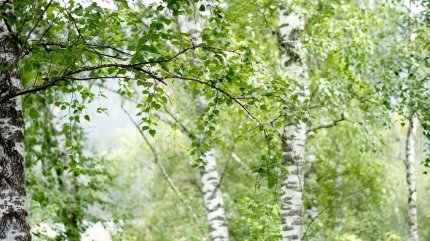
Birch has an openwork crown and decorative light bark, so it seems like a good choice even for a small yard.
However, some birches reach considerable height with age and form widely branched roots.
During dry periods, they can actively use available soil moisture.
Is birch dangerous for the foundation?
It cannot be said that birch necessarily destroys the foundation.
However, near a house on soil that changes volume greatly when drying, a large tree can be an additional risk factor.
Birch roots can also compete with lawn grass and ornamental plants.
If space is limited, it is better to look at compact varieties, but check their adult size.
7. Walnut: large crown and inconvenient proximity to buildings
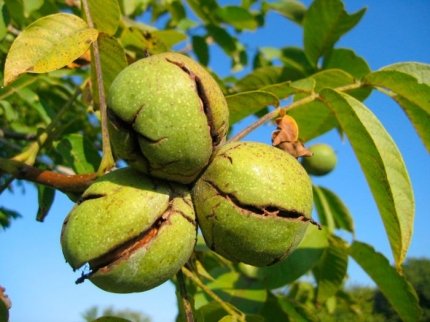
Walnuts are often planted on private plots for their fruit and dense shade.
However, a mature tree may have a broad crown and a powerful root system.
In a small yard, this creates a number of practical inconveniences.
Why is it better to plant walnuts away from the house?
Large branches can come close to the roof, and fruit and leaves can fall onto the roof and into gutters.
The dense canopy also shades a significant portion of the area.
Other plants near the tree may lack light and moisture.
Separately, the location of paths, outbuildings, and underground utilities should be taken into account.
At the same time, the widespread claim that walnuts will necessarily damage any foundation has no sufficient basis.
The main reason for caution is its large size and the need for sufficient space.
8. Large conifers: problems with crown, shading and wind
Spruce and pine trees are often chosen for landscaping around private homes because they remain green all year round.
However, large conifers also need to be placed taking into account their adult size.
In some species, a significant part of the root system is located relatively close to the soil surface.
This does not mean that every spruce tree falls easily or is dangerous to the foundation. The stability of a tree depends on the species, soil, root development, and condition of the wood.
Why you shouldn't plant a large spruce tree under windows
A mature spruce tree can block natural light throughout the year.
Unlike deciduous trees, it does not shed its needles completely in winter and continues to create shade.
In addition, large trees should be placed taking into account wind loads, power lines, and safe access to the facade.
For compact areas, it is better to consider slow-growing or dwarf ornamental forms of conifers.
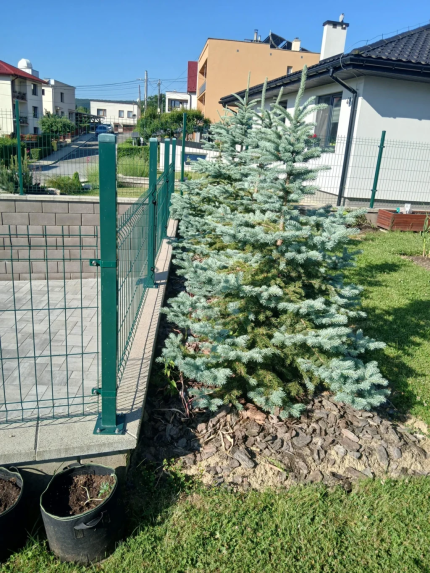
Which trees most often cause problems near the house?
The choice depends not only on the name of the species, but also on its final dimensions.
| Tree | Main risk factor | Which areas is it best suited for? |
| Large-leaved willow | Active water consumption, branched roots | Spacious areas |
| Poplar | Large size, fast growth | Large areas |
| Oak | Wide crown, significant water requirement | Spacious gardens |
| Elm | Branched roots, large crown | Large courtyards and parks |
| Sharp-leaved maple | Surface roots, dense shade | Plots with sufficient space |
| Silver maple | Large size, brittleness of individual branches | Open areas |
| Birch grew big | Moisture consumption, competition with plants | Gardens with sufficient space |
| Walnut | Wide crown, fruits, shading | Areas away from buildings |
No position in the table means an automatic ban on landing the corresponding species.
At what distance from the house can trees be planted?
The distance should be determined taking into account current building and local regulations, the size of the adult tree, and the characteristics of the site.
The Ukrainian rules for maintaining green spaces provide a guideline of 5 meters from the outer wall of the building to the axis of the tree trunk and 1.5 meters to shrubs.
However, the applicability of a specific standard depends on the type of plantation and area.
These numbers do not mean that any tree will be safe at a distance of exactly five meters.
For a large poplar, willow, or oak, this distance may not be enough.
What should be the distance to the neighboring plot?
As of November 2026, DBN B.2.2-12:2019 provides for a distance from the border of an adjacent land plot to the trunks of trees being planted of 4 to 6 meters, depending on the size of the crown, but not less than half its diameter.
For bushes, the distance given is 1 meter.
Before landing, you must take into account the current version of the regulations, the specifics of the territory, and possible additional local requirements.
Why it's not enough to just measure five meters
Let's imagine two trees.
The first is an ornamental apple tree, which when mature will have a crown approximately three meters wide.
The second is a large poplar, capable of forming a much wider crown.
Even if both trees are planted at the same distance from the house, their impact on the area will be different.
In addition, roots can extend far beyond the crown projection.
Therefore, before planting, it is necessary to assess the future height and width of the crown, as well as the conditions for the development of the root system.
Can tree roots grow into sewer pipes?
Yes, but most often the problem occurs where the pipeline already has damage or leaky connections.
Roots naturally grow towards areas where water, oxygen and nutrients are available.
If an old pipe is leaking, the surrounding soil may remain wetter.
This creates favorable conditions for roots to penetrate through cracks or joints.
Properly sealed modern pipelines are usually much less vulnerable to such a problem.
Should you be afraid of roots near a septic tank?
Plants should be chosen especially carefully near septic tanks, drainage systems, and infiltration fields.
Large trees with extensive roots can complicate the operation and maintenance of underground structures.
You should not plant a tree directly over pipes or where access may be required for repairs.
Before landing, it is important to know the exact location of communications.
What trees are best to plant near a private house?
If the yard is small, it is more practical to choose species and varieties with predictable compact sizes.
At the same time, the concept of "small tree" is relative: even a tree five meters tall needs space for its roots and crown.
Decorative apple trees
Compact varieties of ornamental apple trees may be suitable for small gardens.
They bloom in the spring, and in the fall some form decorative fruits.
However, before purchasing, it is important to know the height and width of a particular variety at maturity.
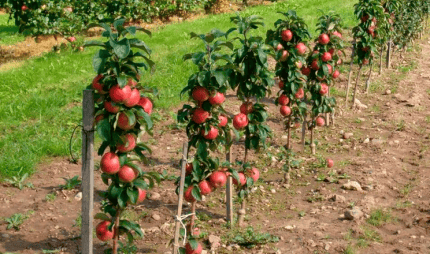
Apple trees on dwarf rootstocks
For a small orchard, you can consider apple trees on dwarf or semi-dwarf rootstocks.
The size of such a tree is determined not only by the apple variety, but also by the rootstock.
Individual dwarf apple trees can grow to approximately 2.5–4 meters, depending on the rootstock and conditions.
However, they sometimes have a weaker anchorage in the soil and require support.
Compact pear varieties
For small areas, there are also pears on rootstocks that limit growth force.
However, their suitability depends on winter hardiness, rootstock compatibility, and climatic conditions.
You need to choose a specific variety and rootstock, not just a tree labeled "dwarf."
Hawthorn
Some ornamental forms of hawthorn are well suited for small gardens.
They bloom beautifully and can form decorative fruits.
But some species have thorns and grow quite large, so they should not be planted close to walkways.
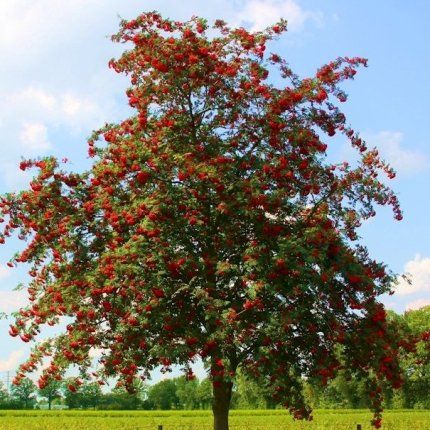
Rowan
Rowan can become a decorative accent thanks to its flowers, berries, and fall color.
However, common mountain ash can grow to considerable heights, so for a compact yard it is better to consider suitable varieties and check their final dimensions.
A compact variety does not mean that the tree can be planted directly next to the foundation. The correct distance remains a prerequisite.
How to choose a tree for a small yard
Before purchasing a seedling, it is important to evaluate not its current appearance, but the characteristics of the adult plant.
First of all, pay attention to:
expected height in 15–20 years;
maximum crown width;
growth force and features of the root system;
water need;
wind resistance;
number of leaves, fruits and seeds;
lighting requirements;
suitability for the local climate.
For fruit trees, be sure to specify the type of rootstock.
For example, two apple trees of the same variety can differ significantly in size due to the use of different rootstocks.
Also, you don't need to rely solely on the designation "columnar".
The shape of the crown does not always mean that the root system will be as compact.
Can you plant a tree near the house if you prune it regularly?
Pruning helps shape the crown, but does not turn a large tree into a naturally dwarf tree.
The root system and overall growth strength depend on the species, variety, age, and growing conditions.
Regularly reducing the height can be costly and is not always safe for the health of the tree.
Radical pruning of the top is especially undesirable, after which numerous weakly attached shoots may form.
Therefore, it is better to immediately choose a tree of the appropriate size.
Pruning should maintain the correct crown structure, not compensate for a poor planting location.
What to do if a large tree is already growing too close to the house
The mere fact that there is a large tree near the wall does not mean that it needs to be cut down immediately.
Most trees growing near buildings do not cause structural damage.
First, you need to assess the actual condition of the tree and the house.
What signs need attention?
new or noticeably enlarged cracks in the walls;
uneven subsidence of paths or paving;
large dry or damaged branches above the roof;
a tilt of the tree that was not characteristic before;
peeling bark, hollows or signs of rot;
regular problems with sewage;
damage to the trunk or root collar.
Not every crack in a house is caused by wood.
The cause may be construction errors, soil subsidence, faulty drainage, or other factors.
Therefore, drawing a conclusion solely on the basis of the proximity of the roots is incorrect.
Can you just cut the roots?
Cutting large roots near the trunk yourself can be dangerous.
This can damage the tree, disrupt its water supply, and reduce its resistance to wind.
It is especially risky to cut off large supporting roots on one side.
If roots are lifting the path, it is best to evaluate the possibility of changing the pavement design or another way to solve the problem.
You should not automatically destroy part of the root system for the sake of a flat tile.
Do root barriers help protect foundations?
A root barrier is a special structure that limits or directs root growth.
Such solutions are sometimes used in landscape construction, in particular near paths and engineering structures.
However, the barrier does not guarantee a complete stop to the spread of roots.
Roots can change their growth direction and pass under the structure if they find suitable conditions.
Additionally, installing a deep barrier near a mature tree may require damaging part of its root system.
Therefore, the most reliable prevention is the correct choice of planting location.
What mistakes are made when planting trees near the house?
Focus on the size of the seedling. After a few decades, the tree can become several times larger.
Ignoring soil type. For clay areas, the effect of large trees on moisture is especially important.
They don't check the location of the pipes. Underground utilities can be damaged during digging.
Trees are planted without considering the neighboring plot. Over time, the wide crown and roots can cause conflicts.
They hope to control the size by constant pruning. This is not always effective and can worsen the condition of the tree.
Large trees are planted under power lines. Over time, the branches can approach the danger zone.
They do not take into account future shading. A mature tree can significantly reduce the lighting in rooms and the garden.
Deciding to cut down a tree without determining the cause of the cracks. On clay soils, a sudden change in water consumption after removing a large tree can also cause soil movement in some cases.
How to plan planting a tree near the house: a practical example
Let's say there is a strip of land six meters wide between the house and the fence.
The owner wants to plant a tree that will create shade over the terrace.
A large willow, poplar, or oak in such a space may become uncomfortable over time due to the size of its crown and root system.
Even if the seedling initially looks compact, as an adult the tree can grow close to walls, a fence, or a roof.
In addition, it is necessary to take into account the regulatory distances to the adjacent plot. Under such conditions, planting a tree in this narrow strip may not meet the requirements at all.
A more practical solution is sometimes decorative shrubs of appropriate size or other landscaping that does not require a large space.
If the plot is spacious, a large tree can be placed at a sufficient distance from buildings, leaving room for the natural development of the crown.
Conclusion
There is no universal list of trees that are prohibited from being planted near a house under any circumstances.
However, large willows, poplars, oaks, elms, some maples, birches, and walnuts require particularly careful site selection due to the size of their crown, root system, and water consumption characteristics.
The main risk for foundations is often not related to mechanical destruction of concrete by roots, but to changes in the moisture content of clay soil. For pipelines, already damaged or leaky connections are usually more dangerous.
For a small yard, it is better to choose compact ornamental trees and fruit varieties on appropriate rootstocks, always taking into account their adult size and standard distances.
FAQ: Frequently asked questions about trees near the house
What trees should not be planted close to the foundation?
Caution is especially needed with large willows, poplars, oaks, elms, and some maples. Their size and root systems can cause problems if planted incorrectly. However, the risk depends on the species, soil, and foundation design.
At what distance from the house should trees be planted?
Ukrainian rules for maintaining green spaces provide a guideline of 5 meters from the outer wall of a building to the axis of a tree trunk. However, the specific applicability of the standards depends on the territory, and for large species, this distance may not be sufficient.
Can tree roots destroy a concrete foundation?
Roots usually do not penetrate strong, intact concrete. However, they can penetrate existing cracks. In clay soils, large trees can also affect soil shrinkage through intensive water absorption.
Can I plant walnuts near the house?
It is possible if there is enough space and the necessary distances are observed. However, a mature walnut forms a large crown, creates shade, and its leaves and fruits can accumulate on the roof and near gutters.
Is it dangerous to plant a birch tree near a foundation?
Not necessarily. However, large birches can actively use soil moisture and form an extensive root system. In areas with clay soil and shallow foundations, this should be taken into account.
What are the best trees to plant in a small yard?
You can consider compact ornamental apple trees, certain varieties of hawthorn, small ornamental trees and apple trees on dwarf rootstocks. The choice depends on the area, lighting, soil and regulatory requirements for distances.
Can a tree damage a sewer?
Roots can penetrate sewer or drainage pipes through cracks and loose joints. Properly sealed pipelines are much less vulnerable. Therefore, it is important to consider the condition of communications and not plant large trees directly above them.
Do I need to cut down a tree if it grows close to the house?
No, proximity alone does not mean removal is necessary. You need to assess the health of the tree, the condition of the foundation, the presence of cracks and the risk of falling branches. The decision should be based on real signs of danger, not just distance.
Can you trim the roots of a tree so it doesn't damage the house?
Cutting large roots yourself can weaken the tree or reduce its stability. It is especially dangerous to cut supporting roots near the trunk. The method of solving the problem depends on the location of the roots and the condition of the tree.
Does a root barrier help protect a house?
In some situations, root barriers can help guide root growth. However, they do not provide complete protection, as roots can grow under the structure. The most effective way to prevent problems is to properly site the tree before planting.

