
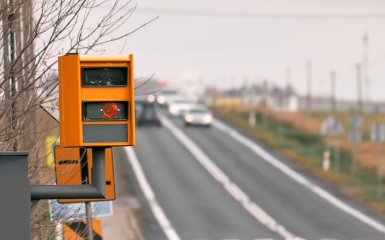
A speed camera should not be perceived as a “camera post” in front of which it is enough to brake sharply. Modern speed control systems work in different ways: some measure the speed in a specific area in front of the camera, others accompany the car with a video recording, and still others can record approaching or receding vehicles. There is no exact universal distance from which any speed camera records a car.
Points of attention
- Braking suddenly in front of a camera does not guarantee avoiding a fine and can create a danger for the car behind.
- TruCAM is a portable laser speedometer used by patrol officers.
- The device can start following the vehicle, read data, perform measurements, and generate evidence before the driver even visually realizes that it is a speed camera.
In Ukraine, stationary complexes of automatic photo and video recording and portable laser devices TruCAM operate. The stationary system records violations automatically, and information after the event is sent to the data processing center of the Patrol Police Department. There, an authorized police officer checks the materials and issues a resolution if there are grounds for a fine.
The main practical advice for the driver is simple: do not try to guess the measurement point. It is safer to reduce the speed in advance, even before the control area, and keep it within the permitted limits. Braking sharply in front of the camera does not guarantee avoiding a fine and can create a danger for the car behind. Ukrainian traffic rules directly prohibit braking sharply, except in cases where it is impossible to prevent an accident without it.
What search intent does this topic have?
The intent is mixed: informational, instructional, and partly legal. The driver wants to understand when exactly the camera measures speed, at what distance the speed camera operates, whether it is possible to brake in time, what error is taken into account, when a fine is issued, and whether a stationary camera differs from a TruCAM.
Therefore, the answer should explain not one “secret”, but the entire chain: speed limit, type of device, measurement zone, moment of fixation, photo or video, processing of materials, responsible person, fine, and safe behavior on the road.
Speed camera, auto-fix camera and TruCAM: what's the difference?
In everyday life, the word “speed camera” is often used to refer to any speed camera. In reality, it can be a variety of equipment.
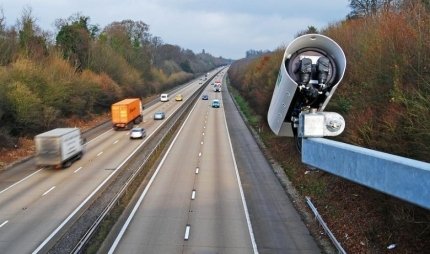
A stationary auto-fixing complex is a fixed technical device that operates in automatic mode. It detects events with signs of traffic violations, takes photos or videos, recognizes license plates and transmits data to the system. The National Police notes that such complexes are placed in hazardous areas or areas of concentration of road accidents, and the installation locations are agreed with the authorized body of the National Police.
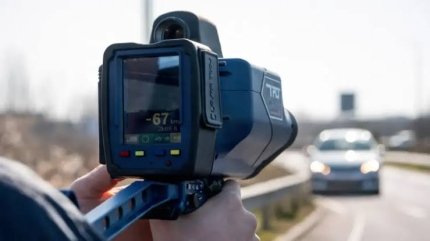
TruCAM is a portable laser speed camera used by patrol officers. It can be used in designated areas, mainly where automatic speed cameras are already in operation or are appropriate. The patrol police reported that the locations of TruCAM use are determined taking into account the accident rate, and service vehicles with blue flashing lights on must be in a visible place.
That is, a stationary camera works without the driver stopping, while TruCAM is usually associated with patrol control in a specific area. But both options have the same goal - to record exceeding the established speed limit.
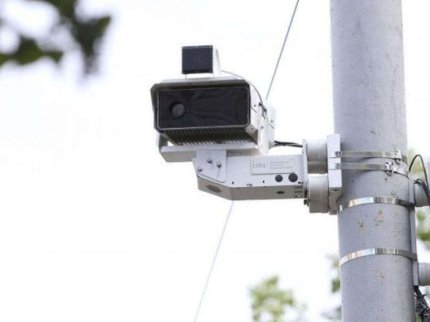
At what distance does the camera record speed?
There is no single number for all cameras. The distance depends on the type of complex, installation angle, traffic lane, optics, radar or laser module, settings, road geometry, visibility, markings, and the method of forming evidence.
For stationary cameras, it is important to distinguish three things:
from what distance the camera sees the car;
in which zone the device measures speed;
at what point is a photo taken or evidence formed.
The camera can see the car before the violation event occurs. The license plate can be recognized after the speed measurement. The photo may not be taken at the same moment when the system calculated the speed. Because of this, the driver cannot accurately determine the “line” after which it is too late to brake.
The situation is different with TruCAM. It is a laser device that can measure speed at a much greater distance than most drivers expect. The Ministry of Internal Affairs, in its announcement about the use of TruCAM, noted that the device has laser guidance and allows measuring speed at a distance of up to 1200 meters. The technical specification of the LTI 20/20 TruCAM II also indicates a maximum range of 1200 m, a speed range of 0–320 km/h for approaching or receding vehicles, a speed measurement accuracy of ±2 km/h, and a measurement time of 0.33 seconds.
This does not mean that every measurement in Ukraine is performed from exactly 1200 meters. It means that relying on “I saw the device — then I’ll slow down” is technically unreliable.
Why a camera can capture a car before the driver notices it
The driver looks at the road, traffic, signs, pedestrians, the navigator and mirrors. A camera or laser device works differently: it does not “assess” the situation like a person, but performs measurements according to a built-in algorithm. The device can start following the vehicle, read the data, perform measurements and form evidence even before the driver visually understands that this is a speed camera.
This is especially true for TruCAM. LTI’s technical materials for TruCAM II state that the device collects speed measurements for approaching and receding traffic, can store photo and video evidence of the violation, and has a rear license plate mode, where speed is measured during approach and the chain of evidence continues until the rear license plate is captured.
Because of this, the common belief that “the photo was taken after the camera, so the speed was measured there” may be incorrect. In different measurement systems, video recording and the photo of the license plate may be separated in time.
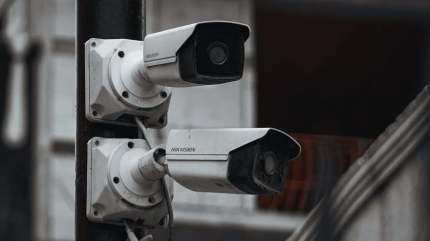
Is it possible to brake in time in front of a speed camera?
Sometimes a driver can indeed slow down before entering the measurement zone. But trying to do this at the last second is dangerous and unreliable. You don't know the exact settings of the device, you can't see the boundaries of the measurement zone, and you can't be sure that the speed hasn't been recorded yet.
Braking hard in front of a camera has several risks:
the car behind may not have time to react;
the driver may lose control on wet or slippery roads;
the maneuver can create a braking wave in the flow;
the camera could have already measured the speed earlier;
a patrolman with TruCAM can work much further than it seems;
Sudden braking in itself is prohibited by traffic regulations without the need to prevent an accident.
The Ukrainian traffic rules require that a safe speed be chosen, taking into account the road conditions, the condition of the vehicle and the load, so that the driver can constantly control the traffic. In the dark and in conditions of poor visibility, the speed should allow the car to stop within the visibility of the road.
The camera should not be a signal for panic braking, but for checking whether the speed complies with the limit on the entire section.
What is the speed limit in Ukraine?
The basic restrictions in Ukraine are set by the Traffic Regulations. In built-up areas, the speed of vehicles is allowed at a speed of no more than 50 km/h. In residential and pedestrian areas, it is no more than 20 km/h. Outside built-up areas, the following guidelines apply to most vehicles: up to 90 km/h on other roads, up to 110 km/h on roads with separate carriageways separated by a median strip, and up to 130 km/h on motorways.
But the actual limit on a specific section may be lower or higher due to signs. For example, in cities, the speed limit on certain roads may be increased subject to appropriate road conditions and approval by the National Police. The National Police cited the example of Kyiv, where on some roads during a certain season, 80 km/h was allowed, and the fine threshold for cameras was calculated from this speed.
Therefore, the driver should focus not on the “usual 50”, but on signs, seasonal modes, road type, and specific section.
Permissible excess: why “+20” does not mean a safe margin
In Ukraine, a fine for speeding does not apply for every extra kilometer. According to the current logic, responsibility for exceeding the established speed limits begins at more than 20 km/h. For automatic fixation, the permissible error of the device is also taken into account, but not more than ±3 km/h.
An example from the official explanation: if the speed limit in Kyiv is 50 km/h, and the maximum error of the device is ±2 km/h, a fine will be imposed when the complex records 73 km/h or more. The logic is as follows: 50 + 20 + 2 = over 72 km/h.
But this does not mean that “you can safely drive 70”. There is a difference between the technical threshold for liability and safe speed. If a driver drives faster than the permitted speed near a school, pedestrian crossing, stop, intersection or in the rain, the risk of an accident increases even without a fine.
WHO emphasizes that higher speed increases the likelihood of accidents and the severity of the consequences: every 1% increase in average speed is associated with a 4% increase in the risk of a fatal accident. Therefore, “no fine” and “safe speed” are different concepts.
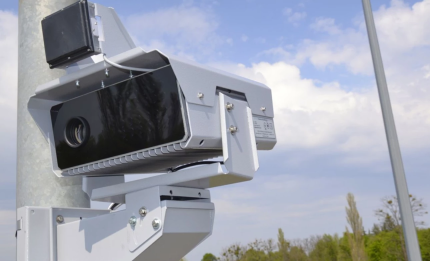
What are the fines for speeding?
As of the date of preparation of the material, exceeding the established speed limits by more than 20 km/h is punishable by a fine of UAH 340, and exceeding by more than 50 km/h is punishable by UAH 1,700. Such amounts are indicated in official materials of the Patrol Police and the Ministry of Internal Affairs.
The fine for auto-fixing can be paid with a 50% discount if it is paid within the time limit specified by law. The Ministry of Internal Affairs reports that the fine is reduced by 50% if it is paid within 10 calendar days from the date of receipt of the resolution. The total term for paying the fine is 30 days from the date the resolution enters into force.
An important nuance: if the car is not used by the owner, it is worth appointing an appropriate user. The individual or head of the legal entity under which the vehicle is registered, or the appropriate user, if his data is entered in the Unified State Register of Vehicles, is responsible for automatically recorded violations.
What exactly goes into auto-fixation materials?
The auto-recording system generates more than just a photo of the car. The materials must contain data that allows you to identify the event, vehicle, place, time, and signs of a violation. The Ministry of Internal Affairs explains that after the event is recorded, the information is sent to a data processing center, where an authorized police officer reviews the materials, taking into account information from the registers.
In the violation check service, the driver can view an image or video recording of the vehicle at the time of the administrative offense and the resolution in electronic form.
It is usually important for the driver to check:
date and time of the event;
place of fixation;
license plate;
recorded speed;
permitted speed on the site;
the amount of the excess;
photo or video quality;
does the car belong to him?
whether the proper user has been assigned.
If the materials show another car, the license plate is recognized incorrectly, or there are other reasons to doubt the decision, it can be appealed in accordance with the established procedure.
Where do speed cameras work?
Cameras should not be installed randomly. The National Police notes that stationary devices are placed in emergency-prone areas or areas of concentration of road accidents, and the installation locations are agreed in writing with the authorized body of the National Police.
The Ministry of Internal Affairs reported in 2026 that 376 control devices are operating in places of concentration of road accidents with serious consequences, in 32 cities and 18 regions of Ukraine, except for regions where hostilities are ongoing. The same report states that the addresses of all complexes and the permitted speed on the sections are available on the Ministry of Internal Affairs portal in the autofix section.
This is useful for drivers not as a way to “avoid the camera,” but as a way to understand risky areas of the route. If a camera is installed near a crossing, school, intersection, or emergency section, it is worth driving more carefully there, regardless of whether the device is working at a particular moment.
Why fixation may not occur where the sign is
A warning sign about photo or video recording does not mean that the measurement is already starting right next to the sign. The sign should warn the driver about the control so that he has time to check the speed and bring the traffic in line with the rules without dangerous braking.
The same applies to speed limit signs. The camera may be installed further away, but the speed limit starts to apply according to the rules for installing the signs, and not from the moment the driver sees the camera housing. The traffic rules also stipulate that additional speed limits can be introduced temporarily or permanently, and permanent restrictions are allowed, in particular, in dangerous areas, near unregulated pedestrian crossings, road patrol police stations and near childcare facilities.
Therefore, it is important to brake not in front of the camera, but before the beginning of the section where the restriction applies.
Can cameras monitor multiple lanes?
Yes, modern complexes can be configured to control multiple lanes, but specific capabilities depend on the model, certification, installation location, and algorithms. DSTU 8809:2018 applies to remote traffic enforcement devices with photo and video recording functions, including speedometers and meters of spatio-temporal vehicle location parameters; such devices may have an automatic license plate recognition system.
For the driver, this means that you should not rely on the adjacent lane, a truck nearby, or “cover” by other cars. If the system is able to determine the vehicle, speed, and license plate, maneuvering in the flow is not a reliable way to avoid responsibility.
On the contrary, sudden changes near a camera can create an additional risk of an accident. It is safer to stay in your lane, not provoke braking from behind, and adhere to the speed limit.
How TruCAM laser measurement works
A laser speedometer does not “take pictures of speed.” It determines the distance to the target using laser pulses, compares the change in distance over a short period of time, and calculates the speed. Videos and photos are needed for the evidentiary part: show the vehicle, license plate, location, time, and measured data.
Laser Technology describes the TruCAM II as a laser photo and video capture device that collects evidence for speeding, short-distance driving, aggressive driving, and other violations; specifications include measurement speed, range, accuracy, night mode, GPS, and data encryption.
The TruCAM II specification states that the device has pre-measurement video — 1.2 seconds of video before the speed measurement; after the measurement, the parameters for further storage are determined by the operator. This is an important detail: the video can show the movement up to the moment of a specific measurement, and not just one frame.
Should a patrolman stand openly?
According to official reports from the Patrol Police, road signs warning of photo and video recording are installed in places where TruCAM is used, and patrol police service vehicles with blue flashing lights on must be in a visible location.
This does not mean that the driver can ignore the speed until the crew sees it. Firstly, the device can measure speed at a long distance. Secondly, stationary complexes operate separately from the patrol crew. Thirdly, traffic rules apply regardless of whether the driver sees the control.
The correct logic is this: a road sign and visible crew should warn the driver about control and discipline traffic, and not create a game of "made it - didn't make it."
Can they fine you based on the data of an automatic camera without a driver in place?
Yes. The automatic system does not require the vehicle to stop in place. The decision can be made without the participation of the person being held administratively liable.
For a vehicle registered in Ukraine, the responsible person is usually the owner or the authorized user, if included in the register. For a vehicle registered outside of Ukraine, the person who imported such a vehicle into the territory of Ukraine is held administratively liable.
You can check the fine on the web portal of the Ministry of Internal Affairs, in the Driver's Cabinet, in the application or web portal "Diya", in the application of the Ministry of Internal Affairs "Traffic Fines" and through the corresponding Telegram bot.
Why are cameras placed in dangerous areas?
Speed enforcement is not a technical “trap”, but a road safety tool. The European Commission notes that speed enforcement using cameras is most appropriate where accidents are concentrated in specific areas and are related to speeding; it is estimated that automatic enforcement can reduce the number of accidents by 15–20%, although the effectiveness depends on many conditions.
NHTSA also summarizes international research and notes that speed cameras can reduce speeding and crashes, with the best-controlled studies indicating a likely 20–25% reduction in injury crashes at visible stationary control areas.
Therefore, the presence of a camera near the road is a marker of an area where speed matters for the consequences of an accident. You should be especially careful near crossings, schools, intersections, public transport stops, places with poor visibility and areas with frequent road accidents.
The most common myths about speed cameras
Myth 1. The camera only captures what is directly in front of you.
No. The operating range depends on the type of device and its settings. Some systems can monitor traffic at the entrance, others after passing through, and some laser devices operate at a considerable distance.
Myth 2. If you manage to brake in front of the pole, there will be no fine
Not necessarily. The measurement could have taken place earlier. In addition, sudden braking is dangerous in itself and may violate traffic rules.
Myth 3. “+20 km/h” is the speed limit
No. This is the threshold for administrative liability for exceeding the speed limit, not a new speed limit. The permitted speed remains the one established by the traffic regulations or road sign.
Myth 4. The camera always automatically subtracts 10 km/h
In Ukraine, for automatic fixation, the permissible error of the device is taken into account, but not more than ±3 km/h. The specific logic depends on the permitted speed and the error of the complex.
Myth 5. If the car is not mine, the fine does not apply to me
For auto-fixing, the responsibility lies with the owner or proper user. If the actual driver is different, this issue should be formalized through the prescribed procedure, and not ignore the resolution.
What to do if you get a speed camera ticket
Check your materials first. Don't automatically pay if you see an obvious error, but don't wait until the deadline to check.
Procedure:
Open the resolution through the official service of the Ministry of Internal Affairs, Driver's Office, "Diya" or the "SDA Fines" application.
Check the date, time, address, and direction of travel.
Check the license plate and make of the car.
Look at the photo or video of the violation.
Check the speed limit and the posted speed.
Assess whether the owner, authorized user, or another person was driving.
If everything is correct, pay the fine on time.
If there are grounds for objection, prepare a complaint.
A complaint against the resolution may be filed within ten days from the date the resolution enters into legal force to a higher authority or to a court.
How to drive around cameras without stress
The best tactic is not to look for the camera with your eyes, but to drive in a way that the camera does not change your behavior. If the speed is within the limit, the driver does not get nervous in front of the poles, does not brake at the last moment and does not create an emergency situation.
Practical rules:
look at the signs, not the camera body;
slow down early;
do not stay too close to the car in front;
do not brake suddenly without danger;
do not accelerate immediately after the camera;
do not “hide” behind trucks;
don't rearrange yourself in front of the camera;
check the speedometer regularly;
In rain, fog, darkness, and ice, drive slower than the maximum speed if the situation requires it.
Safe speed is not always the maximum speed allowed. Traffic regulations require you to take into account the road conditions and be able to control the movement of the vehicle.
What is important for novice drivers
For drivers with a first license for 2 years, fines have additional significance. The State Center of the Ministry of Internal Affairs reminds that a first driver's license can be exchanged if there are no more than two administrative offenses in the field of road safety; fines for automatic photo and video recording of the car owner are also taken into account, even if he was not behind the wheel.
Therefore, novice drivers should be especially careful to register the correct user if someone else is driving the car. Otherwise, a fine recorded by a camera may affect the future exchange of the license.
Typical mistakes drivers make near speed cameras
The first mistake is to brake only when the camera is already in front of the hood. The device could have measured the speed earlier.
The second mistake is to drive “permitted +20”. This is not the permitted speed, but the limit of responsibility. In dangerous conditions, even this speed can be too high.
The third mistake is to suddenly slow down in front of a camera. This risks being hit from behind and disrupting the flow of traffic.
The fourth mistake is to accelerate immediately after the camera. The section may have several complexes or TruCAM control further along the route.
The fifth mistake is to think that TruCAM is visible in advance. The technical range of laser measurement can be significant, and the moment of fixation itself lasts a fraction of a second.
The sixth mistake is not checking the order. Mistakes are rare, but the driver should check the license plate, location, time, and materials.
The seventh mistake is not assigning the right user to a company or family car. If the car is impounded, the fine may not go to the person who was actually driving.
Conclusion
Photo radar does not have a single universal fixation distance. Stationary cameras, automatic photo and video fixation complexes and TruCAM work on different principles, and the actual measurement zone depends on the device, settings, lane, installation angle and road conditions. In the case of TruCAM, the technical range can reach 1200 meters, so trying to “slow down when you see the device” is not a reliable strategy.
In Ukraine, the fine for speeding starts at more than 20 km/h above the established limit, taking into account the permissible error of the device for automatic fixation. But this does not make exceeding it safe. The permitted speed is determined by the traffic rules and road signs, and the driver is obliged to choose such a speed that he can control the car and not create danger.
The best response to any camera is predictive driving: reduce speed in advance, keep your distance, do not brake sharply, do not change lanes randomly, and adhere to the speed limit throughout the entire area, not just near the camera pole.
FAQ
At what distance does a photo radar detect a car's speed?
There is no universal distance. It depends on the type of device, installation angle, lane, optics, road conditions and algorithm. For TruCAM II, the technical specification indicates a maximum range of 1200 m and a measurement time of 0.33 seconds, but this does not mean that every measurement on the road is performed from this distance.
Is it possible to brake in front of a camera and avoid a fine?
There is no guarantee. The camera or TruCAM could have measured the speed before the driver noticed the device. Braking suddenly in front of the camera is also dangerous for the car behind and is prohibited by traffic regulations without the need to prevent an accident.
What is the speed limit in a settlement in Ukraine?
In built-up areas, the basic speed limit is 50 km/h, in residential and pedestrian areas - 20 km/h. In some areas, the speed limit may vary due to road signs or special decisions of road owners, agreed with the National Police.
When does a speed camera issue a fine in the city?
According to the official example of the Patrol Police, if the speed limit is 50 km/h and the device error is ±2 km/h, a fine for auto-fixing is imposed at a speed of 73 km/h or more. This is the logic of 50 + 20 + 2, i.e. the excess must be more than 72 km/h.
What are the fines for speeding in Ukraine?
For exceeding the established speed limit by more than 20 km/h, the fine is 340 UAH, and for exceeding 50 km/h - 1700 UAH. These amounts are indicated in official materials of the Patrol Police and the Ministry of Internal Affairs.
Does the camera subtract the error automatically?
For automatic fixation, when issuing a resolution, the permissible error built into the control device is taken into account, but not more than ±3 km/h. The specific threshold depends on the permitted speed on the site and the error of the complex.
Can TruCAM capture a car moving away?
Yes. The TruCAM II technical specification states a speed range of 0–320 km/h for approaching and receding vehicles. The device also has a rear plate mode, where it can measure speed during approach and track the event until the rear license plate is captured.
Where can I check a camera fine?
Fines can be checked on the web portal of the Ministry of Internal Affairs, in the Driver's Cabinet, in the application or web portal "Diya", in the mobile application of the Ministry of Internal Affairs "Traffic Fines" and via the telegram bot "Traffic Fines".
Who pays the fine if the owner was not driving?
The owner of the vehicle or the authorized user, if their data is entered in the Unified State Register of Vehicles, is responsible for automatically recorded violations. For vehicles with foreign registration, the person who imported the vehicle into Ukraine is responsible.
Can I appeal the auto-fixation decision?
Yes. A complaint can be filed within ten days from the date the resolution enters into legal force to a higher authority or to the court. Before doing so, it is worth checking the photo or video, license plate number, location, time, speed limit, and recorded speed.

