
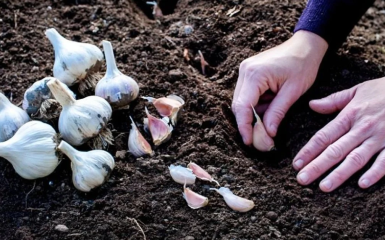
Winter garlic is planted in the fall so that it can establish a root system before winter sets in and quickly resume growth in the spring. However, determining the right moment can be difficult: the ground can still be warm in September, October often brings prolonged warming, and the first night frosts do not always mean the approach of real winter.
If you plant garlic too early, it can actively germinate and form a significant number of leaves before frost. If you plant too late, the cloves will not have time to properly take root before the soil freezes.
The best time to plant winter garlic is when the soil has cooled to approximately +8…+12 °C, and there are approximately 3–6 weeks left before it freezes.
This is not a universal date, but a practical guideline. The specific moment depends on the region of Ukraine, weather conditions, soil temperature, and the characteristics of the variety.
We'll figure out when to plant winter garlic in September, October, and November, how to check the soil temperature, how deep to plant the cloves, whether to water the bed, and what to do if the garlic still sprouts before winter.
Why is it important to choose the right time to plant winter garlic?
Garlic is a cold-resistant crop, but the success of its wintering largely depends on the development of the root system.
After planting, the clove uses the stored nutrients to form roots and begin growth.
Roots help the plant anchor itself in the soil and absorb water.
When the temperature decreases, the intensity of growth processes gradually slows down.
In the spring, after the ground warms up, development resumes.
What happens if you plant too early?
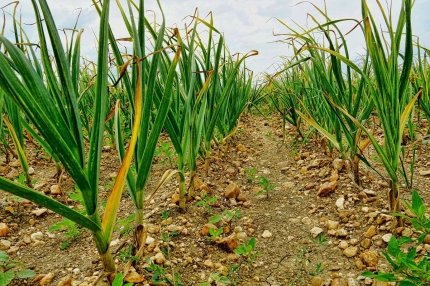
If the soil is still warm, the clove may begin to actively form not only roots, but also above-ground shoots.
During a long, warm autumn, leaves sometimes grow several or even tens of centimeters.
Young green parts can be damaged by severe frosts, especially in the absence of snow cover.
However, the mere fact that sprouts appear in the fall does not mean that the garlic will necessarily die or not produce a harvest .
Cold-resistant varieties often resume growth in spring even after partial leaf damage.
The greatest risk arises from a combination of early active growth, severe frosts, and unfavorable wintering conditions.
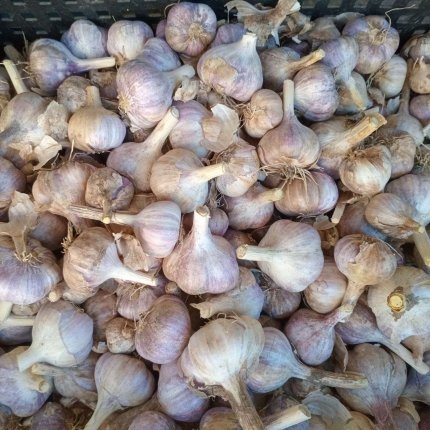
Why late planting is also undesirable
If you plant garlic just before the ground freezes, it may not have time to form sufficiently developed roots.
This impairs the fixation of the clove in the soil.
Additionally, frost heaving is possible during repeated freezing and thawing of the ground.
This is the name given to the movement of soil under the influence of ice formation and melting, which sometimes causes shallowly planted cloves to be closer to the surface.
Therefore, the goal of fall planting is to provide garlic with enough time to take root, but not to stimulate prolonged intensive leaf growth.
When to plant winter garlic in Ukraine: approximate dates by region
Traditionally, winter garlic is planted from late September to November.
However, the deadlines may differ significantly for different regions of Ukraine.
In northern regions, the soil usually cools earlier than in southern regions.
In addition, weather conditions in a particular year may change the usual planting calendar.
| Region of Ukraine | Estimated landing period |
| North: Chernihiv region, Sumy region, Zhytomyr region | End of September - first half of October |
| Center: Kyiv region, Poltava region, Cherkasy region, Vinnytsia region | Mostly October |
| West: Lviv region, Volyn, Ternopil region | End of September - October |
| East: Kharkiv region, Dnipropetrovsk region and adjacent areas | Mostly October, depending on the weather |
| South: Odessa region, Mykolaiv region, Kherson region | Second half of October - November |
| Transcarpathia | October - early November under favorable conditions |
These dates are approximate and not guaranteed to be accurate.
For example, a warm autumn can delay planting even in central Ukraine.
And early, significant cooling sometimes forces work to start sooner.
When to plant garlic in the Kyiv region
For the Kyiv region, the traditional period is October.
However, planting cloves just because it's October 1 or 10 is wrong.
It is better to measure the soil temperature and assess the weather forecast for the coming weeks.
If the ground is still well warmed and prolonged warming is expected, you can wait with planting.
If the soil has cooled but not yet frozen, and there is plenty of time before a hard frost, conditions may be favorable.
Can I plant winter garlic in November?
Yes, if the soil remains suitable for cultivation and is not frozen.
In southern regions, November planting may be a completely normal practice.
In the central regions, it depends more on the specific year.
In northern areas, late planting is usually associated with a higher risk of insufficient rooting.
It is important to consider not only the air temperature, but also the condition of the soil.
What is the best soil temperature for planting garlic?
Soil temperature is one of the most useful indicators for determining planting dates.
It changes more slowly than air temperature and better reflects the conditions in which the cloves will be found.
A practical guideline for planting winter garlic is approximately +8…+12 °C at the depth of the future placement of the cloves, or about 10 centimeters.
Around +10 °C is a convenient reference point.
At the same time, there is no single temperature that guarantees the same result for all varieties and soils.
How to correctly measure soil temperature
A special soil thermometer is suitable for this.
Choose a location on the future garden bed.
Immerse the measuring part approximately 8–10 centimeters or according to the device instructions.
Wait for the indicator to stabilize.
It is advisable to repeat the measurements several days in a row at approximately the same time.
This will allow us to understand whether the earth is indeed gradually cooling.
Why you shouldn't focus only on morning frost
The first autumn frosts may appear when the soil at the planting depth is still quite warm.
For example, at night the air temperature briefly drops below zero, but during the day it returns to +15 °C.
In such a situation, the root zone does not necessarily cool significantly.
Therefore, the first frost on the grass does not automatically mean that garlic needs to be planted immediately.
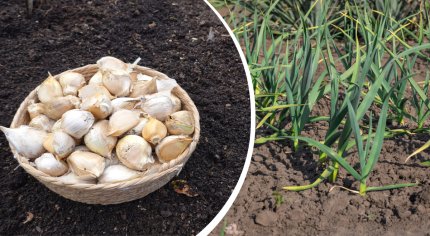
How many weeks does it take for garlic to take root before winter?
Many agronomic recommendations focus on approximately 3–6 weeks until the soil freezes.
During this period, the cloves can form the root system necessary for wintering.
However, the rate of rooting depends on temperature, available moisture, variety, and physical condition of the soil.
In cool weather, roots develop more slowly.
In warm soil, growth processes are more active, but at the same time the likelihood of above-ground shoots appearing increases.
That's why you shouldn't take the rule of a few weeks as an accurate biological timer.
What is the difference between the first frost and ground freezing?
These are two different phenomena.
The first frost means a short-term decrease in air or ground temperature below zero.
Ground freezing is the cooling of the ground to temperatures at which ice forms in it.
Sometimes several weeks pass between these events.
The rate of freezing is affected by snow cover, ground moisture, soil type, and the duration of the cold period.
When planting winter garlic, it is more important to consider the approach of permanent freezing of the root zone, rather than the date of the first morning frost.
How to choose the right variety of winter garlic
Not all garlic is equally well adapted to wintering.
For fall planting, it is important to use varieties suitable for a specific climate.
Garlic is conventionally divided into two main groups: shoot and non-shoot.
Shoot garlic
Shoot-forming varieties form a solid central stem and a flowering shoot.
Many members of this group are well adapted to regions with cold winters.
They usually have relatively large teeth.
In the summer, arrows appear on such plants, which are removed if necessary to direct resources to the development of the bulb.
Non-shooting garlic
Non-shooting forms usually have a softer central stem.
Some of them store better after harvest.
However, winter hardiness depends on the specific variety.
It should not be assumed that any non-shooting garlic is necessarily suitable for autumn planting in all regions of Ukraine.
Can I plant garlic from the supermarket?
Theoretically, store-bought garlic cloves can sprout and form new bulbs.
However, for planned planting, it is better to use proven planting material.
Garlic for food consumption may be of an unknown variety, not adapted to local conditions.
In addition, an outwardly healthy bulb sometimes contains pathogens or pests.
Therefore, it is worth choosing planting material from a reliable source and giving preference to varieties that are successfully grown in your region.
How to prepare garlic cloves before planting
The quality of planting material affects plant development from the very beginning.
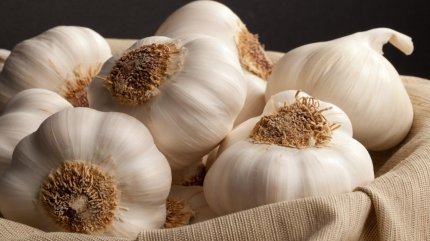
It is best to choose healthy, dense, well-formed cloves for planting.
They must be free of signs of mold, rot, severe drying, and mechanical damage.
Why is it better to take large teeth?
Large, healthy cloves usually contain a greater supply of nutrients.
Under other conditions being the same, they more often form stronger plants and larger bulbs.
However, size does not compensate for disease or improper growing conditions.
Do not use large cloves with soft spots or a damaged bottom.
When to divide the heads into cloves
It is best to do this shortly before planting.
There is no need to disassemble all the planting material in advance and leave it for many weeks.
When separating, try not to damage the protective scales.
It is also important to preserve the bottom of the clove — the lower part from which the roots will develop.
Do you need to peel cloves?
Usually not.
Dry integumentary scales perform a protective function.
Thorough cleaning of the teeth can increase the risk of damage and the introduction of pathogens.
If the clove already has damaged or spoiled scales, it is better not to use it for long-term cultivation.
Do you need to soak garlic before planting?
Household recommendations often suggest soaking cloves in salt, potassium permanganate, soda, or various homemade solutions.
However, the effectiveness of such procedures depends on the specific problem and the concentration of the substance.
Uncontrolled soaking can damage the planting material.
It is especially undesirable to use concentrated salt solutions or unknown mixtures.
For healthy, proven planting material, mandatory soaking is not required.
If there is a risk of a certain disease, the first thing to do is to determine its cause.
The use of special preparations is possible only in accordance with the official instructions, purpose and permitted method of use.
Do not consider home disinfection a guaranteed way to obtain completely healthy garlic.
Where is it best to plant winter garlic?
Garlic requires sufficient light to form large bulbs.
It is best to choose an open, sunny area where water does not stagnate.
It is especially important to avoid places where puddles remain for a long time after rain.
Why drainage is so important
Garlic roots need not only moisture, but also access to oxygen.
If soil pores are filled with water for a long time, the root system may suffer from a lack of air.
Waterlogging also increases the risk of developing certain diseases, including fusarium rot.
Therefore, heavy, poorly drained soil can be a more serious problem than a minor nutrient deficiency.
What soil is suitable for garlic?
The most favorable are usually fertile, loose, and well-drained loams.
The desired soil reaction is approximately pH 6.0–7.0, although the optimal range may vary slightly depending on growing conditions.
In heavy clay, roots develop more difficultly, and bulbs may become deformed.
In sandy areas, water penetrates into deeper layers more quickly.
Therefore, the method of preparing the bed must be selected according to its properties.
After which crops is it better to plant winter garlic?
It is not recommended to grow garlic in the same place for many years in a row.
This is due to the accumulation of pathogens and pests characteristic of onion crops.
It is especially undesirable to plant it immediately after other garlic, onions, leeks, and related plants.
How to follow crop rotation
A practical guideline is to return garlic to the previous site no earlier than after 3–4 years.
In the presence of certain soil-borne diseases, significantly longer intervals may be required.
Suitable for planting are beds after crops that are not onion crops and do not share specific pest problems.
For example, after certain legumes, pumpkins or other vegetable crops, provided that the soil condition is appropriate.
It is important to consider not only the predecessor, but also the overall history of the site.
How to prepare a bed for fall planting
Start by removing weeds and previous crop residues.
After that, check the structure of the soil.
If the soil is compacted, it needs to be loosened to a sufficient depth for root development.
In areas with heavy soil, mature compost can be used to gradually improve its structure.
Can I apply fresh manure?
It is best to avoid this immediately before planting winter garlic.
Fresh manure has an unpredictable rate of nutrient release and can create undesirable conditions for planting material.
Additionally, excessive amounts of available nitrogen are not needed in the fall.
To improve the soil, it is more advisable to use mature compost and take into account the overall fertility of the site.
Is it necessary to add mineral fertilizers?
Garlic needs nitrogen, phosphorus, potassium, and other nutrients.
But there is no universal dose of fertilizer for all gardens.
It is best to rely on the results of soil analysis.
If the soil already contains enough nutrients, over-fertilizing does not guarantee a higher yield.
A significant portion of nitrogen nutrition is usually provided in the spring, when plants are actively forming leaves.
How deep to plant winter garlic in the fall
The correct depth helps protect the cloves from sudden temperature fluctuations and provides conditions for root development.
However, recommendations may vary depending on climate, soil, clove size, and availability of mulch.
It is also important to distinguish between two quantities: the depth to the bottom and the thickness of the soil layer above the top of the clove.
A practical guide for the home garden
For many conditions, a layer of soil about 5–8 centimeters above the top of the clove is suitable.
On light, well-drained soils in colder conditions, a greater depth is sometimes used.
On heavy soils, the safe range may be smaller if it is consistent with local agricultural practices.
But planting too deep can make it difficult for seedlings to emerge in the spring.
Therefore, there is no need to automatically deepen all the cloves by 12–15 centimeters.
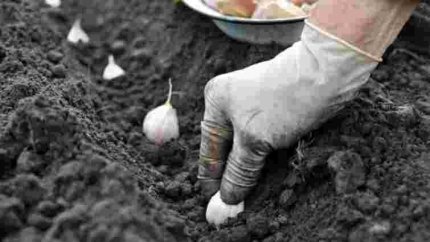
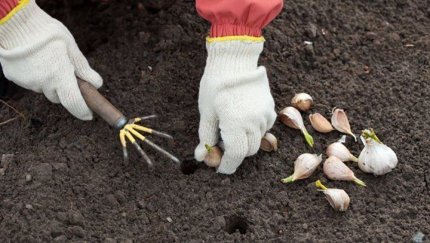
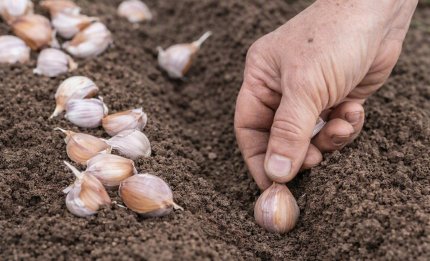
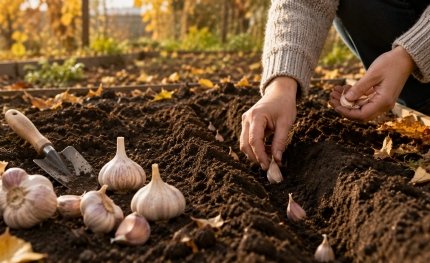
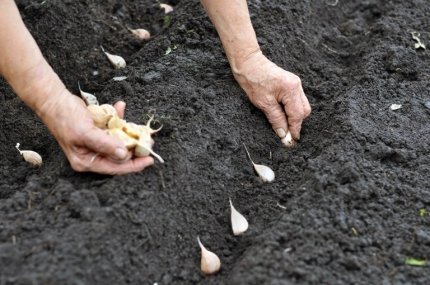
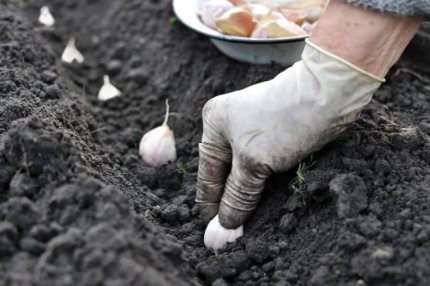
How to properly place a tooth
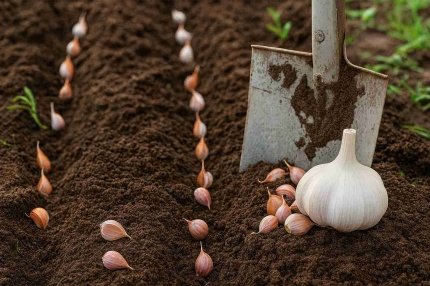
The pointed end should face upwards.
The flat bottom, from which the roots are formed, is placed at the bottom.
Do not press the clove too hard into the hard ground.
It is better to make a planting hole, place the material and carefully cover it with soil.
After this, the surface can be slightly leveled.
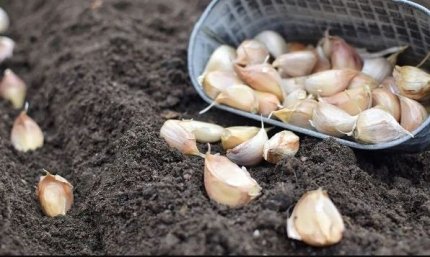
What distance should be between garlic cloves?
If plants are planted too close together, they begin to compete more intensely for water, light, and nutrients.
As a result, the bulbs may form smaller.
Excessively sparse planting is also not always advisable, especially in a small area.
Optimal landing pattern
For regular winter garlic, the following guidelines can be used:
the distance between the teeth in a row is approximately 10–15 centimeters;
the distance between rows is about 20–30 centimeters;
for especially large varieties - more space if needed.
The specific scheme depends on the size of the future bulbs and the method of caring for the bed.
For smaller planting material, denser patterns are allowed.
However, if the goal is to get large, full-fledged heads, you should not over-thicken the plantings.
Do you need to water garlic immediately after planting?
Cloves need available moisture to root.
Therefore, after planting in dry soil, watering can be beneficial.
Water helps ensure soil contact with the cloves and creates conditions for root development.
But if the ground is already sufficiently moist after the autumn rains, additional irrigation is not necessary.
How to determine the need for watering
Carefully check the moisture at the planting depth.
If the soil is dry and crumbles easily, the bed can be moderately moistened.
If the soil is moist but not waterlogged, watering should be postponed.
There is no need to regularly water the bed after each cold snap.
During the cold season, evaporation usually decreases, and excess water can remain in the ground longer.
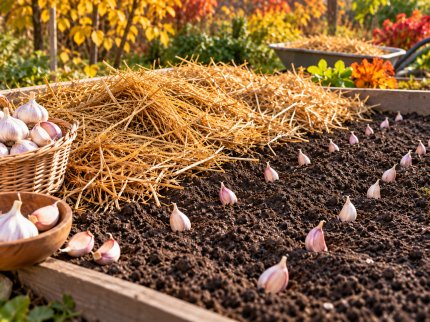
Is it necessary to mulch winter garlic?
Mulching helps reduce soil temperature fluctuations.
This is especially useful in regions where thaws alternate with frosts in winter.
The protective layer also reduces the risk of frost blistering of the cloves, limits weed growth and helps retain moisture.
The better to mulch the bed
Clean straw, dry leaves, and other suitable organic materials are suitable for winter garlic.
The approximate thickness of the winter layer is approximately 5–10 centimeters.
The exact need depends on the climate and the material.
Do not use plant residues with obvious signs of disease or weed seeds.
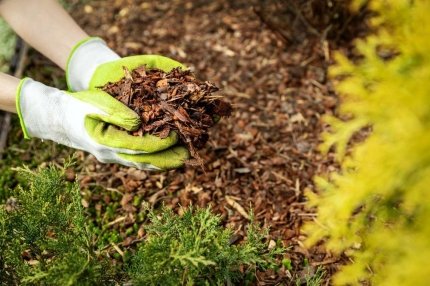
When to apply mulch
Mulch is often applied after the soil has noticeably cooled or at the beginning of a sustained cold period.
In colder regions, this helps reduce the abrupt cycles of freezing and thawing of the ground.
At the same time, a thick layer of mulch applied too early on still warm soil can retain heat longer.
Therefore, the timing depends on the weather.
In the spring, you need to check whether the mulch is preventing the emergence of seedlings.
Part of the layer can be carefully removed when the plants begin to actively develop.
What to do if garlic sprouts in the fall before frost
The appearance of green sprouts does not mean that the crop is lost.
In some varieties, and in favorable weather, leaves may appear before the beginning of winter.
Small seedlings often survive the cold season normally.
However, the risk of damage increases during prolonged severe frosts without snow cover.
Do I need to trim the green shoots?
Usually not.
Cutting the leaves does not eliminate the cause of early germination.
In addition, additional damage to the above-ground parts may be undesirable for the plant.
It is better to leave the stairs without intervention.
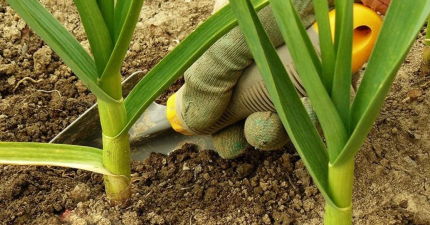
Do I need to cover sprouted garlic?
If severe frosts are expected, you can check the condition of the mulch.
It will help mitigate temperature fluctuations in the root zone.
However, it is not necessary to hermetically seal the bed with polyethylene.
Moisture and condensation can accumulate under such a shelter.
Even if some of the leaves freeze, garlic is often able to resume growth from a living clove in the spring.
What to do if you didn't have time to plant garlic on time
Sometimes the favorable period is missed due to rain, busyness, or a sudden cold snap.
In this case, the first thing you need to do is check the condition of the soil.
If it is not yet frozen and suitable for cultivation, planting may be possible.
But the likelihood of sufficient autumn rooting is gradually decreasing.
Should you plant garlic in very cold soil?
If the ground is already frozen, planting cloves in the usual way is impractical.
Mechanical damage to the soil will not provide normal conditions for root growth.
If the temperature is low, but the ground is not yet frozen, the result will depend on the subsequent weather.
In such a situation, you should not expect a guaranteed yield.
Can I leave garlic until spring?
Yes, but spring planting has its own characteristics.
Garlic needs a period of exposure to low temperatures for the normal formation of bulbs with cloves.
This process is called vernalization.
In the absence of sufficient cooling, plants may form smaller or atypical bulbs.
Therefore, planting material for spring cultivation must be selected taking into account its variety and storage characteristics.
Does the lunar calendar affect the planting of garlic?
Lunar calendars often offer specific favorable and unfavorable days for planting.
However, there is no conclusive scientific evidence that choosing the phase of the moon ensures a better garlic harvest.
Instead, the influence of temperature, soil moisture, fertility, quality of planting material, and root system development is well-founded agronomically.
Therefore, when choosing between a "favorable day" according to the calendar and appropriate weather conditions, it is more advisable to focus on the condition of the soil.
You should not plant cloves in too warm or frozen ground just because of a date on the calendar.
What are the most common mistakes made when planting winter garlic?
Plant on a fixed date. The soil cools differently in different years.
They are guided only by air temperature. After the first frost, the ground may remain warm.
Planting too early. During a long, warm autumn, the plants may actively germinate.
They are delayed until the soil freezes. The cloves do not have time to form sufficient roots.
They use diseased planting material. Disease pathogens can get to the new site along with the cloves.
They clean the teeth of all scales. This increases the risk of damage.
Plant in waterlogged soil. Excess water worsens conditions for the roots.
Growing garlic in the same place all the time increases the risk of specific diseases and pests accumulating.
Plantings are overly dense. Plants compete more for resources.
They apply a lot of fresh manure. Such fertilization is not a necessary condition for successful planting.
Water without checking the moisture content. In the fall, the soil often dries more slowly.
Prune early green shoots. This procedure is usually not necessary.
How to plant winter garlic in the fall: step-by-step instructions
For a home garden, you can use the following sequence.
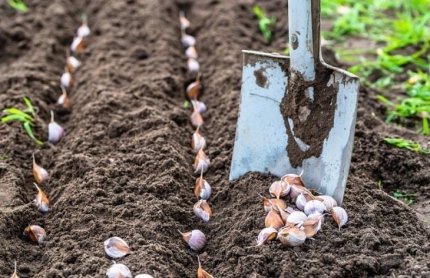
Step 1. Check the weather and ground temperature
Make sure that the soil has already cooled to approximately +8…+12 °C.
Evaluate the forecast for the coming weeks.
It is important that the soil still remains suitable for rooting.
Step 2. Choose a sunny spot
Avoid areas with prolonged standing water.
Consider previous cultures.
Do not plant garlic immediately after onions and other bulbous plants.
Step 3. Prepare the soil
Remove weeds and plant debris.
Loosen compacted soil.
If necessary, add mature compost to improve soil structure.
Do not add fertilizer directly under the cloves in high concentrations.
Step 4. Select planting material
Use healthy, firm cloves of the appropriate variety.
Separate the heads shortly before planting.
Do not damage the bottom and protective scales.
Step 5. Place the teeth
Plant them with the pointed end up.
Aim for a depth that is appropriate for your soil, usually with a layer of soil about 5–8 centimeters above the top.
Leave sufficient distance between plants.
Step 6. Check the humidity
If the soil is dry, water the bed moderately.
If the ground is already wet after rain, do not add additional water.
Step 7. Prepare the mulch
After the ground has cooled, use an appropriate layer of clean straw or other suitable organic material.
In the spring, check to see if it is preventing seedlings from emerging.
What to do with winter garlic after winter
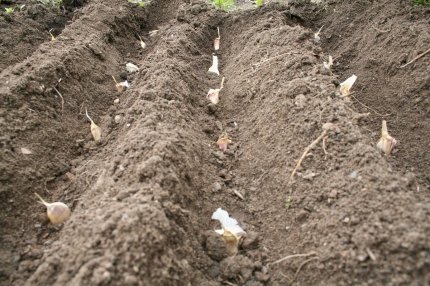
When the soil begins to warm up in the spring, garlic resumes active growth.
During this period, it is important to prevent competition with weeds.
Plants also need available moisture and adequate nutrition.
When to fertilize in spring
The main need for nitrogen increases during leaf formation.
It is a healthy leaf apparatus that provides the plant with resources for the further development of the bulb.
Fertilization should be carried out taking into account soil fertility and the actual condition of the garlic.
Excessive late nitrogen fertilization is undesirable, as it can impair the ripening and keeping quality of the bulbs.
Do I need to remove the arrows?
Flower stalks form in arrowhead varieties in spring or early summer.
If the goal is to get large heads, the arrows are often removed after they begin to curl.
This helps direct more resources towards bulb development.
However, to obtain air bulbs, some of the arrows can be left.
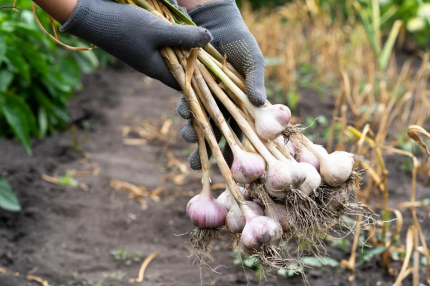
When to harvest
Winter garlic usually ripens in the summer.
The landmark is the gradual yellowing and drying of some of the leaves.
The exact moment depends on the variety and weather conditions.
There is no need to wait for the complete destruction of all the covering scales of the bulb, as this may impair its storage.
Conclusion
The optimal time for planting winter garlic is determined not by a specific date, but by weather conditions and soil temperature.
It is best to plant cloves when the ground has cooled to approximately +8…+12 °C and there is enough time before permanent freezing for roots to form.
For most regions of Ukraine, this is mainly October, but in the north, planting may begin earlier, and in the south it may continue until November.
Equally important are healthy planting material, a sunny location, good drainage, proper depth, and moderate mulching.
If the garlic sprouts a little before frost, this does not necessarily threaten the harvest. The main thing is to provide the plants with normal wintering conditions and not damage the young shoots unnecessarily.
FAQ: Frequently Asked Questions About Planting Winter Garlic
When is the best time to plant winter garlic in the fall?
The best guideline is a soil temperature of approximately +8…+12 °C and a time margin of about 3–6 weeks before the ground freezes. In most regions of Ukraine, this falls on October, but the timing depends on local weather.
At what soil temperature can garlic be planted?
A practical guideline is approximately +8…+12 °C at a depth of about 8–10 centimeters. If the ground is still significantly warmer and prolonged warming is expected, it is often advisable to postpone planting.
Can I plant garlic in November?
Yes, if the soil is not frozen yet. In southern regions of Ukraine, November planting may be normal practice. In colder regions, it carries a greater risk due to limited time for root development.
How deep should winter garlic be planted?
For many home conditions, about 2–3 inches of soil above the top of the clove is adequate. The exact depth depends on soil type, climate, size of planting material, and mulching method.
What to do if garlic sprouts in the fall?
Small green shoots do not need to be pruned. Winter garlic often tolerates partial leaf damage and resumes growth in the spring. If there is a risk of severe frost, it is worth checking the condition of the winter mulch.
Do I need to water garlic after planting in the fall?
If the soil is dry, moderate watering will help create conditions for rooting. If the soil is already sufficiently moist after rains, additional irrigation is not necessary. Excess water is undesirable due to the risk of rotting.
How to mulch garlic for the winter?
Clean straw, dry leaves and other suitable organic materials are suitable. A layer of approximately 5–10 centimetres is often used. Its thickness and laying time should be considered according to the climate and soil conditions.
Do I need to soak garlic before planting?
For healthy, tested planting material, mandatory soaking is not necessary. Homemade concentrated solutions can damage the cloves. If there is a risk of a specific disease, an appropriate, well-founded method of protection is required.
After which crops should garlic not be planted?
It is undesirable to plant garlic immediately after garlic, onions, leeks, and other alliums. It is usually recommended to wait about 3–4 years before returning the crop to the same area.
What happens if you plant winter garlic too late?
The cloves may not have time to form a sufficiently developed root system. This increases the risk of winter damage and can negatively affect the development of the plants in the spring. However, the outcome depends on the subsequent weather, variety and soil conditions.

