
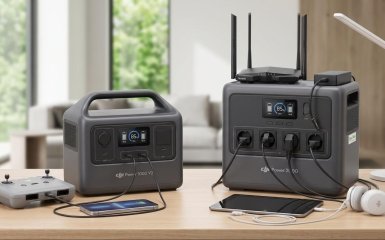
A charging station can keep your internet, lights, laptop, refrigerator, or gas boiler running during a power outage. But even devices with the same price range vary significantly in battery capacity, output power, charging speed, and ability to connect household appliances.
Points of attention
- Some manufacturers specify a short-term peak power, such as 2000 W for a model rated at 1000 W.
- For example, a 1024 Wh station for 27,000 UAH may be more profitable in terms of energy reserves than a 768 Wh device for the same amount.
- For low-power devices, it is sometimes more economical to use compatible DC outputs or a specialized mini-UPS.
For example, a station with a 1000 Wh battery can run longer than a 768 Wh model. At the same time, a more powerful inverter is sometimes enough to start a refrigerator that another station cannot handle, despite a similar battery capacity.
In a budget of up to UAH 30,000, you can find models for maintaining communication and work, as well as devices capable of powering individual household appliances. However, no compact station of this class will provide the usual electricity consumption of the entire apartment without restrictions.
The main rule of choice: battery capacity determines the duration of operation, and output power determines which devices can be connected. To make the right purchase, you need to consider both parameters.
Let's consider five charging stations that can be found on the Ukrainian market in the price segment up to UAH 30,000, compare their characteristics and calculate how many hours of charge will last under different usage scenarios.
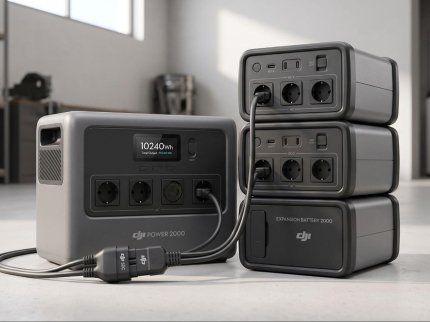
Which charging station to choose for your home: the short answer
A station with a capacity of 300–500 Wh is often sufficient for a router, fiber optic internet terminal, smartphones, and several LED lamps.
If you need to simultaneously power your laptop, lights, and internet during a long outage, a 700–1000 Wh model is usually a more practical choice.
For a refrigerator or gas boiler, you need to additionally check the inverter's rated power, starting currents, and compatibility with specific equipment.
If you plan to connect several powerful devices or have autonomy for more than a day, a budget portable station may not be enough.
What is the difference between the capacity and power of a charging station?
These are two different technical parameters that are often confused.
Battery capacity — Wh
Capacity is measured in watt-hours — Wh, or Wh.
It shows the nominal battery power reserve.
For example, a 1000 Wh battery theoretically contains energy equivalent to operating a 100 W appliance for 10 hours.
However, the actual autonomy will be less due to losses during energy conversion, the station's own consumption and battery protection limitations.
Output power — W
Power in watts shows what electrical load the station is capable of providing.
For example, an inverter with a rated power of 600 W is not designed to continuously power a 2000 W electric kettle.
Even if the battery has a large capacity, the station may shut down due to overload.
Therefore, when choosing, it is important to separately check the maximum total power of the connected devices.
Why peak power is not equal to rated power
Some manufacturers specify a short-term peak power, such as 2000 W for a model rated at 1000 W.
This indicator may apply to short starting loads.
Some stations also have high-power modes that change output parameters, including voltage.
Such modes do not mean that the device is capable of operating at double power indefinitely.
For sensitive electronics and motors, you should focus primarily on the nominal characteristics and requirements of the manufacturers.
5 charging stations under 30,000 UAH: comparison of characteristics
This price segment includes devices with batteries from approximately 700 to 1000 Wh, as well as more compact models.
Below are five stations with different ratios of capacity to output power.
| Model | Capacity | Capacity | Battery type |
| EcoFlow RIVER 2 Pro | 768 Wh | 800 W | LiFePO₄ |
| BLUETTI AC70 | 768 Wh | 1000 W | LiFePO₄ |
| FOSSiBOT F1200 | 1024 Wh | 1200 W | LiFePO₄ |
| Anker SOLIX C800 | 768 Wh | 1200 W | LiFePO₄ |
| EcoFlow RIVER 3 Max Plus | 858 Wh | 600 W | LiFePO₄ |
Price note: as of November 2026, these models can be found in Ukrainian offers within or near the budget of 30,000 UAH. The specific cost, availability, equipment and warranty terms depend on the seller. Not every offer for the specified model will necessarily cost less than 30,000 UAH.
1. EcoFlow RIVER 2 Pro — for work, communication and basic needs
The EcoFlow RIVER 2 Pro has a 768 Wh battery and a rated output power of 800 W.
The station is equipped with a lithium iron phosphate battery, and the manufacturer claims to retain over 80% of the initial capacity after 3,000 cycles under specified conditions.
An important advantage of the model is fast charging from the mains. According to the passport specifications, a full charge can take about 70 minutes.
This is especially useful when electricity is only supplied for a limited time.
What is it suitable for: Internet, laptop, TV, lighting and some household appliances compatible with the output power.
Things to consider: 800W may not be enough for some appliances with high power consumption or starting power. X-Boost mode should not be seen as a complete replacement for a more powerful inverter.
2. BLUETTI AC70 — balance of capacity and power
BLUETTI AC70 has a 768 Wh battery and provides a rated output power of 1000 W.
The model is equipped with a pure sine wave inverter, two AC outlets, and USB-C ports with a power of up to 100W each.
According to the specifications, charging from the mains takes approximately 1.3–1.6 hours in the appropriate mode.
The station also supports the connection of compatible solar panels.
What is it suitable for: workplace, lighting, TV, refrigerator, provided that its starting parameters are compatible.
What to consider: the model does not exceed the EcoFlow RIVER 2 Pro in terms of capacity, but has a more powerful inverter. If the main need is long autonomy of low-power devices, the difference between the models may be less significant.
3. FOSSiBOT F1200 — more power in the budget segment
The FOSSiBOT F1200 is equipped with a 1024 Wh battery and has a rated output power of 1200 W.
This is one of the options for those who value both energy savings and the ability to connect devices with higher consumption.
The model supports fast charging and uses a LiFePO₄ battery.
With favorable price offers, it can be purchased for less than 30,000 UAH.
What it is suitable for: long-term operation of home Internet, laptop, lighting and individual refrigerators or pumps with compatible parameters.
What to consider: A larger capacity does not guarantee that the station will provide 12–15 hours of operation of the refrigerator. The actual autonomy depends on the power consumption of the specific appliance, temperature and conversion losses.
4. Anker SOLIX C800 — for devices with higher loads
The Anker SOLIX C800 has a 768 Wh battery and a rated inverter power of 1200 W.
The manufacturer uses a lithium iron phosphate battery and claims a lifespan of about 3,000 cycles under appropriate operating conditions.
The station supports fast charging and has a backup power function with switching up to 20 ms according to the passport data.
What it is suitable for: work equipment, lighting, refrigerators and some devices with relatively high operating power.
What to consider: In terms of energy reserve, the Anker SOLIX C800 does not surpass the 768 Wh model. Its advantage lies primarily in the more powerful inverter.
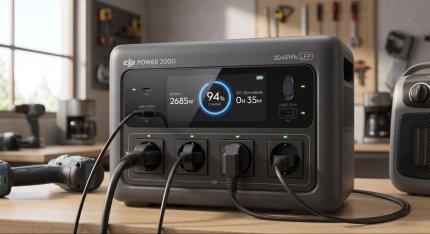
5. EcoFlow RIVER 3 Max Plus — for longer operation of low-power devices
The EcoFlow RIVER 3 Max Plus has a total capacity of 858 Wh and a rated output power of 600 W.
Structurally, this is a set of the RIVER 3 Plus main station with an additional battery module.
This configuration allows you to increase the energy supply without switching to a large stationary system.
What it is suitable for: backup power for the Internet, laptop, lighting, TV and other relatively low-power consumers.
Things to consider: The 600W rated power limit limits the choice of household appliances. If your main task is to run high-load equipment, you should consider stations with a more powerful inverter.
Which charging station is the best value for money?
It is wrong to compare models only by price.
For example, a 1024 Wh station for 27,000 UAH may be more profitable in terms of energy reserves than a 768 Wh device for the same amount.
However, the second model may have better warranty terms, faster charging, lower power consumption, or a more convenient design.
How to compare the cost of energy storage
One simple indicator is the price per nominal watt-hour.
Formula:
Price per 1 Wh = cost of the station ÷ battery capacity.
For example, if a 1000 Wh device costs 25,000 UAH, one nominal watt-hour costs 25 UAH.
But this is not a complete assessment of profitability.
The actual usable capacity depends on the efficiency of the electronics and the way the devices are connected.
For comparison, it is also worth considering the rated power, battery life, charging time, warranty, and availability of service.
How many hours will the charging station last?
To estimate autonomy, you need to know the battery capacity and the power consumption of the connected equipment.
For preliminary calculations, you can use the formula:
Operating time = battery capacity × 0.8 ÷ average load.
The factor 0.8 conventionally takes into account losses in the inverter and part of the battery limitations.
This is only a rough estimate: the actual result depends on the station, temperature, load and connection method.
Examples of autonomy
| Station capacity | Load 50 W | Load 100 W | Load 150 W |
| 512 Wh | 8.2 hours | 4.1 hours | 2.7 hours |
| 768 Wh | 12.3 hours | 6.1 hours | 4.1 hours |
| 858 Wh | 13.7 hours | 6.9 hours | 4.6 hours |
| 1024 Wh | 16.4 hours | 8.2 hours | 5.5 hours |
The table shows approximate values for a stable load through an AC inverter.
At very low loads, the inverter's own consumption can significantly reduce the calculation time.
How long will a Wi-Fi router work from a charging station?
For backup internet, you need to take into account the consumption of all equipment.
If a fiber optic connection is used, power may be required for both the router and the optical terminal ONU.
Let's assume that together they consume 18 watts.
At a nominal usable capacity of 80%, a 768 Wh model will theoretically provide approximately 34 hours of operation.
However, when connected via a 230 V socket, the actual time may be shorter due to the constant internal consumption of the inverter.
For low-power devices, it is sometimes more economical to use compatible DC outputs or a specialized mini-UPS.
It is important to check the voltage, polarity, connector type, and allowable current.
You can't connect a router to a random adapter just because the connector physically fits.
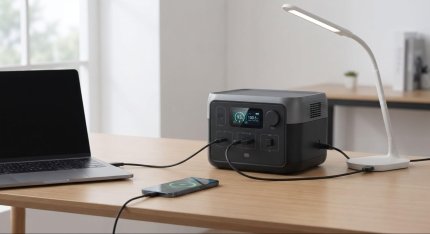
Will a charging station be enough for a refrigerator?
A refrigerator differs from a lamp or a router in that its compressor operates cyclically.
It periodically turns on, cools the cameras, and turns off.
Therefore, the rated power of the compressor is not equal to the average daily consumption of the refrigerator.
How to correctly calculate the autonomy of a refrigerator
It is best to measure its actual consumption using a household wattmeter.
For example, if a refrigerator used 1.2 kWh in 24 hours, its average consumption is 50 watts.
A 1024 Wh station with a conditional efficiency of 80% will theoretically provide approximately 16 hours of operation at such an average load.
But the actual time may vary due to room temperature, door opening frequency, and compressor operating modes.
Why the refrigerator may not start
During startup, the compressor sometimes briefly consumes significantly more power than in normal operation.
Therefore, it is necessary to check not only the average energy consumption, but also the starting characteristics.
A station with insufficient peak power may shut down due to overload.
Even if its battery contains enough energy, this does not guarantee a successful start of the refrigerator.
Can a gas boiler be connected to a charging station?
Many modern gas boilers require electricity for the circulation pump, automation, fan, and other components.
However, their compatibility with portable stations depends not only on power.
For some models, neutral, grounding, and flame control features are important.
Why does the boiler sometimes not work from the charging station?
Some gas boilers are phase-dependent.
Their automation may require certain power supply parameters.
Some portable stations have a different output configuration than the home's fixed electrical network.
Because of this, the boiler may display an error or not start.
There is no need to create jumpers between the neutral and protective conductor yourself or change the grounding circuit.
Before purchasing a gas boiler station, you should check the compatibility of specific models and agree on a safe connection with a qualified specialist.
Can I power an electric kettle, microwave or heater?
Technically, individual charging stations are capable of providing power to powerful devices, if their characteristics allow it.
However, for budget models, such operation is often impractical.
For example, a kettle is 2000 watts higher than the rated power of all five stations considered.
A 1000W electric heater can only operate from a compatible model, but will drain the battery very quickly.
A 1024 Wh plant at such a load will provide less than an hour of operation, taking into account losses.
Therefore, it is more appropriate to use backup energy for critical appliances, rather than for long-term electric heating.
LiFePO₄ or regular lithium-ion battery: which is better?
Most modern mid-range charging stations use lithium iron phosphate batteries — LiFePO₄, or LFP.
Their advantage is long cycle life and high thermal stability compared to some other lithium-ion chemistries.
However, the safety of the device depends not only on the chemical composition of the battery.
Important are the BMS battery management system, quality of electronics, overload protection, and compliance with manufacturer requirements.
What does 3000 charge cycles mean?
A cycle is the conditional equivalent of using the full capacity of a battery.
For example, two 50% discharges can together amount to approximately one equivalent full cycle.
If the manufacturer claims 3000 cycles to 80% of the initial capacity, this does not mean that the station will stop working after 3000 cycles.
It is about a gradual decrease in energy reserves.
Actual battery life depends on temperature, charging modes, depth of discharge, and other operating conditions.
Why charging speed matters during blackouts
If the power supply is only for two hours, a slow charging station may not have time to replenish the energy supply.
Therefore, charging speed is sometimes no less important than capacity.
However, maximum input power does not guarantee a constant speed throughout the process.
Stations can automatically reduce current closer to full charge or at unfavorable battery temperatures.
Can I charge the station and use it at the same time?
Many models support simultaneous charging and powering of connected devices.
But the features of this mode depend on the design of the station.
It is necessary to check the permissible load power, the possibility of through-power supply and the operating mode during a power outage.
If the station consumes significant power during charging, it is also important to consider the load on the home electrical network.
How does the UPS function differ from a regular backup power supply?
A UPS is an uninterruptible power supply.
In portable stations, this designation often refers to the function of automatic switching from mains to battery.
For example, some models declare a switching time of up to 10–20 ms.
For many household devices, this may be enough.
However, some computers, network devices, and sensitive equipment may reboot even after a short interruption.
The UPS designation in the specifications of a portable station does not guarantee completely uninterrupted power supply for any equipment.
If it is important to avoid even a short interruption, you need to check the device's compliance with specific power supply requirements or use a specialized UPS.
Can I connect a charging station to the entire apartment?
You can't just plug the cable from the charging station into a regular apartment outlet to get electricity in other outlets.
Such a homemade connection can create dangerous reverse voltage, damage equipment, and pose a risk of electric shock.
To power individual apartment lines, a properly designed power supply switching system is required.
Its characteristics must correspond to the parameters of the station, the power grid, and the connected consumers.
All work on the electrical panel and fixed connection of the backup power supply must be performed by qualified electricians.
How to safely use a charging station at home
A portable charging station does not generate electricity by burning fuel, so it does not emit exhaust gases during normal operation like a gasoline generator.
However, battery-powered equipment also requires compliance with safety regulations.
It is necessary to ensure sufficient ventilation of the housing and not to block the cooling openings.
Do not leave the station exposed to direct rain or in areas where flooding is possible.
Damaged cables and uncertified adapters should not be used.
It is especially important to adhere to temperature restrictions.
For many LiFePO₄ stations, charging the battery at temperatures below 0 °C is limited or prohibited by the manufacturer.
Therefore, storing and charging the station on a cold balcony without temperature control is undesirable.
Seven mistakes when buying a charging station
Focus only on capacity. A large battery will not help if the inverter is not able to start the required appliance.
Consider peak power constant. Short-term mode is not intended for unlimited operation under high load.
Ignore energy losses. A rated 1000 Wh does not equal 1000 Wh guaranteed to be available through 230 V outlets.
Do not check the refrigerator's starting currents. The compressor may not start even with sufficient rated power.
Buying a boiler station without checking compatibility. Neutral, grounding, and automation features may have values.
Ignore charging speed. During short power outages, slow battery recharge reduces practical autonomy.
Evaluate the purchase only by the lowest price. The official warranty, equipment, type of sockets, service support, and the origin of the device are also important.
How to choose a station based on your budget and needs
For home use, it is important to first determine the list of equipment that should operate during a power outage.
For example, if you only need internet, lighting, and smartphone charging, a powerful 1200W station may not be necessary.
If you plan to connect a refrigerator, starting power, energy reserve, and inverter compatibility become more important.
Three typical scenarios
| Scenario | What needs to be fed | A guide to choosing |
| Base | Router, ONU, lamps, smartphones | 300–500 Wh or dedicated UPS |
| Working | Laptop, internet, lighting, monitor | Approximately 700–1000 Wh |
| Household | Refrigerator, boiler or several appliances | From 1000 Wh with power and compatibility check |
This is not a guarantee of a specific duration of operation. For an accurate choice, you need to measure or determine the actual consumption of all planned devices.
Conclusion
A charging station for up to UAH 30,000 can be a practical solution for backup power for an apartment if you correctly determine your needs.
For the Internet, laptop, and lighting, 700–800 Wh models are often sufficient. If longer autonomy is important, it is worth considering stations with a larger energy reserve.
For a refrigerator and a gas boiler, one capacity is not enough: you need to check the rated and starting power, power supply parameters, and equipment compatibility.
The best charging station isn't necessarily the most expensive or the most powerful. It should provide power for specific devices for the required time and meet safety requirements.
FAQ: Frequently asked questions about home charging stations
What is the best charging station to buy for up to UAH 30,000?
Among the models that can be found in this budget are the EcoFlow RIVER 2 Pro, BLUETTI AC70, FOSSiBOT F1200, Anker SOLIX C800 and EcoFlow RIVER 3 Max Plus. The choice depends on the required capacity, power, charging speed and compatibility with household appliances.
What capacity charging station is needed for an apartment?
For the Internet and lighting, 300–500 Wh is sometimes enough. For working with a laptop and several simultaneous consumers, models with 700–1000 Wh may be more practical. For a refrigerator or long outages, the need depends on actual consumption.
How many hours will a 1000 Wh charging station last?
At a nominal efficiency of 80%, the station will provide approximately 16 hours for a 50 W load or about 8 hours for a 100 W load. The actual time depends on the efficiency of the equipment, temperature and operating mode.
Will the charging station pull the refrigerator?
Maybe, if the inverter provides sufficient rated and starting power. You also need to consider the average power consumption of the refrigerator. The battery capacity indicator alone does not guarantee compatibility.
Can I connect a gas boiler to EcoFlow or BLUETTI?
Some boilers can operate from portable stations, but compatibility depends on the specific model, features of the neutral, grounding and automation. Before connecting, it is necessary to check the equipment parameters. Homemade jumpers cannot be used.
Which is better: a charging station or a regular UPS?
A charging station is convenient for various household appliances and portable use. A specialized UPS may be better for equipment that requires guaranteed fast or continuous switching. The choice depends on the load, desired autonomy and electrical requirements.
Can I connect the charging station to an apartment outlet?
No, you can't do this with a regular two-prong cable. Back-up power to apartment electrical lines requires an appropriate source switching system and professional wiring.
Can I charge a LiFePO₄ station in cold weather?
For many models, charging below 0 °C is prohibited or limited. You should check the manufacturer's instructions for permissible temperatures. Do not charge the station on a cold balcony unless such conditions are specified in its specifications.
Is it worth buying a charging station with a UPS function?
Yes, if automatic switching to battery is required. However, the switching time in portable stations can be 10–20 ms or more depending on the model. For sensitive equipment, it is necessary to check separately whether such a break is permissible.
Will a charging station worth up to UAH 30,000 be enough for the entire apartment?
Usually not, if it comes to the simultaneous operation of all familiar household appliances. Compact stations of this class are better used for priority loads: communications, lighting, work equipment and individual compatible devices.

