
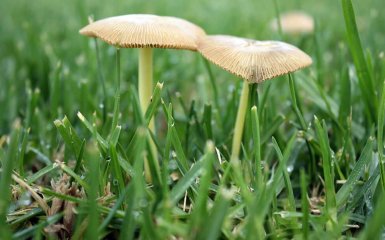
After a few rainy days, dozens of small mushrooms suddenly appear on a well-groomed lawn. They can grow singly, form groups, or even whole circles. For the owners of the plot, this often comes as a surprise: the grass is regularly cut, there are no weeds, and the mushrooms continue to appear.
Points of attention
- Lawn fungi usually appear due to moisture and decomposition of organic matter in the soil and are mostly harmless to the grass.
- Unknown mushrooms should be collected with gloves in areas where children play or animals roam. Removing the fruiting bodies does not destroy the underground mycelium.
- To reduce the recurrence of fungi, you should adjust watering, check drainage, and aerate the soil if necessary.
In fact , most lawn mushrooms are not a sign of grass disease or poor soil condition . More often, they mean that organic matter is naturally decomposing underground, and the humidity and temperature have become favorable for the formation of fungal fruiting bodies.
However, mushrooms can't always be ignored. Some wild species are poisonous, posing a risk to small children and pets. In addition, some soil fungi can affect the availability of water to grass roots, causing dry or yellowed areas.
We'll figure out why mushrooms grow on the lawn after rain, how to properly remove them, whether fungicides, baking soda, and vinegar help, what mushroom circles mean, and how to prevent the mushrooms from reappearing without damaging the grass.
Why do mushrooms appear on the lawn?
Fungi are a natural part of the soil ecosystem. They participate in the decomposition of organic matter and the cycling of nutrients.
Most mushrooms you see on your lawn after a rain are just the above-ground fruiting bodies of organisms that live in the soil.
The main part of a fungus is usually hidden underground. It consists of thin, threadlike structures called hyphae, the collection of which is called the mycelium, or mycelium.
It is the mycelium that uses the organic matter contained in the soil.
When favorable conditions arise, the fungus forms fruiting bodies, which we notice among the grass.
What contributes to the appearance of fungi
The most common factors:
prolonged or heavy rains;
excessive watering of the lawn;
constantly moist soil;
old tree roots beneath the surface;
wood residues or stumps;
accumulation of dead organic matter;
shading and slow drying of grass;
insufficient drainage.
However, the presence of fungi does not necessarily mean that all of these problems exist simultaneously.
For example, if a few mushrooms appear after a three-day rain, and the grass itself remains healthy, there may be no reason for serious intervention.
Why do mushrooms grow after rain?
Moisture plays an important role in the formation of fruiting bodies of many soil fungi.
After rain, the upper layers of the soil become saturated with water, the humidity of the air near the surface increases, and organic residues can decompose faster.
This creates favorable conditions for the development of fungi that already existed underground.
That's why mushrooms sometimes appear almost overnight.
In fact, the mycelium could have been present in the area for years, remaining undetected.
Why are there more mushrooms in the fall?
In autumn, several conditions often combine: sufficient humidity, cooler air, and reduced water evaporation.
In many regions of Ukraine, September, October, and November can be favorable for the appearance of mushrooms on lawns.
However, this does not mean that they grow exclusively in autumn.
Mushrooms can appear in spring, summer after prolonged rains, and even during winter thaws.
Their seasonality depends on the species and local weather conditions.
Are mushrooms dangerous for lawn grass?
Most fungi that form noticeable fruiting bodies on the lawn do not feed on living grass.
They decompose dead organic materials found in the soil.
Such fungi are called saprotrophs.
They can participate in returning nutrients to the soil, including making some of the nitrogen available to plants.
Therefore, the appearance of a few mushrooms among healthy green grass does not necessarily require any action.
When mushrooms can signal a problem
It is worth taking a closer look at the lawn if, along with the appearance of mushrooms, you observe:
large yellowed or dried areas of grass;
circles of dead vegetation;
constant accumulation of water after watering;
unpleasant smell of overmoistened soil;
deterioration of grass growth in certain areas.
In such cases, it is important to determine whether the changes are due to fungal activity, insufficient drainage, or other causes.
Yellowing of the lawn itself does not indicate a fungal disease. Similar symptoms can be caused by drought, soil compaction, improper fertilization, or root damage.
Why do mushrooms always grow in the same place?
If fruiting bodies appear in the same area every year, this is often due to the presence of a constant source of organic matter.
For example, there may be roots of a tree that was cut down several years ago under the lawn.
The wood gradually decomposes, and fungi use it as a source of food.
A similar situation occurs if a stump, wooden boards, or large pieces of roots were left in the soil during site preparation.
How to determine the possible cause
Remember what was previously located at the site of the mushrooms.
If a tree grew there, a wooden structure stood there, or organic materials were buried during lawn maintenance, this may explain the re-emergence of fruiting bodies.
However, it usually doesn't make sense to specifically dig up the entire lawn for a few mushrooms.
The mycelium can exist in the soil for a long time, and the fruiting bodies will gradually cease to appear as the available organic material decomposes.
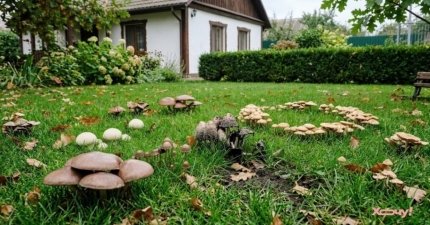
What does it mean when mushrooms grow in a circle?
Sometimes mushrooms form an even circle or arc on the lawn.
This phenomenon is called "witch circles," and in horticulture, mushroom rings.
It has a natural explanation.
The fungus can gradually grow from the central area outward.
As available nutrients are used up, the active growth zone shifts to the edges of the colony.
Under favorable conditions, fruiting bodies can appear there.
However, mushroom rings do not always have the appearance of a perfect circle, and the mushrooms themselves may not appear every year.
What are mushroom rings?
There are usually three main types of lawn care.
| Type | What does it look like? | Impact on the lawn |
| First | Ring of weakened or dead grass | Can cause serious damage |
| Second | Dark green strip of grass growing more intensively | Mainly changes appearance |
| Third | A circle or arc of mushrooms with no noticeable changes in the grass | Usually does not harm the lawn |
In the most difficult cases, the mycelium can create areas in the soil that do not allow water to pass through well.
Because of this, the grass roots do not receive enough moisture even after watering.
The problem becomes especially noticeable in dry and hot weather.
Why does the grass inside the circle sometimes turn yellow?
Some fungal colonies affect the soil's ability to absorb water.
This condition is called hydrophobicity - the water-repellent properties of the soil.
As a result, water may not penetrate well to the roots, and the grass begins to experience a moisture deficit.
A dark green strip sometimes forms next to a dry area, where plants receive additional nutrients from the decomposition of organic matter.
This is how contrasting rings of green and yellowed grass can occur.
Is it necessary to remove mushrooms from the lawn?
If the mushrooms appear on a healthy lawn and do not pose a risk to people or animals, removing them solely for the sake of the condition of the grass is usually not necessary.
Most fruiting bodies do not last long.
After changing weather conditions, they may dry out or gradually disappear.
However, there are situations when it is better to remove mushrooms.
When removal is necessary
This primarily applies to lawns where small children play or pets walk.
Some wild mushrooms can be poisonous, and it is difficult to determine their safety based on appearance alone.
Therefore, unknown mushrooms should not be left in places where a child or dog could accidentally eat them.
Fruiting bodies can also be removed for aesthetic reasons.
But it is important to understand: removing the caps does not mean destroying the mycelium underground .
How to remove mushrooms from the lawn: step-by-step instructions
If mushrooms interfere with the use of the lawn, they can be removed mechanically.
This is the easiest way to remove visible fruiting bodies without using harsh chemicals.
Step 1. Inspect the area
Determine whether the mushrooms grow singly, in groups, or in rings.
Check the condition of the grass and soil.
If the lawn is green and healthy, simply removing the fruiting bodies is sufficient.
Step 2. Collect mushrooms
Put on gardening gloves.
Carefully collect the fruit bodies with your hands or a small garden trowel.
Try not to damage the grass's root system.
Wash your hands after work.
Step 3. Remove the residue
Put unknown mushrooms in a bag and throw them away.
If the goal is to remove potentially poisonous mushrooms from an area where children or animals walk, do not leave them on open ground or in accessible compost.
Step 4. Check the watering mode
If the lawn is consistently wet, reduce the frequency of watering or temporarily stop watering if the soil is already sufficiently moist.
You don't need to add water just on a regular schedule.
Step 5. Re-inspect the lawn
After the next rain, the mushrooms may reappear.
This does not mean that the previous cleaning was wrong.
The mycelium remains in the soil, so the formation of new fruiting bodies is possible for a long time.
Will regular mowing help remove mushrooms?
A lawn mower can cut off the fruiting bodies, but it does not destroy the mycelium.
Therefore, mowing is not a way to permanently eliminate mushrooms.
If there are no children or animals in the area, mushrooms can be removed during normal lawn care.
But when it is important to eliminate accidental eating, it is better to collect them by hand first.
You should not lower the lawn mower to the minimum height just to cut mushrooms.
Mowing too short weakens the grass and can impair its ability to tolerate heat and drought.
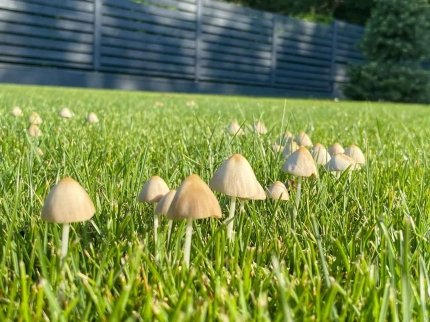
How to get rid of mushrooms on the lawn for a long time
Completely eliminating mycelium from natural soil is virtually impossible and usually unnecessary.
Mushrooms perform an important ecological function.
However, it is possible to change the conditions that contribute to excessive fruiting bodies.
The best result is obtained by combining several measures.
1. Adjust the watering
If the lawn regularly receives excess water, the soil may remain wet for too long.
This promotes the appearance of fruiting bodies of many fungi.
It is best to water the lawn taking into account the weather, soil type, and grass needs.
For an established lawn, less frequent but sufficiently deep watering is often beneficial instead of daily surface moistening.
However, you don't need to intentionally overdry your grass to get rid of mushrooms.
2. Improve drainage
If water stands on the surface for a long time after rain, you need to check the soil's ability to pass it.
The cause may be compaction, heavy clay soil, or an improper slope of the site.
In such cases, fungal fruiting bodies may be just one manifestation of excessive humidity.
3. Aerate
Aeration is the creation of holes in the soil to improve air access and water penetration.
For heavily compacted lawns, aeration by removing small soil cylinders can be particularly beneficial.
It helps reduce compaction and improve water permeability.
However, the procedure must be carried out during the period of active growth of the corresponding type of lawn grass.
Do not work on excessively wet soil, as the equipment may further compact it.
4. Remove excess dead organic matter
A dense layer of grass residue, shoots, and roots can accumulate on the surface of the lawn.
It is called a felt layer, or turf with excessive accumulation of organic residues.
A moderate amount of such material is normal.
But too thick a layer can retain moisture and impair water and air penetration.
If the problem really exists, it is advisable to carry out appropriate lawn combing.
It is not necessary to remove all organic matter from the surface: ordinary short grass clippings, if properly cared for, can be beneficial to the soil.
5. Remove large underground wood debris
If mushrooms consistently appear in the same spot after removing an old tree, the cause may be rotting roots.
In some situations, removing large amounts of wood debris helps reduce the food source for fungi.
But this should only be done when the problem is truly significant.
Completely digging up a healthy lawn because of a few small mushrooms is usually not justified.
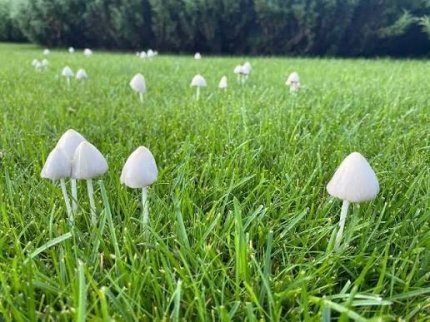
How to tell if your lawn has drainage problems
Mushrooms alone do not prove that the soil does not drain well.
However, it is worth checking the situation if moisture constantly accumulates in the area.
Main signs:
puddles remain for a long time after rain;
the soil is sticky and heavy even a long time after watering;
some areas of the lawn are constantly wet;
the grass has a weak root system;
moss or other signs of adverse conditions appear on the surface.
In this case, it is important to assess the soil structure, relief, and irrigation regime.
If the problem is related to high groundwater levels or improper drainage of precipitation, aeration alone may not be enough.
What to do if mushrooms grow in a circle and the grass inside dries out
This is a more complicated situation than the appearance of individual fruiting bodies after rain.
If the fungal ring is accompanied by dry or dead areas of grass, a water-repellent layer of soil may appear.
In this case, simply reducing watering can worsen the condition of the lawn.
How to repair a damaged area
First, check whether the soil in the ring area really does not absorb water well.
If water is stuck on the surface or not penetrating the roots, local aeration and gradual moistening can help.
For difficult cases, special lawn wetting agents are sometimes used to help water penetrate hydrophobic soil.
Such drugs should be used according to the prescription and instructions.
If the grass has already died, reseeding may be necessary once normal conditions are restored.
You should not automatically apply large doses of nitrogen fertilizers: excessive fertilizing can worsen the condition of the lawn.
Do fungicides help with lawn fungus?
For common mushrooms that grow on organic debris, fungicides are usually not a viable solution.
Most of the visible part of the mushroom is just a temporary fruiting body.
The main mycelium is in the soil and can spread over a significant area.
Surface spraying does not guarantee an effect on the underground colony.
Additionally, fungi that decompose dead organic matter are not necessarily harmful to the lawn.
Why you don't need to sterilize soil
Complete eradication of soil fungi is neither a practical nor desirable method of care.
Many beneficial microorganisms live in the soil, which participate in shaping its structure and nutrient cycling.
Indiscriminate use of fungicides can negatively impact the soil ecosystem.
For true fungal diseases of grass, separate diagnostics are required.
Only drugs approved for the appropriate purpose may be used, in compliance with the instructions and current rules of use.
Can you remove mushrooms with vinegar, salt or soda?
Home tips often suggest soaking mushrooms in vinegar, strong saline solution, or baking soda.
However, such methods do not eliminate the main cause of the appearance of fungi.
Even if the above-ground fruiting body is damaged, the mycelium can remain in the soil.
At the same time, concentrated homemade solutions can negatively affect grass.
Why you shouldn't use salt
Excess salt increases soil salinity and can disrupt the water balance of plants.
Because of this, lawn grass can turn yellow and die.
Therefore, sprinkling mushrooms with table salt is not a safe way to care for them.
Why vinegar doesn't solve the problem
Acidic solutions can damage above-ground plant tissues.
If you spray them on your lawn, not only the fungus but also the grass nearby may suffer.
At the same time, the underground mycelium often remains intact.
Does boiling water help?
Pouring boiling water over mushrooms is also not an effective way to clean your lawn.
Hot water can damage grass and plant roots.
In addition, this method does not ensure complete destruction of the mycelium in the deeper layers of the soil.
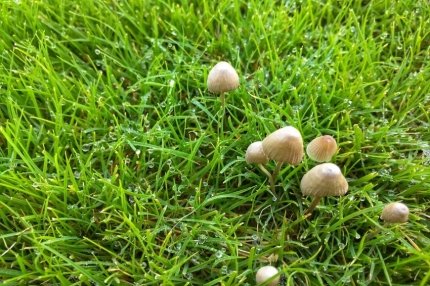
Are mushrooms on the lawn dangerous for children?
Yes, potentially dangerous.
Although most soil fungi do not harm grass, this does not say anything about their suitability for consumption.
Among wild mushrooms, there are poisonous species that may resemble edible ones in appearance.
It is especially important to monitor the area where small children play.
A child may put a mushroom in their mouth without understanding the possible consequences.
How to secure the site
Before taking a small child for a walk, check the places where they will play.
Especially after rain, when mushrooms can appear quickly.
It is better to remove unknown fruiting bodies from an accessible area.
Do not allow children to taste wild mushrooms, even if they look like champignons or other familiar species.
If your child has eaten an unknown mushroom, seek medical attention immediately, without waiting for symptoms to appear. If possible, save a sample or take photos of the mushroom for later identification.
Do not induce vomiting yourself without medical advice.
Some severe poisonings may not manifest immediately, but after many hours.
Are mushrooms on the lawn dangerous for dogs and cats?
Yes. Pets can accidentally eat wild mushrooms while out for walks.
However, even a small number of individual toxic species can cause serious consequences.
It is impossible to determine the safety of a mushroom for an animal based solely on its color, size, or location.
What to do if your dog ate a mushroom
Do not wait for vomiting, diarrhea, weakness, or other symptoms to appear.
You need to contact a veterinarian immediately.
If possible, take a photo of the mushroom, where it grows, and save a sample for identification.
Do not attempt to self-medicate or induce vomiting without the advice of a veterinarian.
For prevention, regularly inspect your lawn and remove unknown mushrooms from areas where pets walk.
Can you eat mushrooms that grew on the lawn?
Unknown wild mushrooms should not be consumed.
Even if they look like familiar edible species, that doesn't guarantee safety.
Some poisonous mushrooms have a very similar appearance to edible ones.
For correct identification, it is necessary to take into account the structure of the cap, plates, stem, base of the fruiting body, and other features.
Individual species can only be reliably distinguished with the help of a specialist.
You should not rely on common folk methods of testing using onions, silver objects, or color changes during cooking.
They do not detect the presence of dangerous toxins.
It is also important to understand that heat treatment does not always neutralize mushroom poisons.
Why do mushrooms appear on new rolled lawn?
After laying a rolled lawn, fungi sometimes appear within the first weeks or months.
This does not necessarily mean that the turf was of poor quality.
The cause may be organic materials in the soil, natural mycelium, and the intensive watering required during the grass's rooting stage.
A new lawn often needs regular moisture, and moisture promotes the formation of fruiting bodies.
Should I reduce watering of a new lawn?
You should not abruptly stop watering just because of the appearance of mushrooms.
Young turf must form a sufficiently strong root system.
If you reduce moisture too early, the grass may not establish properly.
Therefore, the watering regime should be determined by the condition of the turf, the weather, and recommendations for its installation.
Mushrooms can be carefully picked by hand without damaging the young grass cover.
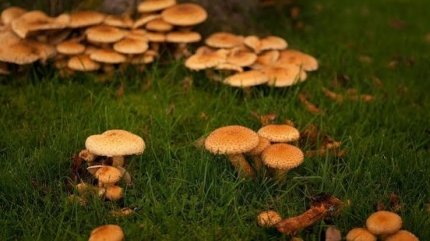
Why mushrooms grow in shaded areas of the lawn
Areas under trees, near fences, or on the north side of buildings often dry more slowly.
In such places, moisture remains in the soil and on the surface of the grass longer.
If there is organic residue there, it can create favorable conditions for many fungi.
However, shading in itself does not mean that the lawn will necessarily be covered in mushrooms.
Soil structure, ventilation, and the amount of available organic matter are also important.
How to improve conditions in a shaded area
First, check whether the grass variety matches the lighting level.
Some lawn mixes tolerate partial shade better than others.
It is also worth controlling watering and avoiding constant waterlogging.
If the grass is not growing well due to too much shade, additional fertilizer or constant removal of fungi will not solve the underlying problem.
Do mushrooms on the lawn mean the soil is fertile?
Not necessarily, although their appearance indicates the activity of fungal organisms in the soil.
Some fungi decompose organic matter, helping to return nutrients to the cycle.
But a large number of fruiting bodies is not an accurate indicator of fertility.
For example, mushrooms can actively grow in an area with old wood debris, where lawn grass is also suffering from poor drainage.
To assess fertility, it is necessary to take into account soil composition, nutrient availability, acidity, and plant condition.
Fungi are just one of many elements of the soil ecosystem.
The most common mistakes when fighting mushrooms on the lawn
Douse mushrooms with harsh chemicals. This can damage the grass without eliminating the mycelium.
Use table salt. Excess salt has a negative effect on the soil and plant roots.
Stop watering completely. Overwatering can cause more damage to your lawn than the fungus itself.
Ignore repeated waterlogging. If water constantly stands on the surface, you need to check the drainage.
Destroy all soil organic matter. It is an important component of healthy soil.
Mowing the grass too short. This weakens the lawn and increases its vulnerability to adverse conditions.
Consider all mushrooms harmless. Most are harmless to grass, but some can be poisonous to humans and animals.
Try to remove all the mycelium by digging it up. This can damage the lawn without guaranteeing the final result.
Consider any yellow circle as a fungal disease. Such signs can occur due to drought, fertilizers, or other factors.
How to prevent the reappearance of mushrooms: seasonal lawn care
Proper care does not guarantee the complete absence of fungi.
However, it helps to reduce conditions that contribute to excessive fruiting bodies.
In the spring
Inspect the lawn after winter.
If necessary, remove accumulated dead grass residue and check for areas with poor drainage.
If the soil is heavily compacted, aeration can be scheduled at an appropriate time.
In the summer
Monitor the watering regime.
Do not allow prolonged waterlogging, but do not leave the grass without the necessary amount of water.
Pay special attention to areas where mushroom rings with yellowed grass have previously appeared.
In the fall
During prolonged rains, review your automatic watering settings.
Reduce it or turn it off if necessary.
Remove excessive accumulations of leaves that have been lying in a thick, moist layer for a long time.
If your lawn is having problems with compaction, fall may be an appropriate time to aerate some cool-season grasses.
In winter
Do not aggressively aerate frozen or waterlogged lawns.
If fruiting bodies remain in the fall, most of them will gradually break down naturally.
However, in areas where animals roam, it is better to remove unknown mushrooms regardless of the season.
Conclusion
Mushrooms on the lawn are mostly a natural phenomenon associated with the decomposition of organic matter in the soil.
If the grass is healthy and the mushrooms only appear after rain, complex measures are usually not necessary. It is enough to remove the fruiting bodies if they interfere or pose a risk to children and pets.
To reduce the recurrence of fungi, it is important to properly organize watering, ensure drainage, and avoid excessive soil compaction.
Fungicides, salt, vinegar, and other harsh chemicals are not a one-size-fits-all solution. They can damage the grass without killing the mycelium.
If the mushrooms grow in rings and the lawn inside turns yellow or dries out, you need to separately check the soil permeability and the condition of the root system.
FAQ: Frequently Asked Questions About Mushrooms on the Lawn
Why did mushrooms suddenly appear on the lawn?
This is most often due to high humidity after rain or watering. The mycelium can remain in the soil for a long time, decomposing organic matter. Under favorable conditions, it forms noticeable fruiting bodies.
Is it necessary to remove mushrooms from the lawn?
No, if the lawn is healthy and the mushrooms do not pose a risk to people or animals. However, in areas where small children play or pets walk, it is best to regularly remove unknown mushrooms.
How to get rid of mushrooms on the lawn forever?
There is no guaranteed easy way, as the main mycelium is underground. You can reduce the frequency of fruiting bodies by adjusting watering, improving drainage, and removing large underground wood debris if it is causing the problem.
Does baking soda or vinegar help with lawn fungus?
Such products do not guarantee the destruction of the mycelium and can damage the grass. For common mushrooms on the lawn, it is better to use mechanical removal of fruiting bodies and adjustment of care conditions.
Why do mushrooms grow in circles on the lawn?
This could be a fungal ring. The fungus gradually grows in the soil, forming a circular or arc-shaped area. Sometimes it affects grass growth, causing dark green or dry rings.
Are mushrooms harmful to lawn grass?
Most fungi that appear after rain do not harm the grass. They decompose organic matter. However, some fungal rings can impair water penetration into the soil, causing the grass to suffer from a lack of moisture.
Can you eat mushrooms that grow on the lawn?
Unknown wild mushrooms should not be eaten. They may include poisonous species that look similar to edible ones. The safety of a mushroom cannot be reliably determined based on its photo, color, or location.
Will fungicides help remove mushrooms from the lawn?
Fungicides are not recommended for most common soil fungi. Most of them are underground, and the fruiting bodies often disappear on their own after a change in weather conditions. If a grass disease is suspected, separate diagnostics are required.
Why do mushrooms always grow in the same place?
This can be caused by old roots, stump remains, or other organic matter beneath the surface. The fungi use these materials as a food source and may periodically appear in the same spot for several years.
What to do if a dog or child eats a mushroom from the lawn?
You should seek immediate medical or veterinary attention, without waiting for symptoms. If possible, save a sample of the fungus or take photographs of it. Do not try to induce vomiting or use home remedies.

