

Sauerkraut should be crunchy, juicy, with a pleasant sourness and a characteristic aroma. However, home fermentation does not always give the desired result. Sometimes the cabbage becomes too soft, acquires a bitter taste, becomes covered with mucus or remains almost tasteless even after several days of fermentation. The reason usually lies not in the recipe itself, but in the fermentation conditions. Even a small deviation in the amount of salt, temperature or storage method can affect the development of microorganisms responsible for the formation of lactic acid.
To keep sauerkraut crispy, you need to use fresh, dense heads of cabbage, add about 2–2.5% salt by weight of the vegetables, maintain a stable temperature, and keep the cabbage completely submerged in the brine.
We analyze the ten most common mistakes in home fermentation, explain why cabbage spoils, how to correctly determine its readiness, and in which cases the product can no longer be consumed.
Why does sauerkraut become soft, bitter, or slimy?
Souring is a process of lactic acid fermentation, during which natural bacteria convert some of the sugars contained in cabbage into organic acids.
The gradual accumulation of lactic acid creates a characteristic sour taste and helps inhibit the growth of many unwanted microorganisms.
At the same time, the process depends on several conditions: salt concentration, temperature, oxygen access, raw material quality, and fermentation duration.
If the balance is disturbed, not only the taste but also the structure of the cabbage leaves changes.
Under certain conditions, microorganisms and their enzymes contribute to the destruction of pectin substances, which help cell walls maintain strength. This causes cabbage to lose its elasticity.
Before looking for a way to fix the situation, it is worth assessing the nature of the problem.
| What happened to the cabbage? | Probable cause |
| It became soft and lost its crunchiness. | High temperature, incorrect salt concentration |
| Too salty | Error in salt dosage |
| Almost no acid | Low temperature, excess salt, insufficient time |
| It is bitter. | Raw material characteristics, poor fermentation or spices |
| Has a slippery surface | Possible microbiological spoilage |
| It's getting darker. | Oxidation, contact with air, high temperature |
| Has an unpleasant putrid odor | Fermentation disruption and possible spoilage |
Important: Appearance is not always a reliable indicator of product safety. If cabbage shows signs of spoilage, it should not be tasted to check.
Mistake #1. Incorrectly calculated amount of salt
Salt is one of the main factors in successful fermentation. It affects the release of juice, the texture of the cabbage, and the development of microorganisms.
In the correct concentration, salt creates favorable conditions for lactic acid fermentation and limits the development of some unwanted microflora.
If there is not enough salt, the cabbage can become soft and spoil. If there is too much, fermentation slows down and the taste becomes overly salty.
How much salt is needed for 1 kg of cabbage
For traditional dry pickling, a scientifically based guideline is 20–25 g of salt per 1 kg of prepared vegetables , i.e. approximately 2–2.5% of their mass.
For a homemade recipe, it is convenient to use 22–25 g of salt per kilogram.
| Mass of prepared cabbage | Amount of salt |
| 500 g | 11–12.5 g |
| 1 kg | 22–25 g |
| 2 kg | 44–50 g |
| 3 kg | 66–75 g |
| 5 kg | 110–125 g |
The values given refer to the traditional fermentation method without adding a large amount of water.
For other recipes, particularly fermentation in a large volume of brine, the proportions may vary.
Why is it better to weigh salt?
A tablespoon of salt does not always contain the same number of grams.
The mass depends on the size of the crystals, density, and how the spoon is filled.
Fine salt can weigh more than coarse salt for the same volume.
Therefore, it is better to use a kitchen scale for sauerkraut. This is especially important if you are preparing a small portion of cabbage in a liter jar.

Mistake #2. Using the wrong salt
For fermentation, it is most convenient to use regular table salt without additional components.
Specialized recommendations for home fermentation often favor canning salts without additives.
The reason is that additives can change the clarity of the brine or the appearance of the vegetables.
Can you ferment cabbage with iodized salt?
Iodized salt does not become toxic during fermentation. However, some food preservation guidelines warn that it can affect the color of the product and the course of fermentation.
The consequences depend on the specific composition of the salt.
For the most predictable result, it is advisable to choose pure table salt without additives.
Sea salt can also be used if it is food grade and has the appropriate composition. However, it should be weighed, not measured with spoons.
Mistake #3. Leaving cabbage in a place that is too warm
Temperature determines the rate of fermentation and greatly affects the final texture.
At too high a temperature, microorganisms develop faster, and the structure of vegetables may deteriorate.
As a result, the cabbage sometimes becomes soft before the desired flavor is formed.

What is the best temperature for fermentation?
For traditional home fermentation, the recommended range is around 21–23 °C.
Under such conditions, the complete fermentation process according to proven recipes often takes 3–4 weeks.
If the temperature is 15–18 °C, fermentation can take about 5–6 weeks.
Temperatures above 24–26 °C increase the risk of excessive softening and spoilage of the product.
Therefore, you should not place a container with cabbage near a radiator, stove, or on a windowsill in direct sunlight.
It is better to choose a place with a stable temperature and without sudden fluctuations.
Mistake #4. Cabbage is in contact with air
One of the main conditions for successful lactic acid fermentation is limited access of oxygen to vegetables.
If any part of the cabbage is above the surface of the brine, it will be exposed to air, which creates conditions for mold and other unwanted microorganisms to grow.
The problem especially often occurs in narrow jars, when small pieces of cabbage float to the top.
How to properly pickle cabbage
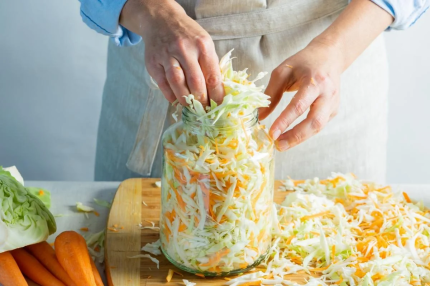
After mixing with salt, the cabbage should be placed tightly in a clean container and pressed down.
The juice should completely cover the vegetables.
To keep cabbage under brine, a special glass or ceramic container designed for fermentation is used.
In large containers, you can use a suitable plate and food load.
It is desirable that the vegetables are approximately 2–5 cm below the surface of the brine, if the design of the container allows it.
It is important to regularly check to see if individual pieces of cabbage have risen during active gas production.

Mistake #5. Not enough juice or wrong brine
After adding salt, cabbage begins to release moisture. This occurs due to osmosis, the movement of water from the vegetable's cells under the influence of differences in the concentrations of dissolved substances.
The secreted juice gradually forms a natural brine.
If there is not enough liquid, the cabbage remains partially open to the air.
What to do if the cabbage has not released its juice
First, check the quality of the raw materials and the amount of salt.
If the proportions are correct, you can leave the shredded cabbage for about 10–15 minutes after pickling.
Then gently knead it with clean hands so that it begins to release moisture more actively.
If natural juice is still not enough, proven recipes allow adding a small amount of pre-boiled and cooled saline solution.
To do this, use approximately 28–30 g of pure salt per liter of water.
Do not add regular unsalted water at random. It can reduce the salt concentration and change the fermentation conditions.
Mistake #6. Using old or poor-quality cabbage
Not all cabbage is equally suitable for pickling.
Fresh, dense, and juicy heads with firm leaves usually yield the best results.
Medium-late and late varieties of white cabbage are often used for traditional autumn pickling.
They usually have a denser structure and are well suited for longer storage.

How to choose cabbage for pickling
Pay attention to the following signs:
the head is dense and heavy for its size;
leaves are elastic, without mucus;
no mold or rotten areas;
the cut of the cob shows no signs of spoilage;
The smell is fresh, characteristic of cabbage.
Before cooking, remove the outer damaged leaves, rinse the head and let the water drain.
Don't use cabbage with mold or signs of rot, hoping that fermentation will make it safe.
Mistake #7. Incorrect cutting and excessive kneading
The thickness of shredded cabbage affects its texture and evenness of salting.
Very thick pieces may release juice more slowly, and too thin cabbage sometimes loses elasticity more quickly.
For traditional sauerkraut, it is convenient to cut the cabbage into strips approximately 2–4 mm thick.
It is important that the pieces are approximately the same size.
Do you need to mash the cabbage a lot?
Moderate kneading helps to extract the juice.
However, there is no need to turn cabbage strips into porridge.
If the cabbage is juicy, it is often enough to thoroughly mix it with salt, leave it for a while and mash it slightly.
If the head is denser, it will take a little more effort.
The main guideline is the appearance of a sufficient amount of natural juice and the preservation of the integrity of most of the strips.

Mistake #8. Incorrect capacity or poor hygiene
Not only are the ingredients important for fermentation, but also the utensils.
It is most convenient to use glass jars, special ceramic containers for fermentation, or food-grade plastic that is approved for contact with acidic products.
Do not use dishes made of unknown materials, with damaged glaze, rust, or non-food coatings.
Acidic environments can interact with some metals and materials.
How to prepare a jar
Before planting cabbage, you must:
Wash your hands and work surface thoroughly.
Clean the knife, cutting board, and other utensils.
Wash the jar and cargo elements.
Properly process dishes according to a proven recipe.
Make sure the container is free of cracks or damage.
For small batches in glass jars, special lids with a fermentation valve are especially useful.
They allow carbon dioxide to escape and reduce the product's contact with air.
A regular jar cannot be hermetically sealed without allowing gas to escape: during active fermentation, the pressure inside can increase dangerously.

Mistake #9. Cabbage is considered ready too early
In the first few days after salting, the cabbage may begin to actively produce bubbles.
This is a normal sign of the beginning of lactic acid fermentation.
However, active gas formation does not mean that the product has been fully fermented.
Microorganisms need time to produce sufficient acid.
How many days should cabbage ferment?
The duration depends on the temperature, batch size, and recipe.
According to the recommendations of proven technologies:
at 21–23 °C — approximately 3–4 weeks;
at 15–18 °C — approximately 5–6 weeks;
below 15 °C the process may slow down significantly or not proceed properly.
Homemade recipes sometimes require consuming cabbage after 3–5 days.
However, during this time it may remain only partially fermented. Its taste, acidity and microbiological stability will not necessarily correspond to the fully finished product.
If the goal is traditional sauerkraut for further storage, it is better to focus on the proven technology of full fermentation.
Mistake #10. Incorrect completion of fermentation and storage
Even successfully fermented cabbage can go bad after fermentation is complete.
If the finished product is left in a warm room, the acidity and texture may continue to change.
Cabbage gradually becomes more sour, and over time it may lose its crunch.
After fermentation is complete, it must be moved to a cold place.
How to properly store cooked cabbage
For home use, it is most convenient to use a refrigerator with a temperature no higher than 4 °C.
Cabbage is kept in a clean, closed container, preferably under a layer of its own brine.
Clean equipment is used for collection to avoid introducing additional microorganisms.
Fully fermented cabbage can be stored in the refrigerator for several months under proper conditions. However, its quality gradually changes, and the actual shelf life depends on the correctness of the entire preparation process.
If you plan to store cabbage for a long time without a refrigerator, you need a separate, proven canning technology. Simply putting the cabbage in a jar and screwing on the lid is not enough.
How to properly ferment cabbage at home: a basic recipe
For the first preparation, it is better to use a simple recipe without a lot of spices, sugar, and additional vegetables.
This will allow you to control the process and understand how salt, temperature, and fermentation duration affect it.
Ingredients
white cabbage - 1 kg in prepared shredded form;
pure table salt without additives — 23 g;
cumin - a small pinch, optional.
If you add carrots or other vegetables, consider their weight when calculating the salt. It is easiest to start with just cabbage.
Step-by-step cooking
Step 1. Prepare the cabbage. Remove any damaged outer leaves, rinse the head, cut the head and finely shred.
Step 2. Weigh the vegetables. For an accurate salt dosage, use the weight of the already prepared cabbage.
Step 3. Add salt. Distribute it evenly between the cabbage strips.
Step 4. Stir and leave for 10–15 minutes. During this time, the juice will begin to stand out.
Step 5. Gently mash the cabbage. You need to get enough liquid to cover the vegetables.
Step 6. Pack tightly into a clean container. Add cabbage in small portions and press down to remove air pockets.
Step 7. Install the load. The cabbage should be completely submerged in the brine. Leave enough space for foam and liquid to rise.
Step 8. Ensure gas escape. Use an appropriate fermentation lid or other method provided by proven technology.
Step 9. Place in a place with a stable temperature. Optimally maintain around 21–23 °C.
Step 10. Monitor the fermentation. Make sure the cabbage remains under the brine and that no signs of spoilage appear on the surface.
Once fermentation is complete, transfer the product to the refrigerator.

How to tell if sauerkraut is ready
Readiness depends on several signs.
Properly fermented cabbage has a characteristic pleasant sour aroma, a fairly dense texture, and a balanced sour-salty taste.
At the end of the process, active bubble formation usually decreases noticeably.
However, the smell alone or the absence of gas does not guarantee the safe completion of fermentation.
Is it necessary to measure acidity?
For more precise control, you can use a properly calibrated food pH meter.
A general guideline for safe acidity in fermented foods is a pH of no higher than 4.6. For properly prepared sauerkraut, the final value is often much lower, around 3.4–3.6.
Measuring acidity is especially useful if you regularly ferment large batches.
At the same time, low pH in itself does not justify violating the recipe, not enough salt, or using poor-quality raw materials.
For a reliable result, you must follow the entire technology.
Why does sauerkraut taste bitter and can it be fixed?
The bitter taste may be due to natural substances contained in the cabbage, characteristics of the variety, or spices.
Cruciferous vegetables contain glucosinolates, natural compounds that can affect taste and aroma.
During fermentation, these substances undergo changes, so the flavor profile gradually changes.
However, bitterness can also accompany unsuccessful fermentation.
If the cabbage has a normal sour smell, the right texture, and was prepared using proven technology, a slight natural bitterness does not necessarily mean spoilage.
If mucus, an unusual color, or an unpleasant odor are added to it, the product should be discarded.
Do not try to hide such signs with sugar, vinegar, or spices.
Why does a white coating appear on sauerkraut?
During home fermentation, a thin light film sometimes forms on the surface of the brine.
In some cases, it is a film yeast, often called Kahm yeast.
They can appear when brine comes into contact with air.
However, it is not always possible to reliably distinguish a yeast film from the initial manifestations of mold based on its appearance.
Particularly dangerous signs are fluffy formations, colored spots, a putrid odor, or a slippery consistency.
If mold or spoilage is suspected, the safest solution is to throw away the entire batch of cabbage.
Don't just remove the visible layer and assume the rest of the product is guaranteed to be safe.
Can you save failed sauerkraut?
The possibility of correction depends on what exactly happened to the product.
If the cabbage remains normal in appearance, has a characteristic odor, and is fermented using the correct technology, some shortcomings may be due only to taste preferences.
But if there are signs of microbiological spoilage, the product cannot be repaired.
| Problem | What to do |
| Not acidic enough, fermentation is still ongoing | Check temperature, brine, and time |
| Cabbage is too sour, but fermented properly | Use a small portion in culinary dishes |
| A little saltier than desired, but no signs of spoilage | Balance the taste when serving |
| Slippery or has a putrid smell | Cast out |
| Suspicious mold has appeared | Throw away the entire batch |
| The cabbage became very soft due to fermentation disorders. | Do not use for food. |
| Fermentation does not start under the proper conditions | Check the recipe and temperature; don't automatically assume the product is safe |
You should not add vinegar to a failed batch in the hope of killing unwanted microorganisms.
Similarly, an extra portion of salt will not make a spoiled product safe.
Do I need to add sugar or vinegar during fermentation?
In the traditional recipe, cabbage already contains natural sugars that are used by lactic acid bacteria.
Therefore, there is usually no need to add regular sugar to start fermentation.
Excess sugar can alter the fermentation process and flavor profile.
Vinegar is also not needed for classic fermentation.
It creates acidity directly, whereas in true fermentation, acids are produced by the activity of microorganisms.
Pickled cabbage with vinegar and sauerkraut are different cooking methods.
For traditional lactic acid fermentation, it's best to start with cabbage, the right amount of salt, and controlled conditions.
Is it necessary to pierce cabbage during fermentation?
Old home recipes often recommend piercing the cabbage with a wooden stick every day to release gas.
Indeed, carbon dioxide is produced during fermentation.
However, modern fermentation tanks with appropriate valves allow it to come out without having to constantly open the can or disturb the cabbage layer.
For such systems, piercing is usually not necessary.
If a traditional large container without a valve is used, appropriate proven technology must be followed that ensures gas escape and minimal contact of vegetables with air.
Do not seal the container without the possibility of pressure relief.
Is sauerkraut really good for the intestines?
Properly fermented cabbage can contain live lactic acid bacteria, organic acids, and dietary fiber.
However, the number and composition of live microorganisms depend on the conditions of fermentation, storage, and further processing.
Not every fermented product is automatically a probiotic in the scientific sense of the term.
For such a determination, it is necessary to confirm that specific microorganisms in certain quantities provide health benefits.
It is also worth remembering that sauerkraut contains a significant amount of salt.
People who need to limit sodium in their diet should consider portion size.
You should not reduce the salt concentration in your home fermentation recipe on your own, as this may compromise its safety.
Important: the material is for informational purposes only. Sauerkraut is not a cure for diseases. If you have medical dietary restrictions, you should consult a doctor first. Self-medication can be harmful to your health.
Conclusion
Crispy and delicious sauerkraut is the result of properly organized fermentation, not a random, successful recipe.
The most important things are to use fresh, dense cabbage, weigh the salt accurately, maintain a consistent temperature, and make sure the vegetables remain under brine throughout the process.
If the cabbage turns out soft, excessively bitter, or does not sour, it is worth checking these conditions. And if mucus, mold, or a putrid smell appears, the product should be thrown away.
FAQ: Frequently Asked Questions About Sauerkraut
Why does sauerkraut turn out soft and not crispy?
The most common causes are too high a fermentation temperature, the wrong amount of salt, and using poor quality raw materials. Softening can also be due to unwanted microbiological activity. If the cabbage becomes slimy or has an unpleasant odor, it should be thrown away.
How much salt is needed per 1 kg of cabbage for pickling?
For traditional dry pickling, use approximately 20–25 g of salt per 1 kg of prepared vegetables. A convenient guideline is 23 g per kilogram. It is best to weigh the salt on a kitchen scale, as the weight of a tablespoon depends on the size of the crystals.
How many days does it take to ferment cabbage?
At a temperature of around 21–23 °C, complete fermentation according to proven recipes usually takes 3–4 weeks. In a cooler room, the process can take 5–6 weeks. Cabbage that has only been sitting for a few days is not necessarily fully fermented.
Why doesn't sauerkraut turn sour?
Possible causes include too low a temperature, too much salt, or not enough time. You also need to check the quality of the raw materials and the recipe. The absence of visible bubbles does not in itself prove that the fermentation is going wrong.
What to do if the sauerkraut did not produce enough juice?
Leave the shredded cabbage with salt for 10–15 minutes, then mash it gently. If the juice is not enough to cover the vegetables, a proven recipe may include adding boiled and cooled brine. Plain water without salt should not be added.
Can I ferment cabbage with iodized salt?
Iodized salt is not toxic, but some fermentation guidelines warn that it can affect the color of the cabbage and the fermentation process. For the best results, it is best to use pure table salt without additives.
Why does sauerkraut become slimy?
A slimy consistency may indicate the development of unwanted microorganisms. Risk factors include high temperature, insufficient salt, and improper fermentation conditions. Such cabbage cannot be considered safe: it should be thrown away.
Can you eat sauerkraut with white coating?
A thin white film is sometimes formed by the growth of filmy yeasts. However, it is difficult to distinguish this from the initial manifestations of mold without proper evaluation. If there is any doubt about the nature of the coating or other signs of spoilage appear, the product should be discarded.
Why does sauerkraut taste bitter?
The reason may be the natural compounds of the cabbage, the characteristics of the variety, spices or a violation of the fermentation process. A slight bitterness does not always indicate spoilage, but in combination with an unpleasant odor, mucus or unusual color is a reason to refuse consumption.
How to properly store ready-made sauerkraut?
After fermentation is complete, the cabbage should be refrigerated at a temperature not exceeding 4 °C. Store in a clean, closed container, preferably under brine. Under proper conditions, a fully fermented product can be stored for several months, but its quality gradually changes over time.

