
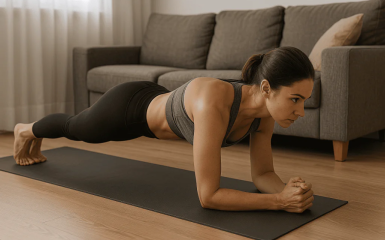
As we age, muscles gradually change: they may lose mass, strength, and the ability to exert force quickly. This can make it harder to get up from a low chair, climb stairs, carry heavy bags, or maintain balance. The marked age-related loss of muscle strength, mass, and physical function is called sarcopenia. It is associated with weakness, falls, fractures, and loss of independence.
Points of attention
- Strength training is an effective tool for maintaining muscle and strength, even in people over 60.
- The exercises described do not require complex training and a barbell; they are aimed at regularly loading the main muscle groups and gradually increasing the complexity.
- The basic recommendation for adults is strength training twice a week using your own body weight, dumbbells, or elastic bands.
The main evidence-based tool for counteracting these changes is regular strength training. And it's not too late to start, even at an older age: studies show that resistance training can improve strength, physical function, and muscle mass in people over 60, particularly those who already have sarcopenia.
This doesn't necessarily require complex barbell exercises or high-intensity workouts. It's much more important to regularly load the main muscle groups and gradually increase the difficulty.
The material is for informational purposes only. Self-medication can be harmful to health. If you have cardiovascular disease, osteoporosis, severe joint problems, balance problems, after surgery or a long break in physical activity, you should first consult a doctor before starting training.
What happens to muscles during aging
The muscular system changes gradually. The quantity and quality of muscle tissue decreases, neuromuscular coordination may deteriorate, and recovery from exercise becomes slower.
It is especially important that strength can decline faster than muscle mass itself with age. Therefore, a person sometimes hardly notices any changes in appearance, but already notices that it is more difficult to get up from the floor, walk up the stairs, or hold on after an accidental stumble.
Inactivity accelerates this process. The National Institute on Aging notes that insufficient physical activity and poor nutrition are among the factors that increase the risk of sarcopenia.
The good news is that muscles retain their ability to adapt to training even at very old ages. A meta-analysis of studies involving people aged 75 and over showed significant increases in strength after resistance training, and positive results were observed even in groups over 80 years of age.
What workouts are best for preserving muscle?
Walking is good for your heart, endurance, and overall physical activity level, but resistance is needed to maintain muscle strength.
They can be:
own body weight;
dumbbells;
elastic bands;
exercise machines;
water bottles;
a full backpack.
The CDC recommends that adults do strength-training exercises for all major muscle groups at least two days a week. For people 65 and older, aerobic activity and balance exercises are added to this.
For strength training, a practical starting point is 8–12 repetitions. The resistance should be such that at the end of the set, the movement becomes noticeably difficult, but the technique remains controlled. The CDC notes that one set is enough to start, and two or three can provide additional effect.
1. Getting up from a chair
One of the most useful exercises for everyday life is simply getting up from a chair.
It works your quadriceps, glutes, hamstrings, and core muscles, which are needed to get up from a chair, toilet, car, and climb stairs.
The ability to quickly and confidently rise from a chair is so important that the multiple-repetition stand test is used to assess lower limb strength, balance, and functional capacity in older adults.
How to perform
Sit on a sturdy chair without wheels. Place your feet about hip-width apart.
Lean your body forward slightly and rise until you are fully upright. Then slowly return to the chair.
Start with 6–10 repetitions. If necessary, use your hands or a chair with armrests at first.
When the exercise becomes easy, you can gradually:
reduce hand assistance;
use a lower chair;
hold a small weight near your chest;
perform more repetitions or add another set.
You don't need to immediately move on to deep squats with a barbell. For a beginner, controlled standing up from a chair already creates a useful load.

2. Incline with weight - a movement like a deadlift
In everyday life, we constantly have to bend over: to pick up a bag from the floor, take a laundry basket, put down a suitcase, or pick up a child.
The correct movement begins mainly with the pelvis being pulled back, rather than with significant rounding of the back.
This is the movement that the light weight deadlift variation trains.
It loads:
gluteal muscles;
the back surface of the thigh;
back muscles;
corps;
hands and forearms.
How to perform
Stand straight with your feet about hip-width apart. Hold two light dumbbells, a water bottle, or a small backpack.
Bend your knees slightly. Tilt your pelvis back while tilting your torso with a neutral back position.
Lower the weight to about knee level or slightly lower—as far as your mobility allows.
Tighten your buttocks and return to an upright position.
Initially, 8–12 controlled repetitions are sufficient.
If the movement technique is unclear or there is lower back pain, it is better to first practice the movement itself without additional weight.
3. Pulling the elastic band to the torso
As you age, it is especially important to maintain strength in your upper back and shoulder girdle.
Pulling movements help train the latissimus dorsi, rhomboids, hamstrings, and biceps, which are involved in many everyday tasks, from opening heavy doors to carrying things.
For home training, it is convenient to use an elastic band.
How to perform
Securely secure the band at about chest level or use a version that allows you to safely perform the pull-up while seated.
Straighten your body. Pull your arms back, keeping your elbows in line with your torso.
At the end of the movement, the shoulder blades naturally come closer together.
Slowly bring your arms forward.
Perform about 8–12 repetitions.
If all the reps are very easy, you need a slightly stronger band or more tension. It is the gradual increase in load that gives the muscles the signal to adapt.
4. Push-ups from a wall or support
Regular push-ups can be too challenging for someone who hasn't exercised in a while, but the principle of the exercise is easy to scale up.
Push-ups work the pectoral muscles, triceps, shoulders, and core muscles.
Start with the wall
Place your palms on the wall at about chest level and take a step back.
Keeping your body straight, bend your elbows and bring your chest closer to the wall. Then push back in a controlled manner.
When this option becomes too easy, you can use a lower support:
countertop;
sturdy table;
stable bench.
The lower the support, the more load the muscles receive.
There is no need to rush to the floor. The goal is to gradually increase strength, not to perform a specific "athletic" version of the exercise.
5. Climbing a ladder
Climbing a low step combines leg muscle work with coordination and balance control.
This is a very functional movement: it actually replicates climbing stairs.
Quadriceps, glutes, calves, and muscles that stabilize the pelvis work.
How to perform
Use a lower step or a stable low platform.
Place the entire foot of one foot on it. Shift your weight forward and rise, trying to do the main work with the foot that is on the step.
Lower back down in a controlled manner.
Start with about 6–10 repetitions on each side.
People with unstable balance need to perform the exercise near a handrail or other reliable support.
Do not use an unstable chair, box, or random objects instead of a platform.
What about calf muscles and balance?
To the five basic exercises, it is worth adding a simple toe raise.
Standing near a support, slowly raise your heels, pause for a moment, and then lower back down. The calf muscles are important for walking, climbing stairs, and controlling body position.
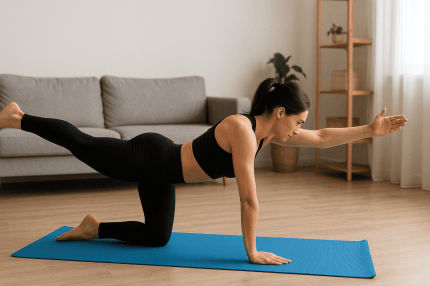
Older adults are also encouraged to do balance exercises, such as standing on one leg at a support, walking heel-to-toe, or other safe exercises. The CDC includes balance, along with strength and aerobic activity, as a core component of physical activity for those 65 and older.
Do you need to lift heavy weights?
Muscles need sufficient load, but the word "heavy" is very relative.
For a trained person, this could be a serious barbell. For an untrained person, it could be a dumbbell weighing a few kilograms, an elastic band, or even your own body weight.
A meta-analysis of randomized trials in people with sarcopenia confirmed that resistance training of varying intensities can improve strength and physical function.
A practical criterion is much more useful than the number on the dumbbell: the last repetitions should be difficult, but the person must maintain proper technique, movement control, and normal breathing.
If after 12 repetitions it seems like you can easily do another 15, the load is probably too light for strength development.
Do you need to constantly change exercises?
No. Muscles do not need to be regularly "surprised" with a new program.
For progress, it is more important to gradually increase the load: add resistance, repetitions, sets, or move on to a more difficult version of the exercise.
If you completely change the program every week, on the contrary, it becomes more difficult to assess progress.
Basic movements can remain in your training for months. It is worth changing them if they cause discomfort, no longer meet your goals, or you want to diversify your program.
Are jumping and high-intensity training necessary?
The ability to quickly generate muscular effort is really important as we age. It's needed, for example, to quickly regain balance after a stumble.
Research shows that strength training, in which lifting is performed with the intention of moving quickly, can improve certain measures of physical function in older adults.
But that doesn't mean that everyone over 60 needs jump squats, plyometrics, or HIIT.
A safer way to develop power for an already prepared person might be, for example, controlled rising from a chair with a slightly faster rise phase and a slower return. The level of difficulty should be selected according to physical capabilities.
For someone with balance problems, osteoporosis, or joint problems, jumping exercises without prior evaluation may pose unnecessary risk.
How often to exercise after 50–60 years of age
For most adults, a good base is strength training at least twice a week that targets the major muscle groups.
A simple home program might look like this:
Two to three times a week:
Getting up from a chair — 8–12 repetitions.
Incline with weight - 8–12 repetitions.
Elastic band pull - 8–12 repetitions.
Push-ups from support - 8–12 repetitions.
Step ups — 6–10 repetitions with each leg.
At first, you can do one set at a time. After adaptation, you can do two or three.
It is convenient to leave time for recovery and to engage in walking or other aerobic activity between strength training sessions.
For people 65 and older, the CDC recommends combining strength training with at least 150 minutes of moderate aerobic activity per week and balance training.

How to understand that training is working
You don't need to focus only on the appearance of your muscles.
Progress can manifest itself in much more practical ways:
you get up from a chair more easily;
you can walk more steps without getting tired;
bags seem lighter;
improved stability;
you can perform more repetitions;
the same exercise requires less effort;
it became possible to use greater resistance.
Maintaining function is especially important as you age. Strength training helps maintain the ability to perform normal daily activities and maintain independence.
Why one workout is not enough
Muscles need not a one-time load, but regular stimulus.
Nutrition, adequate protein intake, sleep, and overall physical activity are also important. Malnutrition and very low-calorie diets can make it difficult to preserve muscle tissue.
It is equally important to sit less during the day. The WHO emphasizes that excessive sedentary behavior is associated with negative health consequences, and any increase in physical activity is better than no physical activity at all.
Therefore, training twice a week works well as a foundation, but daily walks, stairs, and regular household activity also make a difference.
When to stop training
The usual feeling of muscle work during strength exercises is normal. Acute pain is not.
Training should be stopped if:
chest pain or pressure;
severe dizziness;
pre-unconscious state;
unusually severe shortness of breath;
acute pain in the joint or back;
sudden weakness;
impaired coordination.
You also don't need to train "through pain" to get results faster. In older age, gradual increases in load and sufficient recovery are especially important.
Conclusion
It is impossible to completely stop the biological aging of muscles, but the rate of loss of strength and functionality depends largely on lifestyle.
The best-researched method is regular strength training with gradual increases in load. Chair raises, weighted inclines, band pulls, bench presses, and stair climbing cover the basic movements needed in everyday life.
The main indicator of success is not a record in the gym, but the ability to remain strong, mobile and independent in ordinary daily activities for longer.
FAQ
At what age does muscle loss begin?
Age-related changes in the muscular system develop gradually and depend on physical activity, nutrition, diseases, and other factors. Pronounced loss of muscle strength, mass, and function in older age may correspond to sarcopenia.
Is it possible to build muscle after 60 years of age?
Yes. Strength training can increase strength and muscle mass even in older people. Positive results of strength programs have also been shown in people over 75–80 years of age.
How many times a week should you train your muscles?
The basic recommendation for adults is to strength train the major muscle groups at least two days a week.
How many repetitions should you do after 60 years of age?
As a starting guideline, the CDC suggests doing about 8–12 repetitions of a strength exercise. The exercise should feel noticeably challenging toward the end of the set.
What is better for muscles after 60 years of age - walking or strength training?
These activities serve different purposes. Walking builds aerobic endurance and helps maintain overall activity, while resistance training provides a stronger stimulus for maintaining and developing muscle strength. It's best to combine them.
Are bodyweight exercises enough?
For a beginner, this is often the case. If the exercises gradually become too easy, you need to increase the difficulty or resistance for further adaptation.
Are dumbbells necessary for training after 50?
No. You can start with your own body weight and elastic bands. Dumbbells become a convenient way to more accurately dose and gradually increase the load.
Is it possible to start strength training at 70–80 years old?
Age alone does not preclude strength training. Studies have shown that strength can be improved even in very old people. The program should be tailored to your health, mobility, and initial fitness level.
Does protein help preserve muscle?
Adequate nutrition, particularly protein intake, is important for maintaining muscle tissue. But nutrition is no substitute for strength training: muscles need regular stimulation to maintain strength.
Is it necessary to do HIIT and jumping jacks to make muscles age more slowly?
No. Regular resistance training, aerobic activity, and balance training remain the foundation. High-intensity or jumping exercises can be used by trained individuals, but they are not a prerequisite for preserving muscle.
undefined

