

Eating something small between lunch and dinner, and then feeling hungry again an hour later is a common situation. The reason is often not in “too fast metabolism”, but in the composition of the snack. Juice, a candy bar, a few crackers or a piece of fruit can quickly remove the sharp feeling of hunger, but they do not always provide long-term satiety.
Points of attention
- Protein foods and foods with fiber are more filling, helping you feel fuller for longer.
- Choose snack combinations that match your hunger level and help you wait for your next meal.
- Avoid snacks that consist mostly of refined carbohydrates or are low in protein and fiber.
The satiating power of a food is influenced by its volume, amount of protein and fiber, energy density, texture, degree of processing, and even whether the product needs to be chewed. Protein foods have been shown to reduce hunger and increase feelings of fullness on average in short-term studies, although the long-term effect depends on the entire diet.
Fiber can also maintain satiety, but the effect depends on its type and product: not every food labeled "source of fiber" will automatically keep you full for several hours.
Therefore, a good snack is not necessarily the lowest calorie food. It is more practical to choose a combination that truly matches your hunger level and helps you wait for your next meal calmly.
The material is for informational purposes only. Self-medication can be harmful to health. If you have digestive system diseases, diabetes, eating disorders, food allergies, or other medical conditions, you should first consult a doctor before making any significant changes to your diet.
How is hunger different from satiety?
Hunger is a signal that prompts us to seek food. Satiety occurs during a meal and helps to complete it. Satiety is a state after a meal during which the desire to eat remains reduced.
Therefore, two snacks with the same calorie content can feel completely different.
For example, a sweet drink can be drunk in a few minutes with almost no chewing. And an apple with natural yogurt should be eaten, it has a larger volume, contains fiber and protein.
This is one of the reasons why evaluating a snack based solely on calorie content is not enough.
What makes a snack more filling?
There is no formula that guarantees that everyone will feel full for the same number of hours. However, it is useful to pay attention to four components.
White
Sources can be:
natural or Greek yogurt;
sour milk cheese;
eggs;
fish;
bird;
legumes;
hummus;
tofu.
A meta-analysis of randomized trials has shown that higher protein intake in the short term can reduce hunger and increase feelings of fullness.
Cellulose
It is found in fruits, vegetables, legumes, whole grains, nuts, and seeds.
Its effect on appetite depends on the specific type of fiber, the structure of the product, and other components of the meal. In general, foods with natural fiber help make a snack more voluminous and nutritious.
Fats
Nuts, seeds, avocados, and nut spreads can make a snack more filling, but they are energy dense, so a moderate serving is usually enough.
In some controlled studies, almonds as a snack were better at controlling hunger than certain refined carbohydrate foods, although the effect of nuts on appetite is not the same in all studies.
Volume and structure
A whole fruit and a glass of juice are different foods in terms of satiety.
Whole fruit retains fiber, requires chewing, and takes longer to consume. Harvard Nutrition Source also notes that whole fruit generally keeps you fuller longer than juice.
1. Sweet breakfast cereal
Crispy breakfast cereals may look like a complete morning meal, but the composition of different products varies greatly.
In options with a lot of added sugar and little protein and fiber, the bulk of the serving is made up of quickly available carbohydrates.
It's especially easy to have a breakfast that's not very filling if you pour a small portion of sweet cereal and pour a small amount of milk over it.
How to make it more filling
It is better to choose cereals or muesli made from whole grains and with a small amount of added sugar.
You can add:
natural Greek yogurt;
milk;
berries;
apple;
seed;
a small portion of nuts.
Another option is to replace cereal with oatmeal and add a protein source.
The point is not to ban cereal, but to ensure that it is not the only component of a meal.
2. White toast with jam
Bread with jam is quick to make and has a nice sweet taste. But if your snack consists of just white toast and jam, it may be low in protein and fiber.
Because of this, a small portion can only satisfy hunger for a short time.
White bread doesn't need to be declared "bad." The problem is that such a snack on its own may not be enough.
How to make it more filling
For a sweet option, you can combine bread with:
sour milk cheese and berries;
peanut butter and banana;
natural yogurt and fruit.
For the unsweetened:
egg;
hummus;
cheese;
tuna;
avocado and a source of protein.
Whole grain bread can further increase the amount of fiber.
3. Crackers, rice cakes and dry snacks
A few breads or crackers seem like a convenient “light” snack. The problem arises when that is actually the entire meal.
Many such products are high in starches and low in protein. The amount of fiber depends on the composition and can be very small.
Additionally, dry, crunchy snacks are easy to eat mechanically while working or watching videos.
How to make it more filling
Use crackers or bread as a base, not the entire snack.
To these you can add:
hummus;
sour milk cheese;
hard cheese;
boiled egg;
avocado;
fish;
vegetables.
For example, two bread rolls with cheese plus an apple is a completely different snack structure than six dry bread rolls in a row.
4. Croissant, cookie or sweet bun
Baked goods can be very high in calories, even in small portions. They are often high in refined flour and fat, and relatively low in protein and fiber.
This does not mean that croissants should be excluded from the diet.
If you want a croissant, you can eat it. But it's worth understanding the difference between dessert and a snack, the task of which is to maintain satiety until the next meal.
How to make it more filling
Unsweetened croissant can be supplemented with:
egg;
cheese;
turkey or chicken;
vegetables.
You can add natural yogurt or cottage cheese and fruit to sweet pastries.
This increases the volume of food intake and provides a source of protein.
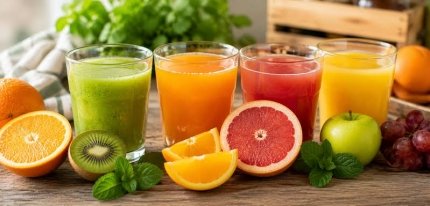
5. Juice instead of fruit
Juice may contain vitamins and other substances from fruit, but its structure is significantly different from a whole orange, apple, or handful of berries.
When making regular juice, much of the fiber is removed. It's also easy to drink the drink faster and in larger quantities than eating the same amount of fruit.
That's why nutritional recommendations favor whole fruit over juice.
How to make it more filling
If you want a fruit snack, it's better to have a whole fruit.
For example:
apple + yogurt;
pear + a few nuts;
orange + cottage cheese;
berries + Greek yogurt.
Juice can remain part of the diet, but you shouldn't count on it as a full-fledged satisfying snack.
6. Fruit Smoothie Without Protein
Smoothies are a special case, as their nutritional value depends entirely on the recipe.
A drink made from banana, mango, juice, and honey can contain a lot of energy, but not much protein.
Another smoothie with natural yogurt, berries, oatmeal, and a small amount of seeds is closer in composition to a full-fledged snack.
Harvard Nutrition Source notes that whole fruit smoothies retain fiber better than juices, but they can easily become overly calorie-dense due to the large amount of fruit, sweeteners, nut spreads, and additional ingredients.
A more balanced smoothie formula
You can combine:
Fruit or berries — for flavor and fiber.
Protein base - Greek yogurt, milk, kefir or another suitable product.
Additional fiber - oatmeal, chia, or berries.
A moderate source of fat is a small amount of nut butter or seeds.
You don't have to add everything at once. It's important that the smoothie doesn't consist primarily of a few servings of fruit and juice.
7. Small sweet yogurt
Yogurt is often perceived as an automatically filling product, but its composition can vary greatly.
A small jar of dessert yogurt can contain a lot of added sugar and relatively little protein.
For comparison, it's worth looking at the label: two seemingly similar yogurts can differ significantly in terms of protein, sugar, and serving size.
In one controlled study in women, a high-protein yogurt snack was better at controlling appetite and delaying the next meal compared to lower-protein options. However, the effect varies by product, and not every yogurt study shows the same difference.

How to make it more filling
Choose natural yogurt with enough protein and add:
berries;
fruits;
oat flakes;
nuts;
seed.
If you like a sweet taste, fruit or a small amount of honey give you the opportunity to control the sweetness yourself.
8. Salad with only cucumber and greens
A large bowl of vegetables can take up a lot of space in your stomach, yet contain little energy and protein.
This is a great side dish. But if a person is very hungry and calls this salad lunch or a snack, hunger can quickly return.
Vegetables, however, remain very important in the diet — they provide fiber, water, vitamins, and minerals. The question is how to complete the dish.
How to make a salad more filling
Add a protein source:
egg;
chicken;
fish;
shrimp;
tofu;
beans;
chickpeas;
sour milk or hard cheese.
If necessary, you can add complex carbohydrates:
whole grain bread;
quinoa;
buckwheat;
potatoes.
And a small amount of fat:
olive oil;
nuts;
seed;
avocado.
Then the salad turns from a bowl of vegetables into a full meal.
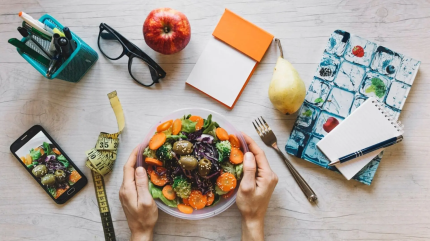
9. A “Fitness” Bar That’s Actually a Dessert
The labels "fitness", "protein", "energy", "natural" or "no white sugar" do not guarantee anything in themselves.
A bar can be a convenient product on the go, but before buying, it's worth looking at:
portion size;
amount of protein;
fiber;
added sugars;
total calorie content;
list of ingredients.
It's especially easy to go wrong with bars based on dates, syrups, nuts, and chocolate. They can be made with completely ordinary products, but still be very energy-dense.
Conversely, the smallest low-calorie bar may simply not meet real hunger.
What can you take instead?
For the office or on the road, it is convenient to prepare:
fruit + natural yogurt;
egg + vegetables;
cottage cheese + berries;
a small portion of nuts + fruit;
hummus + vegetables;
whole grain sandwich with protein filling.
The NIDDK also recommends using simple whole foods—fresh fruits, vegetables, yogurt—more often for everyday snacks instead of cookies, chips, and other typical ultra-processed snacks.
How to make a hearty snack in 30 seconds
The simplest rule is to take at least two components.
Protein + fiber
For example:
yogurt + apple;
cottage cheese + berries;
egg + vegetables;
hummus + carrots;
tuna + whole grain bread.
Second option:
fruit or vegetable + protein + small source of fat.
For example:
apple + natural yogurt + a few nuts.
This approach is more practical than searching for the “most filling product.”
Do you need to snack at all?
No. Snacks are not a prerequisite for a healthy diet.
If three main meals are well-satisfying and there is no pronounced hunger between them, there is no need to specifically eat every two to three hours.
A snack makes sense when:
a large interval between main meals;
training ahead;
there is no opportunity to eat normally;
real physical hunger appeared;
A small snack helps avoid severe hunger in the evening.
If a person is constantly chewing something out of boredom, stress, or habit, the problem is not choosing the "perfect" snack.
Why do you still crave sweets after a snack?
Hunger and craving a specific food are different things.
You can physically eat your fill, but still crave chocolate out of habit, smell, emotion, or anticipation of dessert.
Therefore, not every desire for sweets means that the snack was "wrong."
And vice versa: if after an apple you want to eat a full lunch 20 minutes later, perhaps the person was simply too hungry for a small snack.
In such a situation, it is better to eat normally rather than trying to suppress hunger with a few more low-calorie foods.
Do you need to avoid carbohydrates to stay full longer?
No.
Carbohydrates are not automatically “unsatisfying” foods. Oatmeal, legumes, whole grain bread, potatoes, and fruit can all be great additions to a filling meal.
The problem more often arises when a small portion of quickly eaten refined carbohydrates becomes the entire snack.
Instead of a ban, it is better to use a combination.
For example:
banana + yogurt;
bread + egg;
oatmeal + dairy product and berries;
potatoes + fish and vegetables.
How to know if your snack is working
You can focus on simple practical signs.
After him:
acute hunger disappears;
no need to look for other food after 20–30 minutes;
you can safely wait for the next meal;
there is no heaviness due to an excessively large portion;
the product fits into the overall diet.
You don't need to expect a single yogurt to keep you full for six hours. If it's still four hours until dinner and you're really hungry, you need a bigger snack or a normal meal.
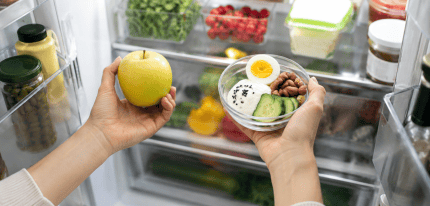
Do hearty snacks help you lose weight?
Snacking by itself does not accelerate weight loss.
What matters for weight change is total energy intake over time. Even nuts, avocados, or peanut butter can create a calorie surplus if eaten in large portions.
The benefit of a hearty snack is another: it can help you better control your hunger and make your eating regimen more comfortable.
The NIDDK emphasizes that long-term weight management is based on an eating pattern that a person is able to maintain, not on one single product.
When constant hunger needs attention
If a person eats normally, but almost constantly feels very hungry, it is worth assessing the whole picture.
The reason may be long gaps between meals, too low a calorie diet, insufficient sleep, high physical activity, or the habit of eating very small portions.
But a pronounced increase in appetite sometimes accompanies medical conditions.
It is especially important to see a doctor if severe hunger occurs suddenly or is combined with:
constant thirst;
frequent urination;
unexplained weight loss;
trembling;
pronounced weakness;
other new symptoms.
Conclusion
A snack can quickly satisfy hunger, but that doesn't mean it will provide long-lasting satiety.
Small snacks that are mostly refined carbohydrates or liquid calories and contain little to no protein or fiber are often poorly satiating. These can include juice, dry crackers, sweet yogurt, a croissant, or a small “fitness” bar.
The principle of improvement is simple: you don't have to give up your favorite product - you should supplement it. Fruit can be combined with yogurt, bread with egg or hummus, salad with fish or legumes, and smoothies with a protein base.
A satisfying snack is a meal that meets your actual hunger level and helps you comfortably wait for your next meal.
FAQ
What snack is the most filling?
There is no universal product. Snacks that combine protein and fiber are usually more filling: natural yogurt with berries, cottage cheese with fruit, egg with vegetables, or hummus with vegetables.
What to eat to keep you from wanting to eat for hours?
Choose a portion size that is adequate in protein, fiber, and a little fat if needed. If it's a long time until your next meal, a small apple may simply not be enough.
Why do I feel like eating fruit so quickly?
Fruit contains water and fiber, but most fruits are low in protein. If you are very hungry, you can pair fruit with yogurt, cottage cheese, or a small serving of nuts.
Can I snack on nuts?
Yes. Nuts contain protein, fiber, and unsaturated fats. However, they are high in energy density, so it's best to control portion size.
Why is a smoothie not filling?
It depends on the recipe. If it consists mostly of fruit and juice, the protein may not be enough. Adding plain yogurt, milk, oatmeal or seeds makes the snack more complete.
What is better for a snack - juice or fruit?
Whole fruit is usually more beneficial for satiety. It contains natural structure and fiber, and it takes longer to eat, while juice is easy to drink quickly in large quantities.
Do you need to eat protein with every snack?
Not necessarily. But if a snack needs to keep you full for several hours, a protein source often makes it more practical.
Are protein bars good for you?
It depends on the specific product. The name "protein" does not guarantee optimal composition. It is worth checking the amount of protein, fiber, added sugars, calories and serving size.
Is it necessary to snack between main meals?
No. If breakfast, lunch, and dinner provide sufficient satiety, snacks are not necessary. They should be used when you are truly hungry or when there is a long interval between main meals.
Can you snack while losing weight?
Yes. The frequency of meals alone does not determine the result. It is important that snacks fit into the overall diet and do not turn into a constant, unnoticed consumption of additional energy.

