

Elbow pain can occur after exercise, working with a tool, sitting at a computer for a long time, falling, or even for no apparent reason. In many cases, the problem is associated with tendon overload and gradually disappears after the load is corrected. But acute pain after an injury, joint deformation, significant swelling, numbness of the fingers, or a hot red elbow with a temperature require a different tactic.
Points of attention
- Tennis elbow and golfer's elbow: known causes of elbow pain.
- Elbow pain can be caused by tendon overload, nerve disease, or arthritis.
- Correct diagnosis and timely medical examination are important for effective treatment and prevention of complications.
- Incorrect self-treatment can be harmful to your health. If you experience severe pain, swelling, or numbness in your fingers, you should immediately consult a specialist.
- Preventive measures and timely rehabilitation after injuries help reduce the risk of recurring elbow pain.
The location of the pain often gives the first clue. Pain on the outside is typical of tennis elbow, while pain on the inside is typical of golfer's elbow or ulnar nerve irritation. Swelling right at the tip of the elbow may be a sign of bursitis.
It is not worth making a diagnosis based on location alone. Similar symptoms can occur with injuries, arthritis, nerve problems, and sometimes the pain radiates to the elbow from the neck or shoulder.
Important: the material is for informational and educational purposes only and is not medical advice, diagnosis or treatment recommendations. The information in the article should not be used for self-diagnosis, prescription, change or discontinuation of treatment. Self-medication can be dangerous to your health. If you have any complaints, symptoms, chronic diseases or questions about your health, be sure to consult a qualified doctor. In case of a sharp deterioration in well-being or the appearance of dangerous symptoms, you should immediately seek medical help.
How the elbow is arranged and why it can hurt
The elbow joint is formed by three bones: the humerus, ulna, and radius. Together, they allow you to flex and extend the arm, as well as rotate the forearm with the palm facing up and down.
Around the joint are located:
tendon;
connections;
muscles;
joint capsule;
bursae — small sacs filled with fluid;
nerve;
blood vessels.
That is why the phrase "elbow hurts" can mean a problem with completely different structures.
For an initial assessment, it is useful to answer a few questions:
where exactly it hurts - outside, inside, behind or deep in the joint;
was there an injury or not;
the pain appeared suddenly or gradually;
is there swelling;
Is it possible to fully bend and straighten the arm?
Do you experience numbness and tingling in your fingers?
Does the pain increase when squeezing objects?
Is there a fever or redness?
1. Tennis elbow: pain on the outside
Tennis elbow, or lateral epicondylopathy, is one of the most common causes of elbow pain.
Despite the name, this condition does not require you to play tennis.
The problem can occur due to repetitive movements of the hand and forearm:
working with a screwdriver;
use of hand tools;
dyeing;
gardening;
racket training;
prolonged use of the mouse in an uncomfortable position;
carrying objects;
regular strong hand squeezing.
The condition was often described as “tendonitis.” A more modern explanation is overuse and structural changes in the tendons that attach the forearm muscles to the outside of the elbow.

How does tennis elbow manifest itself?
A typical symptom is pain or severe tenderness on the outside of the elbow.
It can become stronger when a person:
raises the cup;
clenches his hand into a fist;
unscrews the lid;
returns the key;
uses a screwdriver;
picks up an object with the palm down;
actively moves the wrist.
Sometimes the pain spreads down the forearm and grip strength decreases.
2. Golfer's elbow: pain on the inner side
Medial epicondylopathy, often called golfer's elbow, is similar to tennis elbow, but the problem area is located on the inner side of the joint.
The cause is usually repetitive or excessive strain on the muscles that flex the hand and fingers.
Symptoms may appear after:
strength training;
working with heavy tools;
horticulture;
throwing movements;
rock climbing;
golf;
prolonged manual labor.
The pain is usually localized near the bony prominence on the inside of the elbow and may radiate to the forearm.
A clue is increased pain with a strong grip, flexion of the hand, or rotation of the forearm.
3. Elbow bursitis: when a "bump" appears behind the elbow
On the back of the elbow is the olecranon bursa, a small sac filled with fluid that helps tissues glide over each other.
When it becomes irritated or inflamed, fluid can accumulate.
Then a rounded swelling appears at the tip of the elbow, sometimes quite large.
The reason may be:
shock;
prolonged support of the elbow on a hard surface;
repetitive mechanical irritation;
inflammatory diseases;
infection.
Bursal swelling alone, without severe pain and fever, is not always an emergency.
When bursitis becomes more dangerous
Urgent evaluation is needed if the elbow:
hot;
red;
is increasing rapidly;
it hurts sharply;
very sensitive;
accompanied by fever or chills.
In such a situation, it is necessary to rule out infectious bursitis or infection of the joint itself.
You should not puncture or try to "squeeze fluid" out of the bursa yourself.
4. Ulnar nerve entrapment
Almost everyone is familiar with the sharp "electrical" pain after a blow to the inside of the elbow. The ulnar nerve runs very superficially there.
If it is regularly compressed or stretched, cubital tunnel syndrome may occur.
Characteristic symptoms:
tingle;
numbness;
burning sensation;
pain on the inside of the elbow;
numbness of the little finger;
numbness of half of the ring finger;
weakening of the grip;
clumsiness of the brush.
Symptoms often worsen when the elbow is bent for a long time.
Typical situations:
a long telephone conversation;
sleeping with a bent arm;
prolonged sitting with your elbow on the table;
armrest support.
If numbness becomes permanent or the arm weakens, it is better not to delay a visit to the doctor: prolonged compression of the nerve can lead to permanent impairment of its function.
5. Sprain, bruise or other injury
After a fall, impact, or unsuccessful movement, elbow pain may be associated with soft tissue damage.
With a slight injury, the following are possible:
local soreness;
small bruise;
moderate swelling;
pain when pressed.
When tendons are stretched or damaged, symptoms may worsen during movement.
The most important thing after an injury is to assess the function of the hand.
If the person can move the elbow, the pain is moderate and gradually subsides, a few days of a cautious regimen may be sufficient.
Another situation is severe pain, significant swelling, or the inability to use the hand normally.
6. Fracture or dislocation
A fall on an outstretched arm, a sports injury, a car accident, or a strong direct blow can lead to a fracture or dislocation.
Alarming signs:
the elbow has changed shape;
the hand is at an unnatural angle;
very severe pain;
swelling is increasing rapidly;
a large bruise appeared;
there was a crack or characteristic "crunch" during the injury;
it is impossible to fully move the arm;
it is impossible to turn the palm up or down;
fingers go numb;
the brush has become cold or has changed color.
If there is obvious deformation, you should not try to "straighten" the joint yourself.
It is best to fix the hand as carefully as possible in the position it is in and seek emergency medical attention.

7. Arthritis
The elbow joint can be affected by various forms of arthritis.
Among them:
osteoarthritis;
rheumatoid arthritis;
psoriatic arthritis;
gout;
other inflammatory diseases.
Elbow osteoarthritis is less common than knee or hip osteoarthritis. The risk is higher after a previous injury or years of heavy use.
Possible symptoms:
constraint;
movement restrictions;
pain;
crackle;
edema.
Inflammatory arthritis is more characterized by prolonged morning stiffness, swelling, other painful joints, or systemic symptoms.
Sudden, very severe pain with a hot, swollen joint can occur with gout, but so can an infection. It can be difficult to tell the difference between the two conditions on your own.
8. The pain may not be coming from the elbow.
Sometimes the structure of the elbow itself is not the source of the problem.
The pain can be:
from the cervical spine;
from the shoulder joint;
due to nerve root irritation.
For example, if the neck hurts at the same time, and the discomfort spreads through the shoulder and forearm to the hand, a neurological cause should also be considered.
Additional tips:
numbness;
tingle;
"shots" in the arm;
change in symptoms when moving the neck;
weakness of certain muscles.
In such cases, treating the elbow exclusively with ointments may be ineffective.
Where does the elbow hurt: a quick tip
| Location or nature of pain | Possible cause |
| Outer side of the elbow | tennis elbow |
| Interior | golfer's elbow, ulnar nerve |
| Swelling at the tip of the elbow | bursitis |
| Pain after a fall | bruise, sprain, fracture, dislocation |
| Numbness of the little finger and ring finger | ulnar nerve irritation |
| Joint stiffness and swelling | arthritis |
| Red, hot, and sharply painful elbow | infection, gout, or other acute inflammation |
| Pain radiates from the neck to the arm | possible nerve pain |
This table helps you navigate, but does not replace diagnostics.
What to do at home if your elbow hurts after exercise
If there has been no serious injury, redness, fever, significant swelling, or neurological symptoms, you can start with conservative measures.

Temporarily reduce the provocative load
You don't have to stop using your hand completely.
It is better to identify the specific movement that provokes symptoms and reduce its volume for a certain period of time.
For example:
change training technique;
take a lighter weight;
reduce tool work;
take breaks more often;
set up a workplace.
Complete immobility without indications is also undesirable - the joint may become more stiff.
Cold or heat
After recent overload or with swelling, a cold compress for 10–20 minutes through a cloth may be comfortable.
For chronic stiffness, some people find heat more helpful.
There is no need to apply ice directly to the skin.
Maintain mobility
If the movement does not cause sharp pain, you can slowly bend and straighten your arm within a comfortable range several times a day.
For epicondylopathy, special exercises are often used to stretch and gradually strengthen the forearm muscles.
The load should be increased gradually, and not trained through acute pain.
Does an elbow bandage help?
For tennis or golfer's elbow, some people find relief from a special forearm cuff or brace.
This remedy can temporarily reduce the load on the tendons during work.
However, the bandage does not eliminate the cause of the overload.
If improper training technique, working posture, or repetitive movement remains unchanged, symptoms may return.
The orthosis should also not squeeze the arm or cause numbness.
Do I need to have an MRI or X-ray?
Not every elbow pain requires a CT scan.
For many overload conditions, the diagnosis can be made based on the history of symptoms and clinical examination.
An X-ray is more often needed when there is suspicion of:
fracture;
dislocation;
pronounced bone changes;
consequences of a previous injury.
Ultrasound or MRI may be used in certain situations to evaluate tendons, soft tissues, or other structures.
The mere fact that pain lasts for several days does not automatically mean that an MRI is necessary.
Can I apply anti-inflammatory gel to my elbow?
Topical nonsteroidal anti-inflammatory drugs can provide short-term pain relief for some musculoskeletal problems.
But "relief" and "cure the cause" are different things.
If the elbow continues to receive the same excessive load every day, one gel will not solve the problem.
Anti-inflammatory drugs also have contraindications. If you are pregnant, allergic to NSAIDs, have certain diseases of the stomach, kidneys, cardiovascular system, or are taking other medications, it is best to check with your doctor or pharmacist for the safety of the drug.
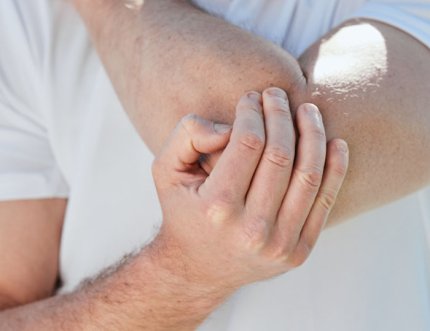
When you need to see a doctor soon
Make an appointment for a check-up if:
the pain does not decrease after home measures;
symptoms last for several weeks;
the pain gradually increases;
the problem keeps coming back;
the elbow hurts even at rest;
pain prevents sleep;
it became difficult to squeeze objects;
the arm has noticeably weakened;
unable to fully flex or extend the joint;
numbness of the fingers occurs regularly;
there is prolonged morning stiffness;
an unexplained swelling appeared.
With such symptoms, a doctor will be able to determine whether physical therapy, additional testing, or other treatment is needed.
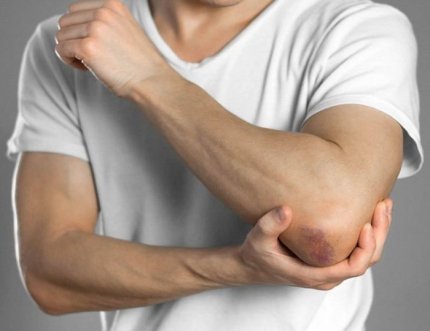
When elbow pain requires urgent care
There are several situations in which waiting a few days is not worth it.
The elbow is deformed after an injury.
A noticeable change in the shape of a joint may indicate a fracture or dislocation.
Bone is visible or there is a deep wound
An open fracture requires emergency medical attention.
Severe pain, severe swelling, and inability to move the arm
Especially if the symptoms occurred immediately after a fall or impact.
Fingers become numb, pale, or cold
After an injury, this may indicate nerve damage or impaired blood supply.
Elbow suddenly became hot, red, and swollen
It is especially dangerous if the temperature rises at the same time, chills appear, or there is a sharp deterioration in well-being.
This can lead to septic arthritis, a bacterial infection of the joint that needs to be treated quickly.
Sudden loss of strength or sensation in the arm
Acute loss of sensation or strength requires urgent medical evaluation.
When arm pain may be related to the heart
Elbow pain by itself is rarely a typical sign of a heart attack.
But it is dangerous to ignore sudden pain or discomfort in the arm if it is accompanied by:
pressure or tightness in the chest;
heaviness behind the sternum;
dyspnea;
cold sweat;
nausea;
dizziness;
pain that spreads to the arm, shoulder, back, neck, or jaw.
In such a situation, you need to call emergency medical help.
Don't wait for the pain to go away after an elbow massage or anti-inflammatory gel.
What not to do if you have elbow pain
Don't exercise because of acute pain
The phrase “needs to be worked out” does not apply to every injury.
Do not exercise the joint yourself.
If a dislocation is suspected, this can damage blood vessels, nerves, or bones.
Don't heat up a red hot joint
If an infection is suspected, the person needs medical attention, not home warming.
Don't wear the brace 24/7 unnecessarily.
Excessive immobilization can contribute to muscle stiffness and weakness.
Don't blame numbness for months on an "overworked hand"
Persistent numbness in the little finger and ring finger may be a sign of a problem with the ulnar nerve.
How to reduce the risk of recurring pain
With congestion problems, prevention is often more important than a short course of ointment.
Useful:
increase training load gradually;
take breaks when performing repetitive manual work;
do not keep your elbow on a hard surface for hours;
adjust the table height and mouse position;
use a tool with a comfortable handle;
train the forearm muscles;
pay attention to the technique of sports movements.
If the problem regularly returns after the same action, it is worth changing the mechanics of the load itself, rather than simply waiting for the pain to go away each time.
Conclusion
Elbow pain is most often caused by tendon overuse, bruising, bursitis, or nerve irritation. Pain on the outside is typical of tennis elbow, pain on the inside is typical of golfer's elbow or ulnar nerve problems, and noticeable swelling behind the joint can be a sign of bursitis.
Moderate symptoms after exercise can often be managed with activity modification, comfortable movement, and cold or heat, depending on the situation.
However, deformity following an injury, severe swelling, loss of mobility, sudden numbness, a cold hand, or a hot, red joint with fever require prompt medical evaluation. In such cases, self-treatment at home may delay necessary care.
FAQ
Why does my elbow hurt without injury?
The most common cause is tendon overuse, such as tennis or golfer's elbow. Bursitis, arthritis, nerve irritation, or pain radiating from the neck or shoulder are also possible causes.
Why does the outside of the elbow hurt?
The typical cause is lateral epicondylopathy, or tennis elbow. The pain is often aggravated by gripping objects, working with the hand, lifting a cup, or turning a doorknob.
Why does the inside of the elbow hurt?
Medial epicondylopathy and ulnar nerve irritation are possible. If both the little finger and ring finger are numb at the same time, special attention should be paid to the nerve.
What to do if your elbow hurts after training?
Temporarily reduce the load that provokes pain and maintain comfortable mobility of the joint. You can try cold or heat. If the pain is severe, movement is significantly limited, or symptoms do not go away, an examination is necessary.
Can I warm my elbow if it hurts?
Heat is sometimes comfortable for chronic muscle stiffness. A hot, red, severely swollen elbow, especially with a fever, should not be warmed up — infection must be ruled out.
Why do my fingers go numb along with elbow pain?
Numbness of the little finger and part of the ring finger is typical of irritation of the ulnar nerve in the area of the cubital tunnel. Prolonged or progressive numbness requires evaluation by a doctor.
How much can tennis elbow hurt?
Epicondylopathy often recovers slowly. Symptoms may last for many weeks or months, and in some people longer. Load modification and gradual rehabilitation are important.
Which doctor should I see if my elbow hurts?
You can start with a family doctor, an orthopedic traumatologist, or a physical and rehabilitation medicine specialist. If numbness is severe, a neurologist may be needed, and if systemic arthritis is suspected, a rheumatologist.
When is an X-ray needed for elbow pain?
X-rays are most often needed after a significant injury or when a fracture, dislocation, or bone change is suspected. For typical tennis elbow, they are usually not the first test needed.
When is elbow pain dangerous?
Seek emergency care if you have a deformity after an injury, an open wound with visible bone, severe swelling and inability to move your arm, sudden loss of sensation or strength, or a hot, red joint with a fever. Arm pain along with chest tightness and shortness of breath also requires emergency care.

